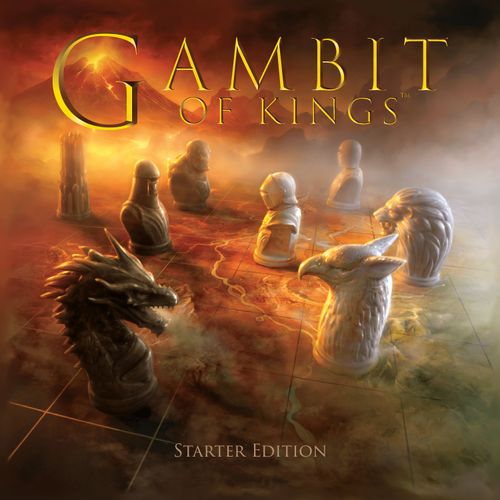
Gambit of Kings
Gambit of Kings Rulebook
Table of Contents
Table of Contents
Standard Rules
Object of the Game: To destroy your opponent's Castle. This is done by moving one of your pieces onto the space occupied by your opponent's Castle.
Pieces: You may choose to play either with the king's pieces (light) or the exiled king's pieces (dark). Each light piece has an equivalent dark piece and vice versa. There are two tiers of pieces: greater pieces and lesser pieces. The movement patterns for each piece are displayed on page 5 and on the additional movement sheet.
Gameboard Setup: The gameboard should be set up as displayed on page 4. Your greater pieces should be placed on the row closest to you and your lesser pieces should be placed on the next closest row. The king's pieces should be placed on the light side of the board and the exiled king's pieces should be placed on the dark side of the board.
Gameplay: To begin, you and your opponent must set up the board and choose a random means to determine who will move first, such as by flipping a coin. Players then alternate moves. When it is your turn to move, you must move exactly one of your pieces. You can't move to a space occupied by one of your other pieces, and you can't "jump" over any pieces unless otherwise specified. If you move to a space occupied by one of your opponent's pieces, his or her piece is destroyed. Once you move, your turn is over. The first player to destroy his or her opponent's Castle wins the game.
The King's Pieces
The king (or queen) is an honorable and just ruler. He ensures the protection of his subjects and the prosperity of the kingdom. Should you choose to play the role of the king, these are your pieces:
Lesser Pieces
Soldier: The Soldier can move 1 space horizontally or forward, or 2 spaces forward if doing so would not cause it to destroy a piece. If the Soldier destroys a greater piece or reaches the farthest row on the opposing side of the board, it becomes a Knight; no more than two additional Knights can be present on the board.
Human soldiers are valiant warriors, sworn to serve king and country. Their prowess with the sword is matched only by their bravery.
Elf: The Elf can move up to 2 spaces diagonally.
Elven warriors are known for their dexterity in battle. The elves and the humans forged an alliance to combat the growing number of orcs and undead plaguing their lands.
Greater Pieces
Knight: The Knight can move up to 3 spaces in any one direction.
Knights are noble warriors, often riding into battle on horseback. Only soldiers who have shown their courage in battle and loyalty to the crown are granted such distinction.
Lion: The Lion can move 1 space horizontally or vertically, and then may move up to 2 spaces diagonally in the same direction as the horizontal or vertical movement.
The lion is the sigil for the royal house. In battle, lion banners are raised high to give valor to those who fight for the king.
Griffin: The Griffin can move up to 3 spaces horizontally or vertically. The Griffin can fly (jump) over pieces.
Griffins are ferocious beasts. They have the head, wings, and talons of an eagle, and the body and hindquarters of a lion.
Giant: The Giant can move up to 3 spaces in any one direction, except backward (vertically or diagonally). The Giant can't be jumped by any piece and can't be destroyed by a lesser piece.
Giants are descendants of an ancient race. Though once at war with humans, they have joined forces to combat the horde of invading orcs and undead.
Paladin: The Paladin can move any number of spaces in any one direction.
The paladin serves as hand and champion of the king. His skill in battle is unrivaled, destroying enemies of the crown with righteous fury.
Castle: The Castle can't move. If your Castle is destroyed, you lose the game.
The castle lies at the heart of the kingdom. If the castle is taken, all is lost.
The Exiled King's Pieces
The exiled king (or queen) is a malevolent overlord. Banished for his profane use of dark magic, he seeks revenge against the kingdom and all who reside within it. Should you choose to play the role of the exiled king, these are your pieces:
Lesser Pieces
Skeleton: The Skeleton can move 1 space horizontally or forward, or 2 spaces forward if doing so would not cause it to destroy a piece. If the Skeleton destroys a greater piece or reaches the farthest row on the opposing side of the board, it becomes a Death Knight; no more than two additional Death Knights can be present on the board.
Skeletons are the foot soldiers in the army of the undead. Reanimated through dark magic, skeletons fear neither foe nor death.
Orc: The Orc can move up to 2 spaces diagonally.
Orcs are fearsome warriors who thirst for battle. They wear the ears of slain elves as necklaces and symbols of their rank.
Greater Pieces
Death Knight: The Death Knight can move up to 3 spaces in any one direction.
Death knights are undead commanders. Often mounted, they lead the legion of the undead into battle.
Dire Wolf: The Dire Wolf can move 1 space horizontally or vertically, and then may move up to 2 spaces diagonally in the same direction as the horizontal or vertical movement.
Dire wolves are known for relentlessly hunting their prey. It is said this is the reason they were chosen as the sigil for the exiled king.
Dragon: The Dragon can move up to 3 spaces horizontally or vertically. The Dragon can fly (jump) over pieces.
Dragons are the most feared creatures throughout the kingdom. Their fire scorches land and melts flesh and stone.
Ogre: The Ogre can move up to 3 spaces in any one direction, except backward (vertically or diagonally). The Ogre can't be jumped by any piece and can't be destroyed by a lesser piece.
Ogres are dim witted, but monstrous creatures. They are easily influenced by the dark magic of the exiled king.
Lich: The Lich can move any number of spaces in any one direction.
The lich is the exiled king's most terrifying weapon. The lich is a blight upon the land and brings with him only death.
Castle: The Castle can't move. If your Castle is destroyed, you lose the game.
The castle is the unholy fortress of the exiled king. If the castle is taken, all is lost.
Gameboard Setup
Printed page 4 (the board diagram). The board is a 10 by 10 grid of spaces. The rows below are read from the diagram: the light side occupies the two rows at the bottom edge of the board and the dark side the two rows at the top edge.
Light side (the king), nearest row first:
- Row 1 (greater pieces): Knight, Lion, Griffin, Giant, Castle, Paladin, Giant, Griffin, Lion, Knight
- Row 2 (lesser pieces): Soldier, Elf, Soldier, Elf, Soldier, Elf, Soldier, Elf, Soldier, Elf
Dark side (the exiled king), nearest row first:
- Row 1 (greater pieces): Death Knight, Dire Wolf, Dragon, Ogre, Lich, Castle, Ogre, Dragon, Dire Wolf, Death Knight
- Row 2 (lesser pieces): Skeleton, Orc, Skeleton, Orc, Skeleton, Orc, Skeleton, Orc, Skeleton, Orc
Every space between the two armies is empty at the start of the game.
Movement Patterns
Printed page 5 (movement-pattern diagrams). Each diagram shows the piece's movement from its centre space; the printed notes that accompany the diagrams are reproduced below.
- Soldier/Skeleton*: The Soldier/Skeleton can move 1 space horizontally or forward, or 2 spaces forward if doing so would not cause it to destroy a piece. If the Soldier/Skeleton destroys a greater piece or reaches the farthest row on the opposing side of the board, it becomes a Knight/Death Knight; no more than two additional Knights/Death Knights can be present on the board.
- Griffin/Dragon*: The Griffin/Dragon can fly (jump) over pieces.
- Giant/Ogre*: The Giant/Ogre can't be jumped by any piece and can't be destroyed by a lesser piece.
The diagrams show the following movement for each piece pair:
- Elf/Orc: up to 2 spaces diagonally.
- Knight/Death Knight: up to 3 spaces in any one direction.
- Lion/Dire Wolf: 1 space horizontally or vertically, then up to 2 spaces diagonally in the same direction.
- Griffin/Dragon*: up to 3 spaces horizontally or vertically, flying (jumping) over pieces.
- Giant/Ogre*: up to 3 spaces in any one direction, except backward (vertically or diagonally).
- Paladin/Lich: any number of spaces in any one direction.
- Castle: does not move.
* Starred pieces are marked with an asterisk on the printed sheet and the note above applies to them.