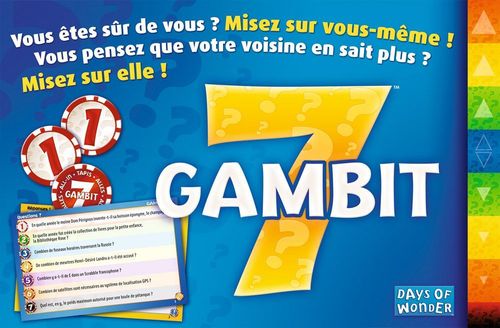
Gambit 7
Gambit 7 Rulebook
Table of Contents
Table of Contents
Game Overview
The More the Merrier
While Gambit 7 can be played with as few as 3 players, the more friends and family you gather, the more fun and excitement you will experience! With more than 7 players, simply split into teams of 2 or 3 and work together to answer the questions and decide how to bet.
Game Set-up
Give each player (or team) an Answer Card, 2 Betting Chips and a Gambit 7 Chip, all of the same color, plus a Dry Erase Pen. Give each player a paper napkin or tissue to wipe-off their Answer Card.
- Answer Card — the erasable card a player writes their guess on.
- Betting Chips — two chips per player, used to bet on an answer.
- Gambit 7 Chip — one chip per player, used for the all-or-nothing gamble described in Step 3.
- Dry Erase Pen — used to write on the Answer Card.
Write your name (or a witty team name) on your Answer Card.
Each player or team has its own color, which is also on the Scoring Board.
- Choose one player as the Host of your game. That Host is responsible for reading the questions aloud and watching the timer during the game. Place the Sand Timer next to that player.
- Choose another player as the Score Keeper for the game. The Score Keeper is responsible for computing the scores at the end of each round and writing them on the Score Card.
- The Host shuffles the Question Card deck, draws 7 Question Cards and stacks them, Questions facing up, on the table. These are the 7 Question Cards that will be used during the game. The Betting Board is also opened up and placed in the center of the table.
Component notes:
- The Sand Timer — the 30-second timer used to time both answering and betting.
- A Question Card — each card carries a stack of numbered questions, one of which is read per round.
- The Score Card — tracks each player's (or team's) running score by color.
Step 1: Ask & Answer the Question
Asking the Question: The Host picks up the 1st Question Card from the stack, announces that it is Question #1, and reads the question in the first position on that card aloud. In future rounds, the host will read the question in 2nd position on the 2nd Question Card, the question in 3rd position on the 3rd Question Card, ... and the question in bottom position on the final and 7th Question Card.
Answering the Question: The Host then turns over the 30-second Sand Timer. Each player (or team) now has approximately 30 seconds to write an answer on their Answer Card. The correct answer to each question will always be a number. Your answer should always try to be as close as possible to the correct answer, without being higher!
The measuring unit used (i.e. feet, metres, etc.) will vary from question to question, depending on usage in various Commonwealth countries, but will usually be specified in the question. When in doubt, spell it out on your Answer Card.
Answers to all questions relative to world records and other (potentially) time-dependent data were correct as of March 31, 2009.
Step 2: Sort & Place the Answers
Sorting the Answers: When the Sand Timer runs out, each player reveals their Answer Card. The Score Keeper sorts these out in order, placing the Answer Cards in a column, with the lowest value answer at the bottom and the highest one at the top.
Equal Values: Answer Cards with the same answer are placed side-by-side.
Placing the Answer Cards: The sorted Answer Cards are then centered on - or around - the middle (Blue section) of the Betting Board, depending on whether the number of unique guesses on the Answer Cards is odd or even.
For example, with 5 guesses where two of them are duplicates (giving 5 unique-guess columns worth of spread), the cards are arranged as a column running, from top to bottom: 2006, 1997, the duplicate pair 1994/1994 side-by-side, then 1992 — centered on the Betting Board's middle section. With 5 unique guesses and no duplicates, the same column of answers — 2006, 1997, 1995, 1994, 1992 — is likewise centered on the middle section.
Step 3: Place Your Bets
The Host turns over the 30-second Sand Timer. Each player (or team) now has approximately 30 seconds to place their betting chips on the Betting Board, next to the Answer Card(s) they want to bet on.
Betting Rules
- Betting Chips may be placed next to any Answer Card, not just the players' own.
- Betting Chips may not be placed on a section of the Betting Board with no Answer Card next to it, except in the All Too High section (see below).
- Both Betting Chips may be placed next to the same Answer Card, in the hope of doubling their winnings if correct!
- They may also be split across any two answers, to increase the odds of getting at least one Betting Chip next to the winning Answer Card.
- Betting Chips may be moved until all players are satisfied with their bets.
- Once the Sand Timer runs out, betting chips may not be moved anymore.
All Answers Too High
If a player thinks that all the answers displayed on the Answer Cards are too high, he can place chips on the All Too High section, at the bottom of the Betting Board.
Gambit 7 Chip
Instead of using his two Betting Chips, a player may decide to take a bigger gamble and use his Gambit 7 Chip as his only bet this turn to try and multiply his score by 7!
If the player turns out to be correct, he will likely win more points than if he had used his two Betting Chips. But if he is wrong, he will lose all previously earned points and his score resets to zero!
Step 4: Determine the Winning Answer & Score the Points
Read the Answer: Once all players have finished placing their bet(s), the Host flips the current Question Card over and reads the official answer written on its back (and any fun fact) to the players.
Determine the Winning Guess: The section of the Betting Board next to the Answer Card(s) with the exact answer - or the closest answer lower than the actual answer - is deemed the Winning Section and its Answer Card(s) are the Winning one(s).
If all the guesses on the players' Answer Cards are too high, then the All Too High section of the Betting Board is the Winning Section this turn.
The Score Keeper now determines the players' new score(s), if any.
Example: Question: Jimi Hendrix, Janis Joplin, Jim Morrison and Kurt Cobain all died at the same age. How old were they? The actual answer is 27 years old. 28 was too high, so the two Answer Cards marked "25" are the Winning Answer Cards and the Blue section is the Winning Section.
Losing Bets
- The Score Keeper gives back to their respective players all the Betting Chips - and Answer Cards - that are not in the Winning Section.
- If a player bet his Gambit 7 Chip in a section that is not the Winning Section, the Score Keeper gives him his Chip back and this player's score is immediately reset to zero!
Scoring Winning Bets
For each Betting Chip in the Winning Section, a player scores points as follows:
- if the player was the only player to bet there this turn, he scores the value indicated in front of the single-person icon;
or
- if two or more players placed a bet there this turn, they score the value indicated in front of the two-person icon.
Example: Red gains 2 x 4 = 8 points and Yellow 4 points this turn; if Yellow hadn't bet here, Red would have scored 2 x 6 = 12 points instead!
- If the Winning section is All Too High, the Score Keeper adds 15 points for each Betting Chip a player successfully bet there.
- If a player successfully bet his Gambit 7 Chip in the Winning Section, the Score Keeper multiplies that player's previous score by 7, regardless of what or where other players bet.
Example: Red and Yellow score points exactly like before. With a prior score of 8, Green now jumps ahead of the pack, with a new score of 56!
Scoring Winning Answers
The Score Keeper then gives a number of points equal to the value printed in the 2 + Player Winning Section (the one with a Star), to all the players with a Winning Answer Card next to the Winning Section. These points are in addition to any points the players might have won through their bets.
These players then get their Answer Cards back and a new round starts.
The player with the highest score at the end of the 7th round wins the game! If two or more players are tied, they both win.
Additional Information
There are 100 different Question Cards included in this game, each features 7 different questions. Each question belongs to one of the following 8 categories:
- Business & Economy
- Arts & Literature
- Geography & Nature
- History & Government
- Pop Culture
- Sciences
- Sports & Leisure
Wild Cards, a catch-all category used in random positions on the Question Cards.
Since the cards are drawn at random, and the questions are selected based on the order the cards were drawn in, hundreds of hours of fun already await you.
Days of Wonder Online
For even more fun and new ideas, and to stay informed of future Question packs, we invite you to visit us at www.gambit7.com.
Register by visiting www.gambit7.com and clicking on the New Player Signup button on the home page. You can also discover our other physical and online award-winning board games at www.daysofwonder.com.