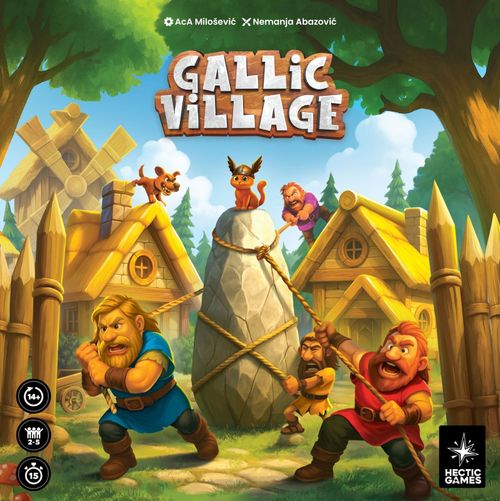
Gallic Village
Gallic Village Rulebook
Table of Contents
Table of Contents
Components
- 52 Action cards
- 16 Menhir tokens
- 1 Aisling token
- 1 Lorcan token
- 4 Victory point markers
- Game board
- Rules
Game Setup
- Place the game board at the center of the table, so it's easily reachable by all players.
- Place 4 Menhir tokens in each of the four neighborhoods in the village.
- Place the Aisling token on the game board, outside the village walls.
- Place the Lorcan token on the first spot of the Round Track at the bottom right corner of the board.
- Place the Player victory point markers at the beginning of the victory point track.
- Shuffle the Action cards and deal ten cards to each player.
- The player that visited the countryside most recently plays first.
Gameplay
The Goal of the Game
The goal of the game is to score the most points.
Game Turn
On their turn the player will:
- Play an action card from their hand.
On their turn, the player must play one card from their hand and perform the action shown on the card. The played card is then placed face up, charged, in front of the player and remains there until scoring is triggered.
NOTE: A played card is considered to be charged until it participates in scoring. Once the card has been scored it becomes exhausted.
Action Card Anatomy
- Card Action: Each card features one of seven distinct actions.
- Flower Colors: The color of the flowers determines which neighborhoods are evaluated for scoring.
- Tool Symbol: Cards display one of three tool symbols (sword, hammer, or sickle), which are used to initiate scoring.
Card Actions
There are seven different actions in the game.
- Switch the positions of two played cards - When you play this card you can switch the place of any two cards that were already played. You can make the switch between any two players.
- Remove one Menhir token from the game - You can choose to remove one Menhir token from any neighborhood on the board and return it to the box.
- Move one Menhir token to an adjacent neighborhood.
- Move two Menhir tokens from one neighborhood to two different neighborhoods.
- Move one Menhir token from the one neighborhood to the second, and another Menhir token from the third neighborhood to the fourth.
- Move the Aisling token - Move Aisling to another field that has the least tokens not counting the field it's currently on. If there are two or more fields with the same, least amount of tokens the player chooses where to move the Aisling token.
- Draw a card.
Step 2: Move the Aisling token
Move Aisling to the neighbourhood with the least amount of Menhir tokens. If the Aisling is already in the neighbourhood with the least amount of Menhirs on it, then the Aisling doesn't move. If there are two or more fields with the same, least amount of tokens the player chooses where to move the Aisling token.
Examples:
- It's the end of the turn, and Aisling must move from the neighborhood he's in, to a neighborhood with fewer Menhirs.
- At the end of this turn Aisling is already in the neighborhood with the least Menhir in it, so it doesn't move.
- Since there are two neighborhoods with the same, least amount of tokens Aisling can move to any one of the two neighborhoods.
NOTE: If you've played the "Move the Aisling token" card, you do not move the Aisling token the second time.
Step 3: Check if scoring is triggered
If there are four (or more) identical tool symbols on the charged cards on the table, scoring is triggered.
Players earn points for each charged card they have that features one of the four symbols. Points are calculated by counting the Menhirs in neighborhoods that match the color of flowers on these cards. Players earn an additional 3 points if the neighborhood matching the card's flower color also has the Aisling token.
NOTE: The number of tool symbols on each card contributes only to triggering scoring, but does not multiply points. A player can score the same neighborhood twice in one scoring phase only if they possess two cards of the same color, both featuring the required tool symbol.
Once points are tallied, advance each player's victory point marker on the victory point track accordingly.
Transcriber note: the printed text reads "one of the four symbols" here, while the card anatomy and the scoring trigger name three tool symbols (sword, hammer, sickle). Transcribed as printed.
Scoring Example
Player 1 has one charged yellow card. They score 5 points, since there are 5 Menhir tokens in the yellow neighborhood. Player 2 has one charged red card, and scores 6 points. Player 3 has two charged cards, but only one has the hammer symbol on it, eligible for scoring. Player 3 scores 5 points for the Menhir tokens in the yellow neighborhood. Finally, Player 4 doesn't have a charged card with a hammer symbol on it, so they don't score any points this time.
After the scoring is concluded, all cards used in scoring should be exhausted. Exhausted cards can't be used in scoring again.
End Game
The game ends after seven rounds. The player that has the most points at the end of the game wins. In case of a tie, all tied players share victory.