Galaxy of Trian: The Beginning of Conquest
Galaxy of Trian: The Beginning of Conquest Rulebook
Table of Contents
Table of Contents
Fleet Tokens (Ships)
The term 'fleet tokens' refers to all Corvette and Rogue tokens appearing in the game.
Regardless of the number of players taking part in the game, players always have 3 Corvettes and 2 Rogues at their disposal.
The number of available fleet tokens is limited. When players run out of ships (players do not have any fleet tokens of a given kind left on their race card), they cannot place new fleet tokens – they can only move those already in play.
Only one resource token and one fleet token can lie on a single tile at the same time.
The Exmitter affects the fleet tokens the same way it affects the emissary tokens.
Types of Fleet Tokens
Corvette
These middle-class ships are used for patrolling and defending the borders of planetary systems. Corvettes can engage in battle, block rivals' emissaries, and protect their own emissaries. In battles they win against Rogue-class ships. During final scoring they limit the number of VP other players receive for their planetary systems.
Rogues
Rogues are small mining ships used in the extraction of valuable minerals from closed nebulae. These ships possess their own extractors, giving them the ability to mine minerals from uncontrolled nebulae or those controlled by a rival.
Expansion Setup
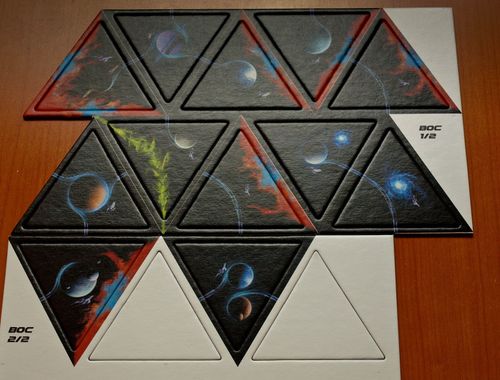
The twelve new tiles included in this expansion are shuffled together with the tiles from the basic version of the game, according to the standard rules.
Each player attaches the expansion board to the race card and places the fleet tokens of the appropriate color on it at the start of the game.
New Rules
1. Obtain Minerals
During the obtain minerals step, an active player's Rogue ships collect mineral markers from closed nebulae that are not controlled by the active player (e.g. controlled by another player, or uncontrolled). For each of the active players' Rogues on a tile with a fragment of such a nebulae, the active players obtains 1 mineral marker from those nebulae.
Note: it is only possible to extract 2 mineral markers from the same nebula.
The Beginning of Conquest expansion introduces two new actions which are added as options to the third step of the player turn.
New Actions
- g. Send a ship into outer space
- h. Move ship
'Can' vs. 'Cannot'
All forbidding rules, with the expression 'cannot', have a priority over the allowing rules, with the expression 'can'. When any rules stand in contradiction to each other, forbidding rules take precedence.
g. Send a Ship into Outer Space
When players decide to send a new ship into outer space, they choose a fleet token from their race card and place it on the table according to the following rules:
Corvette
- The active player can put a Corvette token only on a tile placed in this turn, depicting an area of outer space, and only as long as the interconnected area of outer space does not hold other Corvettes (either active player's or a rival's).
- If the tile placed by the active player this turn is a teleport or trade outpost tile, the active player can put a Corvette token on that tile.
- The active player cannot put a Corvette token on an exmitter tile or on any of the three adjacent tiles (connected by edges).
- The active player cannot put a Corvette token on the tile adjacent to a tile with a Rogue token (either the active player's or a rival's).
Rogue
- The active player can put a Rogue token only on a tile placed in this turn depicting an area of outer space, and only as long as there are no fleet tokens (either the active player's or a rival's) on any adjacent tiles.
- If the tile placed by the active player this turn is a teleport or trade outpost tile, then the active player can put a Rogue token on that tile.
- The active player cannot put a Rogue token on an exmitter tile or on any of the three adjacent tiles (connected by edges).
The way to send a ship into outer space. (Diagram on page 10 of the rulebook, with the tile-placement examples below.)
The following tokens cannot be put on the tile placed here:
- A) Rogue, because there is another ship on the adjacent tile.
- B) Corvette, because there are other ships on the adjacent tiles.
- C) Corvette, because there is another Corvette class ship in this area of outer space.
Following tokens can be put on the tile placed here:
- D) Rogue, because the exmitter has no effect on this tile and there are no other ships on the adjacent ones.
- E) Rogue, because there are no other ships on the adjacent tiles, and the presence of other ships in this area of outer space has no effect with this ship.
- F) Corvette, because there are no other ships on the adjacent tiles, and there are no Corvette class ships in this area of outer space.
h. Move Ship
When the active player decides to use this action, one of the active player's ships on the table can be moved, according to the following rules:
General movement rules
- Fleet tokens can move a maximum of 3 tiles per action.
- During movement, fleet tokens can fly across tiles with other ships belonging to the active player, but they cannot land on them (only one fleet token can occupy a tile at any time).
- During movement, fleet tokens cannot fly across or onto tiles occupied by a rival's ship.
- During movement ships cannot fly through or into areas of nebulae and gas clouds.
- During movement ships cannot fly across or onto exmitter tiles, or any of the three adjacent tiles (connected by edges).
Corvettes
- Corvettes cannot fly across or onto planet tiles with a research or a space station located on them.
Rogues
- Rogues can fly across or onto planet tiles with a research station located on them.
- Rogues cannot fly across or onto planet tiles with a space station located on them.
Movement examples (diagram on page 11 of the rulebook). The letters A–H refer to the arrows and tiles in the diagram.
Xemh Corvette:
- A) can move to the adjacent tile, but it cannot cross a gas cloud or a nebula;
- B) can move to the adjacent tile to protect the emissary, but it cannot cross a tile with a space station located on it;
- C) can move 1 tile to protect the emissary, can move 2 or 3 tiles to block the K'haarquar emissary;
- D) the nebula, where a fight for domination is currently taking place;
- E) Borf-Naree Corvette cannot cross the research station [even the player's own];
- F) Borf-Naree Rogue can cross the research station [even a rival's];
- G) K'haarquar Corvette can move to the adjacent tile, but it cannot move to the next tiles, because the exmitter field is in effect;
- H) Borf-Naree Rogue can move to the adjacent tile, but it cannot cross the space station.
Ship Battle
Whenever fleet tokens belonging to at least two different players are on adjacent tiles that are not separated by a gas cloud or nebula, a battle takes place. Such a situation can happen as a result of a ship movement or a teleportation.
Gas clouds and nebulae limit the visibility of the fleet tokens. Ships separated by a gas cloud or a nebula do not engage in battle with each other, despite lying on adjacent tiles.
Battle ends the ship move.
Depending on the classes of ships taking part in the battle, the following results may occur:
- Corvette vs. Corvette – The Corvette that moved/was teleported into the battle wins. Both ships return to their players' race cards.
- Corvette vs. Rogue – The Corvette wins the battle. The Rogue returns to its race card and the Corvette stays on the board.
- Rogue vs. Rogue – The Rogue that moved/was teleported into the battle wins. The other Rogue is defeated. Both ships return to race cards.
The owner of the victorious ship receives 5 VP.
Multiship Battles
If a player moves/teleports a ship into an area with more than one rival ship, the player who owns the ship that was moved/teleported begins the fight.
If the moved/teleported ship is a Rogue and there are no enemy Corvettes, the attacker chooses one of the rival Rogues to fight. Both ships return to race cards and attacker gains 5 VP.
If the moved ship is a Rogue and at least one of the rival ships is a Corvette, Rogue chooses which Corvette to fight. The Corvette wins and its owner gets VP. The defeated Rogue returns to the race card and the Corvette remains on the board.
If the moved ship is a Corvette, it firstly defeats any enemy rogues and gains 5 VP for each win. The Rogues return to their race cards and the Corvette remains on the board. After that, the owner of the attacking Corvette chooses one rival Corvette (if there are any) to fight. Both Corvettes return to the race cards. The attacker gains 5 additional VP.
Ship Teleportation
Ship teleportation diagram (page 12 of the rulebook). The symbols on the tiles show where a ship may or may not be teleported:
- Check mark: A ship can be teleported onto this place and it dominates the outer space area.
- Hand icon: A ship can be teleported onto this place and the battle begins.
- Shield: A ship can be teleported onto a planet and protect it. If an emissary is already located on the planet, the ship also protects the emissary.
- Prohibition sign: A ship can be teleported onto a rival's planet and block it. If an emissary is already located on the planet, the ship also blocks the emissary.
- Red downward triangle: The ship cannot be teleported onto the marked places, due to the other fleet tokens already lying on it.
- Red X: Exmitter field effect.
Green arrow represents a victory and the Corvette stays on the tile. Blue arrow represents a victory, but both ships return to their race cards.
Interaction of Resource Tokens and Fleet Tokens
Emissaries
Can be blocked or protected by Corvettes. Allow the movement of all Corvettes and Rogues.
Research stations
Block the movement of all Corvettes (even the player's own), but don't block the movement of Rogues.
Space stations
Block the movement of all Corvettes and Rogues.
Protecting an Emissary
When as a result of a movement or teleportation, a Corvette token is placed on a tile depicting a planetary system or trade outpost with an emissary of the same player located on it, the ship protects that emissary. To indicate a protected emissary, the Corvette token is placed on top of the emissary token. You cannot teleport a protected emissary. Furthermore, a protected emissary is counted during the fight for control when a closing planetary system, as well as final scoring.
Blocking an Emissary
When, as a result of a movement or teleportation, a Corvette token is placed on a tile depicting a planetary system or a trade outpost with a rival's emissary on it, the ship blocks that emissary. To indicate a blocked emissary, the ship token is placed on top of the emissary token. The emissary remains blocked until the blocking ship is removed (as the result of a battle or teleportation). A blocked emissary cannot be teleported. Furthermore, a blocked emissary is not counted during the fight for control of a closing planetary system and is not counted during final scoring. If a Corvette blocks an emissary on a planet, the planet it lies on is also not counted during final scoring.
A blocked or protected emissary cannot activate a research station.
Changes in the Basic Rules
d. Use a Trade Outpost
When using a trade outpost, players can still execute a maximum of 2 actions, but they now have 5 actions to choose from:
- Activate a research station
- Upgrade a research station into a space station
- Place a ship on the added tile
- Move a ship
- Send a ship through a teleport
The player may choose to perform both of the actions or perform one of the actions twice (except: "Send a ship into outer space"). Alternatively, the player can choose to perform only one of the actions or skip taking an action entirely.
e. Teleport
When players, during the second step of their turn, play a teleport tile, they can take any fleet token (either the active player's or a rival's) from a tile adjacent to the teleport and move it onto any legaltile (see below).
Send a Ship through a Teleport
A player whose ship is located on a tile depicting a teleport can give up one action in order to send their ship through a teleport.
Rules concerning ship teleportation
- A ship can be moved to any fragment of outer space even if there is another fleet token (either the active player's or a rival's) within the area.
- A ship can be moved to a teleport or a trade outpost tile.
- A ship cannot be teleported to a tile, which it would not be allowed to enter during normal movement (Exmitter effect field, space stations, etc.).
As with the base game, the player can still teleport an emissary token, but with the following additional rules:
- An emissary can be moved to a tile with a Corvette located on it. In such a case the emissary automatically becomes blocked or protected, depending on the owner of the Corvette (whether it belongs to the same player as the emissary or a rival). Regardless of ownership, the fleet token is placed on top of the emissary token.
- When an active player's emissary is teleported to a tile featuring a free trade outpost that also contains an enemy Corvette, the emissary cannot execute any additional actions provided by the outpost's ability, and the emissary becomes blocked.
- An emissary cannot be teleported when it is protected or blocked by a Corvette.
Capture Free Areas with Teleportation
If all emissaries in a closed planetary system are blocked by Corvettes and there is no research station or space station, then the owner of these emissaries loses control of the system and it is treated as free. Therefore, players can teleport emissaries into it, effectively gaining control of the system. If a planetary system has changed control in this way, then as soon as one of the former owner's emissary tokens becomes unblocked, it is removed from the system and returned to its owner's race card. As usual, when gaining control of free planetary systems, the controlling player only receives VP for the system at the end of the game.
Players regard first the result of a ship battle before checking for control of a system. Therefore a player regains control of a system, when corvette/s blocking his emissaries are destroyed.
The End of the Game
Players remove their emissaries according to the rules of the base game.
After that, all ships which do not block emissaries and/or planets, and do not take part in plundering, are returned to their owners' race cards. Those emissaries do not generate any points.
Then:
- Count all the points for plundering.
- Count all the points for planetary systems and nebulae.
- Count all the points for accumulated minerals.
Players Receive VP for Plundering
The player who has the most fleet tokens in a given area of outer space (including those on the planets within it's boundaries) plunders all rivals' planetary systems within the said area. Each system is plundered separately and the area of outer space does not need to be closed to make plundering possible. When all players have the same number of ships in a given area of outer space, plundering does not happen and the ships are returned to their owners.
When two or more (but not all) players are tied for the most ships in a given area of outer space, the tied players plunder only systems controlled by other players and equally share (rounding down) VP for the plundered systems.
During plundering, the player checks the level of a given planetary system (research station level 1, space station level 2). This value is multiplied by the number of planets in the plundered system (blocked planets are also counted).
The player controlling the plundered system loses VP equal to the result and the plundering player gains that amount of VP.
Note: There IS NO plundering in systems without a research or space station.
Tip: After plundering ends, players can turn the tokens of the plundering ships upside down. It will make it easier to determine where the plundering VP are yet to be counted.
Then, players receive VP for nebulae and planetary systems they control at the end of the game, and for the mineral markers they have accumulated.
Plundering examples (diagram on page 14 of the rulebook). The examples refer to the three areas A, B and C of the diagram.
- A – in this area, K'haarquar wins:
- it plunders Xemh's planetary system [receives 5 VP=( 5 planets x 1st technological lvl];
- Xemh receives 3 VP for the system [(2 non blocked planets + 0 emissaries) x 4 [1st technological lvl]) - 5 VP from K'haarquar plundering] ;
- B – The trapped K'haarquar's ship doesn't plunder any planetary system;
- C – in this area, Quuylto wins:
- it plunders Borf-Naree's planetary system [receives 3 VP];
- it plunders Xemh's planetary system [receives 4 VP];
- receives 80 VP for the controlled planetary system;
- Borf-Naree receives 13 VP [16-3VP] for the planetary system;
- Xemh receives 16 VP [20-4VP] for his planetary system.
Final Scoring on Nebulae
Final scoring on nebulae – no change to original scoring methods.
Final Scoring on Planetary Systems
During final scoring, planets blocked by a Corvette (and the blocked emissaries) are ignored for the calculation of the final VP from that system.
Additional Variants
Family Variant
The family variant is a game with the rules for the base game (e.g. no The Beginning of Conquest expansion). It uses only emissary resource tokens, which cannot be leveled up (research and space stations are not used).
The rules have the following changes:
- After a planetary system becomes closed the controlling player receives VP as usual, but all emissaries are returned to their owner's race cards.
- After a nebula becomes closed and the controlling player receives VP, the controlling player decides how many emissaries are to be left in the nebula (including none), independent of who closed the nebula.
- Minerals are not extracted. Instead, at the end of the game, players receive 3 VP for each mineral marker located in their controlled nebulae.
- The trade outpost has no special function (players can still place and teleport emissaries onto it).
Bigger Space Variety Variant
In this variant, players use all the tiles from the base game as well as the 12 extra tiles from the "The Beginning of Conquest" expansion. All rules concerning fleet tokens are ignored however. Other rules remain unchanged.
Team Variant
Galaxy of Trian supports team games. Players can play 2 vs. 2 matches with one copy of the game. With two copies 2 vs. 2 vs. 2, or even 3 vs. 3 games become possible.
2 vs. 2
Players create 2 teams of 2. Each player receives the appropriate starting elements in one color. Each player receives 7 emissaries, 7 research stations, and 2 space stations in the appropriate color.
Even though players of the same team use elements in two colors, all resource and fleet tokens are shared within the team (they are treated as if both players had tokens in the same color). Players can execute actions with their partner's tokens following the same rules as they would for their own tokens.
When any resource and fleet tokens are to be returned to players, they are returned to the appropriate race cards according to their color.
2 vs. 2 vs. 2
Players create 3 teams of 2, and each team receives all components (two race cards, two sets of resource and fleet tokens) in the same color. Each player receives 7 emissaries, 7 research stations, and 2 space stations in their team's color.
All resource and fleet tokens are treated as common within each team. Players can execute actions on all tokens in their team's color according to the usual rules.
When any resource and fleet tokens are to be returned to players, team members decide how they want to share them. However, they must remember that the number of resource and fleet tokens on a given player's race card cannot exceed the number of available spaces.
Personal Variants
Galaxy of Trian's construction and mechanics allow players to combine different rules and expansions. Players can even make their own variants. If you happen to create rules for your own expansion or variant, please let us know and send them to us at [email protected].
We will gladly publish them on our webpage, and maybe even add them to our next expansion.
The game has been thoroughly tested for 2-4 players. With 5 or 6, further testing is needed, but it appears minor changes on the amount of tiles will allow for play:
72 (+12) tiles for 2-4 players / 105 tiles for 5 players / 126 tiles for 6 players
Special Cases
- When at any time, during the game one of the stacks is depleted, game tiles are drawn from only one pile until the end of the game.
- When at any time, during the game minerals markers run out, the minerals have been depleted. Thus, in the case of closing a nebula, players do not put any markers on it. There is a limit of 100 markers in the game.
- It is possible that one placed tile closes several areas. In that case, each area scores and is counted separately. There is no fixed order of scoring in such case.
- When placing a tile with a teleport, the player can move a ship from an adjacent tile onto the tile with a teleport.
- After the game ends, we advise the players to put all tiles with a special action, i.e. teleport, exmitter, and trade station face down. Then shuffle the tiles and put them into two equal piles into the rack. In this way, the tiles will be ready for another game.
- During the course of the game a player doesn't have to show other players what's on the back of the tile she/he has drawn this turn. It could be used for bluffing.
- If a Rogue ship token lies on a tile containing a research station, which is being transformed into space station, the ship returns to the player's resources. This effect is not treated as a battle, so no one receives 5 VP.
- Effect priorities – order in which effects take place:
- Exmitter.
- Ship battle.
- Teleportation.