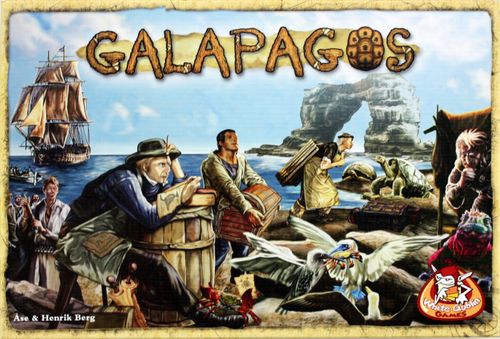
Galapagos
Galapagos Rulebook
Table of Contents
Table of Contents
Game Components
- 1 game board, showing the coast of one of the Galápagos islands, divided into one central volcano and four different areas (north/blue, east/green, south/red and west/yellow). Additionally, the board contains an Education track (going from 0 to 25) and an Exhibition scoring track at the edge (going from 0 to 50).
- Game money in the denominations £100 and £500.
- 104 Action Cards: 26 in each of the colours blue (north), green (east), red (south) and yellow (west). Each colour contains:
- 13 Expedition cards
- 4 Sale cards
- 4 Exhibition cards
- 5 Education cards
- 63 Animal Tokens:
- 13 blue (sea lions)
- 12 yellow (iguanas)
- 11 green (tortoises)
- 10 red (blue-footed boobies)
- 9 pink (penguins)
- 8 brown (crabs)
- 15 Species Tiles, each depicting a pair of two different animals. Six of these tiles are labeled as start tiles.
- 12 Bonus Tiles: 1 for each species and 1 for each number 1, 2, 3, 4, 5 and 6.
- 1 Starting Player figure.
- For each player:
- 1 compass board for bid placements
- 2 game figures in the player's colour
Preparations
-
The game board is laid out on the table.
-
1 token of each animal type is placed on the Education Track:
- 1 blue token (sea lion) on the field 0
- 1 yellow token (iguana) on the field 3
- 1 green token (tortoise) on the field 6
- 1 red token (blue-footed booby) on the field 9
- 1 pink token (penguin) on the field 12
- 1 brown token (crab) on the field 15
The remaining animal tokens are placed as an open supply somewhere on the table.
-
The 6 species tiles labeled as start tiles are shuffled, and one tile is placed face up on each of the square fields in the directions North, East, South and West around the volcano in the centre of the game board. The remaining two start tiles are shuffled together with the remaining species tiles. These tiles are placed as a deck (face down) in the middle of the volcano in the centre of the game board.
-
The bonus tiles are laid out as a sequence next to the game board. Initially, all bonus tiles are laid out with the grey side up, and should be ordered according to the numbers printed in the corner of each tile (1-12). The first bonus tile (the „1“ tile) is turned face up.
-
Each player chooses a colour and receives the compass board and the game figures of this colour. One figure is placed on the field 0 of the Exhibition Points track and the second figure is placed on the field 0 (that is, on the sea lion token) on the Education Track.
-
Each player receives £1500. The remaining money forms the bank somewhere on the table.
-
All the action cards are shuffled, and each player is dealt a hand of 7 cards. The remaining cards are placed as a face down deck somewhere on the table, with some space for a discard pile next to it.
Game Play
The game is divided into 12 rounds, each of which is divided into two phases:
- Bidding for direction and starting player figure
- Playing action cards and performing actions
1. Bidding for Direction and Starting Player Figure
Starting with the player currently holding the Starting Player figure and continuing clockwise around the table, each player may in turn place one bid, by placing any chosen amount of money next to his compass board in a chosen direction.
Example 1: The starting player places £300 in the direction West next to his compass board. The second player places £200 in the direction North next to his compass board. The third player passes, and finally, the fourth player places £200 in the direction North next to his compass board.
After the bidding round, the bids are evaluated to determine two things:
- The direction for this round, that is, what card colour can be played this round.
- The new starting player for this round.
The direction for this round will be the direction receiving the highest total amount of bids. If more directions are tied for the highest amount, early bids beat later bids.
Example 2: In the above example, the bids were W-300, N-200 and N-200. North thus received the highest total amount, and will be the chosen direction for this round.
Example 3: The following bids are placed: W-300, N-100, N-200. Since the West-bid was placed first, it beats the North-bids, even though the total amounts are equal.
Example 4: The following bids are placed: W-200, N-400, W-200. The total amounts are equal, but since North reached 400 first, North „wins“.
When the „winning“ direction has been determined, the player placing the highest bid in this direction gets the Starting Player figure. Again, in the event of a tie, early bids beat later bids.
Example 5: In example 1 above, North was chosen as the direction for this round. The second and fourth player both bid £200 for North, the second player thus receives the Starting Player figure.
If no bid is placed, the current starting player keeps the Starting Player figure, and may freely choose the direction for this round.
After determining direction and starting player, all players who placed bids in the winning direction must pay their bids to the bank. Players with bids in other directions keep their money.
Example 6: In example 1 above, North was chosen, therefore the second and fourth player both have to pay their bids of £200. The (former) starting player keeps his £300.
2. Playing Action Cards and Performing Actions
After determining the direction and starting player for this round, each player may in turn play action cards from his hand, starting with the just-determined starting player and continuing clockwise around the table.
Only action cards with the chosen direction may be played! E.g., if North is the chosen direction this round, only cards labeled „N“ (that is, blue cards) may be played.
Each player plays all cards he wishes to play before the next player gets his turn. All played cards are discarded after playing. Finally, each player draws cards from the deck to refill his hand to seven cards. If the deck is exhausted, shuffle the cards in the discard pile thoroughly to make a new deck.
Example: In this round, we are going south. On the yellow player's turn, he plays an expedition card labeled „S“ (that is, a red card). The species tile in the south direction shows a crab and an iguana, so the yellow player may now take either a crab or an iguana. If he chooses an iguana, he does not have to pay anything, since his figure is further advanced than the iguana on the education track. However, if he chooses to take a crab, he has to pay £600 to the bank, since the crab is the third animal more advanced than his figure on the education track.
The Available Actions
Education
When playing an education card, you may advance your figure 1, 2, 3 or 4 steps on the education track. You may freely choose the number of steps, but you have to pay a price to the bank according to the following table:
| Price | £100 | £300 | £600 | £1000 |
|---|---|---|---|---|
| Number of steps | 1 | 2 | 3 | 4 |
Example: Anna plays an education card, pays £300 and advances two steps on the education track. Thereafter she plays another education card, pays £100 and advances another step on the education track.
Expedition
When playing an expedition card, you may take one animal token from the general supply. The species tile in the current direction on the game board determines which kinds of animals you may take. You may freely take any one of the two given animals. If you play more than one expedition card, you can make a different choice for each card played.
Payment: Basically, taking an animal token costs nothing. However, if you have not yet reached the corresponding animal token on the education track, you have to pay £200 for each animal token up to and including the chosen animal token.
Important: When playing an expedition card, you are not allowed to take any other kind of animal than the two given by the species tile in the current direction!
Sale
When playing a sale card, you may return any one of your animal tokens to the supply in order to receive £600 from the bank.
Exhibition
When playing an exhibition card, you form an exhibition consisting of one or more different animal tokens. For each token exhibited you receive two exhibition points, that is, you advance two steps on the exhibition points track. Finally the exhibited tokens are returned to the supply.
Example: A player has the following animal tokens: a sea lion, a tortoise and a blue-footed booby. By playing an exhibition card, he may return one sea lion, the tortoise and one blue-footed booby to the supply in order to score 6 exhibition points.
Bonus
If an exhibition fulfills the requirements (see below) of a face-up bonus tile, each animal token in the exhibition is worth an extra exhibition point. That is, with the bonus, each animal yields 3 exhibition points instead of 2. Thereafter, the bonus tile is removed from play.
You may never get more than one bonus for any given exhibition. If playing an exhibition that fulfills the requirements of more than one face-up bonus tile, you may freely choose which one of the bonus tiles to use and thereafter remove from play.
Bonus Requirements
In order to use a bonus tile showing a number (1-6), your exhibition has to contain at least the given number of animal tokens. As usual these tokens all have to be different.
In order to use a bonus tile showing an animal, your exhibition has to contain the given animal.
Example: A player has the following animal tokens (figure omitted). The following bonus tiles are currently available (face up) (figure omitted). He plays an exhibition card, and returns one sea lion, the tortoise and one blue-footed booby to the supply. This exhibition fulfills the requirements of both bonus tiles, therefore he receives 9 exhibition points and must remove one of the fulfilled bonus tiles. He chooses to remove the „3“ bonus tile.
Thereafter, he plays another exhibition card. This time he returns the remaining sea lion and the remaining blue-footed booby to the supply. Since this second exhibition fulfills the requirement of the blue-footed booby bonus tile, he receives 3 exhibition points per animal for a total of 6 points. Thereafter he removes the blue-footed booby bonus tile from play.
Special Rules
Using two cards as a wildcard: Whenever a player is allowed to play cards of a given colour, he may discard any two cards of the same given colour and perform any one of the four available actions (Education, Expedition, Sale or Exhibition).
Selling cards: Whenever a player is allowed to play cards of a given colour, he may discard any number of cards of this colour (without performing the associated actions) and receive £100 from the bank for each card discarded.
Exchanging animal tokens: At any time, a player may exchange any two of his animal tokens (equal or different ones) for one animal token of any kind from the supply.
If he has not yet reached the corresponding animal token on the education track, he has to pay £200 for each animal token up to and including the chosen animal token.
Preparing the Next Round
After each round (except for the last, see Game End), the following steps are carried out:
- The two animal kinds that were available this round (that is, the two species depicted on the species tile in the direction chosen this round) both advance one step on the education track.
- The species tile in the direction chosen this round is removed from play and replaced by a new tile from the species tile pile.
- The lowest-numbered face-down bonus tile is turned over.
- Each player receives a payment of £200 from the bank.
Thereafter, the current starting player starts the „Bidding for direction and starting player figure“ phase of the next round.
Game End
Since there are twelve bonus tiles in the game, and one bonus tile is turned over for each round, after twelve rounds there are no more face-down bonus tiles left. After this twelfth round the game ends.
The player with the highest education level receives 4 bonus exhibition points, the player with the second highest education receives 2 points. In the case of a tie for the highest education, all tied players receive 3 points (and no one else receives any bonus points). In the case of a tie for the second highest education, all tied players receive 1 point.
Finally, each player receives 1 point for each two animal tokens he has (regardless of kinds) and 1 point for each £1000.
The player with the most exhibition points wins the game. In the case of a tie, the tied player with the most money wins the game.