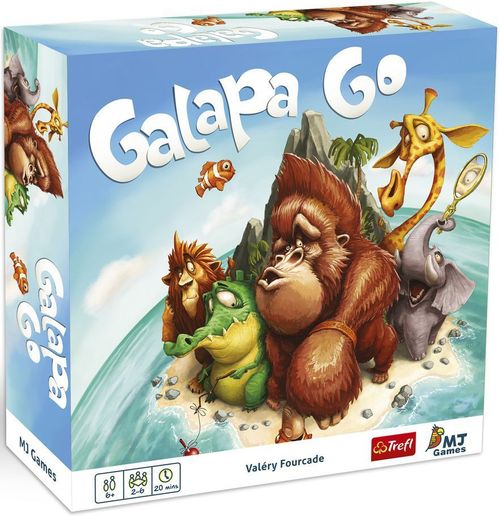
Galapa Go
Galapa Go Rulebook
Table of Contents
Table of Contents
Components
105 cards:
- 6 Camera cards, in six different colours
- 30 Animal cards: normal animals and unusual animals
- 55 Task cards
- 14 Special Task cards
Goal of the Game
Collect as many Animal cards as possible.
Setup
Give each player one Camera card. If there are fewer than 6 players, put the remaining Camera cards back in the box.
If you are playing for the first time, or with small children, do not use the Special Task cards.
Shuffle the Animal deck. Shuffle the Task deck (optionally adding the Special Task cards to the Task deck). Place these two decks face down next to the play area. The player whose home has the largest pet becomes the lead player in the first round. After that, the role of lead player passes from player to player clockwise.
Game Flow
The lead player places 15 Animal cards face up in the centre of the table.
Then the lead player quickly turns the top card of the Task deck face up, so that all players can see it at the same time. This card shows which animals must be found among the 15 cards on the table.
The round begins immediately. All players must simultaneously cover, with their Camera card, the Animal card (or cards) that match the features shown on the revealed Task card. Features are either recommendations (green circle) or restrictions (red circle). If a card shows more than one feature, all of them must be satisfied.
For example:
- Task card: find a card with crocodiles. Matching Animal cards: those showing a crocodile (half-crocodile).
- Task card: find a card showing both a gorilla (half-gorilla) and a red crab. Matching Animal cards: those showing a gorilla (half-gorilla) and a red crab.
- Task card: find a card showing neither a lion (half-lion) nor an elephant (half-elephant). Matching Animal cards: those with no lion (half-lion) and no elephant (half-elephant).
- Task card: find a card showing a lion (half-lion) but no blue crab. Matching Animal cards: those showing a lion (half-lion) and no blue crab.
(The illustrations of the example cards are not reproduced here; the captions above describe them as printed.)
Descriptions of the Special Task cards are at the end of the rules.
End of the Round
The round ends as soon as either:
- every player has covered an Animal card with their Camera card, OR
- no more Animal cards match the features shown on the Task card.
Note: sometimes no player manages to find the required animal. If all players agree that no such animal is among the revealed Animal cards, the lead player turns over the next card from the Task deck.
Then the players check whether they have photographed the correct animals:
- If the animal was identified correctly, the player takes the Animal card and places it face up in front of them.
- If the animal was identified incorrectly, the player loses 1 Animal card won in one of the previous rounds. That card is returned to the box. If the player has no won cards yet, nothing happens.
The Task card used during the round is discarded. The player sitting to the left of the lead player becomes the new lead player and starts a new round.
When only one Animal card or no Animal cards remain on the table, the lead player lays out the 15 remaining Animal cards from the deck on the table, and the game continues. When only one card or no cards remain on the table again, the game ends.
Winning the Game
Players count their won cards. The player who has "photographed" the most animals is declared the winner!
Notes:
- If the Task cards run out at any point, shuffle the discarded Task cards and continue the game.
- If two players try to place their Camera cards on the same Animal card, the player who places the card first wins (that is, the card that is lower in the stack). The other player must take back their Camera card and place it on a different Animal, if possible.
- Apart from the case described above, a player cannot take back their Camera card until the end of the round. Once an animal has been "photographed", the decision cannot be changed.
Complex Variant
This variant is only for play without the Special Task cards.
The lead player turns over not one but two Task cards at the same time. Players must find an Animal card that matches the features of both Task cards at once. If no Animal card matches the features on the cards, both Task cards are discarded and two new ones are drawn.
When 4 or fewer Animal cards remain on the table (instead of 1, as in the normal game), the lead player lays out the 15 remaining Animal cards from the deck on the table, and the game continues. When 4 or fewer Animal cards remain on the table again, the game ends.
Description of the Special Task Cards
Playing with the Special Task cards requires players not only to be clever, but also to react quickly: often it is not enough to give the right answer, you must give it first! The game follows the normal rules, except that you will have to look for other animals, or look for them in a different way.
- Find and cover with a Camera card any unusual animal (one made of halves of two other animals). A card with two normal animals does not count.
- Find and cover with a Camera card any normal animal. A card with two normal animals counts.
- Determine which animal appears most often among the cards laid out on the table. Unusual animals count toward each animal species (a lion-elephant counts both as 1 elephant and as 1 lion). The player who first gives the correct answer receives the card with that animal.
- Determine which animal appears least often among the cards laid out on the table. Absent animals are not counted. Unusual animals count toward each animal species (a crocodile-giraffe counts both as 1 crocodile and as 1 giraffe). The player who first gives the correct answer receives the card with that animal.
As soon as this card is turned over, the lead player must, as quickly as possible, cover any Animal card in the centre of the table with a Camera card. In clockwise order, the other players try to recall (or guess) which animal or animals are shown on that card. If a player correctly names the animals shown on it, they receive that card. If no one gives the correct answer, the lead player takes that card for themselves.