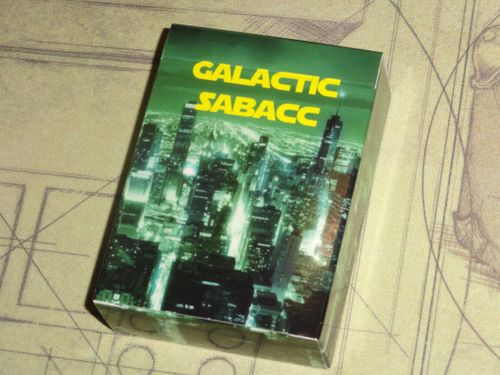
Galactic Sabacc
Galactic Sabacc Rulebook
Table of Contents
Table of Contents
Goal
Sabacc is a betting and card game played with a card deck and dice (to replicate the computerized cards used in the Star Wars universe). This version is based on Corellian Spike Sabacc; there are many variations of the game throughout the galaxy. The goal of sabacc is to achieve a total card hand score of 23, without going over – or to bluff the other players into believing you are closest. Sabacc can be played by up to eight players with a single deck.
Game Materials
- One standard 52-card card deck, plus two Jokers.
- Three (3) six-sided (d6) dice per player.
- Chips, tokens, or other items used for ante and betting.
Card Values
Each card in the deck has a numerical value:
- Joker. Value zero (0).
- Ace. Value one (1).
- Numbered cards two (2) through ten (10). Face value of card 2 to 10.
- Jack. Value eleven (11).
- Queen. Value twelve (12).
- King. Value thirteen (13).
Game Setup
- Select one player to be the dealer. Give the dealer the card deck; the dealer shuffles the deck.
- Assign three dice to each player and some equal quantity of betting materiel (chips, tokens, etc.).
- The dealer deals three cards to each player, face down. Players may look at their cards; the total value of their hand is the sum total of the values of their three cards.
- Each player puts their initial ante (determined by the group) into a pot in the center of the table.
Game Play
-
The game proceeds through hands, which alternate between Betting, Draw, and Flux phases. There are three betting phases separated by two Draw and Flux phases like so: a. First Betting phase b. First Draw Phase c. First Flux Phase d. Second Betting Phase e. Second Draw Phase f. Second Flux Phase g. Final Betting Phase
-
During each Betting phase, starting with the player to the left of the dealer and concluding with the dealer, each player may choose to Hold (not put additional chips into the pot), Raise (add chips to the pot), Call (match a prior player's Raise), or Fold (withdraw from the game, without revealing cards). To remain in the game, each player must Call the highest Raise of players around the table. Rotation of betting continues until all players have Called the highest Raise, or until only one player is left – that player wins the hand and the pot.
-
During the Draw phase, players – starting to the left of the dealer, and concluding with the dealer, discard cards from their hands and are dealt an equal number of cards by the dealer. Discarded and drawn cards remain face down; only the player drawing/discarding knows the value of the cards. a. In the First Draw Phase, players may discard and draw up to three cards. b. In the Second Draw Phase, players may discard and draw up to two cards.
-
During the Flux phase, card values are adjusted by the electrical "Flux". Players select cards to "lock down", whose values will not change. The remaining cards have a Flux die placed next to each of them, then players roll each die individually, placing the new die value on top of the face down card to which it corresponds. Dice values are public information; card values are not. The Flux die changes the value of the card under it by the value of the die, minus one (so increasing the card's value by zero (0) to five (5) points). No card can have a value greater than thirteen (13), points above 13 roll back to zero and add again from there (subtract 14 from the result). a. In the First Flux Phase, players may lock down up to one card. b. In the Second Flux Phase, players may lock down up to two cards. c. Cards with Flux dice attached, if they are discarded in a subsequent Drawing phase, also discard the attached Flux die. Cards which have a Flux die attached which are locked retain their die value. d. A card with a Flux die on it from the First Flux, that is not locked for the Second Flux, rerolls its Flux die. e. Example: Jim draws to three cards: an Ace (1), a ten (10), and King (13), for a total value of 24 (1+10+13). In the First Flux phase, he elects not to lock any cards, places one die on each card, then rolls them for a one (1) result, a six (6) result, and a two (2) result respectively. He places the dice on the cards, resulting in an adjusted value of 1 for the Ace (1 + (1-1)), 1 for the Ten (10 + (6-1) = 15, 15-14 = 1), and 0 for the King (13 + (2-1) = 14, 14-14 = 0), for a new hand value of 2.
Ending the Hand
- After the last Betting phase, if there is more than one player remaining who has not folded, players reveal their hands, starting with the closest player to the left of the deal. Player's declare their total score (sum of the modified card values plus Flux dice).
- Pure Sabacc. If any player has a total value of 23, "Pure Sabacc," that player wins the hand (except for the Idiot's Array, below).
- If no player has Pure Sabacc, the player with the hand total closest to 23, without going over, wins the hand.
- If two or more players have the same total and are tied for the win, if one is the dealer, the dealer wins. Otherwise, the hand ends with no winner, the pot remains in play, and the next hand begins.
- Idiot's Array. If a player scores 23 by having three cards whose values are 0, 2, 3, that player has an Idiot's Array, which beats Pure Sabacc, winning the hand.
- The winning hand claims the pot. The dealer position passes to the next player to the left, and the players ante up to play a new hand.
Ending the Game
- The game may be called by mutual consent; any remaining pot is divided equally among players and the player with the most chips wins.
- Alternately, the game may continue until all remaining players are out of chips, except for one player, who is the winner.
- For long-running games, players may drop out (with their winnings) or enter (paying the appropriate ante for that pot) at the start of any hand.
Variants
Other variations of Sabacc are played throughout the galaxy. Some of those variants include:
- Mantellian Sabacc. Originating with soldiers at the base at Ord Mantell, Mantellian Sabacc uses a range of -23 to 23 with both extremes serving as winning hands. In Mantellian Sabacc, red cards (and dice rolled on red cards) are positive values and black cards (and dice rolled on black cards) are negative values. In Mantellian Sabacc, the pot is not won until either Pure Sabacc or an Idiot's Array is played; it keeps rolling over until claimed. Unclaimed Sabacc pots were often donated to widows' and orphans' funds.
- Coruscanti Sabacc. In Coruscanti Sabacc, house alliance (suit) matters; an Idiot's Array must have cards of the same alliance, and a hand whose cards are of the same alliance beats an equal-valued hand of mixed alliance.