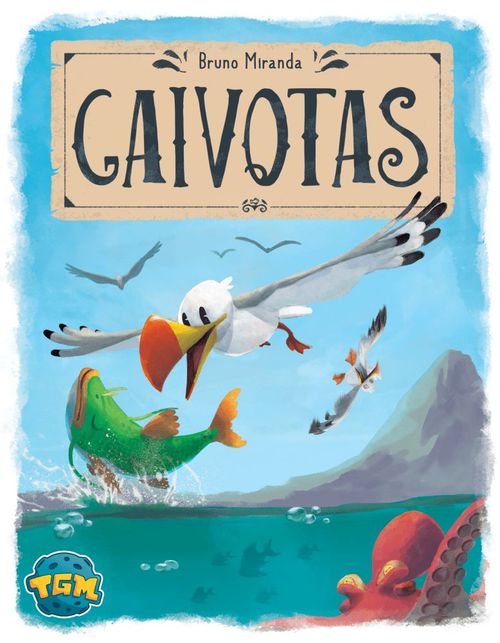
Gaivotas
Gaivotas Rulebook
Table of Contents
Table of Contents
Components
- 50 Fish cards
- 10 Special cards
- 20 Event cards
- 5 Objective cards
- 25 Seagull cards, with 5 cards in each colour
- Current Player token (Ficha de jogador da vez)
- Fishing Boat (Barco de pescadores)
Setup
- Shuffle the Fish cards to form the Sea deck and place it face down on the table. Put the Special cards back in the game box; they are used only in the Advanced mode.
- Reveal 5 cards from the Sea deck (4–5 players) or 4 cards (3 players) and place them to the right of the Sea deck to form the Sea row.
- Place the Fishing Boat to the right of the Sea row and reveal 3 cards (4–5 players) or 2 cards (3 players) from the Sea deck, placing them below the boat.
- Shuffle the Event cards and place them face down to the left of the Sea deck.
- Each player takes a set of Seagull cards of one colour of their choice. (For 3 players, return the card numbered 5 of each set to the game box.)
- Deal one Objective card at random to each player. Keep it secret from the other players.
- The player who most recently went to the beach receives the Current Player token.
Setup for 3 players: the Sea row holds 4 cards and the Fishing Boat holds 2 cards.
Fish Cards
The Sea deck contains Fish cards, and catching fish is the main goal of the game!
There are 4 different types of fish, divided between small and large, identified by icons in the top left corner of the card.
- There are Fish cards with only 1 fish, while others contain 2 fish of the same type on a single card.
- Some cards may have a star icon, indicating that the fish on that card are of superior quality.
The four types of fish are:
- Small fish, yellow, common: single yellow fish card.
- Small fish, red, superior quality: double red fish card.
- Large fish, green, common: double green fish card.
- Large fish, purple, superior quality: single purple fish card.
Event Cards
Event cards can be of two types: Event or Clear Sky.
A new Event card is revealed each round and may influence the players' strategies.
If the card is Clear Sky, nothing happens. In all other cases, the players must follow the instructions on the Event card.
Event cards shown in the rulebook:
- Patos (Ducks): "The current player [text hidden in the scan] a card from the Sea deck [text hidden] and swaps it for [text hidden] card of the Sea row." The rest of this card's text is covered by another card in the printed rulebook and could not be transcribed.
- Isca de Peixe (Fish Bait): "Starting with the current player, each player draws a card from the Sea deck and adds it to their collection."
- Céu Limpo (Clear Sky): "A beautiful day for fishing." Nothing happens.
- Redemoinho (Whirlpool): "Shuffle all the cards in the Sea row and reposition them at random."
Seagull Cards
Seagull cards are the sets of cards used by each player during the game to choose which card from the Sea row they will try to catch each round.
Each set has 5 cards numbered 1 to 5, in one of the 5 colours available.
How to Play
Each round of Gaivotas is divided into 4 distinct phases:
- Planning
- Event
- Fishing
- End of Round
1. Planning
Time to plan your attack!
Each player chooses one Seagull card from their hand and places it face down on the table.
The number of the chosen card indicates which card of the Sea row the player intends to catch.
Example: Paula wants to catch the superior-quality purple fish in position 3. To do so, she chooses the Seagull card numbered 3 and places it face down on the table.
2. Event
Something unexpected happens... or not.
The current player reveals an Event card and follows its instructions.
If the card is Clear Sky, nothing unexpected happens in this round.
The Event card Redemoinho (Whirlpool) reads: "Shuffle all the cards in the Sea row and reposition them at random."
3. Fishing
Lunch time!
All players reveal their Seagull cards simultaneously.
Starting with the current player and proceeding clockwise, each player catches the card in the Sea row that matches their Seagull card, and adds it to their collection.
Collision (Encontrão!): If two or more players reveal Seagull cards with the same number, a collision occurs. None of those players catches the card in the Sea row.
Starting with the current player and proceeding clockwise, each participant in a collision must, if possible, choose a card from the Fishing Boat and add it to their collection. Some players may not catch any cards in this round.
4. End of Round
Organising a new catch.
Each player returns the Seagull card they used to their hand.
All remaining cards in the Sea row and on the Fishing Boat are shifted to the right, and new cards are drawn from the top of the Sea deck to fill the empty spaces.
The current player passes the Current Player token to the next player clockwise.
Collecting Fish
Cards caught from the Sea row or from the Fishing Boat are added to each player's personal collection.
The first card is placed face up on the table in front of the player, starting a row. From the second round onwards, all new cards must be added to the left or to the right of one of the end cards of that row, never between two cards.
Completing Schools
A school (cardume) is formed by fish of the same type in sequence in a player's collection row.
- A large school is formed with 3 fish.
- A small school needs 5 fish.
Each school is worth 2 points, regardless of the type of fish!
Quality Schools
A school that contains at least 1 superior-quality fish becomes a quality school, worth 3 points.
Having more than one superior-quality fish in the same school does not change its score.
Optimising Schools
Schools in a row may be considered from left to right or from right to left, depending on the player's intention.
Double fish cards can be used to form two different schools.
Example: Bruno has 5 green fish cards, which he can arrange into schools in two distinct ways, shown below.
- Arrangement 1: two schools of 3 fish, each a quality school worth 3 points, for a total of 6 points.
- Arrangement 2: one school of 3 fish worth 2 points and one quality school of 3 fish worth 3 points, for a total of 5 points.
Objective Cards
Each player keeps their Objective card secret from the other players. At the end of the game, the objectives fulfilled on it are scored.
- 2 points: Have the largest number of fish of one type of your choice, among all players.
- 3 points: Have at least 3 schools of different types in your collection.
End of Game
The game ends immediately when there are no more cards to completely fill the Sea row, or when there are no more cards in the Event deck.
Each player adds up the score of the schools in their collection and the objectives fulfilled on their Objective card.
| Scoring item | Points |
|---|---|
| Common schools | 2 points each |
| Quality schools | 3 points each |
| Objectives | 0–5 points |
The player with the most points is declared the winner!
Tie: In the case of a tie, the player with more superior-quality fish becomes the winner.
Advanced Mode
Experienced Seagull players may want to add a new layer to the game with the Special cards.
To play the Advanced mode, simply shuffle the Special cards together with the rest of the Sea deck at the start of the game.
Each Special card has a different effect, described on the card itself. Otherwise, the Special cards follow the basic rules of the game and are added to the Sea row just like Fish cards.
- Polvo (Octopus), 2 cards: Worth more points if it is at one end of the collection at the end of the game. Card text: "Worth 1 point, but if it is at one end of your collection, it is worth 3 points."
- Pelicano (Pelican), 2 cards: Immediately discard the Pelican and a Fish card. Card text: "Discard a Fish card from your collection. Discard this card."
- Rede de Pesca (Fishing Net), 2 cards: Valuable cargo, but it can only be caught on the boat. Card text: "Worth 2 points, but can only be caught on the boat."
- Peixe Surpresa (Surprise Fish), 4 cards: A wild card, serving as a common fish of any type. Card text: "Counts as a fish of the type of your choice."