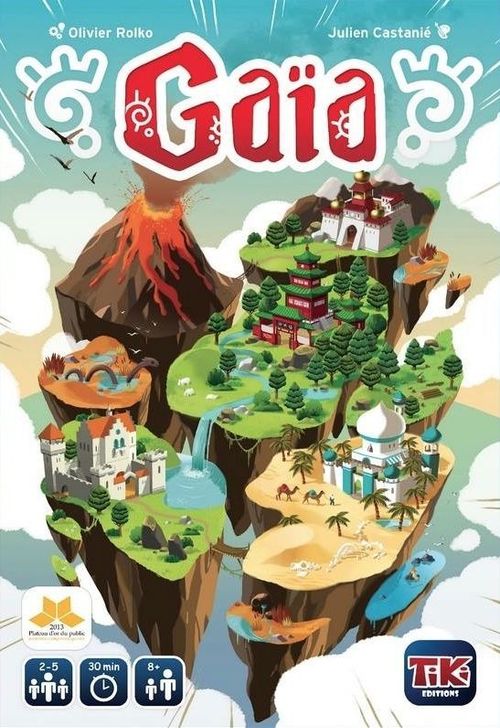
Gaïa
Gaïa Rulebook
Table of Contents
Table of Contents
Object of the Game
Be the first to place your 5 people (6 with 2 players) on Gaïa.
Basic Rules
Components
- 27 wooden people pawns (6 blue, 6 yellow, 5 green, 5 red, 5 white)
- 20 cardboard animal tokens (deer / fish)
- 48 land tiles (10 plains, 8 forests, 7 seas, 10 deserts, 6 mountains, 7 swamps)
- 40 green Nature cards (8 plains, 8 forests, 7 seas, 6 deserts, 6 mountains, 5 swamps)
- 30 blue Life cards (18 cities, 12 animals)
- 9 yellow Objective cards. Note: remove the 2 "Power" Objectives (the ones that show 4 red cards) as they are only used in the advanced rules.
Setting up the Game
-
Place the land tiles into 6 stacks (deserts, plains, swamps, seas, mountains and forests) near the edge of the table.
-
Form an Animal bank next to the Land tiles.
-
Shuffle the Objective cards and reveal:
- 4 with 2 players
- 5 with 3 players
- 6 with 4 players
- 7 with 5 players
Place them face up next to the Land tiles and discard the rest. You won't need any more Objectives for the rest of the game.
-
Shuffle and put the Nature cards face down next to the Land tiles. Deal 2 cards to each player and reveal 3 cards next to the Nature deck.
-
Shuffle and put the Life cards face down next to the Nature deck. Deal 1 card to each player and reveal 2 cards next to the Life deck.
-
Each player takes 5 pawns of the same color and places them in front of him. With 2 players use the 6 blue and the 6 yellow people pawns.
Choose a first player. The game then proceeds clockwise. Everyone may now look at their cards and the game starts!
Game Turn
On his turn, each player must take 2 actions amongst the following options:
- Draw a Card.
- Play a Card from his hand.
The player takes his actions in the order of his choice. You are allowed to play the same action twice.
Draw a Card
The player can draw:
- One of the face up Nature or Life cards. The player adds it to his hand and reveals a new card from the corresponding deck.
or
- One of the face down Nature or Life cards (taken from the top of the deck).
A player is never allowed to have more than 6 cards in his hand. If he draws a 7th card, he has to discard a card of his choice from his hand without playing it.
Play a Card from his hand
Play a Nature card
Once played, the Nature card is kept face up in front of the player who played it. That player then takes a corresponding land tile and places it next to a tile already on the table. The first tile played is simply put at the center of the table.
A player may never play a Nature card if there are no corresponding land tiles left.
Fulfill an Objective:
When a player has cumulated all the Nature cards shown on an available Objective, he immediately discards all the corresponding Nature cards and places one of his people pawns on top of the Objective to indicate it is no longer available for the other players.
Note that Objective cards are never replaced during the game.
Play a Life card
There are 2 types of Life cards: animals and cities.
Animals: The player puts 4 animal tokens on a free corresponding land tile (with no city or animals) then he discards the card. A star on the card means you can put the animals on any kind of land. If there is more than one corresponding land tile in play, the player chooses one single Land tile to place his 4 animals.
A player may never play an animal card if there are not at least 4 animals tokens left in the bank.
City: The player puts his city card on a free land tile (with no city or animal) already in play. The city must respect the 2 following rules:
Rule 1: City land tile
- A city with a specific land icon in the top left corner can only be placed on a corresponding Land tile.
- A city with a star in the top left corner can be placed on any Land tile except sea tiles.
Rule 2: City's satisfaction (minimum 2 needs)
To put a city on a tile, a player must satisfy at least 2 needs at the bottom of the card. A need is satisfied when the element shown (land or animal) is found on a land tile directly next to the city. Land tiles in diagonal are not taken into account.
Then he places one of his pawns on the city to indicate he owns it.
Note: A city covers the land tile it is placed on. The neighboring cities may not use this land tile anymore to satisfy their needs. As a consequence, a new city can lower the satisfaction of the neighboring cities (see below).
Animals tokens don't cover land tiles.
Increase a city's satisfaction
When a player increases the number of needs satisfied in one or more cities (for example if he puts animals or a new land tile in play), he must place a new people pawn on each city where he increased the satisfaction. He does so only if he doesn't already have a pawn on those cities.
A player may only have one people pawn of his color per city in play.
If a city has animals on an adjacent tile, adding new animals tokens will not increase its satisfaction.
Reduce a city's satisfaction
This situation arises if:
-
a new city covers a tile. This tile can no longer be used to satisfy the needs of the neighboring cities.
-
All animal tokens next to a city have been consumed (see "Hunting and feeding") and the "animal" requirement is no longer satisfied for this city
-
When you use powers (only in advanced rules).
-
If a city has only 1 need satisfied: All pawns on the city return to their owners (pawns may be reused afterwards), but the city stays, empty, on the tile.
-
If a city is no longer satisfied (0 need satisfied): All pawns on the city return to their owners (pawns may be reused afterwards) and the city is removed from the tile and discarded.
End of turn
If no one has won after the player has completed his two actions, the next player begins his turn.
Start of a new turn
Hunting and feeding
Before taking his two actions, a player must (if he is able) feed all his cities which have an animals icon. One animal per city in need of being fed is removed from an adjacent land tile (diagonals are not taken into account) and returned to the bank. If there are animals on several tiles around those cities, the player chooses any one tile to take the animal from. If there are no animals around the city, you don't remove any token and the animals need is no longer satisfied. Remember to adjust the people pawns if needed.
End of Game and Victory
The game ends when:
-
A player has placed all of his people pawns. That player wins the game.
-
A player wants to draw a Nature, a Life card or a Power card (in advanced rules only) but there are none left (neither face up nor face down):
In this case, the winner is the player with the most people pawns on cities and Objectives.
In case of a tie, the winner is the person sitting closest (clockwise) to the player who just ended the game.
Illustrated Example: Basic Rules
It's the beginning of the yellow player's turn:
a) He must start by feeding his city in the bottom left because that city has the animals icon. He removes the last animal from the desert, reducing the satisfaction of this city. Since the city now only has 1 need satisfied (desert), he must remove his pawn from the city.
b) 1st action: Yellow plays a plain card and places a plain tile to increase the number of needs satisfied for the city on the top right (3 needs satisfied). This move allows him to put one of his yellow pawns on the city, next to the blue pawn.
c) Yellow then adds the card just played to the other Nature cards he already has in front of him. He now has cumulated all the Nature cards shown on an available Objective. He discards his 4 Nature cards and fulfills this Objective by placing one of his pawns on the card. From now on, this card is not available to the other players.
d) 2nd action: Yellow plays an animal card and puts 4 animals tokens on the desert. He increases the number of needs satisfied for the bottom left city to 2, so he adds one of his pawn on the city.
During his turn, the yellow player has removed 1 people pawn then put 3 pawns (2 on cities, 1 on an Objective).
Advanced Rules
Basic Rules Modifications
Stealing a city
From now on, when a player increases the satisfaction of a rival city, he replaces the opponent's pawn by his own! The opponent's pawn is returned to his owner (it may be reused afterwards).
The 4 Needs of a City
When a player satisfies all 4 needs of a city, he now places 2 of his pawns on that city.
If the satisfaction drops back to 2 or 3 needs, remove one of the two pawns. When 1 or 0 need is satisfied, follow the basic rules.
THE POWERS
New components
- 30 red Power cards (6 suns, 6 rains, 5 lightnings, 3 earthquakes, 2 eruptions, 4 tornados, 4 protections).
- 2 new "Power" Objective cards (the ones that show 4 red cards).
Additional Set Up
The "Power" Objective cards are shuffled into the Objective deck. Then reveal as many Objectives as indicated in the basic rules.
Shuffle and put the Power cards next to the Nature and Life decks.
Deal 1 Power card to each player (raising a player's starting hand to 2 Nature cards, 1 Life card and 1 Power card) and reveal 2 cards next to the Power deck.
Power Card Rules
Draw a Power card
From now on the player can draw:
- One of the face up Nature, Life or Power cards. The player adds it to his hand and reveals a new card from the corresponding deck.
or
- One of the face down Nature, Life or Power cards (taken from the top of the deck).
A player may never have more than 2 Power cards in his hand. If he draws a third, he must immediately discard one of the Power cards in his hand without playing it.
Also, a player can never have more than 6 cards in his hand (see basic rules).
Play a Power Card
The player plays and keeps in front of him the Power card (just like his Nature cards). The player then carries out the Power's effect (see descriptions on page 8).
Note that you may play a Power card on the Cities you own.
Fulfill a "Power" Objective (if available)
When a player has cumulated 4 Power cards and a power objective is available, he discards his 4 Power cards and places one of his pawns on top of the Objective to indicate it is no longer available to the other players.
Note: The Power's effects on land tiles, cities and animals may change the satisfaction of surrounding cities. After each power use, check if the number of needs of each city in play has increased or decreased.
Example A: Playing a sun card allows Paul to replace a plain tile with a desert tile, decreasing the satisfaction of a nearby city. Paul then follows with a rain card and replaces back the desert with a plain tile. Paul places one of his pawn on the nearby city because he has just increased its satisfaction.
Example B: Melanie destroys a city with a lightning card which uncovers the land tile underneath. It increases the satisfaction of a nearby city, so she can now place one of her pawns on that city.
Variant "A Peaceful Life"
Remove all lightnings and eruptions from the Power cards. Remove all "Power" Objective cards from the Objectives deck.
Illustrated Example: Advanced Rules
The green player plays an earthquake to switch the sea tile (including the fishes on it) and the mountain tile.
Results of this action:
- The top left city is still owned by the yellow player since it stays at 2 needs satisfied. Before the earthquake, the needs satisfied were desert and sea. After the earthquake, they are desert and mountain. Since the satisfaction has not decreased or increased, the ownership of the city stays the same.
- The city on the right goes to the green player since he increased the number of needs satisfied from 2 to 3 (adding the sea tile). The blue player takes back his pawn and the green player puts one of his own.
- The city at the bottom center rises from 3 to 4 needs satisfied. The green player can now put 2 of his pawns on that city.
Plateau d'or 2013 des Journées ludiques de Québec
Gaïa won the "Plateau d'or du public" (public choice award) during the "Journées ludiques de Québec" (Quebec gaming festival) in 2013 under the name "Creationa".
Special Thanks
The author wants to thank Benoit Besner, Maxime Besner, Simon Besner et Francis Rolko for testing the game and for their suggestions; the organizers of the "Plateau d'or 2013" and the participants of the "Journées ludiques de Québec" for their kind support; David Duperret for believing in his game; and everyone that has contributed to Gaïa.
The author also wants to give special thanks to Ariane Pagé Sabourin for her patience, her clever ideas and her great support during this wonderful adventure.
Powers Description
Note: After using a Power card, check if the satisfaction of each city in play has increased or decreased. Adjust people pawns if necessary.
Sun
Replace a swamp tile in play with a plain tile from the reserve.
or
Replace a plain tile in play with a desert tile from the reserve.
A player may never play a sun card if there are no land tiles left in the reserve to complete this effect. A player may never play a sun card on a tile covered by a city.
Rain
Replace a desert tile in play with a plain tile from the reserve.
or
Replace a plain tile in play with a swamp tile from the reserve.
A player may never play a rain card if there are no land tiles left in the reserve to complete this effect. A player may never play a rain card on a tile covered by a city.
Lightning
Remove the animal tokens, city, and people pawns from one tile of your choice. The city is discarded, animals are put back in the bank and pawns are given back to their owners.
Note: Discarding a city uncovers the land tile underneath, which now can be used to increase the satisfaction of neighboring cities.
Earthquake
Switch two adjacent land tiles.
All animals, cities and people pawns are switched with their tiles.
Eruption
Select a mountain tile in play.
The eruption affects this tile and all adjacent tiles (doesn't affect tiles diagonally):
Remove cities, animals tokens and people pawns from these tiles (cities are discarded, animals put back in the bank and pawns given back to their owners).
Replace plain, forest and swamp tiles with desert tiles.
A player cannot play an eruption card if there are not enough desert tiles left to replace the other tiles.
Tornado
Steal one card from each other player (you can only look at the back of the cards to select which cards you wish to steal). Then you can look at the cards you have stolen. Keep one of these cards and discard the rest without playing them.
Protection
The Protection card is the only card that may be played on another player's turn.
Cancel the effect of another Power card that has just been played.
Protection may not be played to cancel another protection.
The player who has played the canceled Power card can keep his card in front of him to fulfill an Objective. If two players fulfill a "Power" Objective at the same time, priority is given to the player whose power has just been cancelled by a protection.