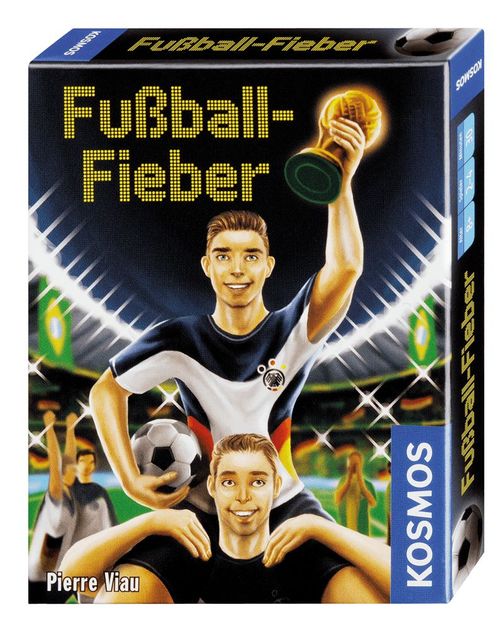
Fußball-Fieber
Fußball-Fieber Rulebook
Table of Contents
Table of Contents
Object of the Game
Each player takes charge of a team and guides it through the group stage of the World Cup, which consists of 3 matches (against 3 different teams). Each player is in a different group, so the players do not meet each other directly. By playing cards you can influence the outcome of the matches, including the matches of the other players!
Each match is worth 3 points for a win, 1 point for a draw and 0 points for a loss. The points and the "goal difference" of each match are recorded. The player with the most points after the group stage wins. In case of a tie, the "goal difference" decides.
If you want a somewhat longer game, you can then play the quarter-final, semi-final and final.
Components
- 4 Order Cards (Reihenfolge-Karten)
- 4 Score Cards (Spielstand-Karten)
- 4 Strength Adjustment Cards (Spielstärkeanpassung-Karten)
- 32 Team Cards (Team-Karten)
- 56 Playing Cards (Spielkarten)
- 8 Joker Substitutions (Joker-Einwechslungen)
You also need a sheet of paper and a pen.
Setup
Only some of the cards are meant to be held in hand and played: the 56 playing cards and the 8 joker substitutions. The other cards (score cards, order cards, strength adjustment cards and team cards) show which team plays against which and what the current score is. It is therefore important to sort the different card types at the start of the game and to use them as described below.
Choosing Teams
Each player chooses one of the 32 teams. If several players want the same team, draw lots to decide.
Because the teams have different strengths, and it would be unfair if one player chose a strong team while another chose a weak one, the strengths of all player teams are adjusted as follows:
- If the chosen team has strength 4, the player takes a strength adjustment card and places it slightly offset under his team card so that the -2 is visible in the upper left corner.
- If the chosen team has strength 3, the player takes a strength adjustment card and places it slightly offset under his team card so that the -1 is visible in the upper left corner.
- If the chosen team has strength 2, the player makes no strength adjustment.
- If the chosen team has strength 1, the player takes a strength adjustment card and places it slightly offset under his team card so that the +1 is visible in the upper left corner.
This guarantees that all player teams have strength 2. The strength adjustment cards stay with the player's own team for the whole game! Unneeded strength adjustment cards go back into the box.
Example: The player chose a team of strength 4. He places the strength adjustment card with the -2 showing under his team card.
Drawing the Groups
The teams that were not chosen are sorted by category (A, B and C) and placed as 3 face-down stacks. Shuffle each stack separately. Then each player receives 3 randomly drawn "neutral" teams as group opponents: 1 opponent from category A, 1 from category B and 1 from category C.
Each player also receives a randomly drawn order card. This card indicates the order in which the player must play his 3 group opponents. Each player lays out his group opponents from left to right in the correct order, starting with the match on the far left. The 1st opponent is turned 90°, so that the card is upside down. The player's own team (including its strength adjustment card) is placed below the 1st group opponent. If there are fewer than 4 players, the unneeded order cards go back into the box.
Example: The player who plays Germany must first play against Portugal, then against Italy and then against the USA. The other players have their own groups with other group opponents.
Note: It can happen that players are dealt group opponents of different strengths. This may seem unfair, but it is intended. It brings dynamism into the game, and in reality it is the same. Sometimes a team draws an easy group, and sometimes a "group of death".
Score Display
Each player receives a score card, which shows the current score of the current match. It is placed to the left of the player's own team card.
A match is decided by the difference between the strength of the player's own team and the strength of the opposing team. However, the strengths of the teams are still affected during the game by the playing cards and joker substitutions!
To show the current score of the player's own match, the order card is turned to its back side and placed on the score card so that the current difference in strength is visible right next to the card edge.
Whenever the strength of a team changes because a card is played, the score is updated immediately by moving the order card! If there are fewer than 4 players, the unneeded score cards go back into the box.
Dealing Joker Substitutions and Playing Cards
At the start of the game, each player receives 2 joker substitutions. If there are fewer than 4 players, the unneeded joker substitutions go back into the box.
Each player also randomly receives 8 playing cards from the shuffled, face-down draw pile. This pile is placed in the middle of the table and is still needed during the game. Should the pile ever run out, the resulting discard pile is shuffled and placed as the new draw pile.
Each player now has 10 cards (8 playing cards and 2 joker substitutions). With these cards the player must play all 3 matches against his group opponents! He receives no additional cards during the group stage.
Tip: It is advisable not to use all 10 cards for the first match, because otherwise you will have no way to influence the other two matches afterwards.
Gameplay
The game (the group stage) consists of 3 matches: each player plays one match against each of his 3 group opponents. All players first play their match against their respective first group opponent, in parallel. The players take turns in order. Whoever is on turn may either play 1 card or pass. A player who has passed may play a card later, when he is on turn again.
If, however, all players pass directly one after another, the first match ends and the scores of all players are checked (see "End of a Match").
Playing cards may be used in the following ways:
- to support your own team
- to weaken the current opponent of your own team
- to weaken the team of a fellow player
- to support the current opponent of a fellow player
Joker substitutions may only be used to support your own team!
Playing Cards at a Glance
There are two kinds of playing cards: action cards and reaction cards.
Action Cards
Action cards are played directly onto a team to change its strength (positively or negatively). When a player plays an action card, he must immediately decide which team he wants to play it on. Any number of action cards may be played (one after another) onto each team. Action cards are placed slightly offset so that the values of the cards underneath remain readable.
Each action card is laid out as follows:
- Name of the card
- Value, which states how the strength of the team is changed, on which the card is played: (+1, +2, -1, -2)
- Duration, stated by 1 to 3 card icons, which states how many matches the card stays in effect. (Here there are 2 card icons, i.e. the card applies for 2 matches.) The card is placed below the opponent up to which it has effect, but at most below the 3rd group opponent of the group stage. This duration only affects the player's own teams.
- Motif of the card, in large and small print
If an action card is played onto the current opponent of your own team, or onto the opponent of a fellow player, the action card has only duration 1, regardless of how many card icons are shown on it.
Example: A fellow player has played an injury onto the German player with a duration of 3. The injury (-1) therefore applies to the current match and also to the next two matches. The new score is now -2, which is marked on the score card.
Reaction Cards
A reaction card may only be played onto a place where a matching action card already lies. "Matching" means that the motif of the action card is shown in small print at the lower right of the reaction card. Each reaction card also has the same background color as the action cards it matches.
Each reaction card is laid out as follows:
- Icons showing what the reaction card does
- Name of the card
- Motifs of the action cards that can be influenced by this card (shown in small print)
- Motif of the card in large and small print
There are three kinds of reaction cards:
Reaction cards that reduce the duration of an action card
- Shown by a single chevron icon (reduces duration by 1 match) or a double chevron icon (reduces duration by 2 matches).
- If this reaction card is played onto a matching action card, the duration of that action card is reduced: by 1 match (single chevron) or by 2 matches (double chevron). The action card is moved to the left. If it is moved to the left of the current match, it is removed and placed on the discard pile. The reaction card always goes onto the discard pile.
Example: The German player plays a team doctor (Mannschaftsarzt), which allows him to reduce the duration of the injury (Verletzung) by 1. He pushes the injury 1 match to the left. In the match against the USA the injury is no longer in effect. The score of the current match (against Portugal) does not change!
Reaction cards that remove an action card
- Shown by a crossed-swords icon.
- The player who plays such a reaction card immediately removes a matching action card. Both the removed action card and the played reaction card go onto the discard pile.
Example: In the course of the game, the German player has weakened Portugal with the action card "Auseinandersetzung" (confrontation). Now a fellow player plays the reaction card "Trainer-Ansprache" (coach's talk) and removes the "Auseinandersetzung". The score changes again from ±0 to -2.
Reaction cards that strengthen an action card
- Shown by an arrow icon pointing right.
- A player who plays such a reaction card (fan choreography, Fan-Choreografie) places it directly onto the matching action card (fan chant, Fan-Gesang). Both cards together strengthen the team: +1 + 2 = +3.
Example: Later in the game, the German player has played the action card "Fan-Gesang" onto his team. He now also plays the reaction card "Fan-Choreografie" onto the "Fan-Gesang". The score changes to +1.
End of a Match
When all players have passed directly one after another, the match ends for all players. Then the current score of each player's match is checked:
- If the score is positive, the player receives 3 points (win).
- For a draw, the player receives 1 point.
- If the score is negative, the player receives 0 points (loss).
The names of the players and the points earned (3, 1 or 0) are noted on the sheet of paper. In addition, the score of each match is noted, the so-called "goal differences" (for example "+2", "0" or "-1").
All playing cards and joker substitutions that lie directly on the teams of the finished matches are removed. The playing cards go onto the discard pile; the joker substitutions go back into the box. The opposing teams of the finished matches are turned over to their back sides.
Next Match
Afterwards, each player may place up to 2 of his playing cards that he still holds in hand onto the discard pile, and draw the same number of new playing cards from the draw pile. Joker substitutions may not be discarded! The number of cards of each player therefore does not change.
Each player then places his team (including the strength adjustment card!) below his next group opponent. Action cards that lie there because of their duration are moved offset onto the player's own team card. The current score is set on the score card. The match is then played according to the same rules as the first match.
Before the third match, each player may once again exchange up to 2 of his playing cards with the draw pile. The third match is then played according to the same rules.
End of the Group Stage (End of the Game)
When all 3 matches of the group stage have been played, the points achieved by each player are added up on the sheet of paper. The player with the most points wins the game.
In case of a tie, the player among those tied with the best overall "goal difference" wins. If the tie remains, there are several winners.
Extended Game with Quarter-Final, Semi-Final and Final
If you want to play longer, you can continue after the group stage: quarter-final, semi-final and final. (The round of 16 is left out to shorten the game somewhat.) Here, however, players drop out one after another, because only two teams can reach the final.
The group stage is played as before. To qualify for the quarter-final, a player must score at least 5 points in the group stage (the "goal ratio" does not matter). A player who has fewer than 5 points is unfortunately eliminated.
If no player qualifies for the quarter-final, the player who performed best in the group stage wins. If only one player qualifies for the quarter-final, the game ends immediately and that player has won. If more than one player has qualified, the quarter-final is played next.
The quarter-final, semi-final and final are played according to the same rules as the matches in the group stage, with the following change:
- All action cards now have duration 1 (regardless of what is shown on the card), i.e. they only apply to the current match.
Quarter-Final
In the quarter-final, the players still do not meet each other directly. Each player who has not yet been eliminated is assigned one quarter-final opponent: a randomly drawn team card from the stack of category B.
Each player receives 8 new playing cards from the draw pile. If a player still holds unused playing cards from the group stage, he may add them to the 8 new playing cards, but must then reduce his playing cards to 8! If a player still holds unused joker substitutions from the group stage, he may keep them. There are no new joker substitutions for the players!
The player must play the quarter-final, the semi-final and the final with these cards (8 playing cards plus any joker substitutions). He receives no additional cards any more!
Each player who wins or draws his quarter-final match qualifies for the semi-final. A player who loses is eliminated.
If no player qualifies for the semi-final, the player who performed best in the group stage (and who reached the quarter-final!) wins. If only one player qualifies for the semi-final, the game ends immediately and that player has won. If more than one player has qualified, the semi-final is played next.
Semi-Final
The semi-final requires 4 teams. Qualified are all player teams that won or drew their quarter-final. In addition, the "neutral" teams that won against a player team in the quarter-final are qualified. If fewer than 4 player teams were in the quarter-final, 1 or 2 teams are missing. These are drawn randomly from the stack of category A. If the stack of category A is empty, draw from the stack of category B.
The 4 qualified team cards are then shuffled below the table and drawn randomly for the two semi-final pairings.
Important: If only 2 players are in the semi-final, these two player teams must not meet each other! Instead, each player is assigned a "neutral" team as opponent by lot. With more than 2 players in the semi-final, players now meet each other directly for the first time.
Before the semi-final, each player may place up to 2 of his playing cards that he still holds in hand onto the discard pile, and draw the same number of new playing cards from the draw pile. Joker substitutions may not be discarded! The number of cards of each player therefore does not change.
Each player who wins his semi-final match qualifies for the final. A player who loses is eliminated. In the case of a draw, the teams are drawn by lot below the table to determine which of the two teams qualifies for the final.
If no player qualifies for the final, the player who performed best in the group stage (and who reached the semi-final!) wins. If only one player qualifies for the final, the game ends immediately and that player has won. If two players qualify, the final is played next.
Final
Before the final, each player may again place up to 2 of his playing cards that he still holds in hand onto the discard pile, and draw the same number of new playing cards from the draw pile. Joker substitutions may not be discarded! The number of cards of each player therefore does not change.
The player who wins the final is the world champion and wins the game. In the case of a draw, the finalist who performed better in the group stage wins.