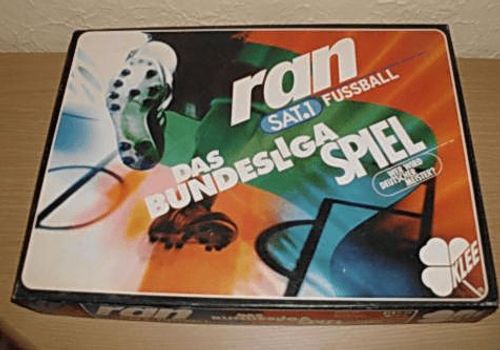
Fußball-Bundesliga: Das große Geschäft
Fußball-Bundesliga: Das große Geschäft Rulebook
Table of Contents
Table of Contents
Components
Contents as listed on the rulebook's contents page:
- Game board
- Game money in 5,000, 10,000, 20,000, 50,000, 100,000 and 200,000 DM notes
- 1 Bundesliga table
- 4 team strength tables
- 4 cylindrical plastic playing pieces (blue, red, yellow, green)
- 8 round wooden pieces (2 per player colour)
- 18 yellow cards
- 18 blue cards
- 18 brown DFB Cup cards
- 4 small cup cards
- 80 small player cards (16 × 1 point, 22 × 2 points, 22 × 3 points, 12 × 4 points, 8 × 5 points)
- 3 round red stickers for covering spaces
- 1 die
Game Instructions
I. Participants
The game is suitable for 2–4 players. One additional player may also be used as banker.
II. Start of the Game
Each player receives from the bank a starting capital of 700,000 DM at the beginning of the preliminary round (Vorrunde), or 150,000 DM at the beginning of the return round (Rückrunde), in the form of game cheques (Spielschecks):
- 1 × 200,000 DM
- 3 × 100,000 DM
- 3 × 50,000 DM
- 3 × 10,000 DM
- 4 × 5,000 DM
All income and payments are handled through the bank.
In addition, each player receives from the bank 11 player cards with the following team strength:
- 2 players at 1 point = 2 points
- 4 players at 2 points = 8 points
- 3 players at 3 points = 9 points
- 1 player at 4 points = 4 points
- 1 player at 5 points = 5 points
11 players = 28 points
The team strength is decisive for the course of the game and can be changed by buying or selling players. Each player receives a team strength table on which every change in team strength is shown.
Each player also receives one DFB Cup card and one playing piece with 2 small pegs of the same colour. These are used to show the player's table points and team strength. In a central Bundesliga table, all points won in the preliminary round and the return round are recorded (see also III).
III. Course of Play
Each player chooses a playing piece and places it on the start space. Players roll the die in turn, and the youngest player begins. The players taking part roll alternately, and the playing pieces are moved forward by the number rolled.
The spaces are basically divided into: points-match spaces, private-match spaces, DFB Cup spaces, European Cup spaces, cost spaces and event spaces.
1. Points-match spaces
The red points-match spaces are important whether a player lands on them directly or merely passes over them. Points-match spaces are marked with the name of the club and the name of its stadium.
a) Landing directly: Compare your own team strength with the points value given on the space for the opposing Bundesliga team concerned.
- Case 1: Your own points value is greater than the opponent's. This means a match win = 2 table points in the Bundesliga table.
- Case 2: Your own points value equals the opponent's. This means a draw = 1 table point in the Bundesliga table.
- Case 3: Your own points value is less than the opponent's. This means a match loss = no table points in the Bundesliga table.
When playing directly onto a space, the matches are treated as home matches and are therefore linked with spectator income.
At the start of the game the players may choose between the following two options:
- For every home match the player receives the amount entered on the space in full from the bank.
- The amount of income from home matches depends on the player's place in the table. Therefore the table points of all players must be compared before the decisive match.
The table places have the following significance:
| Place | Income |
|---|---|
| 1 | Amount given on the space, in full |
| 2 | Amount given on the space, less 50,000 DM |
| 3 | Amount given on the space, less 100,000 DM |
| 4 | Amount given on the space, less 150,000 DM |
b) Passing over: If a player merely passes over a points-match stadium, this match always counts as an away match. The result is determined as described above, but only the income from the match is missing. Any points won are recorded in the Bundesliga table, just as for home matches.
2. DFB Cup
If a playing piece lands after the roll on the DFB space (brown space with a ball), the player must draw a brown DFB Cup card from the stack and play against the opponent it names. The opponent's team points show the outcome of the match. The income from this match is also stated and the player receives it regardless of the result.
No table points can be won here; the only aim is to get through to the next Cup round.
- Case 1: Your team strength is greater than that of the drawn opponent: match win, you remain in the Cup round (the drawn card is put back at the bottom of the stack).
- Case 2: Your team strength is less than that of the drawn opponent: match loss, you are eliminated from the Cup round (the drawn card is likewise put back).
- Case 3: Your team strength is equal to that of the drawn opponent: draw.
In this case there are two possibilities which the players should agree on beforehand:
- On a draw, a new card is drawn until a decision has been reached. Only the card drawn last applies for the income.
- Drawn games lead to a replay on the opponent's place in the table. This can improve or worsen the player's starting position, so it must be checked whether the drawn DFB Cup card refers to a home or an away match:
- Home match: Replay on the opponent's place. The match is automatically lost (elimination from the Cup round).
- Away match: Replay on your own place with home advantage. The match is automatically won (remain in the Cup round).
If the DFB Cup match is lost, the player is eliminated from the further Cup competition. Every further landing on these spaces is then meaningless for him. As a visible sign of this, the player returns his Cup card, which was handed to him at the start of the game, to the bank.
3. Private-match spaces
These spaces bring the player income in the amount stated on the space. The money is paid out by the bank.
4. European Cup
On landing on these spaces the player receives the stated amount (home match) or pays it to the bank (away match).
5. Cost spaces
Here money must be paid to the bank on landing. The sums are either printed on the spaces or easy to work out.
6. Event spaces
On landing on the blue or yellow spaces, the player must draw a card of the same colour from the stack of that colour and read it aloud, and the instruction on it must be carried out. In individual cases the cards must be set aside up to the stated follow-up events; some cards apply to several follow-up events.
7. Purchase and sale of players
Before each roll of the die, a player may strengthen his team by buying players. Before and after each roll of the die, the team may be reduced by selling players. The bank manages the player cards. The purchase and sale prices of the players are stated on the player cards and are payable to the bank. The team strength must be adjusted after every player transfer.
8. Start / return round
When a player reaches the start space after the preliminary round, he waits until all players have arrived there. Each player then receives another 150,000 DM from the bank. Only then do the players roll the die again, where applicable all together.
9. Playing eligibility
If, after the preliminary and return rounds, a player's team has fewer than 15 table points, it is relegated and thereby drops out of the continuing course of play.