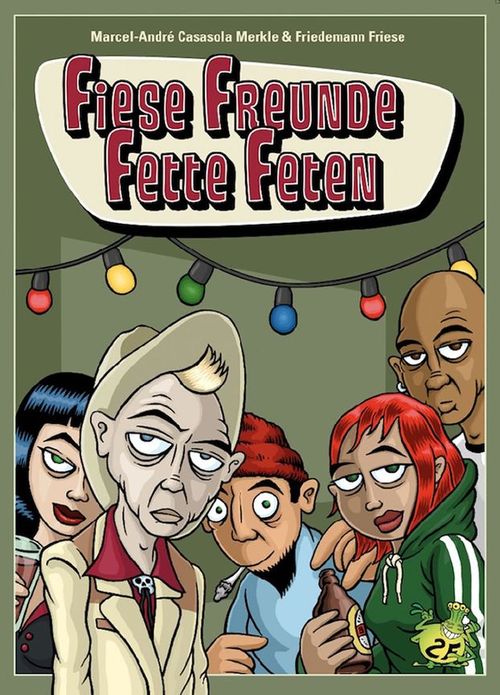
Funny Friends
Funny Friends Rulebook
Table of Contents
Table of Contents
Contents
- 6 player tableaus in 6 player colors
- 54 wooden discs, 9 each in 6 player colors
- 30 player markers, 5 each in 6 player colors
- 40 person markers
- 48 time markers
- 30 sex/child markers
- 30 offer markers, 5 each in 6 player colors
- 140 cards:
- 20 puberty cards (red)
- 81 life cards (blue) in 2 categories (40x category A, 40x category B, 1x blank category B for ideas)
- 35 life goals (green) in 5 categories (7 each of lifestyle, job, relationship, friends, spirit)
- 4 mega goals
Overview And Goal
What would happen if? In this game, players try out a fresh, unspent life, fall blindly into puberty, and try impossible things as they have their first experiences at life. Each event shapes their characters. Players can try coloring their hair green, becoming a priest, or even experience their first loves. Puberty passes quickly and real life begins! Players fly into new experiences as their lives unfold. Players take their first drinks, become religious, meet new people, start relationships, and end them. But, always the players must keep their life goals or the mega goals in mind, for the first to achieve 5 goals is the winner!
Introduction To The Game System
Each player's personality profile is displayed (for all to see) on their player tableau. By playing cards, players try to change their profiles in order to fulfill the prerequisites for their life or mega goals.
Cards
There are four kinds of cards, that are important at different times in the game: red = puberty, blue = life card, green = life goal, and yellow = mega goal.
All cards are designed using the same principle. The symbols on the left side show the prerequisites, that a player must first fulfill in order to play the card. When a player plays the card, he places it on the table and experiences the event. His personality profile changes in accordance with the effects of the card (symbols along the bottom).
Note: In "Playing the game" (see page 6!), the rules describe when a player may play a card.
Prerequisites — Example: "Chain smoking" is a life card (blue). In order to play this card, a player needs at least 1 wealth point.
Effects — When a player plays the card, he adds 1 point to both his smoking and illness on his player tableau.
The 9 Characteristics
Each personality has 9 characteristics: smoking, drinking (alcohol), drug use, wealth, illness, fat, grief, religion, and wisdom.
Each characteristic can have a value between 0 and 3 points.
The current values are shown using the wooden discs on the players' tableaus. At the start of the game, all characteristics are on 0 (the wooden discs are on the colored symbol at the top of each column). When a player gains points in a characteristic, he moves his wooden disc downward one space on his tableau for each point he gains.
The value of a characteristic can never be greater than 3. When a player gains one or more points in a characteristic when it is already at 3, he does not move the disc. Instead, he looks at the lined out symbol just below the disc and moves the disc for that symbol to value 0 on his tableau.
Example: A player has 3 drinking points. He gains another drinking point. The drinking disc remains at 3, but, as the player stupidly drinks too much, his wisdom moves back to 0.
The characteristics appear as symbols on the cards, either as prerequisites (left) or effects (bottom):
Prerequisites: The player must have a value of at least 1 in each of the characteristics shown. If a number is shown with the characteristic, the number indicates the minimum value.
Effect: The player gains 1 point (or as many shown if a number is shown with the symbol).
As a prerequisite: The player must have a value of 0 in that characteristic.
As effect: The player must move the characteristic (back) to value 0.
Circle of Friends
During the game, the players build a circle of friends, which can include both fellow players and neutral persons. Fellow players are represented by colored markers in the color of the player. Neutral persons are not controlled by any player. Otherwise, they are equivalent to fellow players as friends. They are represented by person markers.
The circle of friends is shown in the lower third of the tableau. All relationships are shown in this area, as well.
The circle of friends area is divided into several smaller areas. The area where a marker lies defines the relationship the player has with the person represented by that marker.
The square area on the left is for normal friends. The four areas in the middle are for the player's current romantic relationship. Here, if the player is not "single", his partner marker is placed. If the partner is on the first space, he is in love, in the second space he is engaged, in the third he is married, and in the fourth he is happily married. On the right side are the areas for ex-partners. The area to the far right is for an ex-partner the player is still married to, but is currently separated from.
Note! Friend is the term used for all markers in this area of the tableau. Normal friends have no additional characteristics, but even ex-partners are still considered friends.
Gain Friends
Friendships are only gained with the play of cards. When two or more people take part in an event together, they become friends. When a person becomes acquainted with another person, he notes this by placing the appropriate player marker (for fellow players) or person marker (for neutral persons) on his tableau.
Prerequisite: The player selects a person (or the number of persons shown, if there is a number with the symbol) to take to the event. He must already be friends with these persons.
Effect: The player selects a person that he already knows to take to the event, or he looks for a person he does not yet know (player or neutral person) to take, in which case, he adds that player or person marker to the circle of friends area of his tableau. Details on who a player may choose are at the end of the rules.
Letters
If a card shows more than one person symbol, each is assumed to refer to a different person. The exception: Symbols marked with A are always the same person.
Example: For this card, the player needs a friend. Through the event, they become partners and also have sex.
Partners
Relationships develop only through the playing of cards and each player may have only one partner at a time.
Prerequisite: The player must have a partner. He takes his partner automatically to the event.
Effect: The player chooses a new partner (this could be a normal friend, ex-partner, or a new person that the player did not yet know), to begin a relationship with or chooses to intensify an existing relationship with his current partner (see below).
Prerequisite: The player must be single (have no partner).
New Relationship
The player places the marker of the new partner on the first partner space (in love). Any existing relationship is dissolved (see also separation!).
If a player returns to a relationship with an ex-partner, then he places the partner's marker on the "engaged" space. If a player returns to a relationship with an ex-partner, that he is still married to, he places the partner's marker on "happily married".
Intensify A Relationship
The player moves the marker of his partner to the right to the next partner space. If, by this movement, the marker reaches the "married" space, both partners are married (see also "married").
When a partner marker reaches the far right space (happily married), it cannot be moved further to the right!
Note: When a marker is on "engaged" or "happily married", the relationship can not be affected from attacks from the outside (s. a. details!).
Separated
A relationship ends, when one of the partners begins a new relationship or plays a card to separate from his partner.
As effect: If the player has a relationship, it is ended and the current partner becomes the ex-partner.
When the partner marker is in one of the first two partner spaces, the player moves the marker to the ex-box. When the partner marker is in the third or fourth spaces, the couple remains married despite the separation and the ex-partner marker is moved to the box space on the far right.
Ex-Partner
As prerequisite: The player must have an ex-partner. If there is a number in the corner, the player must have at least that many ex-partners.
Married
A player is married, when the marker of his partner is on the third or fourth partner space or the marker of an ex-partner is on the "still married" space on the far right. In order to marry, a player must participate in a marriage ceremony or intensify his relationship to the married space.
Prerequisite: The player must be married.
Prerequisite: The player must be happily married (the marker of his partners is on the fourth partner space).
Effect: The player marries the person represented by A. He places the corresponding player marker on the third partner space ("married"). If the player was already married to someone else, that marriage ends immediately in divorce.
Divorce
With a divorce, an existing marriage is dissolved and the old marriage partner marker is moved to the normal ex-box.
Prerequisite: The player may not be married.
Effect: If the player is married, he becomes divorced.
Sex
In the game, there are two kinds of sex: Anonymous sex and sex with another player or neutral person.
Anonymous sex is marked by placing a sex marker in the box for anonymous sex (upper right) on the tableau (bed). The player can freely decide, whether to have sex with a woman (upper half) or sex with a man (lower half).
A player marks sex with a player or a neutral person by placing a sex marker on the corresponding player or person marker on his tableau.
Prerequisite: The player must have had sex once or at least as many times as the number shown in the corner. It matters not whether the sex was anonymous or with another player or neutral person.
Prerequisite: The player must have had sex once or at least as many times as the number shown in the corner with the person represented by A. Anonymous sex will not fulfill this prerequisite!
Effect: The player has anonymous sex once.
Effect: The player has sex with the person represented by A.
Children
Children are indicated by the player placing a child marker on the player or neutral person marker who the player had the child with. If a child is the result of anonymous sex, he places the child marker in the box for anonymous sex.
Note: Children can only be the result of opposite gender sex. Consider this a prerequisite for children.
Prerequisite: The player must have one child or at least as many children as shown by the number shown in the corner.
Effect: The player has a child with the person represented by A.
Restrictive Card Texts
These texts amend the normal rules for this card.
Preparation
Each player chooses a color, takes the tableau and 9 wooden discs in his color. He places 1 disc on the top-most symbol of each of his characteristics on the tableau.
Each player also takes all his colored player markers and all his colored offer markers. Each player keeps one for each other player in the game, returning the rest to the box (for example, with 4 players, each keeps 3 of each marker).
Each player places his player markers with his gender (male or female) face up next to his tableau. He gives each opponent one of his offer markers, which they place next to their tableaus.
In addition to the players, there are neutral persons in the game, represented by person markers. Players choose neutral persons so there are always exactly 5 women and 5 men in the game.
Note: In a 6 player game, if all players have the same gender, one must choose the opposite gender to play, and place his player markers with the chosen gender face up.
For each neutral person chosen for the game, place one marker for each player in the game in the middle of the table. Place unused person markers back in the box.
Note: As the person markers are two-sided (male/female), players may choose which side of each to play with as long as the correct balance is kept. With more players, not all choices will be available.
Count out 8 time markers for each player and place them as a supply in the middle of the table. Place the rest back in the box - they will not be used in the game.
The players choose a starting player. Each player gets a different number of time markers depending on where they sit in relation to the starting player (see below):
Place the 30 sex/child markers in the middle of the table.
Sort the 35 life goals by category (lifestyle, job, relationship, friends, spirit) and shuffle each face down. Next, create 7 face down stacks of 5 cards each, so such that each stack contains one card from each category!
Each player takes a stack and the 5 life goals into his hand. Place the untaken stacks next to each other on the table as a supply.
Sort all other cards by their back sides (mega goal cards, puberty cards, life cards A, life cards B), shuffle each separately, and place each as a supply stack in the middle of the table.
Turn over the top-most card from the mega goal stack.
Playing The Game
The game is divided into several periods of life. In each period, new opportunities are offered the players. From the offered opportunities (displayed cards), the players choose cards to change their personality profiles to bring them closer to their life goals.
The game begins with puberty, that very special period in life where people form the very basis for their personalities. After puberty, players begin the first period of their "true lives", during which players spend time to acquire cards to change their personality profiles.
The game continues until a player achieves 5 life goals and wins the game.
1st Life Period: Puberty
Place 3 puberty cards per player (place 4 each with 2 and 3 players) face up next to each other in the middle of the table (for example, 12 cards with 4 players). Place the remaining puberty cards back in the box.
Players take turns in clockwise order beginning with the starting player. On a player's turn, the player chooses one of the following possible actions:
a) He takes a puberty card from the middle of the table and executes it.
b) He passes and takes time markers. When a player passes, he is done with this life period and takes no more turns until all players have passed in puberty. He may still, however, participate in other players' events.
c) He fulfills a goal.
A) Execute A Card
The player selects a puberty card from the middle of the table and places it face up in his play area. Next, he moves the wooden discs on his personality chart in accordance with the effect symbols on the card. If a player earns several characteristics from a card, he may choose the order in which he takes them (see also details).
Note: The card "it was just one time" may only be chosen by a player who has not yet had sex in the game.
B) Pass
When a player passes, he takes time markers from the supply. The number he takes depends on the number of players and the number of players who passed before he did, as shown in the table below:
Time markers are the currency of the game (time is money!) and beginning with the 2nd life period are used to acquire cards.
The remaining players continue to play, until all have passed. Then, the players remove all remaining puberty cards from the middle of the table and begin a new period of life.
Note: If all players but one have passed, this player can continue to play without interruption, playing cards and fulfilling goals as long as he can and wants.
C) Fulfill A Goal
The player fulfills one of his goals or the face-up mega goal. A player can only fulfill a goal when the personality profile, shown on his tableau meets the prerequisites shown on the upper left of the goal card being fulfilled. When a player fulfills a goal, he places the goal card face up in his play area and makes the adjustments shown on the goal card to his personality profile.
When a player fulfills a mega goal, he turns over the next mega goal card from the supply.
Note: It is even possible for a player to fulfill a goal during puberty.
On The Next Life Periods: "True Lives"
For each new period, turn over 5 life cards from category A and 5 life cards from category B (with 2 or 3 players use only 4 cards of each category) and place them face-up next to each other in the middle of the table.
In each new life period, the starting player is the player who passed first in the previous period.
On a player's turn, he takes one of four possible actions:
a) Select and auction a card
b) Pass
c) Fulfill a goal
d) Trade a goal
A) Select And Auction A Card
A player may not just select and take a card, but must auction the card he selects, giving the other players (who have not passed this period) a chance to get it. Players select cards whose prerequisites they meet. The player begins the bidding with a bid of 0 or more time markers. The bidding continues around the table in clockwise order with each player passing or increasing the bid (in time markers).
The bidding continues until all but one player has passed.
Only players who meet the prerequisites of the selected life card and who have not passed their turn in this period (action b above) may bid on an auctioned card. Also, a player may not bid more time markers than he has. Players must keep their time markers visible in their play areas, so all players know how many each has.
The highest bidder pays his bid in time markers to the supply and executes the life card. If the player selected the card does not win the auction, it is still his turn. His turn continues until he wins an auction or takes one of the other actions. Thus, a player who selects a card for auction and does not win the auction is free to choose any of the four possible actions to continue his turn.
B) Pass — Like In Puberty, Except
If the time marker supply does not have enough for the player, he takes all and steals the rest of the number he is allowed to take from one or more players. When all players have passed their turn in this period, remove all remaining life cards from the middle of the table and turn over 10 new cards (8 with 2 or 3 players) as before.
C) Fulfill A Goal — Like In Puberty
As soon as a player has fulfilled 5 goals (his own or mega), the game ends and he wins!
D) Trade A Goal
By paying 4 time markers (to the supply) a player may trade any number of his unfulfilled goal cards for the same number of cards from the supply. Requirement: After the trade, he must have exactly the same number of goal cards in each category as before! Afterwards, he places the supply, including the cards he traded in, face down on the table.
Game End
The game ends immediately when a player completes a 5th goal. The fulfilled goals may be either life goals or mega goals. The player who completed 5 goals is the winner.
Details
The following cover special situations, which may occur from time-to-time in a game.
Who Does A Player Bring With, When He Must Bring Others Along?
In general, the player who executes the card decides who is to come. If the player gets to meet a new person with the card, he must choose a neutral person. If he must take a friend (as a prerequisite), he selects a person from his circle of friends. The selected person may not refuse.
Note: In order to meet a fellow player through an event, the active player uses one of his offer markers. Also, the other players can use their offer markers to encourage the active player to choose them (see also Offers).
The selected participants do not have to possess the required prerequisites shown on the card. However, the effects of the event apply to all participants. Players who have already passed in this round may be participants in events.
Exception! Life goal effects only apply to the active player! Friendships, relationships, separations, divorce, marriage, sex, and children also affect the person involved, naturally (see also Symmetry).
Offers/To Meet Fellow Players
When the active player plays a card that requires other person(s) to participate, the other players may attempt to influence the active player's choice by using their offer markers in the color of the active player. This is the only possible way for a player to meet his fellow players.
If some players have played their offer markers, the active player must choose among them. He may choose freely among those who played their offer markers, including as many of those as he possibly can, according to the card. The active player can play his offer marker in the color of another player to force the player to participate in an event.
Offers work as follows: First the player who played the card chooses the person he wants to participate with him. Then, all other players may play their offer markers. A player may also play an offer marker as a reaction to another player playing an offer marker. A player may not withdraw an offer marker once played.
After all players have had the chance to play offer markers, the active player decides which player will participate with him in the event. All chosen players must give up their played offer markers (back to the box). Any player not chosen to participate takes back his offer marker and may use it again later in the game. If the active player played markers, he gives up only those that match players he chose to participate. The rest he keeps.
Example: The yellow player plays the "Bungee Jumping" card. As a prerequisite, the player must have a friend to take. The yellow player chooses the neutral person Tim, whom he met at an earlier event. As the yellow player already knows players green, rose, and light blue, these players can use their offer markers if they want to participate. Players green and rose play their offer markers, indicating they want to participate in the event. The yellow player must choose between green and rose, but, instead, plays his light blue offer marker to force the light blue player to join him at the event.
Note: A player may not play an offer marker for life goals and mega goals.
Sexuality
With relationships, sex, and marriage both opposite sex and same sex is allowed. However, children are only possible in opposite sex relationships.
Symmetry
All symbols which refer to two persons (e.g. friendship, partner, separation, divorce, marriage, sex, children) affect both people involved - not just the active player.
Examples: Player A has sex with player B. He marks this by placing a sex marker on person B on his tableau. At the same time, player B must mark this by placing a sex marker on person A in his tableau. Player A separates from player B. Player A moves player B's marker to the ex-partner box on his tableau. Of course, player B must also move player A's marker to the ex-partner box on his tableau at the same time.
Secure Relationship
If a partner marker is in the second (engaged) or fourth (happily married) partner space, the relationship is secure.
A player may separate such a relationship only when the partner agrees. Neutral persons will not agree to such a separation.
Life Cards Exhausted
When all life cards have been used, shuffle the non-executed cards, first sorted by category, and place face down as new supplies.
If the situation occurs where there are not enough cards left in the game, the game ends with no winner, as all players have failed to attain their life goals.
Timing With Several Symbols
When a player earns several characteristic points with a card, he chooses the order to apply them to his tableau, as it may make a difference in the final positions of some characteristics.
Example: A player has 3 alcohol points and executes "write poetry". He can take the point for alcohol first and wisdom second or the other way around. In the first case, he will have afterwards 3 alcohol and 1 wisdom. In the second case, he would end with 3 alcohol and 0 wisdom.
Celibacy
If a player fulfills the life goal "celibacy", he may no longer choose cards that involve having sex or beginning (or continuing) a relationship.
Note: All sex markers earned previously remain on his tableau. It is possible for the player to still have children as long as they come as a result of a previous encounter, but no new sex or relationship.
Such a player may not be required to participate in an event that involves sex or the beginning or furthering of a relationship. Such may make such a card impossible to play.
Example: the yellow player wants to auction the "first semester party" card on his turn. Unfortunately, yellow is only friendly with rose, who has fulfilled the "celibacy" life goal. Thus, the yellow player cannot auction the card as he could not buy and fulfill the prerequisites, as he has no friend to take to the party.
Version For Control Freaks
The players do not randomly draw life goals at the beginning of the game.
With 2 to 3 players: Each player gets 2 life goal stacks and chooses one card in each category.
With 4 to 6 players: Each player takes 1 life goal stack and chooses one card from the stack. Then, each player passes the life goal stack to his left neighbor, who takes one card from another category, and passes the stack on until each has 5 life goal cards.
A player may not take a second card from the same category.
Thanks
Nicole Albrecht, Hanno Balz, Lüder Basedow, Sören Bendig, Christoph Breuer, Gudrun Casasola, Manuel Casasola Merkle, Maja and Rüdiger Dorn, Steffi Giese, Thomas Glander, Ingrid Hahn, Lutz E. Hahn, Christian Hildenbrandt, Iris, Joker, Henning Kröpke, Ana-Marija and Lukrecija Kocmanić, Tobias Lang, Steffen Mahnert, Bob Mathies, Jago Matticzk, Maura, Andrea Meyer, Jürgen Münzer, Jürgen Neidhardt, Julia Nether, Wolfgang Panning, Henning Poehl, Frank Poggemann, Helge Possehl, Harro Rache, Maren Rache, Michael Schramm, Antek van Straelen, Hedwig Thelen, Katja Stockmann, Ulrich Walter, Anja Wrede, Klaus-Jürgen Wrede, Anna Zeiler, den Testern von Bödefeld and den BSW-Treffen, Tagungshaus Drübberholz and naturally all persons, friends, affairs, and others that have helped inspire this game.
Graphics & illustrations: Maura Kalusky