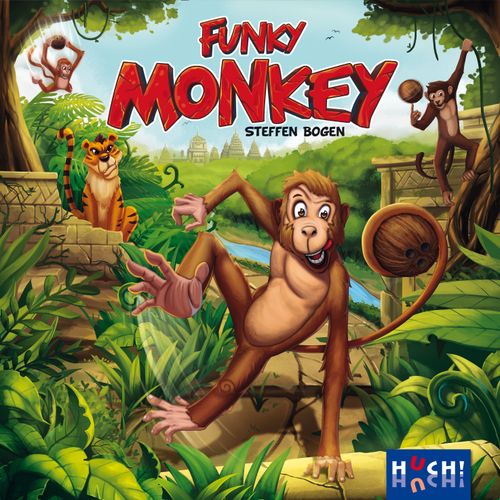
Funky Monkey
Funky Monkey Rulebook
Table of Contents
Table of Contents
Game Overview
Movement cards and jungle tiles: The players secretly play movement cards and uncover jungle tiles along the way. On their path through the temple they can gain or lose coconuts, movement spaces and action options.
Bluffing, or: Bold Ones First! The players choose movement cards with which they send the other monkeys through the temple ruin. They bluff, and if they tell the truth they receive bonus moves.
Goal of the Game
The first monkey to jump onto the back of the tiger with at least one coconut has won.
Contents
- 1 game board
- 40 movement cards
- 12 treasure cards
- 40 coconuts
- 1 golden coconut
- 14 jungle tiles
- 7 monkey cards
- 7 monkey chips
- 7 monkeys
- 1 monkey pyramid
- 1 tiger
Setup
Place the game board in the middle of the table. Sort the jungle tiles by their back sides (granite, pebbles, mosaic). Shuffle the 3 stacks face down and separately, and remove one tile from each stack unseen from the game. Place the remaining tiles face down on the spaces provided in the temple ruin.
Note: The space with the treasure chest stays empty. No jungle tile is ever placed there.
Basic game: At the start of the game, all tiles except the first two are face down. During the game the monkeys explore the jungle step by step; the boldest are always at the front.
Variants: Once you have some experience with the game, you may also uncover every second tile. This gives you some information, so you can bluff better. For experts, and for the two-player game, we recommend laying out all tiles face up. This gives full information, which often makes the game more tactical and more plannable.
- Uncover the first 2 jungle tiles next to the start spaces. All other tiles lie face down on the board and are only uncovered when a player ends his move with his monkey on that space.
- There are 3 tiger spaces in the temple: place the tiger on the corresponding space. The tiger spaces are each marked for a particular number of players: 6+7, 4+5, 2+3.
- There are 2 start spaces, a front one and a rear one. There is no clear advantage or disadvantage to either start space compared with the other.
- Place 1 coconut from the supply on the first offering bowl; the second bowl remains empty. The remaining coconuts (including the golden coconut) form the general supply in the dried-up well in the middle of the temple.
- The number of movement cards in play depends on the number of players:
| Movement cards | 2 players | 3 players | 4 players | 5 players | 6 players | 7 players |
|---|---|---|---|---|---|---|
| Number cards "1" | 4 | 5 | 6 | 7 | 8 | 9 |
| Number cards "2" | 4 | 5 | 6 | 7 | 8 | 9 |
| Number cards "3" | 4 | 5 | 6 | 7 | 8 | 9 |
| Number cards "4" | 4 | 5 |
- Each player chooses a player colour, takes the corresponding monkey and monkey card, and places both in front of himself. Each player also receives 3 coconuts, which he places on his monkey card in front of him.
Notes: At the start of the game, no player has the golden coconut in front of him. In addition, during the game it must be visible at all times who has how many coconuts.
- The youngest player places his monkey first on a start space and may freely choose between the two start spaces. His left neighbour must take the other, still free space; the third player may again choose freely, and the fourth player must again balance out, and so on. You keep choosing and balancing until all monkeys are placed.
- Sort out the movement cards you do not need in this round and return them to the box. Shuffle the movement cards that are in play and deal 5 cards face down to each player. Place the remaining movement cards as a face-down stack on the space provided on the game board.
- Shuffle all the treasure cards together and place them as a face-down stack on the corresponding space of the game board.
- The monkey chips determine, during the course of the game, which player is next. Before the game, sort out all chips of monkeys that are not in the game and return them to the box. Shuffle the remaining monkey chips and place them as a face-down stack on the round space in the temple.
Game Sequence
The youngest player turns over the top monkey chip. The colour of the chip determines which monkey becomes the active player in this round.
Movement Cards and Jungle Tiles
As the active player you must secretly play one movement card from your hand. The movement cards are: number cards "1", "2", "3" or "4", and the MiNuss card. The number on a movement card shows how many spaces a monkey must move when the player reveals that card. If the player reveals a MiNuss card, he must place one of his coconuts in the general supply (the well of the temple). In this case he may also give up the golden coconut.
Each player must make do with his five hand cards. No movement cards are drawn again. At the latest when all players have played their five cards, the game ends (see "End of the Game").
Jungle Tiles
The monkeys explore the temple together through the dense jungle and creep up on the tiger. The jungle tile on which a monkey lands is turned over if necessary and states which action that player must carry out immediately.
- Coconut: When you land on the coconut space, you must take 1 coconut from the well in the middle of the temple.
- Golden coconut: When you land on the golden coconut space, you must take the golden coconut. It makes no difference whether it currently lies in the well (general supply) or is owned by another player. In both cases you take the golden coconut.
- Notes: If the golden coconut is the last coconut of another player and that player has no coconut left after your move, he is eliminated from the game immediately.
- If you already own the golden coconut yourself, nothing happens.
- Move-to-the-nearest-offering-bowl: When you land on one of these spaces, you must immediately move forward or backward to the nearest offering bowl. You jump over all other spaces on the way there. In the first and third row it is clear which bowl is nearest. In the middle row you may freely choose which bowl you want to jump to. Once there, you must immediately carry out the action and take 1 coconut or sacrifice 1 of your own coconuts.
- Start space: When during the course of the game you land on one of the two start spaces, you either receive the golden coconut (front start space) or must sacrifice 1 coconut (rear start space). Important: this rule applies only if you land on one of the two spaces during the course of the game, not at the start of the game!
- Empty tiger space: When you land on an empty tiger space, you must immediately sacrifice 1 of your own coconuts. Important: this rule applies only if you land in front of the tiger, not on or behind the tiger.
- MiNuss tiles: When you land on the MiNuss tile showing one coconut, you must place 1 of your own coconuts in the well. When you land on the MiNuss tile showing two coconuts, you must place 2 of your own coconuts in the well.
Bluffing, or: Bold Ones First!
As the active player you must play 1 movement card from your hand. However, you may not use this card directly for the movement of your own monkey. Instead you must play the card face down into the round, i.e. pass it face down to your left-hand neighbour (exception: the treasure card "Crown").
Play the card tactically: If you have already explored part of the temple and some tiles are face up, you should take care to play a card that gives you an advantage while possibly putting your fellow players in difficulty. Simply count on which space you would land and on which spaces your fellow players would land. Especially at the end of the game it can be important to choose your own card tactically and thoughtfully!
The tile on which the monkey lands determines what happens next (see "Jungle Tiles"). If a monkey moves onto a face-down tile, that tile is turned over first.
A revealed and carried-out movement card is placed on the discard pile next to the game board.
Offered card: pass it on unseen. If you decide against an offered movement card, you pass it on face down and without looking at it to your left-hand neighbour. You name no new value and do not change the position of the monkey pyramid. Your left-hand neighbour must now decide in turn whether to accept the card or pass it on.
When the card has gone all the way round and comes back to the active player, that player must accept it, reveal it and carry out its effect.
Why should I decline a card? A player may have various reasons for declining a card:
- Reason 1: You believe the active player's announcement and see that the announced movement distance (and therefore the space on which your monkey would land) would be bad or at least risky for you (for example because you would have to give up coconuts, or because you would land directly in front of the tiger and it could then catch you).
- Reason 2: You do not believe that the active player is telling the truth. The move is too good to be true. Everything would be perfect for your monkey, but you do not trust the active player and fear that he wants to lure you into a trap.
Example: Sandra believes Michael's announcement, but precisely because of that she does not reveal the card: with a "3" she would land on a space that is negative or at least risky for her. Instead she passes the card face down to Bernd.
Accept and reveal an offered card. You must decide without looking at the card beforehand (exception: the treasure card "Telescope"). If you decide for an offered movement card, you reveal it and lay it face up in front of you.
Important: For your move the value printed on the card always applies, regardless of which value the active player announced.
Once you have revealed the card, you must follow its instructions. If the card is a number card, you must move your monkey forward toward the tiger by the corresponding number of spaces. The spaces that count are: face-down tiles, face-up tiles, both start spaces, both offering bowls, the space with the treasure chest, and all 3 tiger spaces. If the card is the MiNuss card, you must sacrifice 1 coconut (you may also sacrifice the golden coconut, if you own it).
Example: Sandra reveals the card Michael passed to her. The card really shows a "3". Sandra immediately moves her monkey 3 spaces forward. There she must immediately carry out the action of the tile. Michael has therefore not lied and receives a bonus move (see "Bonus Move").
Treasure Cards
The tile on which the monkey lands determines what happens next (see "Jungle Tiles"). If you land on a space or a tile that shows a treasure chest, you must draw the top treasure card and take it. You may use this card from now on. The treasure chest contains items that can help you during your turn.
The treasure cards are:
- Scales
- When can you play the card? At the end of a turn in which you played a movement card OR accepted a movement card and revealed it.
- Your action: Choose one fellow player who shares coconuts with you. Throw your coconuts together and divide them fairly 50:50. If the number of nuts is odd, you receive the surplus nut.
- Telescope
- When can you play the card? You may play this card when a face-down movement card is passed to you.
- Your action: You may look at the face-down movement card secretly. Afterwards you decide whether to reveal and accept the card, or to pass it face down to the next player.
- Crown
- When can you play the card? At the start of your own turn, before you play a movement card.
- Your action: With the crown you are, for a moment, the monkey king! As king you may play your own movement cards face up for yourself and use them yourself. You therefore do not have to pass the card face down to your fellow players.
Bonus Move: Did the Active Player Tell the Truth?
When a player reveals the face-down movement card, the announced action (number card or MiNuss card) and all subsequent actions of the jungle tiles that follow from it (such as taking a coconut, giving up a coconut, drawing a movement card, and so on) are carried out to the end. Once all actions have been carried out, you check together whether the active player told the truth or bluffed when playing the card.
How does this work? The active player marked the value he announced with the monkey pyramid. Compare the value of the revealed card with the space on which the monkey pyramid stands.
Do the two values match?
- ✘ No, they do not match: The player did not tell the truth but bluffed. In this case the active player receives no bonus move and the current turn ends. The next player is up.
- ✔ Yes, the values match: The player told the truth. In this case the active player may, as a reward, carry out 1 bonus move with his monkey OR 1 bonus move with the tiger.
- Bonus move with your own monkey: The player may move his own monkey 1 space forward toward the tiger. The monkey must immediately carry out the action stated on the jungle tile. If the monkey moves onto a face-down tile, it is turned over as in a normal move. Chain reactions can also occur during a bonus move, and they must all be carried out immediately.
- Bonus move with the tiger: The player may move the tiger 1 space toward the monkeys. The tile on which the tiger lands triggers no action. Face-down tiles are not turned over in this case. If the tiger lands on a space on which one or more monkeys stand, the tiger has caught those monkeys and the monkeys are eliminated immediately.
In a two-player game you may also simply take turns playing the role of the active player.
Our tip: Since the order of turns (especially at the end of the game) can play a decisive role, we recommend that you also use monkey chips in a two-player game. Before a new round, one player takes one chip face down into his left fist and one into his right fist and lets the other player decide which fist he should open. The chosen chip shows which player is the first active player; then the other player follows, and afterwards you take chips into both fists again.
Who Is Eliminated?
Eliminated monkeys: A monkey is eliminated from the game when:
- it has no coconuts left (a golden coconut also counts as a coconut, and can save the monkey as its last nut before elimination);
- it has moved beyond the tiger's space and lands behind the tiger;
- the tiger catches the monkey by moving onto the monkey's space in a bonus move (see "Bonus Move with the Tiger").
When a monkey is eliminated, it is taken off the board and placed on its matching monkey card. If more than 1 monkey still stands in the temple after one or more monkeys have been eliminated, the game continues.
Who Is Up Next?
When all actions, follow-up actions and any possible bonus move (including chain reactions) have been carried out, the turn ends. Before the next turn, a player must turn over the top monkey chip of the stack. The colour of the chip determines which monkey becomes the active player in this turn. This chip is placed face up on the monkey chip discard space, where you stack the monkey chips already used. When every player has been the active player and all chips lie face up, the monkey chips of the eliminated monkeys are sorted out. The remaining monkey chips are shuffled again and placed as a new face-down stack.
End of the Game
The game can end through one of the following three events:
- COURAGE TEST PASSED: A player lands with his monkey directly on the tiger's space and bonks it on the head with 1 coconut. It makes no difference whether the monkey lands there through the played movement card, a bonus move, or an action of the tiles on the tiger's space. It is also irrelevant on which space the tiger stands at that moment. However the monkey got onto the tiger, the game ends immediately. This monkey is the champion of the game! It has won the nerve-racking courage test, remained cool to the end, and is celebrated by the others with a Funky-Monkey groove!
- LAST MONKEY STANDING: If only 1 monkey is left in the game, it has kept its nerve, has been the coolest monkey in this game and has won!
- QUITTING TIME (Feierabend): Each player has 5 movement cards, which he plays during the course of the game. When every player has played his last movement card, the monkeys have lost their taste for fooling around and the game ends. In this case the monkey that stands nearest in front of the tiger wins the courage test. In case of a tie, the tied monkey that holds the golden coconut wins. If none of the tied monkeys holds the golden coconut, the tied monkey that has the most coconuts wins. If there is still no winner, everyone dances together to the Funky-Monkey groove ... and simply plays one more game!