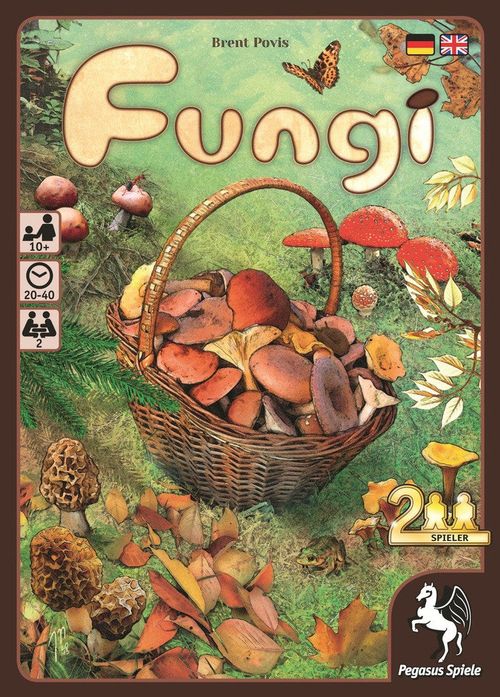
Fungi
Fungi Rulebook
Table of Contents
Table of Contents
- Components
- Setup
- Flow of Play
- A) Take 1 card out of the Forest
- B) Take all the cards out of the decay pile
- C) Cook 3 or more identical types of mushrooms
- D) Sell 2 or more identical types of mushrooms
- E) Put down 1 Pan
- After your turn
- End of Game
- Alternate Way of Forming the Forest
- Glossary of Mushrooms
Components
- 86 Forest cards
- 8 Night cards
- 18 Sticks
- 1 Pair of Shoes
- 6 Overview cards
The mushrooms
Each mushroom card shows two numbers. The number under the little pan symbol (upper left and right) is the Flavor points you earn for cooking that mushroom. The number under the little stick symbol is the amount of Sticks you gain per mushroom when selling. The count is how many of that card are in the draw pile.
| Mushroom | Common name | Count | Flavor points | Sticks |
|---|---|---|---|---|
| Armillaria mellea | Honey fungus | 10 | 1 | 1 |
| Auricularia auricula | Tree Ear | 8 | 1 | 2 |
| Coprinus comatus | Lawyer's Wig | 6 | 2 | 1 |
| Lentinula edodes | Shiitake | 5 | 2 | 2 |
| Grifola frondosa | Hen of the Woods | 5 | 3 | 1 |
The other Forest cards
- Fly agaric (Amanita muscaria): 5 cards
- Butter: 3 cards (requires cooking 4 or more identical mushrooms; worth +3 Flavor points)
- Cidre: 3 cards (requires cooking 5 or more identical mushrooms; worth +5 Flavor points)
- Pan: 13 cards
- Basket: 5 cards
- Moon: 8 cards
Night cards
There are 8 Night cards – one for each type of mushroom except the Morels and the Fly agaric (Armillaria mellea, Auricularia auricula, Coprinus comatus, Lentinula edodes, Grifola frondosa, Leccinum scabrum, Boletus edulis and Cantharellus cibarius). A Night card counts as 2 mushrooms, but only as 1 card for your hand limit.
Sticks
Sticks are neither Forest nor Night cards. They never go into your hand and never count towards your limit. With action D) Sell 2 or more identical types of mushrooms you can gain Sticks. You need them for action A2) Take 1 card out of the Deep Forest. Should you ever run out of Sticks, just use some other form of marker temporarily.
Setup
First, take 2 Pans from the Forest cards and put them aside for now. Shuffle all the rest of the Forest cards and put them as a draw pile on one side of the table. Make sure there is enough room beside it for a discard pile.
Reveal 8 cards from the draw pile of the Forest cards and with them, form a line between you two. These cards are called the Forest. The two cards that are farthest away from the draw pile of the Forest cards are the immediate area in front of your feet. To signify this, put the pair of shoes card horizontally in front of these two cards. Keep a little space next to these two cards as well for the decay pile. (At the end of the rules you can also find an alternate way of forming the Forest.)
Shuffle the 8 Night cards and put them in a face down pile next to the draw pile of the Forest cards.
Also put the pile of Sticks next to these piles.
Now each player receives the following items:
- 1 Turn Overview: On the front you can see the actions that are available to you on your turn. On the back you can see what you have to do at the end of your turn.
- 1 of the 2 Pans that have been put aside earlier during setup. Put it in front of you in your display.
- 3 Forest cards of the draw pile. This will be your hand at the beginning of the game. Should you draw one of these three cards, do the following:
- Basket: Put this card into your display. Do not draw a replacement card.
- Moon: Put this card on the discard pile and draw a Night card into your hand as a replacement.
- Fly agaric: Put this card on the discard pile. Do not draw a replacement card. Whoever last had mushrooms for dinner will be the start player.
Flow of Play
Goal of the Game
In a game of Fungi you try to collect the most delicious mushrooms and roast them gently in a pan. With butter and cidre you can refine your meal. For preparing mushrooms you will earn Flavor points. The player who was able to receive the most Flavor points by game's end will be the winner.
Forest cards and Decay pile
Forest cards are the main cards of this game. Special functions of each type of card are explained in separate boxes. At the end of each turn, 1 Forest card will go to the decay pile. For a short while now, this card and others – maybe even a few at a time – will still be accessible before they will finally be discarded and out of reach.
On your turn
On your turn you must do 1 of the following 5 Actions, you cannot pass voluntarily:
- A) Take 1 card out of the Forest
- B) Take all the cards out of the decay pile
- C) Cook 3 or more identical types of mushrooms
- D) Sell 2 or more identical types of mushrooms
- E) Put down 1 Pan
If you cannot perform any one of those actions, your opponent will carry out 1 action after the other until you can act again. Try to avoid such situations by closely observing your hand limit (see below)!
A) Take 1 card out of the Forest
Take 1 card out of the Forest and put it in your hand (Exception: Basket, Moon and Fly agaric – see below).
Take heed of your Hand limit. At the beginning it's 8 cards – that means you may never have more than 8 cards in your hand at all times. You can extend your hand by playing Baskets (see the Basket box).
If you choose this action, you will have two options:
A1) Take 1 card from the immediate area in front of your feet
Take 1 card out of the Forest that is in front of the pair of shoes. This area is immediately in front of you and gathering is very simple.
A2) Take 1 card out of the Deep Forest
Take 1 card into your hand that is deeper into the Forest – these are the 6 cards that are not in front of your shoes. To gather such a mushroom you have to expend 1 or more Sticks. The first card that is deeper into the Forest (i.e. comes right after the shoes) costs 1 Stick, the card after that 2 Sticks and so on. The card that's deepest into the Forest therefore costs 6 Sticks. Put all expended Sticks back onto their pile.
For both actions A1) and A2) remember: If you take a Moon card, put the card onto the discard pile and draw a Night card instead (see the Moon box). A card Basket or Fly agaric will always go right into your display. They never go into your hand and don't count towards your limit (see the Basket and Fly agaric boxes).
Basket: A Basket will never be part of your hand. Immediately put it into your display. Therefore it never counts towards your hand limit. Each Basket will immediately extend your limit by 2 cards. So with 2 Baskets in your display, your limit would be 12 cards.
Moon: Mushrooms gathered under the glow of moonlight are even more delicious... If you take a Moon card, put the card onto the discard pile and draw a Night card instead. Each type of mushroom (apart from the Morels and the Fly agaric) has 1 corresponding Night card. These cards count as 2 mushrooms, but only as 1 card for your limit. Therefore, for action D) Sell 2 or more identical types of mushrooms, 1 Night card would suffice.
Fly agaric: A Fly agaric will never be in your hand. Immediately put it into your display. Therefore it never counts towards your hand limit. If the Fly agaric is one of the (max. 4) cards of the decay pile (see action B), take all other cards into your hand.
In each case you immediately have to trim your hand down to exactly 4 cards after this; Baskets do still work, however. Therefore, should you have 2 Baskets in your display, you have to trim your hand down to 8 cards. All cards removed this way go onto the discard pile. If you are already at or below this new limit, you may not voluntarily discard your cards.
This new limit will be in effect until the end of your next turn, after which the Fly agaric will go to the discard pile and your old limit will again be in effect. In the right moment, the Fly agaric can be used to your advantage to get rid of unwanted cards!
B) Take all the cards out of the decay pile
Take all the cards out of the decay pile (between 1 and 4 cards after the 1st turn of the game): Resolve all the Moon, Basket and Fly agaric cards as described under A) and put all the other cards into your hand. Take heed of your hand limit.
Note: If you have reached your hand limit, you may still take up to 3 cards from the decay, so long as it contains at least 1 Basket. It will immediately go to your display, so that your hand limit is increased by 2 – allowing you to take the other cards into your hand. However, if the decay is comprised of 4 cards, the decay would have to contain 2 Baskets.
C) Cook 3 or more identical types of mushrooms
As soon as you have 3 or more identical types of mushrooms in your hand, you can decide to cook them. To cook them, play these cards onto an empty Pan in your display, or play an empty Pan into the display together with the mushrooms. Mushrooms and Pans will stay together in your display until the end of the game. During the course of the game you will not be able to cook any more mushrooms into this Pan nor will you be able to reuse the Pan.
During your turn you can only cook 1 type of mushroom.
Pan: You cannot cook mushrooms without a Pan! Be sure to never run out! You start the game with 1 Pan in your display and with actions C) and E) you can get even more Pans out!
Mushrooms: The cooking of these delicious forest fruits is the goal of this game. In the boxes on the upper left and right of each card right below the little pan symbol you can see exactly how many Flavor points you will get for each cooked mushroom at the end of the game. Whoever has more of these points by game's end will be the winner.
Should you have cooked 4 Birch boletes for example – using 2 Forest cards and 1 Night card – you will have gained 12 Flavor points at the end of the game.
Butter and Cidre: If you manage to cook 4 or more identical types of mushrooms (Night cards again count as 2), you may also put 1 Butter in the Pan; if you manage to cook 5 or more identical types of mushrooms, you may instead put 1 Cidre into the Pan. Following this pattern it is possible to put 2 Butter into the Pan if you manage to cook 8 or more identical types of mushrooms, or with 9 or more identical, 1 Butter and 1 Cidre, and if you manage to cook 10 or more identical mushrooms at once, you may even add 2 Cidre.
Each Butter will yield 3 additional Flavor points, each Cidre will yield 5.
You cannot add Butter or Cidre after you have cooked the mushrooms. They have to be played in action C) together with the mushrooms.
D) Sell 2 or more identical types of mushrooms
If you have 2 or more identical types of mushrooms in your hand you may sell them to gain Sticks.
Put 2 or more identical types of mushrooms onto the discard pile and count how many Sticks you will gain. Put the Sticks into your display. The amount of Sticks you will gain for each mushroom is denoted by the number underneath the little stick symbol in the boxes on the upper left and right of each card. As an example: If you sell 3 Shiitake (1 Forest and 1 Night card), you will gain 6 Sticks.
During your turn you can only sell 1 type of mushroom.
E) Put down 1 Pan
Put down 1 Pan into your display. During a later turn you can use it in action C) Cook 3 or more identical types of mushrooms.
After your turn
After your turn perform the following 3 steps in order:
- No matter what action you took, put the card that is closest to the decay pile onto the decay pile. Make sure that the cards on there are not perfectly aligned so you can always tell all the cards in the pile. The decay pile may never consist of more than 4 cards. Should a 5th card try to enter the pile – discard all previous 4 cards into the discard pile and begin a new decay pile with the 5th card.
- Slide the cards of the Forest towards the decay pile, so that there are again 2 cards in front of the pair of shoes.
- Replenish the Forest to contain 8 cards. Draw 1 or 2 Forest cards and put them into the Deep Forest, farthest away from the pair of shoes. You will not be able to perform this last step once the game nears completion.
Now your turn is over, and play passes to your opponent.
End of Game
The game will end immediately as soon as the last card from the Forest has been taken.
Now count the Flavor points of all the mushrooms you managed to cook. In the boxes on the upper left and right of each card right below the little pan symbol you can see exactly how many Flavor points you will get for each cooked mushroom. Note that Night cards will yield double the points. Also count the additional points that you gain from Butter and Cidre. The skilled mushroom gatherer who has managed to gain more Flavor points will be the Winner.
In case of a tie, whoever has managed to cook the greatest amount of mushrooms will be the winner. (Night cards still count as 2; Cidre and Butter do not count.)
Enjoy your meal.
Alternate Way of Forming the Forest
To decrease the handling of the Forest at the end of your turn you can use this alternate way of forming the Forest:
Again, use the pair of shoes to mark the immediate Forest area in front of your feet. If you take a card that is in the immediate Forest area, then after your turn you only have to draw 2 Forest cards and put them at the end of the Forest and then slide the pair of shoes to the 2 cards at the start of the Forest on the other end. If you took a card from the Deep Forest (Cards 1 through 6), you first have to close the gap in the Forest by sliding the cards together.
Glossary of Mushrooms
- Amanita muscaria: Fly agaric; one of the most famous poisonous mushrooms, in earlier times it was sometimes used as an edible mushroom in Japan (and even in the area of Hamburg).
- Armillaria mellea: Honey fungus; in its raw form poisonous, becomes edible when cooked and often seen in meals.
- Auricularia auricula: Tree ear; highly regarded edible mushrooms especially in asian cuisine.
- Boletus edulis: Porcini; highly regarded edible mushrooms even during the days of Rome. Hard to cultivate.
- Cantharellus cibarius: Chanterelle; highly regarded edible mushroom since antiquity; is currently suffering from the effects of environmental pollution.
- Coprinus comatus: Lawyer's Wig; as a young mushroom very edible, has to be cooked after gathering very quickly or will dissolve and become unedible.
- Grifola frondosa: Hen of the Woods; known and loved as Maitake in Japan.
- Leccinum scabrum: Birch bolete; edible mushroom that is under Conservation in Germany.
- Lentinula edodes: Shiitake; one of the most cultivated edible mushrooms; in China and Japan also sought for its supposed medicinal purposes.
- Morchella esculenta: Morel; a highly regarded edible mushroom that is under Conservation in Germany.
If you want to know more about mushrooms, get a guide and get in the woods!