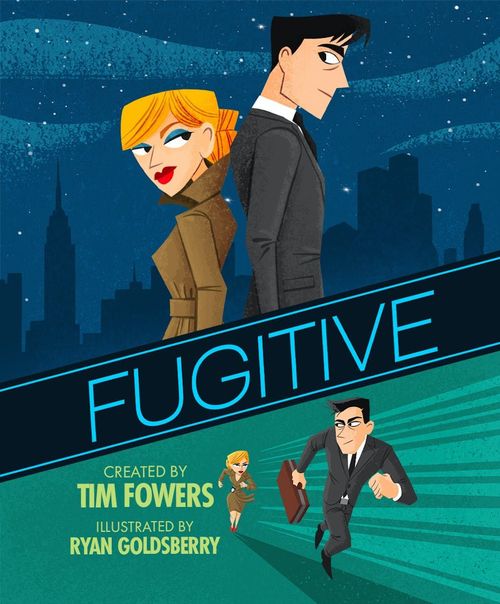
Fugitive (Second Edition)
Fugitive (Second Edition) Rulebook
Table of Contents
Table of Contents
Objective
The Fugitive wins by playing cards until he can eventually play the Hideout 42 card to escape the Marshal.
The Marshal wins by identifying all the Fugitive's Hideouts to catch the Fugitive.
Setup
Place the 0 card, the Fugitive's first Hideout, in the center of the play area. This is the first card of the center row.
Sort the Hideout cards into 3 decks: 4–14, 15–28 and 29–41. Each deck has its own icon in the bottom right corner. Shuffle all decks separately and place them face down near the center row.
Give the Fugitive and the Marshal their Role cards, and give the Marshal her Notepad card and marker.
Form the Fugitive's starting hand with the Hideout cards numbered 1, 2, 3, and 42. In addition to those 4 cards, the Fugitive draws 5 more cards from 2 of the 3 sorted Hideout decks, without revealing them to the opposing player:
- (4–14): Draw 3 cards
- (15–28): Draw 2 cards
Hideouts
Each Hideout card has 2 values: a Hideout number (0–42) and a Sprint number indicated by footprints (+1 or +2).
The Fugitive uses cards by either placing them as Hideouts or by sacrificing them in order to Sprint. The Marshal uses cards she draws to deduce where the Fugitive is hiding and to decrease the number of options available to the Fugitive.
Gameplay
The Fugitive and Marshal alternate turns throughout the game. On the Fugitive's turn, he may move to a new Hideout as part of his path to escape. On the Marshal's turn, she attempts to catch the Fugitive by uncovering the Fugitive's Hideouts. The Fugitive always takes the first turn.
Fugitive's first turn:
- The Fugitive places 1 or 2 new Hideouts.
Marshal's first turn:
- The Marshal draws 2 cards total, either from the same deck or from different decks.
- The Marshal makes a guess to find one or more Hideouts.
Fugitive's subsequent turns:
- The Fugitive draws 1 card from any deck.
- Then the Fugitive may place 1 new Hideout or draw from the lowest number deck that still has cards in it.
Marshal's normal turn:
- The Marshal draws 1 card from any deck.
- The Marshal guesses to find one or more Hideouts.
Continue taking turns until one player wins:
The Fugitive wins by playing card #42, and by escaping the Manhunt, if necessary (see Start a Manhunt below).
The Marshal wins by correctly guessing all the Fugitive's Hideouts, either during her normal turn or through a Manhunt.
The Fugitive's Options
Place a new Hideout
The Fugitive places a card face down to the right of the previous Hideout, adding a new Hideout to the center row. The Fugitive can look at any facedown cards at any time to help him remember what's been played.
Placing a Hideout normally
Normally, the Fugitive can place a Hideout card if its Hideout number is up to 3 higher than the previous Hideout. The Fugitive cannot place a new Hideout with a lower number than his previous Hideout.
For example, if the previous Hideout were a 4, the Fugitive could choose to play Hideout 5, 6, or 7, but not Hideout 3 (because that's lower than the previous Hideout number) or 15 (because that's more than 3 higher than the previous Hideout number).
Using cards to Sprint
The Fugitive may extend the normal range of 3 by placing the new Hideout with one or more extra cards underneath it, face down. These extra cards are used as Sprint cards, and they extend the Fugitive's range by the sum of their Sprint numbers. When using cards as Sprint cards, the Fugitive must place them so that the Marshal can see how many Sprint cards have been played (but not their Sprint numbers). The Fugitive may always choose to place more Sprint cards than necessary, even if no sprinting is required.
Returning to the example: if the previous Hideout were a 4, the Fugitive could normally only play the 5, 6, or 7 Hideouts. If the Fugitive wants to play the 10 as the next Hideout, he must add cards with a total Sprint value of at least +3 (because 10 is 3 higher than the Fugitive's normal range).
Not Playing a Hideout
After drawing, the Fugitive can choose to play no Hideout. If he does, he may draw an additional card from the lowest numbered deck that still has cards.
The Marshal's Options
Guess a single Hideout
The Marshal guesses a number between 1 and 41. If that number matches any of the facedown Hideouts in the center row, the Fugitive reveals the Hideout card and any Sprint cards under it. The Marshal doesn't need to select a specific facedown card when guessing, and she never needs to guess Sprint cards.
Guess a series of Hideouts
The Marshal guesses multiple numbers:
- If all of her guesses match facedown Hideouts in the center row, the Fugitive reveals all the guessed Hideout cards and any Sprint cards under them.
- If any of her guessed numbers are wrong, the Fugitive does not reveal any cards — even if one or more guessed numbers are correct.
The Marshal doesn't have to guess Hideouts in a specific order, and she never has to guess Sprint cards.
Start a Manhunt
As a last effort to catch the Fugitive, the Marshal can start a Manhunt, which happens separately from the normal sequence of turns. The Marshal can start a Manhunt only when the Fugitive plays the Hideout card numbered #42 while the highest revealed Hideout number is #29 or lower.
In a Manhunt, the Marshal guesses a single Hideout (as above): If she guesses correctly, she continues to guess another single Hideout.
If the Marshal guesses all Hideouts, the Manhunt was successful. She catches the Fugitive at the last second, and the Marshal wins!
If she guesses incorrectly at any point, the Manhunt failed. The Fugitive escapes and wins!
Reveal any Sprint cards under a correct guess during a Manhunt as normal, but don't reveal any Sprint cards under the #42 Hideout.
SHIFT System
SHIFT cards can be used in a best-of-5 game series of Fugitive. Each SHIFT card has a unique ability for the Fugitive or for the Marshal to use once per game. Only use the side of the card for the role you are playing.
Draw 2 SHIFT cards when you lose a game and choose 1 to keep. Use it in every game after this. Reveal all SHIFT cards at the start of each game, but then players keep them in hand like a Hideout card.
Players can decide which roles to play each game in the series. Play until one player wins 3 games in the series. (Change series length to your preference.)
Advanced Variant: If both players are experienced, have the player who lost draw 2 SHIFT cards, choose 1 and give the other to their opponent.
Strategies and Tips
Being a good Fugitive requires taking risks. The Marshal must methodically search and deduce where the Fugitive might be. Here are a few strategies and tips for each side.
Fugitive Strategies
- You don't always have to play a Hideout. Not playing a hideout gains you an additional card.
- You may Sprint to your first Hideout.
- Sprinting too often as the Fugitive can use up too many cards, often making you wait for a good draw.
- You can bluff by playing unnecessary Sprint cards, but don't bluff too often. It keeps the Marshal guessing but can also make you run out of cards quickly.
- Drawing from a higher pile than you need can throw off the Marshal and help you later in the game.
- Playing a Hideout number that the Marshal just guessed can be smart: she's unlikely to guess it again.
Marshal strategies
- Take notes with the marker on the notepad to remember what you've guessed.
- When guessing a Hideout with two Sprint cards, there is a 50% chance the total Sprint value is +3.
- Don't guess more than one Hideout very often. It can leave you further behind instead of catching up. However, if you are certain about one Hideout, it can be useful to guess it along with another number.
- Sometimes drawing exclusively from a higher pile can create a "roadblock" that severely limits the Fugitive's options as he moves forward.
- Guessing a higher Hideout can reveal Sprint cards that help guess the Hideouts before it. Sometimes you can count backwards with the revealed Sprint cards to determine the Hideout immediately before it.
- Pay attention to the cards the Fugitive looks at when checking a guess. Watch which deck he draws from.