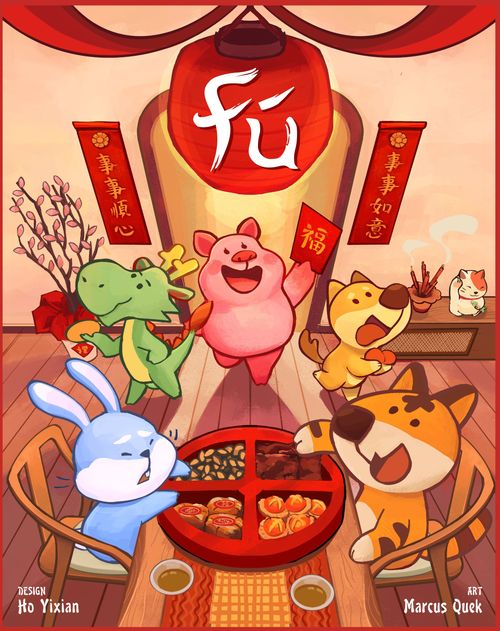
Fú: Festive Fortunes
Fú: Festive Fortunes Rulebook
Table of Contents
Table of Contents
Components
- 1 Market Board
- 5 Home Boards
- 5 Snack Stalls (double-sided)
- 20 Red Envelopes (4 for each of the 5 players)
- 82 Snack Tokens (excluding spare tokens)
- 35 Family Tokens (7 per player)
- 20 Decoration cards
- 1 Year Marker
- 5 Turn Markers
- 5 Overview cards
- 1 Distant Relative Tile
- 100 Money cards
Setup
Common Area Setup
- Place the Market Board in the middle of the playing area.
- Place 1 Family Token per player onto the Fortune space of the Fortune Track, corresponding to the colours/animals on their Home Board - see Player Setup. This is where you will track your Fortune as it is scored during the game.
- Place the Snack Stalls onto the spaces with corresponding colours on the Market Board (i.e. in the Orange, Seed, Sweet, Savoury, and Tea stalls). Every Snack Stall is double-sided - you may randomly select which side to use in a game. For an easier first game, use the sides marked with a red star on the top right.
- Shuffle the Decorations and place them face down to form a draw deck, then populate the store with 3 face-up Decorations.
- Place the Year Marker into the "Year 1" column, and the row corresponding to the number of players.
- Place all the Snack Tokens corresponding to your chosen Snack Stalls below the Market Board.
- Place all the Money next to the Market Board.
Player Setup
Each player receives:
- A. 1 Home Board
- B. 1 Turn Marker. Give "1" to the oldest player, then continue clockwise in ascending order.
- C. 1 set of Red Envelopes matching their Home Board, with "recipients" on the back matching every other player in the game.
- D. 2 Family Tokens matching their Home Board.
- E. 1 of every other player's Family Token (e.g. if there is no Dragon player, do not place the Dragon token). Stand the tokens on the indicated spaces (the 5 column) of your Generosity Track.
- F. 1 Fortune Token. Place this onto the left-most section of your Dining Table.
- G. Money as indicated by the Year Marker (e.g. in a 5-player game, receive 70 Money), in a mix of 5 and 10 denominations.
- H. 1 double-sided Overview card (optional).
For additional setup and rules for 3 player games, refer to the 3 Player Games section.
Gameplay
Overview and Objective
Fú is played over 5 Years (rounds), each split into 4 phases. Aim to score the most Fortune ("fú") by enticing other players to visit your home over the new year, and eating snacks as you visit other players' homes.
Phase 1: Shopping
Prices for traditional snacks often rise as the new year approaches... Stock up early for the best "early-bird" prices!
Starting with the player holding Turn Marker "1" and going clockwise, players take turns until everyone has taken 2 turns each (i.e. go twice around the table).
On your turn, you will usually place a Family Token on the Market Board either to (A) buy Snacks or (B) buy a Decoration. Alternatively, you may also (C) take Money from the supply, by placing a Family Token on an unoccupied "+10" space in the Decorations store. If playing with Decorations, these spaces are only revealed after a Decoration has been bought. If playing an easier game without Decorations (see below), these spaces are always revealed.
You may also skip your turn (i.e. don't place a Family Token).
(A) Buy Snacks
Buy Snacks to entice visitors to your Home - score 1 Fortune per visitor to your Home each year (see Phase 2: Visiting).
To buy Snack(s), place 1 Family Token on an unoccupied space closest to the Snack Stall of your choice. You may then buy 1 or 2 Snacks from that Stall, paying the indicated price. Prices shown are for 1 Snack only. There are a finite number of Snack tokens - you may not buy a Snack after it has run out.
Place the Snacks you have bought into the Snack Platter at the top right of your Home Board. Each Snack Platter has 4 sections, which may each contain only 1 type of Snack (but any number of Snacks). You may also place the same type of Snack in multiple sections. You may not rearrange Snacks after placing them.
You do not score Fortune for Snacks you have bought; only for Snacks you have eaten (see Phase 3: Eating). Most Snacks score Fortune at the end of the game, as indicated on the corresponding Snack Stalls.
Example: Dog wants to buy Snacks. Dog wants to buy 2 Snacks but the 5 space is occupied. They place their Family Token on the next closest unoccupied space, and pay 20 in total for 2 (i.e. 10 x2). Dog takes 2 tokens from the supply, and immediately places them into their Snack Platter.
Snack Platter placement:
- OK: only 1 type of Snack per section.
- NOT OK: different types of Snacks in the same section.
- OK: any number of Snacks per section.
- OK: same type of Snack in multiple sections.
(B) Buy a Decoration
Buy Decorations to give yourself special abilities or extra ways to score Fortune.
To buy a Decoration, place 1 Family Token on the space below the Decoration, then pay 15 as indicated. Place the Decoration in an empty slot on the left of your Home Board. If both slots are filled, you may discard a Decoration to make space. Do not replenish the Decoration from the deck until the end of the Year (see Phase 4: Prepare for next Year).
Most Decorations provide a permanent effect. However, some Decorations may only be used once - where indicated, discard the Decoration into the discard pile after use.
For an easier game, exclude Decorations from the game and reduce the Money each player receives during setup by 10.
Example: Dog wants to buy a Decoration. Dog wants to buy the Firecrackers Decoration. They place their Family Token on the space in front of the Firecrackers card, then pay 15 as indicated. Dog places the Firecrackers card in an empty slot on the left of their Home Board.
Phase 2: Visiting
Never give red envelopes containing less money than in previous years... Doing so would be a big faux pas and result in serious loss of face!
Fill and give Red Envelopes
All players prepare their Red Envelopes simultaneously and secretly for every other player - either filling them with Money, or leaving them empty (note that each Red Envelope shows a different target recipient on the back).
When everyone is ready, simultaneously give 1 Red Envelope to every other player (always give out all your Red Envelopes, even if they are empty). We recommend giving Red Envelopes recipient-side up to avoid confusion.
To visit a player (the "host"), give them a Red Envelope filled with Money. The amount you give must be more than or equal to the amount you have given this host in previous years, which is tracked using your Family Token on the host's Generosity Track. In other words, you may never give less than the amount indicated by your Family Token on the host's Generosity Track (see "Open Red Envelopes" below). You also may not give more than 50 except in the last year of the game.
To skip visiting, give the host an empty Red Envelope. You may always skip visiting regardless of how much you gave last year. Note that hosts score 1 Fortune per visitor, so you may decide not to visit if the host's Snacks are not tasty enough!
Example: Tiger wants to visit Dog. Tiger would like to visit Dog. Tiger's Family Token is currently in the 15 column on Dog's Generosity Track. Tiger must therefore give Dog a Red Envelope filled with 15 or more. Tiger sees that Dog is offering some delicious Snacks and decides to visit with 35.
Open Red Envelopes
All players should now have received 1 Red Envelope from every other player. Simultaneously open the Red Envelopes and record how much Money you received according to the rules below. You may keep the Money received for use in future years.
- A. If you received more Money from a visitor than indicated by their token on your Generosity Track, move their token to the corresponding column on your Generosity Track.
- B. If you received the same amount of Money as indicated by a visitor's token, leave their token standing on the same spot.
- C. If you received an empty Red Envelope, lay that player's token down but do not change its location.
Example: Dog records what they received this Year. (A) Tiger's token is in the 15 column, but they have given 35. Move their token to the 35 column. (B) Rabbit's and Pig's tokens are in the 20 column, and they have again given 20 each. Leave their tokens standing in the same spots. (C) Dragon has given an empty Red Envelope (i.e. did not visit this Year). Lay their token down.
In future Years, to visit Dog - Tiger must give 35 or more, Rabbit and Pig must give 20 or more, and Dragon must give 30 or more. They may all also choose not to visit.
Phase 3: Eating
We are not suggesting that hosts actually reserve their best snacks for the most generous visitors... are we?
Eat Snacks
Starting with the host holding Turn Marker "1" and moving clockwise, resolve the eating of Snacks at each host.
In order from highest to lowest generosity (as indicated on the host's Generosity Track), visitors must eat all the Snacks in a single section of their choice, from the host's Snack Platter. Players who did not visit (i.e. they gave an empty Red Envelope and their Family Tokens are lying flat) do not eat.
Place eaten Snacks into the corresponding section of your Dining Table, fully visible to all players (i.e. do not stack them). Eaten Snacks on your Dining Table are scored at the end of the game.
- If two or more visitors are tied, they eat in reverse turn order (i.e. from highest to lowest number on their Turn Marker).
- If there are more sections with Snacks than visitors, visitors continue eating in order from highest to lowest generosity.
- If there are fewer sections with Snacks than visitors, some visitors go home hungry!
- If nobody visited, you may eat any number of Snacks from your own Snack Platter. Hopefully not a common occurrence!
Example (tiebreaking): Players eat in the following order: Tiger > Rabbit > Pig. Rabbit and Pig are tied, but Rabbit eats before Pig, because Rabbit has the larger Turn Marker number (5 versus 3). Dragon did not visit and does not eat.
Example: More sections with Snacks than visitors. After Tiger, Rabbit and Pig have all eaten from their chosen sections, Tiger eats again from the remaining section.
Example: Fewer sections with Snacks than visitors. Only Tiger and Rabbit get to eat from the 2 sections filled with Snacks. Pig goes home hungry.
Phase 4: Time Passes...
Back to the grind and save up for next Chinese New Year!
Year-end scoring
Score +1 Fortune for each visitor you received this Year (count the number of Family Tokens still standing on your Generosity Track). Track your score by moving your Family Token on the shared Fortune Track.
Also score Fortune from any Decorations that are scored at the end of the year (if applicable). Unless otherwise stated, do not score Fortune from eaten Snacks on your Dining Table at this time; only score eaten Snacks at the end of the game (see "Game End & Scoring").
Prepare for next Year
- Return Home: Return all empty Red Envelopes and Family Tokens on the board to their respective players. Stand up any Family Tokens on your Generosity Track that are lying down, but do not change their location.
- Pass Turn Markers: Pass your Turn Marker to the player on your left (i.e. clockwise).
- Collect Income: Advance the Year Marker one space to the right and give each player Money from the supply as indicated.
- Refresh Decorations: Discard remaining face-up Decorations, and replenish the empty slots from the top of the draw deck.
Example: Red Peonies - Brings beauty and charm - what better way to jump to the front of the line? When Shopping, always pay the cheapest price for a Snack, regardless of what space your Family Token is on. Discard all remaining face-up cards (Firecrackers and Lucky Bamboo). Replenish all empty slots from the top of the face-down draw deck.
Game End & Scoring
The game ends after 5 Years (rounds).
In addition to the Fortune you have scored throughout the game, now also score:
- For Snacks you have eaten: score the Snacks on your Dining Table only according to the scoring rules on the Snack Stalls (where two scoring rules are shown on the same Snack Stall, both will apply unless otherwise stated - see separate insert for full scoring rules and descriptions of each type of Snack); and
- For Decorations: score as stated on your cards; and
- For Money: score 1 Fortune for every 50 Money in your hand.
The player with the most Fortune at the end of the game wins! In the case of a tie, the player who ate the most number of Snacks wins. If still tied, they share the victory.
Note: the Fortune Track stops at 30 Fortune but players may exceed that score. If you score more than 30 Fortune, move your Family Token back to the beginning and continue to tally your score from there.
3 Player Games
The Distant Relative (Automa)
Setup
Place the Distant Relative Tile on the Dragon Home Board, to the right of the first player. Place 1 Dragon Family Token (the Distant Relative lives alone!) and Turn Marker "4" next to the Distant Relative Tile. All players should also receive their Red Envelope with the Dragon as a Recipient, like they would with any other player.
When playing with the Distant Relative, ignore the Generosity Track area of the Dragon Home Board.
Gameplay
Phase 1 Shopping: On the Distant Relative's turn, place their Dragon token in front of the left-most stall that has not yet been occupied by players this year. The Distant Relative then buys Snacks worth up to 20, following the same shopping rules as for players (i.e. up to 2 Snacks). In other words, the Distant Relative could buy 2 Oranges, 2 Seeds, 2 Sweets, 1 Savoury or 1 Tea. Place the Snack token(s) onto the Distant Relative Tile. The Distant Relative does not need to pay for the Snack(s). If there are no more Snacks available at the left-most unoccupied stall, the Distant Relative shops at the next unoccupied stall.
Example: Pig, Tiger and Rabbit bought Oranges, Melon Seeds and Shrimp Rolls this year. Hence, place the Dragon Token in front of the Pineapple Tart stall and place 2 Pineapple Tarts on the Distant Relative Tile.
Phase 2 Visiting: You must also give the Distant Relative a Red Envelope, which may contain Money or be empty. At the end of the Visiting Phase, open the Red Envelopes to reveal how much Money each player has given the Distant Relative. Unlike players, the Distant Relative does not track your generosity from year to year (because they're distant!). The Distant Relative is a recluse and does not visit any players.
Phase 3 Eating: The most generous visitor this Year eats the Snack(s) on the Distant Relative Tile. In the event of a tie, follow the same tiebreaking rules (i.e. based on Turn Marker). If no player visited the Distant Relative (i.e. all Red Envelopes were empty), return the Snack(s) to the supply. Return all money received by the Distant Relative to the supply.
Phase 4 Time Passes: Pass Turn Markers clockwise as if the Distant Relative were a player.
Appendix: Snack Scoring Rules
Chinese all over the world celebrate the New Year with a variety of different snacks. These represent just some of our favourite festive snacks, which we grew up eating in Singapore!
Mandarin Orange
Mandarin oranges represent good luck. Exchanging them (always in pairs!) are a must when visiting family and friends.
Beginner (red star)
- Score 1 Fortune for every 2 Oranges eaten; and
- Lose -2 Fortune if you have eaten an odd number of Oranges.
Advanced
- Score 2 Fortune if you have eaten at least 4 Oranges, or 4 Fortune if you have eaten at least 6 Oranges; and
- Lose -2 Fortune if you have eaten an odd number of Oranges.
Melon Seed
Chinese uses the same characters for "seed" and "child", so seeds are regarded as a sign of fertility! Melon seeds also signify a good harvest and abundance.
Beginner (red star)
- Score 6 Fortune if you have eaten the most Melon Seeds; or
- Score 3 Fortune if you have eaten the 2nd most Melon Seeds.
- If 2 or more players tie for most, they split 9 Fortune (rounded down); then no players score for 2nd most. If 2 or more players tie for 2nd most, they split 3 Fortune (rounded down).
Advanced
- Score 5 Fortune if you have eaten at least 3 more Melon Seeds than the player(s) who has eaten the fewest Melon Seeds.
- Multiple players may score.
Pineapple Tart
A buttery cookie base topped with pineapple jam, pineapple tarts are said to bring good fortune. Pineapple in some dialects sounds similar to "luck coming your way"!
Beginner (red star)
- Score 2 Fortune for every 3 Pineapple Tarts eaten; and
- Lose -3 Fortune if you have eaten the fewest Pineapple Tarts (including 0).
- If 2 or more players tie for fewest, they split -3 Fortune (rounded down).
Advanced
- Score 2 Fortune for every 3 Pineapple Tarts eaten; and
- Score 2 Fortune if you were the first or second to eat 4 Pineapple Tarts (score this immediately, not at the end of the game).
Shrimp Roll
Like a mini spring roll but filled with dried shrimp, chilli, garlic and shallots, shrimp rolls symbolise happiness and wealth.
Beginner (red star)
- Score 1 Fortune if you have eaten 1 Shrimp Roll, 4 Fortune if you have eaten at least 3 Shrimp Rolls, or 7 Fortune if you have eaten at least 5 Shrimp Rolls.
Advanced
- Score 1 Fortune for every Shrimp Roll eaten; and
- Score 1 Fortune for every Shrimp Roll that is paired with a Tea (Jasmine Tea).
- E.g. if you have eaten 2 Shrimp Rolls but only 1 Jasmine Tea, you score 3 Fortune.
Jasmine Tea
Made with green tea scented with jasmine blossoms, jasmine tea was popularised in China during the Qing dynasty (17th century).
Beginner (red star)
When eating only, you may choose whether to place it in the Tea section or any other section of your Dining Table.
- Score 1 Fortune for every Jasmine Tea eaten (i.e. in the Tea section); or
- Count Jasmine Tea as a different type of Snack, corresponding to its position in your Dining Table (no longer scores as Tea). (Place in any other section to use as wild: Orange / Seed / Sweet / Savoury.)
Advanced
- Score 1 Fortune for every 1 Jasmine Tea eaten, and
- For every 2 Jasmine Teas eaten, you may also immediately eat 1 Orange, Seed or Sweet of your choice from the supply.
Choosing your character according to the Chinese Zodiac
The Chinese zodiac runs on a 12-year cycle (based on the lunar calendar), each year represented by a different animal. Your zodiac animal is said to influence everything from your personality to your compatible partners! In this game we use 5 of the 12 animals as player characters (see below); the remaining are rat, ox, snake, horse, sheep, monkey, and rooster.
- Dragon: Confident, courageous, tenacious and enterprising. The emperors of ancient China often regarded themselves as the Dragon, Son of Heaven. Most compatible with: Rat, Monkey, Rooster. Born in years: 1940, 1952, 1964, 1976, 1988, 2000, 2012, 2024.
- Rabbit: Gentle, quiet, and elegant, as well as quick-witted, alert, and very responsible. The Rabbit is a symbol of longevity and peace. Most compatible with: Dog, Pig, Goat. Born in years: 1939, 1951, 1963, 1975, 1987, 1999, 2011, 2023.
- Pig: Easygoing, honest, trusting, calm, down to earth and easy to get along with. Pigs make great companions and trustworthy friends. Most compatible with: Tiger, Rabbit, Goat. Born in years: 1935, 1947, 1959, 1971, 1983, 1995, 2007, 2019.
- Tiger: Competitive, bold, expressive and confident. Tigers can be very charming and well-liked by others. Most compatible with: Dog, Pig, Horse. Born in years: 1938, 1950, 1962, 1974, 1986, 1998, 2010, 2022.
- Dog: Loyal and honest, amiable and kind, cautious and prudent. Dogs are usually protective and caring towards their loved ones. Most compatible with: Tiger, Rabbit, Horse. Born in years: 1934, 1946, 1958, 1970, 1982, 1994, 2006, 2018.