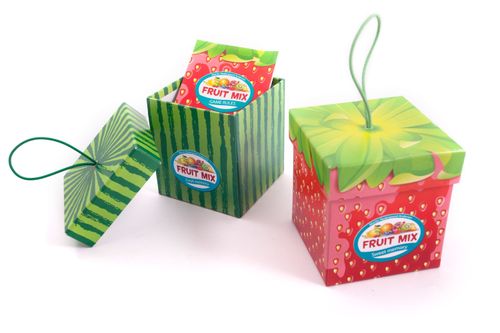
Fruit Mix
Fruit Mix Rulebook
Table of Contents
Table of Contents
Aim of the Game
Get rid of your tiles as quickly as possible.
Components
- 48 tiles with 12 different pictures (fruit and berries) in 4 different shapes (plates) and 4 different colors (tablecloth)
- Game rules
Basic Game Rules (7+)
Setup
Place 5 tiles face up in a line in the middle of the table and distribute the remaining tiles face down according to the number of players:
- 2 players – 21 tiles each
- 3 players – 14 tiles each
- 4 players – 10 tiles each
- 5 players – 8 tiles each
- 6 players – 7 tiles each
Each player keeps their tiles in a face-down draw pile in front of him. Put any surplus tiles back in the box.
Game Turn
All players try to memorize the tiles on the table. As soon as everyone is ready (for example after 20 seconds) the tiles are flipped over. The youngest player starts the game and then players take turns clockwise.
During your turn reveal your top tile, place it face up below one of the face-down tiles in the line and reveal that tile.
- If the two tiles are different in all three features (fruit, plate shape, tablecloth color), remove the tile from the top row and put it in the box. Move the tile that you just placed into the empty space in the line, where it remains face up. Well done, you managed to get rid of one of your tiles! Your turn is over, and the player on your left can start his turn.
- If any of the features in the two tiles match (for example, if the plates are the same) you must take the tile from the top line (the one you just flipped) and place it under your draw pile. Move your face-up tile that you placed on the table into the empty space in the line, where it remains face up. Your turn is over, and the player on your left can start his turn.
The next player takes his turn the same way: he reveals his top tile, places it below one of the face-down tiles, reveals the tile, compares them and so on.
If you think that all face-down tiles in the line have something in common with the tile you are about to place, you can put this tile under your pile and draw a new one. You may repeat this procedure as many times as you wish (or before the start of the game you may agree to limit the number of tile changes by 3 per turn).
Starting a New Round
When there are no face-down tiles left in the middle of the table, the current round is over. All players try to memorize the tiles on the table and when they are ready the tiles are flipped over.
The player on the left of the one who finished the previous turn starts a new round. If this player was the first player in the previous round, the player on his left will be the first one now (this situation may occur if the number of players matches the number of tiles in the line).
The game resumes.
Game End
As soon as one of the players gets rid of his last tile, players take their turns to finish the game: the last one to take his turn will be the player on the right of the first player of the game (so that everyone takes the same number of turns).
The player who got rid of all his tiles wins the game! If two or more players got rid of all their tiles, they are joint winners.
The Last Tile Rule
During your turn, if you have only one tile left and if you are sure it matches all the remaining face-down tiles in the line in at least one feature, you can declare that it cannot be placed. After that the tile-check takes place: all the face-down tiles in the line are revealed and if your declaration was true (all revealed tiles match your tile in at least one feature) it means you successfully got rid of all your tiles: remove one of the tiles you revealed during the check and move your last tile into the empty space in the line. If you were wrong (among the revealed tiles there is at least one tile that doesn't match yours in all 3 features), you take one of the revealed tiles (it will now form your pile) and move the tile you just placed into the empty space in the line. After that in both cases players continue taking turns following the game rules.
Notes
You can vary the difficulty level of the game by placing more or fewer tiles in the middle of the table during setup.
The basic rules can also be applied for solo game (one player): place 5 tiles face up in a line and take all the remaining tiles to your draw pile. Following basic rules, try to get rid of all your tiles as quickly as possible. Note the time or the number of turns it took you to succeed and try to beat your record in your next game!
"Lucky Mix" Game Variant (8+)
Follow the basic rules with a few modifications:
If you placed your tile correctly you may choose EITHER to remove the tile from the top row, put it in the box and finish your turn OR to put it aside (not in the box) and try to place one more tile from your pile. If you reveled your top tile, you can't change your mind and finish your turn – you must play one tile to the line (you still may place the revealed tile under your pile and draw a new tile). You may play up to 3 tiles during one turn if you place them correctly. You don't put into the box the revealed tiles during your turn: put them aside and remove them at the end of your turn if you decided to finish your turn or if you placed your 3 tiles correctly. If you made a mistake, take these revealed tiles and place them under your pile.
In this game variant a new round may start during your turn.
For example:
You placed your tile (red round blueberry) correctly, the line on the table is now revealed but you wish to place one more tile. Everyone tries to memorize the tiles, they are flipped over and you continue your turn by placing your tile.
In this game variant the last tile rule is also applied. If you make a mistake, take to your personal draw pile one of the tiles revealed when checking your declaration and also the tiles you put aside during your turn (if there are any).
"Pairs" Game Variant (5+)
This is the variant we recommend for younger children.
Remove 16 tiles (1 card of each plate shape in each tablecloth color) and put them in the box. Spread the remaining 32 tiles face down on the table. In this variant your aim will be to find the pairs of tiles that match: choose if you will seek the tiles of the same plate shape or the same tablecloth color. Choose the first player randomly, and then players will take turns clockwise.
During you turn reveal two tiles among those on the table. If the chosen feature matches on these two tiles, take them, place them in front of you and take one more turn. If the tiles don't match in the chosen feature, flip them over without changing their place, and your turn is over.
When there are no tiles left on the table, the game is over and the player who collected most tiles wins the game.
You may add extra challenge to the game by looking for the tiles that match in 2 features (plate shape and tablecloth color) at the same time.