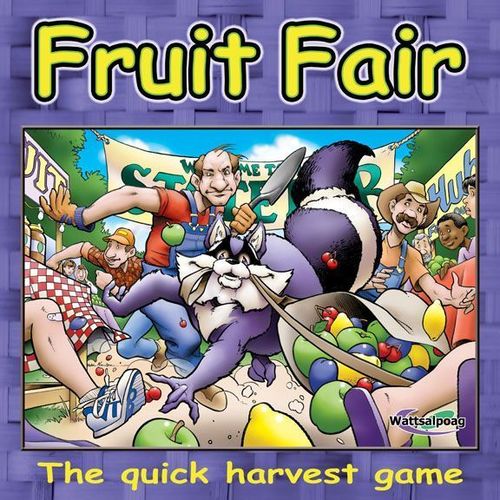
Fruit Fair
Fruit Fair Rulebook
Table of Contents
Table of Contents
Contents
- 54 playing cards: 10 Picker cards, 10 Gardener cards, 10 Extra Worker cards, and 24 Fruit Tree cards
- 80 fruits: 20 cherries (red), 20 apples (green), 20 plums (blue), 20 lemons (yellow)
- 25 prizes: 5 red ribbons, 5 green ribbons, 5 blue ribbons, 5 silver medals, 5 gold medals
- 3 special tiles: 1 Raccoon tile, 1 Migrant Worker tile, 1 Transporter tile
- 5 Turn Order tiles (numbered 1 to 5)
- 4 special markers
- 1 rulebook and 5 rules summary cards
- 1 game board
Game Board
- Raccoon space: the fruit eaten by the raccoon lands here.
- Extra Worker cards go on the marked spaces.
- Special markers go on the marked spaces on the tree trunks.
- Prizes are placed face down on the prize spaces.
- Place the fruits in the orchard trees.
- Players later place their fruit in the wheelbarrow.
Before the first game: please carefully punch out the die-cut pieces from the sheets.
Setup
Place the game board within easy reach in the middle. Then place 5 pieces of each fruit on the corresponding tree. (With 5 players: 6 fruits per tree.) The remaining fruits are placed next to the board and form the supply. Place the Raccoon, Transporter and Migrant Worker tiles next to the board.
Sort the prizes by type (gold, silver, blue, green, red). Of each type, mix all 5 discs face down and place 3 discs, still face down, on the corresponding spaces of the game board. Put the remaining prizes back in the box without looking at them.
Place the Extra Worker cards on their spaces on the game board; the number varies with the number of players as follows:
| Players | 5-card space | 4-card space | 3-card space |
|---|---|---|---|
| 3 players | 2 | 2 | 2 |
| 4 players | 3 | 3 | 2 |
| 5 players | 4 | 3 | 3 |
Place the 4 special markers randomly on the spaces provided on the tree trunks.
Each player receives 1 set of 4 Fruit Tree cards (one of each fruit), two Picker cards, two Gardener cards, and two fruits drawn at random from the supply. Players keep their cards for the entire game. Place the additional 4 Fruit Tree cards next to the Raccoon space.
Take as many Turn Order tiles as there are players and deal one card face up to each player at random.
Lay out the rules summary cards so that every player can read them easily.
Now the setup is done and the game can begin.
[See also EXAMPLE 1 on page 4 for the setup of a 4-player game.]
EXAMPLE 1: A game for 4 players is set up and ready to play.
Course of Play
Fruit Fair is played in rounds, with 5 phases per round.
Each round you can use your cards to assign your pickers and gardeners to the 4 orchard trees, in order to harvest fruit or to plant it for the next round. Give up fruit to win a prize (which is worth victory points) at the annual fair. At the end of the game, the player with the most points wins.
Phase 1: Assign Workers
All players assign their pickers and gardeners to the four trees simultaneously (and secretly). There are two ways to do this:
-
Place a Fruit Tree card face down on the table and place any number (none, one or more) of workers (Gardener, Picker, Extra Worker) face down on this card as well. Repeat this for each Fruit Tree card until you have up to 4 face-down stacks lying in front of you. [See EXAMPLE 2.]
-
The other possibility is to do this in your hand of cards. First the Fruit Tree card, then the workers assigned to it (again, zero, one or more). When you are done, simply lay your cards down as a face-down stack in front of you. [See EXAMPLE 3.]
In both cases you should make sure that nobody sees which tree you are assigning to which workers. Phase 1 ends when all players have assigned all their workers.
EXAMPLE 2: You send no one to the apple tree, two pickers and a gardener to the lemon tree, no one to the cherry tree and a gardener to the plum tree. (Remember that the stacks should be face down and nobody should see the respective number.)
EXAMPLE 3: You send one picker to the cherry tree, two gardeners to the plum tree, no one to the apple tree and one picker to the lemon tree.
Phase 2: The Raccoon Eats
If a player has the Raccoon tile (see Phase 5 for how to get it), that player gives the raccoon one fruit from each of two different trees. He puts the fruit on the Raccoon space on the game board. (Note: the raccoon must eat two different fruits and cannot eat from an empty tree.)
If nobody has the Raccoon tile, determine randomly which two orchard trees are hit, using the extra Fruit Tree cards. In each case one fruit from the drawn tree is placed on the Raccoon space. (If it is an empty orchard tree, draw a replacement card.) [See EXAMPLE 4.]
EXAMPLE 4: The raccoon gets an apple and a lemon from the trees.
Phase 3: Picking and Planting
In turn order, each player now sends his pickers and gardeners into the orchard.
When it is your turn, reveal your cards and show which worker is assigned to which orchard tree. If you have the Transporter tile (see Phase 5 for how to get it), you can reassign your workers. In that case, proceed with the following three steps.
1. Picking
For each Picker and Extra Worker, take one fruit from the tree to which it was assigned. Place the fruit from the tree in front of you on the table. For each Picker (not Extra Worker) that finds nothing to pick because the tree is empty, you may immediately make a fruit swap. The other player cannot prevent this fruit swap. (But: you may not swap if the other player has no fruit.) [See EXAMPLE 5.]
Note: you must take a fruit from the tree (if available) to which you assigned a picker. You may not make a fruit swap instead.
EXAMPLE 5: Player 4 makes two fruit swaps, with Player 1 and Player 2, and now has two cherries.
Result of two fruit swaps. (Illustration: Player 4 swaps with Players 1 and 2; Player 1 and Player 2 end with the swapped fruit.)
2. Planting
Each Gardener and Extra Worker takes a fruit (matching the assigned Fruit Tree card) from the supply and puts it in the wheelbarrow. This fruit may not be picked by another player in the same round. If there is no matching fruit in the supply, nothing is planted. An Extra Worker (picker/gardener) picks and plants at the tree assigned to him.
3. Picking Again (Migrant Worker)
If you have the Migrant Worker tile (see Phase 5 for how to get it), take one fruit from any tree of your choice. If all trees are empty, take it from the supply.
When Player 1 is finished with picking and planting, he takes his cards back for the next round. Player 2 now sends his workers into the orchard. In turn order this continues until every player has had a turn with "picking and planting". [See EXAMPLE 6 on page 7 for an example turn.]
At the end of Phase 3, all fruits from the wheelbarrow are distributed to the matching trees. Note: in each tree 5 fruits are graphically depicted, but every tree can hold an unlimited number of fruits.
EXAMPLE 6: The turn of one player. You own 2 Pickers, 2 Gardeners, 1 Extra Worker and the Migrant Worker tile. You send a picker and an Extra Worker to the cherry tree, two gardeners to the apple tree, nobody to the plum tree and a picker to the lemon tree. A picker picks a lemon and the Extra Worker picks a cherry. Because the picker at the cherry tree is left with nothing (the tree is now empty), you can make a fruit swap with another player. (You swap an apple against a cherry of another player.) You plant a cherry and two apples (these go into the wheelbarrow). And at the end the Migrant Worker picks another lemon. (Illustration: fruit swap.)
Phase 4: To the Annual Fair
In the order of the Turn Order markers, each player can decide whether he wants to trade in fruit to hire an Extra Worker or to win prizes at the annual fair.
On your turn you can acquire one or more Extra Workers or prizes (medals/ribbons). The number of fruits needed, which you return to the supply, is printed next to the respective card or tile on the game board. You can trade in any combination of colors (fruits) that you want. Once you acquire an Extra Worker, you keep it until the end of the game. Each player may acquire a maximum of two Extra Workers in one game. When you take a prize, you may look at its value, but you do not show it to the other players. [See EXAMPLE 7 on page 8.]
If you have the Raccoon tile, you "pay" one fruit less for each Extra Worker and two fruits less for each prize that you acquire.
VERY IMPORTANT: As soon as the annual fair is over (at the end of Phase 4), every player who has more than 8 fruits in front of him must reduce to eight fruits (return the rest to the supply).
EXAMPLE 7: You own seven different fruits. Now you can take either the cheapest green ribbon for five fruits, or the cheapest blue ribbon for six fruits. You cannot take the silver medal, because the cheapest silver medal is already gone and you do not have eight fruits for the next one. You can also take a red ribbon for five fruits, but the green one has a higher value. If you had the Raccoon you could take a gold medal for six fruits, or the green ribbon for three fruits and the blue one for four fruits. Since you do not have it, you decide here to take the green ribbon for five fruits and to keep two cherries for use in Phase 5.
Phase 5: Assign Special Tiles
The players now compare their fruit supplies to determine the turn order for the next round, and who gets to have the Raccoon, Transporter and Migrant Worker tiles. This is determined by the position of the special markers on the tree trunks of the four trees.
Important: when the special tiles are assigned, please do NOT remove the special markers (smaller, diamond-shaped with a brown border) from the tree trunks on the game board. The special tiles (larger, square, no colored border) are handed to the players during Phase 5. Turn Order tiles are special tiles.
The turn order is determined by possession of the most fruit of the tree on which the Turn Order marker lies.
Turn Order
The player with the most fruit of the tree on which the marker lies becomes Player 1 in the next round and takes the Turn Order tile with the 1. The player with the second most fruit of this fruit becomes Player 2 and so on. If two players are tied, the player who currently has the higher position takes it first. (E.g. if Player 5 and Player 3 are tied, Player 5 goes first.) [See EXAMPLE 8.]
EXAMPLE 8: This round the cherries determine the turn order of the next round. (The Turn Order marker lies on the trunk of the cherry tree.) Anna and Carl have 2 cherries, Doris has 4, Ed has 1, and Bob has 0. Doris gets the No. 1. Anna and Carl are tied, but Anna had the No. 1 and Carl had the No. 3, so Carl now gets the No. 2 and Anna the No. 3. Ed will be fourth, and Bob last. (Table in illustration: Anna 1, Bob 2, Carl 3, Doris 4, Ed 5 with their cherries; assigned order: Anna 3, Bob 5, Carl 2, Doris 1, Ed 4.)
Migrant Worker
The player with the most fruit of the tree on which the marker lies receives the Migrant Worker and takes the tile. If two or more players are tied for most fruit, the Migrant Worker is not awarded this round (nobody has it). The player with the Migrant Worker may, at the end of his Phase 3, pick a fruit of his choice from a tree that still has fruit hanging. He does this at the end of his turn in the orchard. (In Phase 3.) If all trees are empty, take it from the supply.
Raccoon
The player with the most fruit of the tree on which this marker lies receives the Raccoon tile. If two or more players are tied for most fruit, the Raccoon is not awarded this round (nobody has it). The player with the Raccoon decides which fruits the raccoon eats and gets a discount when he acquires Extra Workers and prizes at the annual fair. See Phase 2 and Phase 4 for details on the raccoon.
The player with the Raccoon determines the two fruits that will be eaten by the raccoon during Phase 2.
The player with the Raccoon "pays" one fruit less for each Extra Worker and two fruits less for each prize he acquires. (Phase 4.)
Transporter
The player with the most fruit of the tree on which this marker lies receives the Transporter tile. If two or more players are tied for most fruit, the Transporter is not awarded this round (nobody has it). The player with the Transporter can assign his workers to the trees as he likes in Phase 3 (before picking and planting).
The player with the Transporter can, if he sends his workers into the orchard, change them as he likes and send them to other trees (in Phase 3).
The special tiles stay with the players until Phase 5 of the next round, even if the players lose their lead in fruits. The game pieces change only during Phase 5.
After all special tiles have been assigned or not assigned, two special MARKERS swap positions. Swap the positions of the two trees from which the raccoon ate. (Indicated by the 2 fruits on the Raccoon space.) These fruits then go back to the supply. [See EXAMPLE 9.]
EXAMPLE 9: During Phase 2, the raccoon ate a cherry and a lemon. Swap the Transporter and Turn Order markers, so that the Transporter marker now lies at the cherries and the Turn Order marker at the lemons. Cherry and lemon go back to the general supply. (Illustration: "The raccoon ate:" lemon, cherry.)
End of the Game
As soon as only 5 or fewer prizes lie on the game board, one more complete round is played. After this round the game ends.
After the last round, each player turns over his prizes and adds up the values of the prizes PLUS one point for each fruit he still has. The player with the most points wins the game.
Ties are broken by the player with the most valuable gold medal. If still tied, then the player with the most valuable silver medal (possibly then blue ribbon, green ribbon, red ribbon).
See EXAMPLE 10 for a final scoring.
EXAMPLE 10: Anna has 20 + 9 + 16 + 1 = 46 points. Bob has 10 + 15 + 18 = 43 points. Carl has 14 + 16 + 12 + 2 = 44 points. Doris has 23 + 19 + 4 = 46 points. Edmund has 11 + 8 + 19 + 1 = 39 points. Anna and Doris have the same number, but Anna's gold medal is only 20 points, whereas Doris's is worth 23 points. Doris wins!
Rule Variant
In a game with 4 or 5 players, the "felt" disadvantage of coming last in the first round can be compensated with one or both of the following rule changes:
- Instead of drawing the starting fruits at random, players 4 and 5 may choose these two fruits themselves.
- Player 5 chooses, before the start of the first round, the Raccoon or the Transporter tile, which he may then also use.