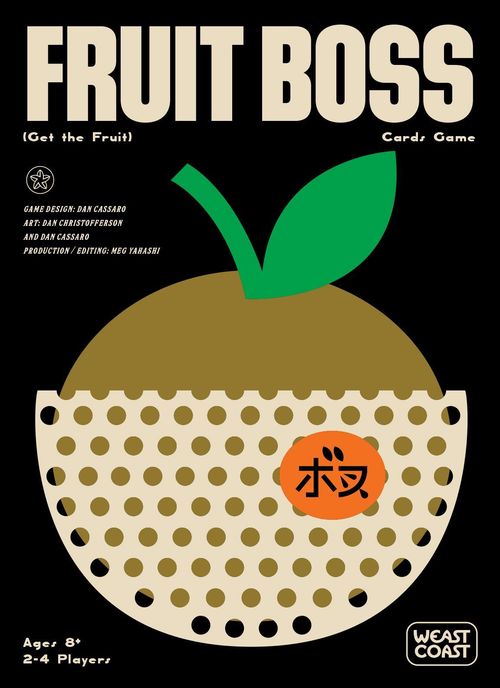
Fruit Boss
Fruit Boss Rulebook
Table of Contents
Table of Contents
Game Overview
Fruit Boss is played over multiple rounds. During each round you will collect stacks of fruit cards from the market for your private collection. You'll collect fruit by making adjacent stacks more valuable. Choose your produce wisely - you'll only score points for 3 fruit suits in your collection. And watch out for those cats! They will literally eat your profits.
Components
- 56 fruit cards in 7 suits (three 1's, two 2's and one 3, 4 and 5 of each).
- 3 Maneki-Neko cards.
- 3 Wild Star Fruit cards.
- 5 Stall cards.
Game Set-Up
For 2 player games, choose one suit to return to the box. (Recommended: tomatoes.)
For 3 and 4 player games, use all suits.
- Shuffle the deck and decide who goes first. In future rounds, the next player to the left goes first.
- Deal 5 cards to each player.
- Lay 5 cards face up in a row, forming the "market".
- Place a stall card below each card to denote the 5 "stalls" in the market.
- Place the remaining cards face down as a draw deck, where all players can access it.
The market is a row of 5 stacks, each above its stall card. A discard pile sits beside the draw deck.
Gameplay
The goal is to collect fruit stacks from the market to form high-scoring sets in your private collection. To collect a stack, you must create a more valuable stack in an adjacent stall. You can do this, or prepare to do this, by performing actions on your turn. There can only be one type of fruit in a stall at any given time, but that type will change over the course of the game.
Playing Your Turn
You may perform up to 2 actions on your turn. These can be the same action, or you can choose to end your turn after one action. Finish your turn by drawing back up to 5 cards.
- In the rare case that you are unable to perform any actions, discard your entire hand, shuffle the draw deck, and draw a new hand.
Market Refills
If at any point there is only one occupied stall or all stalls are empty, immediately draw from the deck to refill empty stalls in the market with single cards (just like you did during set-up). This may happen during your turn or after it.
Available Actions
- A. Add Fruit to the Market
- B. Combine Stacks
- C. Slide a Stack
- D. Play a Maneki-Neko
A. Add Fruit to the Market
Play one or several fruit cards of the same suit from your hand into one of the market stalls as a single action. You can increase the value of an existing stack, or start a new one. A stack's value is determined by adding the numbers on each fruit card in the stack.
- Cards played into a stack must match the suit of cards already in the stall.
- If a stall is empty you can play any type of fruit and start a new stack.
If the sum of the stack you added cards to exceeds that of an adjacent stack of 2 OR MORE CARDS, you will collect that lesser stack into your private collection. This is mandatory. If both adjacent stacks are collectible, you must choose one to collect. The collected stack goes into your private collection to be scored at the end of the round.
Example 001. By adding two lemons to this stack the player has increased its value to 5. They must now take the stack of plums into their private collection. (They may not take the adjacent orange because it only has one card in it.)
Pro tip: You may pay into the same stack twice as two separate actions, as a means of collecting 2 stacks of cards on opposite sides of the stall.
B. Combine Stacks
You may combine a stack of fruit already in the market with another stack of the same suit, creating a more valuable stack in one stall.
- Just as described in Action A, if the sum of the stack you combine exceeds that of an adjacent stack of 2 or more cards, collect the lower value stack into your private collection.
Example 002. By combining the orange cards into one stack the player has increased the value of a stack, and now takes the lemon pile into their private collection. In this way it is possible to collect cards without playing cards from your hand!
Remember: You can only collect stacks of 2 or more cards!
C. Slide a Stack
You may slide a stack across the market to an empty stall as long as there is room to do so. (You may slide through multiple empty stalls as a single action.)
- You cannot "jump" over an occupied stall when sliding.
- You may not collect stacks in this way. You can only collect a stack by adding cards on another stack to increase its value.
Example 003. This player is able to slide the watermelon stack across the market to a new stall in an unbroken line as a single action.
D. Play a Maneki-Neko
Maneki-neko are special. And hungry. If you use one as an action, it will "eat" one card of any value in the market, removing it for the rest of this round. Immediately put the Maneki-neko and the card it "ate" face up in a discard pile.
- If a Maneki-neko ends up in the market from the draw deck, you may capture it using the same methods as you would a fruit stack. Maneki-nekos have a value of 0, and they can be collected as a single card from the market. Instead of adding the card to your portfolio, immediately place it in your hand.
- "But I thought you could only collect stacks of 2 fruit cards minimum?" A cat is not a fruit.
Wild Star Fruit
Star Fruits are wild and count as whatever fruit they are stacked with, both in the market/portfolio. They can be played from your hand with other fruit cards, collected by themselves, or combined with other fruit in the market.
- If a stack of only star fruit is collected from the market, they must be applied immediately to a previously collected set of your choice in your portfolio. If your portfolio is empty, they will be assigned to your first collection of cards.
Toppling
Stacks can only go so high. If the card(s) you place on a stack bring the total number of cards in that stack to 5 or more, the stack immediately topples. When a stack topples, the cards in the toppled stack AND the cards in one adjacent stack are discarded from the market for this round.
- A toppling stack MUST topple an adjacent stack if one is available. If there are 2 stacks adjacent to the toppling stack, you choose which direction the stack gets toppled.
- You can never collect a stack if the cards you have played cause the stack to topple during your current action.
Example 004. By placing a fifth card on the lemon stack this player will topple that entire stack and will choose an adjacent stack to take down with it, either plums or the orange. The player may not take any fruit during this action.
Ending a Round
After the final card in the draw deck has been picked up, a fire sale is triggered. From this point on, players are allowed to collect single cards from the market while completing actions instead of the standard minimum of 2.
Once one player runs out of cards on their turn, everyone gets one more turn. The round is now over.
Scoring a Round
Players now group all similar fruit in their private collection into stacks and tally their score using the criteria below. The player with the most points is declared the winner for this round.
- To score a fruit stack, take the highest value card in that stack and multiply it by the number of cards in that stack. (Ex. a 5, 2, and 1 of Plums would score you 15 points.)
- If a Wild Star Fruit is in a stack, it counts as a fruit of that type.
- You may score only 3 unique fruit suit stacks in your portfolio. All other unique fruit suits in your collection are scored against you.
- Fruit Cards left in your hand are not part of your collection, but will also count against you as "wasted resources." Add up the value of your hand and subtract it from your total.
- A Maneki-Neko left in your hand will "eat" another card in your hand if there are any available.
Scoring Example
Three scoring stacks: 5x6=30, 4x3=12, 3x5=15 (+30, +12, +15). A fourth suit stack not among the best three scores against the player: 2x2=4 (-4). Cards left in hand: 2+1=3 (-3). Score: 50.
Winning the Game
Whoever has the most wins after a predetermined number of rounds is the Fruit Boss Champion. Your prize? A firm handshake from the boss. With eye contact.