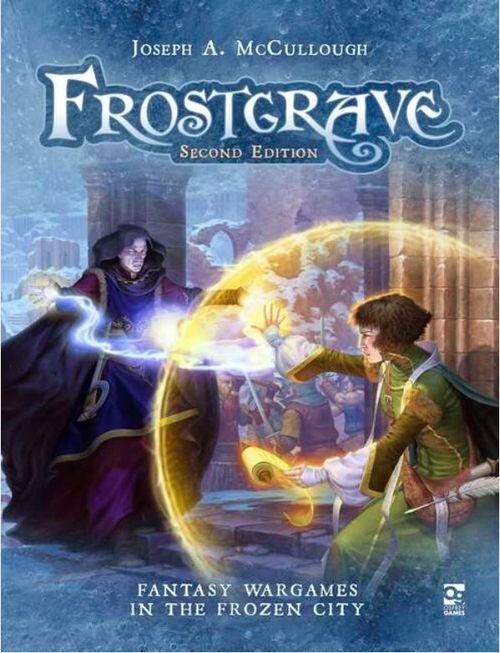
Frostgrave: Second Edition
Frostgrave: Second Edition Rulebook
Table of Contents
Table of Contents
Foreword
I love games that tell stories. And you won't find a miniatures game that does it better than Frostgrave. Every scenario has the potential for action and surprises that players will remember for the rest of their gaming days.
The scenarios in the core book drip with atmosphere – The Mausoleum, The Silent Tower, The Worm Hunts, The Well of Dreams and Sorrows, and all the others. The varied rules, the randomness of rogue creatures, and the near-infinite variety of spells and warbands makes every game a chance to tell a grand and epic tale in the story of the Frozen City… and add to your gaming group's long legacy of desperate victories and last-second defeats.
The very name of Joseph McCullough's epic game – Frostgrave – appeals to the adventurer in all of us. This is a place of frozen death. And that's another part of the genius. This is no mere skirmish game. This is a gritty world where any character can fall, yet still a fantastic narrative of wizards, warriors, monsters, and icy mayhem.
Setting all this in a unique location, the frozen city of Felstad, was a stroke of genius. It instantly sets it apart from other games in its imagery and terrain. The frosted grey walls of the buildings you might see at a convention quickly mark the table as Frostgrave's domain. This isn't just magic swords and sorcery – this is a frigid and beautiful tabletop search for epic treasure, all the while dodging snow trolls, giant worms, and packs of snarling, winter-white wolves.
And all that's just the core game.
Read the excellent stories in Tales of the Frozen City, with stories by Sarah Newton, Graeme Davis, and Ben Counter, just to name a few gaming luminaries, and immerse yourself in even more cold delight. Then venture into the catacombs with Into the Breeding Pits or play the campaign in my personal favourite supplement, Thaw of the Lich Lord. The imagery in the start of the latter, in the scenario Battle on the River, is one of the greatest I've ever played, chasing down treasures between the shattered hulks of ships – sunken and otherwise – on the frozen Meregile River. By the time you get to The Bone Wheel and The Final Battle against the Lich Lord you've not only told an amazing saga, you've had a legendary gaming experience.
I was lucky enough to work with Joseph McCullough soon after we published Savage Worlds. He wrote a scenario for us called Rise, Alabama! You could see his creativity right from the start. Now it's quite a few years later and I'm just as much a fan of his work as I was then. Frostgrave sets a high bar for me, as does its brilliant sequel, Ghost Archipelago, which I'm just now getting into.
If this edition is your first experience with Frostgrave, I'm envious. You have many great and memorable sessions ahead of you. If you're a veteran of Felstad's triumphs and tragedies, I'm there with you, ready to don a fur coat and magic sword and trek once more into the Frozen City. There are a lot more options and figures for the game now, and I've got my eye on some Frostgrave Gnolls. I'll see you on the ice, friend. Or in it.
— Shane Hensley, November 2019, Arizona, USA
Chapter One: Wizards and Warbands
Introduction
Welcome to Frostgrave, a narrative wargame in which the players take on the roles of powerful wizards and lead their small warbands into the frozen ruins of the city of Felstad in search of lost treasure, enchanted artefacts, and forgotten secrets of magic.
In this book you will find all the information you need to play the game, including rules for how to create your wizard and warband, how to set up a table, and how to fight for possession of those magic treasures. While these rules might look intimidating at first, especially if you have never played a wargame before, they are generally straightforward, and most people will have a pretty firm grasp of the rules after playing just a few turns.
Games of Frostgrave are generally quick, and once you have learned the rules you should have no problem completing a game in a couple of hours. Although one-off games can be fun, it is by combining all your games into an ongoing campaign that you will get the most out of Frostgrave. By playing through a campaign, you will watch your wizard grow in power and experience. You can also spend the treasure you acquire in games to expand your warband, acquire new spell books, and even establish a base of operations, equipping it with such resources as a magic laboratory, a summoning circle, and a celestial telescope.
While Frostgrave is designed to be a competitive game between two or more players, it is less concerned with being a tactical exercise and more interested in helping players achieve a shared sense of fun and adventure as their wizards battle their way through the numerous dangers of the Frozen City. The rules attempt to cover all the situations that are likely to occur during play but, without a doubt, there will be times when the exact rule for a given situation is unclear. In these cases, the first question to ask is: 'What would happen in the movie?' To put it another way, decide on the coolest, most dramatic, cinematic result and go with that. This is a game about high drama, big moments, and big explosions!
Always remember that these rules have been created for one purpose: for players to have fun. If there is any aspect of the game you want to change, any rules you want to add, or ideas you want to incorporate that will make the game more fun for you and your gaming buddies, then please do so! Having fun is the point of playing a game, after all.
On a clear night, you can see a green light near the top of one of the tall towers. It flashes like it's signalling someone, but who, and what about, is a mystery...
Why a Second Edition?
Frostgrave was designer Joseph A. McCullough's first real attempt at writing a wargame, and it contained all the inconsistencies, obscurities, and errors that might be expected of a game designer's first work. In the five years since its release he continued to work on Frostgrave, writing numerous supplements, magazine articles, and event-specific campaigns, and slowly compiled a list of changes that would significantly improve the gameplay. Setting out to create this new edition, the three main design goals were: (1) make the game more fun, not less; (2) make the rules clearer, more balanced, and more streamlined, but not at the cost of (1); and (3) keep all the supplements to the first edition useable and relevant.
For the first goal, every spell in the game was made desirable and useful, tightening wording and tweaking mechanics to increase direct player interaction — of the 80 spells presented in the first edition, about 20 were probably never used because they were too weak or too situational. For the second, numerous rules that never quite worked, or led to strange or unwanted results, were eliminated, and balance was improved both within a single game and over the course of a campaign. At its core, this new edition is the same game as the original, and experienced players will find far more that they recognize than things they don't — the few changes with knock-on effects on the first-edition supplements are minor and are outlined in the Appendix. The one major change is that this book presents twenty scenarios rather than the original ten, keeping all the beginner scenarios from the first edition while adding ten new, more advanced ones.
What You Will Need to Play
To play Frostgrave you will need several things besides this book: a table, miniature figures, a tape measure or ruler marked in inches ("), a couple of twenty-sided dice, a copy of the Wizard Sheet from the back of the book, and a pencil. Ideally, you will also have a selection of terrain pieces to recreate the ruins of the city on your tabletop.
Miniatures. Miniatures (or figures, or models) are toy soldiers made out of metal, resin or plastic. Official Frostgrave miniatures are available from North Star Figures (www.northstarfigures.com), and provide options for all the wizards and warband members in the game, as well as a host of creatures that might be encountered. It is not essential to use official miniatures — most fantasy miniatures on the market will do. Frostgrave was designed for use with 28mm miniatures, the most common size; larger or smaller sizes are acceptable provided all players use the same size. The race or exact appearance of a figure makes no game difference — while the setting assumes all wizards are human, the rules don't care if a warband is elves, orcs, dwarves, or anthropomorphic mice. Most wargamers mount their miniatures on 25-32mm bases, though base size makes no game difference. Frostgrave also uses treasure tokens, which can be anything from coins to bits of shiny paper, though miniature treasure chests, scrolls, or magic books enhance the look of a game.
Dice. Frostgrave uses a twenty-sided die (a d20) for all rolls. At a minimum, each player needs one d20.
The Table. Games of Frostgrave are normally played on square tables about 3 feet on a side. With more than two players, consider increasing the table up to 4' x 4'. A 2' x 2' table is probably the minimum needed to play, and tends to make for quicker, bloodier games.
Terrain. The Frozen City is a twisting maze of ruins and rubble, and the table should be filled with terrain accordingly. So long as there is a lot of "stuff" on the table for figures to hide behind, clamber over, and fight upon, the specific look of the terrain is not important — even a set of plain blocks will do.
The Wizard Sheet. In the back of the book is a copy of the Wizard Sheet, used to keep track of a wizard and warband. Each player needs a copy — photocopy it, or download one from the Osprey Games website (www.ospreygames.co.uk).
Creating a Wizard
Before you can play Frostgrave, you must create a wizard. The wizard represents you on the tabletop and is by far your most important miniature — all other figures are there in support of the wizard. To create a wizard, use a copy of the Wizard Sheet from the back of the book.
The first decision is a name, which has no mechanical impact and can be chosen at any point during creation. The next step is to select your wizard type: there are ten different types of wizard, each representing one of the ten schools of magic, and the choice should be based on what kind of magic most appeals to you. Below, each wizard type is described along with its typical behaviour and mode of dress (all generalizations — a wizard is free to act or dress contrary to the norm), followed by a table showing that school's relationship to the other nine. Each school is aligned with three others, neutral towards five, and directly opposed to one. The further a school is from a wizard's own, the harder it is to cast spells from it, and the numbers in the table are the casting penalty incurred. For simplicity, the same word is used for both the type of wizard and their school of magic (a Necromancer's school is technically "Necromancy," but either term is fine).
The wizard takes one look at this violet pool and sees all the bodies and bits of bodies floating in it. Then she hands me a jar and says 'get a sample'…
Wizard Type
Chronomancer. Chronomancers use magic to manipulate time itself. As the youngest branch of magic, it is less developed and less understood than any of the others, and thus potentially the most dangerous. Chronomancers tend to be gamblers and risk-takers – those who prefer a quick path to power. They have no specific style of dress, although they tend to like outfits that project a sense of power and often carry an intimidating weapon, even if they have little skill in using it. Given the powers they wield, Chronomancers are just as likely to appear ancient as eternally youthful, and some may display elements of both, such as a young face on an old body. Also known as: Timerider. Symbols: hourglasses, wheels.
| Chronomancer | Penalty | Schools |
|---|---|---|
| Aligned | +2 | Elementalist, Necromancer, Soothsayer |
| Neutral | +4 | Illusionist, Sigilist, Summoner, Thaumaturge, Witch |
| Opposed | +6 | Enchanter |
Elementalist. Elementalists are the most outwardly powerful type of wizard. Their magic is centred on controlling the four elements, usually in loud, explosive, and unsubtle ways. Their clothes tend to feature one bold colour (usually red, green or blue), and they are more prone to flashy decorations than other wizards – facial tattoos are not uncommon. Most Elementalists, especially those that specialize in the control of fire, tend to have short tempers. Also known as: Fire/Water/Wind/Earth Mage. Symbols: depictions of the four elements: fire, wind, earth, water.
| Elementalist | Penalty | Schools |
|---|---|---|
| Aligned | +2 | Chronomancer, Enchanter, Summoner |
| Neutral | +4 | Necromancer, Sigilist, Soothsayer, Thaumaturge, Witch |
| Opposed | +6 | Illusionist |
Enchanter. Enchanters are hands-on wizards who work their magic by investing it in objects or people. Many Enchanters are also craftsmen, such as carpenters or sculptors, who apply magic to the items they create. In appearance, Enchanters are often the least "wizardly" looking of all wizards, being just as likely to carry craftsman's tools as they are weapons or magic items. Also known as: Transmuter, Imbuer. Symbols: hands, tools.
| Enchanter | Penalty | Schools |
|---|---|---|
| Aligned | +2 | Elementalist, Sigilist, Witch |
| Neutral | +4 | Illusionist, Necromancer, Soothsayer, Summoner, Thaumaturge |
| Opposed | +6 | Chronomancer |
Illusionist. Sometimes derided for being mere stage magicians, an experienced Illusionist can be a dangerous foe. Illusionists use magic to fool the senses, cause confusion and fear, and convince people of things that aren't true. In dress, Illusionists are usually colourful, preferring bright, multi-coloured robes, cloaks, and hats. They rarely carry weapons or other magic equipment openly, preferring to produce these items out of thin air as and when they are needed. Also known as: Conjurer, Prestidigitator. Symbols: mirrors, rainbows.
| Illusionist | Penalty | Schools |
|---|---|---|
| Aligned | +2 | Sigilist, Soothsayer, Thaumaturge |
| Neutral | +4 | Chronomancer, Enchanter, Necromancer, Summoner, Witch |
| Opposed | +6 | Elementalist |
Necromancer. Necromancers study the magic associated with death, as well as the creation and control of undead creatures such as zombies and animated skeletons. They generally wear dark colours (most commonly black), and tend to have a sickly, unhealthy appearance. While Necromancers are not necessarily evil, there are few that have delved deeply into this school of magic without giving in to its corrupting influence. Also known as: Death Mage. Symbols: skulls, bones, scythes, sickles.
| Necromancer | Penalty | Schools |
|---|---|---|
| Aligned | +2 | Chronomancer, Summoner, Witch |
| Neutral | +4 | Elementalist, Enchanter, Illusionist, Sigilist, Soothsayer |
| Opposed | +6 | Thaumaturge |
Sigilist. Sigilists work magic through reading and writing. They are masters of languages, both living and dead, and can see the mystical patterns in writing of all types. Most famously, they are the writers of magic scrolls and books, storing energy within writing for later use. They are often physically weaker, bookish wizards and tend not to carry any weapons other than a staff, but often end up loaded down with books and scrolls. Also known as: Rune Reader, Scribe. Symbols: quills, runes.
| Sigilist | Penalty | Schools |
|---|---|---|
| Aligned | +2 | Enchanter, Illusionist, Thaumaturge |
| Neutral | +4 | Chronomancer, Elementalist, Necromancer, Soothsayer, Witch |
| Opposed | +6 | Summoner |
Soothsayer. The subtle magic of a Soothsayer allows the wizard to extend their senses beyond their body, including through time itself. They can reach into the past to learn the secrets of history or gaze into the future to catch a glimpse of things to come, and can even reach into the minds of other beings. There are very few young Soothsayers as the patience and concentration required favours the old. Soothsayers are most easily recognizable by their eyes, which are almost always very pale, and often possess a distant, empty gaze; they tend to wear an odd mix of clothing and equipment collected for its interesting history. Also known as: Seer, Fortune Teller. Symbols: five-pointed stars, crystal balls.
| Soothsayer | Penalty | Schools |
|---|---|---|
| Aligned | +2 | Chronomancer, Illusionist, Thaumaturge |
| Neutral | +4 | Elementalist, Enchanter, Necromancer, Sigilist, Summoner |
| Opposed | +6 | Witch |
Summoner. Summoners work their magic by opening doorways to different planes of existence, usually to bring forth creatures from these other planes to use as servants, although this is not the limit of this school of magic. The term "demon" refers to any being from another plane of existence – demons are not all necessarily evil, nor do they all have horns or hooves. That said, demons are rarely happy about being summoned, and the life of a Summoner is a dangerous one. Also known as: Diabolist, Demonologist. Symbols: pentagrams, concentric circles.
| Summoner | Penalty | Schools |
|---|---|---|
| Aligned | +2 | Elementalist, Necromancer, Witch |
| Neutral | +4 | Chronomancer, Enchanter, Illusionist, Soothsayer, Thaumaturge |
| Opposed | +6 | Sigilist |
Thaumaturge. Thaumaturges draw their magic powers from positive energy. Most, though not all, believe that this energy comes from some form of deity. These wizards are healers and protectors, who often spend as much time on good works as they do on the study of magic. Thaumaturges rarely carry any weapon other than a staff and some find even that a bit aggressive; in appearance, they usually wear plain, simple robes and favour hoods over hats, and wood and leather over gold and silk. Also known as: Invoker, Wonder Worker. Symbols: the Sun, triangles.
| Thaumaturge | Penalty | Schools |
|---|---|---|
| Aligned | +2 | Illusionist, Sigilist, Soothsayer |
| Neutral | +4 | Chronomancer, Elementalist, Enchanter, Summoner, Witch |
| Opposed | +6 | Necromancer |
Witch. Witches draw on the subtle powers of nature for their magic and specialize in the brewing of potions, casting of curses, and seeking aid from plants and animals. Contrary to popular belief, most witches are not ugly old women but can be found amongst all ages and genders. Witches do tend to be hoarders and always carry around a bag (or several bags) to collect various ingredients – bits of mistletoe, insects (live or otherwise), oddly shaped rocks etc. Also known as: Warlock, Hedge Wizard, Witch Doctor. Symbols: crescent moons, bats, cat's eyes.
| Witch | Penalty | Schools |
|---|---|---|
| Aligned | +2 | Enchanter, Necromancer, Summoner |
| Neutral | +4 | Chronomancer, Elementalist, Illusionist, Sigilist, Thaumaturge |
| Opposed | +6 | Soothsayer |
Choosing Spells
On the Wizard Sheet is a complete list of spells, organized by school of magic (explained in Chapter Four: Spells, page 108). All new wizards begin knowing eight spells, selected with the following limitations:
- Three spells must come from the wizard's own school of magic.
- One spell must come from each of the three aligned schools of magic.
- The final two spells can be selected from any of the five neutral schools, but each must come from a different school.
A starting wizard may never have a spell from their opposing school, though these can be learned later. When a spell is selected, write in its casting number on the Wizard Sheet — for starting wizards this is the spell's base casting number (Chapter Four) plus the penalty if the spell is from outside the wizard's own school. For example, an Elementalist spell attempted by a Soothsayer has a casting number equal to the spell's base casting number +4 (Elementalist is neutral to Soothsayer). As they participate in scenarios, wizards may learn more spells and improve the casting number of spells they know (Chapter Three: The Campaign, page 73).
The Stat-Line
Every figure in Frostgrave – wizard, soldier, or creature – has a stat-line of six stats:
- Move (M): the speed of a figure. The higher its Move, the further it can move each turn.
- Fight (F): the figure's ability in hand-to-hand combat, and its ability to avoid missile fire.
- Shoot (S): the figure's ability with missile weapons such as bows and crossbows. It does not influence spells which generate shooting attacks.
- Armour (A): how much physical protection a figure is wearing, including armour, shields, and magic protection, plus any natural armour a creature may possess.
- Will (W): the figure's determination, courage, and ability to resist spells.
- Health (H): the physical toughness of a figure and how much damage it can endure before it is badly wounded or killed.
Every wizard starts the game with the same stat-line:
| Starting Wizard | M | F | S | A | W | H |
|---|---|---|---|---|---|---|
| 6 | +2 | +0 | 10 | +4 | 14 |
Split Stats. Sometimes it is necessary to record two different values for one stat, shown as e.g. "+2/+3". The first number is always the figure's actual stat, and the second is its effective stat in the current circumstances — this occurs when a figure is using a magic item, under a spell's effect, or suffering an injury.
Items
All wizards, apprentices, and soldiers have at least one item slot: wizards have five, apprentices have four, and soldiers have one (in addition to whatever standard equipment is listed in their stat-line). A starting wizard chooses their items from the General Arms and Armour List (page 33), except that they may not wear armour or carry a shield, as these interfere with spellcasting. In a campaign, wizards can change their items after each game.
That's essentially it for creating a wizard — they're now ready to go. That said, it's a foolish wizard who ventures into the ruins alone; the next section covers assembling a warband of followers.
Assembling a Warband
Every starting wizard begins the game with 400 gold crowns (gc) to hire followers. A warband consists of a maximum of ten figures: a wizard, an apprentice, and eight soldiers, although a few rules allow additional members.
"Spellcasters" is used throughout this book to refer collectively to all wizards and apprentices, and any creatures capable of casting spells (these are extremely rare and generally appear only in specific scenarios).
The Apprentice
It costs 100gc for a newly created wizard to hire an apprentice. While not strictly necessary, going without would be unusual and unwise — apprentices offer a huge degree of tactical flexibility and are the only way to have a second spellcaster in the warband. Not having an apprentice does not increase the number of soldiers allowed.
Apprentice Stats. Instead of a fixed stat-line, an apprentice generates their stat-line as a function of the wizard's stat-line: subtract 2 from the wizard's Fight, Will, and Health, always using the wizard's actual stat (not their current effective stat).
| Determining the Apprentice Stat-Line | M | F | S | A | W | H |
|---|---|---|---|---|---|---|
| Wizard | Wizard -2 | Wizard | 10 | Wizard -2 | Wizard -2 |
| Starting Apprentice | M | F | S | A | W | H |
|---|---|---|---|---|---|---|
| 6 | +0 | +0 | 10 | +2 | 12 |
Apprentice Items. Apprentices have four item slots and choose starting items from the General Arms and Armour List; like wizards, they may not wear armour or carry a shield.
Apprentice Spells. Apprentices learn magic from their wizard and know the same spells, so only one set of spells need be tracked. Because the apprentice is still learning, and secretive wizards rarely share everything even with their own apprentices, apprentices use the same casting numbers as their wizard but with a -2 penalty to every roll to cast a spell.
The Soldiers
With the rediscovery of Frostgrave, several "boom towns" have formed around the outskirts of the city, teeming with men and women hoping to join a wizard and find riches in the ruins. Most have no actual combat training and are generally referred to as "soldiers"; those with high levels of training or specific skills are called "specialist soldiers" and require larger retainers and positions of authority.
Each wizard may recruit up to eight soldiers, of which a maximum of four can be specialists, paying the retainer cost on the tables below (a few soldiers are "free"). Each soldier has fixed stats that never increase except through magic, and a standard set of equipment listed in the Notes column — soldiers may not be given additional items from the General Arms and Armour List, and a lost standard item is replaced free at the end of the game. Each soldier also has one item slot for a potion, magic weapon, or magic item; a soldier may only carry a magic weapon or wear magic armour of the same type as listed in their notes (e.g. a thief, equipped with a dagger, could only use a magic dagger), which then replaces the mundane version and fills the one item slot. The stats given already incorporate any bonuses or penalties from a soldier's standard equipment.
| Standard Soldier Table | Move | Fight | Shoot | Armour | Will | Health | Cost | Notes |
|---|---|---|---|---|---|---|---|---|
| Thug | 6 | +2 | +0 | 10 | -1 | 10 | Free | Hand Weapon |
| Thief | 7 | +1 | +0 | 10 | +0 | 10 | Free | Dagger |
| War Hound | 8 | +1 | +0 |
| Specialist Soldier Table | Move | Fight | Shoot | Armour | Will | Health | Cost | Notes |
|---|---|---|---|---|---|---|---|---|
| Archer | 6 | +1 | +2 | 11 | +0 | 10 | 75gc | Bow, Quiver, Dagger, Light Armour |
| Crossbowman | 6 | +1 | +2 | 11 | +0 | 10 | 75gc | Crossbow, Quiver, Dagger, Light Armour |
| Treasure Hunter | 7 | +3 | +0 |
War Hounds. As animals, war hounds cannot pick up treasure tokens and have no item slots.
Apothecaries. Apothecaries start each game with a potion of healing (page 91). An apothecary may spend an action to give a potion to a member of the same warband within 1", provided neither is in combat; the figure receiving it counts as having drunk it, with effects applied immediately. This applies to any potion an apothecary carries, not just their free healing potion.
Creatures in Warbands
Some spells, and a few magic items, allow wizards to include creatures (anything in Chapter Six: Bestiary, page 176) in their warbands. The spell or item states whether the creature joins temporarily or permanently. A temporary member does not count against the warband's normal maximum size — it is an extra member for one game only. A permanent member takes the place of a soldier, counting toward the maximum warband size, and remains with the warband from game to game until killed or dismissed; the spell, item, or creature description states whether it counts as a standard or specialist soldier.
Among the spells are several "control spells" (Control Construct, Control Undead, Control Animal, and Control Demon). Figures affected by a control spell are always temporary warband members, and a spellcaster may only control one creature of each type at a time. Permanent warband members never count against this control limit, even of the same type (e.g. an Enchanter can have constructs in their warband and still "control" one during a game). Regardless of permanent or temporary status, a creature follows all the rules for a soldier, including activating in the Soldier phase, unless stated otherwise. Creatures have no item slots and may never carry items, but can carry treasure tokens unless stated otherwise.
General Arms and Armour List
Weapons and armour are broken down into set classes; the specific weapon inside a class makes no difference (a "hand weapon" might be a sword, axe, or mace). Some weapons have damage modifiers, added or subtracted to the damage inflicted after the winner of a combat has been determined (Chapter Two, page 38). A figure may carry more than one hand weapon but gains no bonus beyond having a backup. No figure may wear more than one type of armour or carry more than one shield at a time, though a figure wearing armour may also carry a shield.
- Dagger. A knife or other small weapon such as a light club. Daggers have a -1 damage modifier. The first dagger carried by a figure does not take up an item slot.
- Hand Weapon. Any weapon commonly wielded with one hand — swords, scimitars, hand axes, maces, light spears. No combat modifiers.
- Two-Handed Weapon. Heavy melee weapons requiring two hands — two-handed swords, battle-axes, polearms, large flails, heavy spears. +2 damage, but takes up two item slots.
- Staff. Known for defensive properties. -1 damage, and also gives the opponent a -1 damage modifier in hand-to-hand combat (not against shooting attacks). This category includes magic staffs.
- Bow. The most common missile weapon. Loaded and fired in a single action; maximum range 24". Requires a quiver (or magic ammunition) to use.
- Crossbow. Takes one action to load and one to fire; a figure may replace its movement action with a "reload" action instead. +2 damage modifier, maximum range 24", and starts the game loaded. Requires a quiver (or magic ammunition) to use.
- Quiver. Carries arrows or bolts; required alongside a bow or crossbow to make shooting attacks. A quiver may also hold one piece of magic ammunition without taking up an extra item slot.
- Unarmed. A figure with no weapons fights at -2 Fight and a -2 damage modifier. Creatures with no weapons listed in their notes fight with natural weapons and are never counted as unarmed.
- Shield. Any shield from a small buckler to a large tower shield. Grants +1 Armour, but may not be carried with a two-handed weapon or staff. Spellcasters may not carry shields.
Maximum Armour. Permanent warband members may never have an Armour stat greater than 15 — any combination of items, magic, or effects that would exceed 15 is treated as 15 instead. Creatures are not subject to this limit, even if they temporarily join a warband.
| General Arms and Armour Table | Damage Modifier | Maximum Range | Notes |
|---|---|---|---|
| Dagger | -1 | – | First dagger does not take up an item slot |
| Hand Weapon | – | – | – |
| Two-Handed Weapon | +2 | – | Takes up two item slots |
| Staff | -1 | – | -1 damage modifier to opponent in hand-to-hand combat |
| Bow | – | 24" | Load and fire as a single action; must have a quiver |
| Crossbow | +2 | 24" | Load and fire as separate actions; may reload in place of movement; must have a quiver |
| Armour | Armour Modifier | Notes |
|---|---|---|
| Shield | +1 | May not be carried with a two-handed weapon or staff |
| Light Armour | +1 | – |
| Heavy Armour | +2 | -1 Move |
Chapter Two: Playing the Game
Now that you have your wizard and their warband assembled, you are ready to get some miniatures on the table and start your explorations of the Frozen City! This chapter covers all the basic rules for the game including setting up the table, moving, fighting, casting spells, and how to control the creatures that often ambush wizards during their explorations.
Setting Up the Table
The first step in any game of Frostgrave is to set up the table. The easiest way is to turn to Chapter Five: Scenarios (page 138) and select a scenario, which will tell you how to set up terrain, place treasure, position creatures, and any special rules in effect.
Alternatively, players can ignore the scenarios and just play a "standard" game. In a standard game, the players take the terrain they have available and set it up in a mutually agreeable fashion. The ruins of Frostgrave are a dense labyrinth of broken buildings, collapsed walls, shattered statues, and patches of ice and snow — the exact nature of the terrain isn't important, but there should be a lot of it, leaving only a few avenues of open ground so it really shouldn't be possible for a figure on the ground to draw line of sight to any point more than a foot or so away.
Once terrain is set up, the players place five treasure tokens: one, the central treasure, in the exact centre of the table; then each player places one treasure token within 8" of the central treasure but no closer than 6" to any other treasure token; and finally each player places one more treasure token anywhere on the table, more than 9" from any table edge and more than 6" from any other treasure token (always counting vertical distance). Since you don't yet know which side of the table your warband will start on, be careful not to place a treasure token too close to one side.
After treasure is placed, each player rolls a die to determine which side of the table to set up on — highest roll (re-rolling ties) picks first. In a two-player game, the other player starts on the opposite edge; in multiplayer games, the next-highest roller picks second, and so on. Once sides are chosen, the player who picked first places all their figures within 3" of their table edge and no closer than 6" to either corner; the next player does the same, and so on. The dense terrain should ensure no figure can draw line of sight to an opposing figure or to the central treasure before it has moved — if this isn't the case, add more terrain.
Try the Corners. On very small tables (2' x 2'), or in four-way games on 3' x 3' tables, warbands might select starting corners instead of table edges, setting up within 4" of the corner. If starting from corners, treasure tokens should not be placed within 10" of any starting corner if possible.
The Turn
Games of Frostgrave are divided into turns, during which players activate all the figures in their warbands.
Initiative. At the beginning of each turn, all players make an Initiative Roll — a die roll, with the highest becoming the primary player for the turn, the next highest the secondary player, and so on. Ties are re-rolled.
Phases. Every turn is divided into four phases: the Wizard phase, the Apprentice phase, the Soldier phase, and the Creature phase. Once all four are complete, the turn is over and (if the game isn't over) players roll Initiative again for the next turn.
- The Wizard Phase. The primary player activates their wizard and 0-3 soldiers of their choice that started the phase within 3" and in line of sight of the wizard, in any order (the wizard needn't go first). The secondary player then does the same, and so on. A player with no wizard on the table may not activate any figures this phase.
- The Apprentice Phase. Very similar: the primary player activates their apprentice and 0-3 soldiers within 3" and in line of sight that were not activated in the Wizard phase (a figure may only be activated once per turn unless stated otherwise), then the secondary player does the same, and so on. A player with no apprentice on the table may not activate any figures this phase.
- The Soldier Phase. The primary player activates all remaining un-activated soldiers, one at a time in any order; then the secondary player does the same, and so on.
- The Creature Phase. All uncontrolled creatures are activated as specified by their own rules. Creatures that are warband members, temporary or permanent, count as soldiers for activation and so activate in one of the first three phases instead.
Activation. When activated, a figure may perform two actions, one of which can only be movement — the other can be a second move, fighting, shooting, spellcasting, or a special action. Order between the two doesn't matter. A figure need not take any or all its actions; it's fine to activate and do nothing. In situations limiting a figure to only one action, that action need not be movement. When activating soldiers in the Wizard or Apprentice phase, use their positions at the start of the phase, not after the wizard/apprentice has moved. A figure must complete all its actions before another figure is activated.
Group Activation. A player may declare a group activation during the Wizard or Apprentice phase, letting all figures activating that phase move first, before any of them take a second action (actions that normally replace a move, like reloading a crossbow, may not do so during a group activation). After all have moved, each may take its second action in any order the player chooses — e.g. a wizard and up to three soldiers all move, then the wizard casts a spell, then the three soldiers each take their second action. This is mainly useful to gang up on a specific enemy (see Multiple Combats) or to rearrange figures for better line of sight or to let figures pass one another in tight confines.
Stat Rolls. A figure may be called on to make a Stat Roll using one of its stats against a Target Number (TN) — e.g. "Make a Will Roll (TN16)." The player rolls a die and adds the stat; equal to or greater than the TN succeeds. For stats without a +/- (Move, Armour, Health), add the figure's current value (e.g. current Health, not maximum). A split stat uses the figure's current stat.
Automatic Success and Failure, and Maximum Bonuses. An unmodified roll of 20 on any Stat Roll (including Will Rolls to resist spells) is always a success, even if it would still fall short after modifiers; an unmodified roll of 1 is always a failure. No die roll of any type may ever receive a total bonus greater than +10 — treat a higher combined bonus as +10.
Movement
Whenever a figure takes two or more actions in an activation, one must be movement (with a few noted exceptions). The first move in a phase can be up to the figure's Move stat in inches; a second movement action (or even a third, rarely) can be up to half the Move stat. So a figure with Move 5 taking two move actions can move 7.5" (5 + 2.5), or 10" with a third action. Movement need not be a straight line, but distance is measured along the actual path taken, including vertical distance. When measuring, it is the front of the base that moves the maximum distance, with the rest of the figure placed behind that point.
Obstructions. Figures can climb over any obstacle at a cost of 2" per 1" (or partial inch) of height; unless a scenario says otherwise, all terrain may be climbed. If a figure ends its movement partway up a wall where the miniature can't physically be placed, leave it at the bottom and mark the height climbed with a die. Stairs and ladders built to be scaled may be climbed without penalty.
Rough Ground. Any terrain difficult to move over (snow, mud, rubble) — every inch or partial inch of movement through it counts as 2" toward total movement used.
Figure Facing. Figures can see in all directions and turn to face any direction at any time, without using an action.
Movement into Combat. Moving into contact with an enemy figure (an opponent or uncontrolled creature) puts a figure into combat — this doesn't force a fight (that still needs a fight action), but the two figures are locked together. A figure in combat may only take a fight action; it may not move, shoot, cast a spell, drink a potion, reload a crossbow, or use a magic item, which may leave it with only one action for the turn.
Forcing Combat. Whenever a figure moves within 1" of an enemy figure that is free to move (not in combat or unable to move due to a spell), that enemy figure may choose to force combat, immediately moving into contact with the active figure — this can happen at any point along the mover's path. Uncontrolled creatures always force combat when they can, unless stated otherwise.
Movement by Spell. Spells such as Leap or Teleport are not movement actions and aren't subject to rules on multiple moves, obstructions, or forced combat — though ending such a move within 1" of an opposing figure still triggers forced combat. These spells can move a figure out of combat.
Movement off the Table. A figure that moves off the table (to secure treasure or retreat) is out of the game and cannot return. Figures can never be forced off the table involuntarily (pushed back, spell effect, etc.) unless a rule specifically allows it — move it to the edge and leave it there instead. A temporarily controlled figure may be moved off the table only if carrying treasure, which is then secured for the controlling wizard.
Run For It! When activated, before taking any actions, a figure may declare it will run for it: it immediately moves up to 3" in any direction ignoring all movement modifiers, then its activation ends. It may not move within 1" of an enemy figure this way, and may not use this rule if activating in combat, in deep water, or entitled to no actions.
Jumping. A figure may jump any distance provided it moves an equal distance in a straight line first, with total movement (including the jump) not exceeding its permitted maximum for the activation; it may continue moving afterward if its Move stat exceeds 5. Otherwise, a figure may jump up to 1" without any run-up.
Falling. A figure that falls less than 3" is unaffected. A fall of 3" or more inflicts damage equal to the inches fallen × 1.5, rounded down (a 5" fall does 7 damage). A figure may choose to fall voluntarily as a movement action, counting against its movement allowance — if the fall exceeds its Move stat, the fall uses up all its actions. A figure standing closer than 1" to an edge that is pushed back 1" or more toward that edge falls automatically.
Swimming. Water is divided into shallow (counts as rough ground, no other penalty) and deep (assume shallow unless stated otherwise). To move in deep water a figure must swim: whenever it activates in deep water it makes a Swimming Roll — a Will Roll (TN5) modified by the Swimming Modifiers Table below. Success activates as normal; failure gives no actions this turn and inflicts damage equal to the amount by which the roll failed.
| Swimming Modifiers Table | Modifier |
|---|---|
| Light Armour | -2 |
| Heavy Armour | -5 |
| Shield | -1 |
| Carrying Treasure | -2 |
Deep water counts as rough ground for movement, and fighting in deep water gives -2 Fight to both combatants. Figures with the Aquatic, Amphibious, Ethereal, or Flying traits never need Swimming Rolls and suffer no water penalties. Creatures without these traits never intentionally enter deep water and ignore figures in it when moving. No figure may shoot a bow or crossbow while in deep water, but spells may be cast normally.
Combat
Once in combat, a figure may spend an action to fight (its only other real option is to do nothing, since figures in combat can't move, shoot, reload, drink potions, use items, or cast spells). Each figure makes a Combat Roll — a die roll plus its Fight stat and relevant modifiers. Higher wins and may inflict damage: the winner takes its Combat Roll, adds weapon damage modifiers, and subtracts the loser's Armour stat; a positive result is the damage inflicted, subtracted from the loser's Health. Some attacks include a damage multiplier (e.g. the ice toad's Powerful trait doubles damage), applied after base damage is calculated. Tied Combat Rolls mean both figures land their strikes simultaneously — both are winners and both may take damage.
Example: a knight (Fight +4, Armour 13, hand weapon) and a thug (Fight +2, Armour 10, hand weapon) fight. The knight rolls 13+4=17; the thug rolls 7+2=9. The knight wins and inflicts 17-10=7 damage.
After determining a winner and any damage, the winner chooses either to stay in combat or push back one of the two figures (their own or the opponent's) by 1" directly away from the other — unaffected by rough terrain, though walls block it, and a figure can be pushed over an edge this way. No figure may force combat on a figure being pushed back this way, nor force combat against a figure it just pushed back (or that just pushed it back) unless that figure subsequently moves closer. Uncontrolled creatures always choose to stay in combat unless stated otherwise. If pushed back, the figures are no longer in combat, and the figure that initiated the fight may take its second action (usually only movement, since it already took a non-movement action). A tied fight leaves both figures in combat with no push. A figure that wins against one opponent while still in combat with another may only remain in combat or push its opponent back — it cannot move away. Winning and pushing back is generally the only way to escape combat, barring an outside spellcaster changing the situation.
Multiple Combats. When a figure in combat with multiple opponents fights, it first nominates which opposing figure it's fighting, then the fight proceeds normally with this modifier:
| Multiple Combat Modifier | Modifier | Notes |
|---|---|---|
| Supporting Figure | +2 | Every friendly figure also in combat with the target figure, and not in combat with anyone else, gives +2, cumulative (three eligible supporters give +6, maximum +6 total). Only one figure per combat can end up with a supporting-figure modifier — if both figures in a fight are eligible, the modifiers cancel and both fight at +0; if one is eligible for more than the other, only the difference applies. |
Key points for messy multi-figure brawls: only the attacker and its declared target actually fight and can win, lose, or take damage; supporting figures don't need to spend an action to grant their bonus; modifiers from supporting figures always cancel out so neither side in a fight ever benefits from a bonus at the same time; and no Combat Roll bonus can ever exceed +10.
Combat Summary: (1) both figures make a Combat Roll (die + Fight stat + modifiers); (2) the higher roll wins; (3) add the winner's weapon damage modifiers; (4) subtract the loser's Armour stat; (5) apply any damage multipliers; (6) if the result is above 0, subtract it from the loser's Health; (7) the winner chooses to stay in combat or push either figure back 1".
Optional Rule: Critical Hits. A natural 20 on a Combat Roll (or Shooting Roll) is a critical hit — it automatically wins the fight even if the opponent's roll is higher, and deals +5 additional damage on top of normally calculated damage. Both figures can score critical hits and both then deal damage. If both a shooter and target roll natural 20s on a Shooting Roll, the shot simply misses. A few creatures are immune to critical hits — a "critical" against them still wins the fight and deals normal damage, but not the +5 bonus.
Shooting
A figure with a bow or crossbow may spend an action to make a shooting attack (only one per activation). The target must be in range (maximum 24" unless stated otherwise) and in line of sight — a line drawn from the shooter's head to the target's head or torso must be clear. The shooter makes a Shooting Roll (die + Shoot stat); the target makes a Combat Roll (die + Fight stat + shooting defence modifiers). If the Shooting Roll is higher, the target is hit; if the Combat Roll is higher or they're equal, the shot misses. Damage is figured the same way as melee: the Shooting Roll plus weapon damage modifiers minus the target's Armour.
Example: an archer (Shoot +2) fires at a thug (Fight +2, Armour 10) in the open. Archer rolls 8+2=10; thug rolls 2+2=4 — a hit, but 10 minus the thug's Armour 10 is 0 damage.
Figures in combat may not shoot or reload a crossbow. When a spell generates a shooting attack, it follows the same rules except the spellcaster adds the bonus given by the spell instead of their Shoot stat (e.g. Elemental Bolt adds +7).
Shooting Defence Modifiers. All are bonuses to the target's Combat Roll and apply to both magic and mundane shooting attacks.
| Shooting Defence Modifier | Modifier | Notes |
|---|---|---|
| Intervening Terrain | +1 | Cumulative per piece of intervening terrain between shooter and target. Terrain the target is in base contact with counts as cover instead; terrain the shooter is in base contact with doesn't count (though it may block line of sight). Other figures count as intervening terrain. |
| Light Cover | +2 | Target is in contact with solid cover obscuring up to half its body, or soft cover almost completely obscuring it. |
| Heavy Cover | +4 | Target is in contact with solid cover almost completely obscuring its body. |
| Hasty Shot | +1 | The shooter previously moved this activation. |
| Large Target | -2 | The target is particularly tall or broad (normally creatures with the Large trait). |
Shooting into Combat. It's impossible to target a specific figure in combat, but the combat itself can be targeted — the shooter rolls randomly to determine which figure in the combat is actually hit, and must then carry out the attack even against a friendly figure. Any combat with at least one visible figure can be targeted this way, even hitting a figure out of the shooter's own line of sight. Area-effect shooting attacks (like Grenade or Elemental Ball) instead roll separately against every figure in the combat, provided at least one figure in it is within the area.
Shooting Summary: (1) check range and line of sight, declare target; (2) shooter makes a Shooting Roll (die + Shoot stat); (3) target makes a Combat Roll (die + Fight stat + shooting defence modifiers); (4) higher wins; (5) a tie or target win means a miss; (6) if the shooter wins, add weapon damage modifiers; (7) subtract the target's Armour; (8) apply damage multipliers; (9) a result above 0 is subtracted from the target's Health.
Damage
Damage from any source is subtracted from a figure's current Health. Reduced to 0 Health or less, a figure is killed and removed from the table. In campaigns, such a figure may not actually be dead — its fate is checked after the game (page 73). Damage or attacks sometimes carry a specific type (e.g. "elemental damage," "magic damage"), relevant to magic items or creatures that mitigate or are only affected by certain types.
Poison. A figure that is poisoned, or takes at least one point of damage from a creature with the Poison trait, is reduced to one action per activation (any action, not necessarily movement) until cured — by any healing that raises its current Health, or by a spell/item that specifically cures poison — or until the end of the scenario, whichever comes first (a figure is assumed recovered by the next game). A figure can only be poisoned once at a time; further poisonings have no additional effect, and poison has no additional effect on a figure already limited to one action by another rule.
Optional Rule: Wounded. A figure reduced to 4 Health or less (regardless of starting Health) is wounded: one action per activation (any action) and -2 to all die rolls. Healing back above 4 Health removes the wounded state. A figure is never wounded while at its starting Health, even if that's 4 or less — it only becomes wounded on its first point of Health lost. Undead and Construct creatures are never subject to this rule.
Spellcasting
Wizards and apprentices may spend an action to attempt to cast a spell they know; with three actions somehow available in one activation, up to two spells may be attempted, but never more. A figure may not cast a spell while in combat. There's no limit on how many times a given spell can be cast in a game. Full spell details are in Chapter Four: Spells (page 108).
Success and Failure. The player announces the spell and its target, then makes a Casting Roll — a die roll compared to the spell's casting number. Equal or higher succeeds. A lower roll fails, the action is lost, and the spellcaster may take damage per the Spell Failure Table (spells cast Out of Game never cause damage, however badly failed).
| Spell Failure Table | Damage Taken by Spellcaster |
|---|---|
| Failed by 1-4 | None |
| Failed by 5-9 | 1 Damage |
| Failed by 10-19 | 2 Damage |
| Failed by 20+ | 5 Damage |
Empowering Spells. After the Casting Roll and any other bonuses/modifiers are applied, but before effects are determined, a spellcaster may trade Health for Casting Roll on a 1-for-1 basis (immediately taking that much damage). Empowerment can never raise a Casting Roll above 18 unless stated otherwise. Spells cast Out of Game may not be empowered. The most common use is spending just enough Health to turn a narrow failure into a success; empowerment can also push the roll higher than strictly needed, to make a spell harder to resist or to increase its effect (e.g. empowering Summon Demon to summon a major demon) — any such empowering must happen before the target's Will Roll to resist. Empowerment can also be used, after failing a Casting Roll by 20+, to reduce the failure margin (and thus the damage taken) — e.g. empowering a fail-by-20 down to a fail-by-19. Some magic items let a spellcaster empower without spending Health (detailed under their entries in Chapter Three).
Death by Spellcasting. A spellcaster may empower a spell all the way to 0 Health, but this removes them from the table before the spell's effects are determined — so any part of the spell that would have affected the caster no longer has a target (e.g. a Necromancer who empowers Steal Health to 0 Health is removed before gaining any Health back, though the target still resists and takes damage as normal).
Casting Roll Minimum. If a spell is successfully cast, but its final Casting Roll (including empowerment) is less than 14, treat it as 14 — this matters for spells that can be resisted.
Resisting Spells. Some spells can be resisted with a Will Roll: the target rolls a die plus their Will stat, and if this equals or exceeds the spell's Casting Roll (including empowerment), the spell has no effect — though the spellcaster still loses the action and any Health spent empowering. Making a Will Roll never costs an action. Spellcasters may also empower their own Will Rolls to resist, 1-for-1 with Health (or via magic items usable for empowering), with no upper limit. As with all Stat Rolls, a natural 20 is an automatic success and a natural 1 an automatic failure on a Will Roll, and neither can be empowered.
Cancelling Spells. A spell with an ongoing effect and no stated duration lasts until the end of the game. Spells cannot be cancelled or undone by the caster unless the spell specifically allows it, and are not ended by the caster leaving the table or being killed — only by an effect that specifically cancels spells, such as Dispel, Spelleater, or a bottle of null.
Targeting Figures in Combat. If a spell generates a shooting attack targeting a figure in combat, the caster rolls randomly to determine which figure in the combat is hit, as with normal shooting. Otherwise all spells may target figures in combat directly.
Casting Spells from Scrolls. A spellcaster with a scroll of a spell they don't know may spend an action to cast it: the scroll is destroyed and the spell succeeds automatically, treated as a Casting Roll of 14 regardless of the spell's actual casting number. If the scroll's spell is one they already know, it can be used as insurance: attempt to cast normally, and if the Casting Roll fails, discard the scroll to succeed anyway (treated as a Casting Roll of 14) with no damage taken, even after a natural 1. Spells cast from scrolls may never be empowered, and earn no experience. Non-spellcasters may not use scrolls.
Using Potions
On any activation where a figure is not in combat, it may spend an action (which can replace the movement action) to drink a potion. The effect is immediate and automatically successful, and unless stated otherwise lasts until the end of the current game; ongoing potion effects are cancelled by anything that cancels spells (Dispel, bottle of null) unless the potion says otherwise. Any figure that can carry an item can carry and use a potion. A figure may not give a potion to another figure except an apothecary. All potions are one-use and are removed from the Wizard Sheet after use.
Collecting Treasure
A figure in contact with a treasure token may spend an action to pick it up — not allowed if an enemy figure (rival warband member or uncontrolled creature) is within 1" of the treasure or the figure. A picked-up token moves with its carrier. A figure may carry only one treasure token at a time, and is slowed while doing so (Move halved); if it is also carrying a shield, two-handed weapon, staff, bow, or crossbow, it is further encumbered, at -1 Fight. A figure may spend an action (which can replace the mandatory move action) to drop a treasure token, moving figure and token apart so they no longer touch — any friendly figure may then pick it up (enemy figures can't, due to proximity). If a treasure carrier is killed, the token is left where it fell. A figure carrying treasure that moves off the table has secured that treasure for its wizard, and the figure and treasure are both out of the game.
Treasure has no in-game use — figures are too busy fighting to examine loot mid-battle; Chapter Three: The Campaign (page 85) covers determining what treasure actually is, after the game. Treasure tokens are not items and never take up an item slot, regardless of how many items a figure carries or can carry.
Creature Actions
Even a millennium under ice hasn't left Frostgrave uninhabited — see Chapter Six: Bestiary (page 176) for creature descriptions and stats. The last phase of every turn is the Creature phase, in which all creatures not part of a warband ("uncontrolled creatures") take their actions; creatures that are warband members, even temporarily, activate like soldiers instead (alongside a wizard or apprentice, or in the Soldier phase).
Like most figures, a creature may take two actions when activated. Powerful or intelligent creatures may have specific rules (detailed in the Bestiary or a scenario), but lesser, more common creatures follow a simple set of guidelines. Uncontrolled creatures never target or attack each other, and are not considered in combat with each other even base-to-base — but they will always force combat with a warband member that moves within 1" of them. Starting with the creature with the highest current Health, run each creature through the following steps for each of its two actions in turn (since the situation may change between them):
- Is the Creature in Combat? If yes, it fights (attacking the lowest-Health opponent if in combat with more than one, and choosing to stay in combat if it wins). If no, proceed to step 2.
- Is There a Warband Member in Line of Sight? If yes and the creature has a missile weapon and a warband member is in range, it shoots the closest eligible target and takes no second action. If yes and it has no missile weapon, it moves its full Move toward the closest visible warband member, climbing obstacles as needed, and moves into combat if possible (if it enters combat with an action remaining, return to step 1). If no, proceed to step 3.
- Random Movement. The creature takes an action to move its full Move distance in a randomly determined direction, halting early if it hits a wall, obstacle, or table edge (creatures never leave the table from random movement). If an action remains afterward, re-check step 2 — if still no target, the activation ends with no second action; otherwise proceed with step 2 as normal.
Random Directions. A simple way to pick a random direction: roll a d20 and read the arrow formed by the triangular facing above the number rolled.
Ending the Game
A game most commonly ends as soon as the last treasure token is moved off the table — all figures still on the table are assumed to make it home safely. A game can also end when only one player has figures left on the table (the rest killed or withdrawn): that player secures all treasure currently carried by their own figures, and rolls a die for each unclaimed treasure remaining on the table — 15+ secures it, 14 or less loses it. In the rare case that no player has any figures left, the game ends and all treasure on the table is lost. Some scenarios have specific objectives that end the game as soon as they're achieved. In non-campaign games, the player who secures the most treasure wins; in a campaign, most scenarios have no specific win condition, and each player decides for themselves whether their wizard "won" or "lost" the encounter.
Chapter Three: The Campaign
While it is perfectly fine to play a one-off game of Frostgrave, many players will find it much more satisfying to play a campaign of interconnected games. During a campaign, players use treasure to hire new soldiers, buy magic equipment, and improve their base, and wizards gain experience, allowing them to improve stats, learn new spells, and cast known spells more reliably. After each scenario, each player should follow these steps in order: Injury and Death, Out of Game Spells, Experience and Level, Counting Treasure, Spend Treasure.
Injury and Death
Frostgrave is a tough place and inevitably not everyone comes out alive. In a standard game, any figure reduced to 0 Health is dead; in a campaign, a figure at 0 Health is instead "out of the game" and its fate must be checked at the end.
Soldiers. Roll on the Soldier Survival Table.
| Soldier Survival Table | Result |
|---|---|
| 1-4 | Dead — removed from the Wizard Sheet, along with any items carried. |
| 5-8 | Badly Wounded — remains in the warband but sits out the next game, then returns at full Health. |
| 9+ | Full Recovery — returns for the next game at full Health. |
Wizards and Apprentices. Roll on the Spellcaster Survival Table; for a wizard specifically, the player may modify the roll by +1 after rolling.
| Spellcaster Survival Table | Result |
|---|---|
| 1-2 | Dead — see recruiting new warband members under Spending Treasure (page 103). |
| 3-4 | Permanent Injury — roll on the Permanent Injury Table; otherwise returns at full Health. |
| 5-6 | Badly Wounded — sit out the next game, or pay 150gc for medical treatment (100gc discount with an apothecary in the warband; a wizard without the gold may go into debt but may not spend any gold until the debt is repaid). |
| 7-8 | Close Call — no major injury, but loses all carried items (items from the General Arms and Armour Table are replaced for free). |
| 9+ | Full Recovery — returns at full strength next game. |
Permanent Injuries. A permanent injury is noted on the Wizard Sheet; if it penalizes a stat, record that stat as a split stat (e.g. Fight +3/+2 after a Crushed Arm). The first number is the spellcaster's true ability, used to check maximum stat, to generate an apprentice's stats, and for wizard level; the second is used for die rolls involving that stat.
| Permanent Injury Table | Injury |
|---|---|
| 1-2 | Lost Toes |
| 3-6 | Smashed Leg |
| 6-10 | Crushed Arm |
| 11-12 | Lost Fingers |
| 13-14 | Never Quite as Strong |
| 15-16 | Psychological Scars |
| 17-18 | Niggling Injury |
| 19 | Smashed Jaw |
| 20 | Lost Eye |
- Lost Toes. Permanent -1 to all Move Rolls. Can be received twice (cumulative -2); re-roll further results.
- Smashed Leg. Permanent -2 Move. Can be received twice (cumulative -4); re-roll further results.
- Crushed Arm. Permanent -1 Fight. Can be received twice (cumulative -2); re-roll further results.
- Lost Fingers. Permanent -1 Shoot. Can be received twice (cumulative -2); re-roll further results.
- Never Quite as Strong. Starts every game at -1 Health. Can be received twice (cumulative -2); re-roll further results.
- Psychological Scars. Permanent -1 Will. Can be received twice (cumulative -2); re-roll further results.
- Niggling Injury. Must spend 30gc on treatments before each game or start at -3 Health (10gc discount per apothecary in the warband). Received twice: 40gc/-4 Health; re-roll further results.
- Smashed Jaw. May only activate a maximum of two soldiers in its phase (instead of three). A second result drops this to one; re-roll further results.
- Lost Eye. -1 to Combat Roll when the target of a shooting attack. Two Lost Eye results leave the spellcaster effectively blind — unless Miraculous Cure (page 126) is successfully cast on them (a wizard may cast it on themself or their apprentice) during the following Out of Game spells step, the spellcaster must retire and is considered "dead."
Out of Game Spells
Some spells can only be attempted after a game (page 138) — these Out of Game (A) spells may be attempted at this point, once each by the wizard and once by the apprentice per relevant spell. They may not be empowered, cause no damage on failure, and earn no experience.
Experience and Level
Experience. Only wizards gain experience — never apprentices or soldiers. Achievements during a game (not from Out of Game spells) earn experience per the table below, up to a maximum of 300 experience points per game.
| Experience Table | Achievement |
|---|---|
| +5 | For each failed spellcasting attempt that damages the wizard or apprentice. |
| +10 | For each spell successfully cast by the wizard or apprentice (none for a spell with casting number 6 or less). |
| +40 | For each game in which the wizard participates. |
| +40 | For each treasure token secured by the wizard or warband. |
| +5 | For each uncontrolled creature killed by the wizard or warband (max +50/game; excludes creatures with their own scenario-specific reward, or creatures created/summoned by the wizard's own warband). |
Most scenarios provide additional ways to earn experience. After a game, total the experience gained and add it to the wizard's running total; every full 100 points may be converted into a level (banking unconverted experience is fine).
Level. Level is a numerical measure of a wizard's power — all starting wizards are level 0, and higher levels have better stats, more spells, and lower casting numbers. For every level gained, a wizard may improve a stat, improve a known spell, or learn a new spell. An apprentice's stats advance whenever the wizard's do (page 27).
- Improving a Stat. Improve one of Fight (max +5), Shoot (max +5), Will (max +8), or Health (max 20) by +1. Only one stat may be improved per post-game step, even after gaining multiple levels.
- Improving a Known Spell. Lower a known spell's casting number by -1, to a minimum of 5 (any spell can reach casting number 5 regardless of school). Only one spell may be improved per post-game step, even after multiple levels.
- Learning a New Spell. Learn a new spell for which the wizard has a grimoire in their vault (a just-learned spell cannot be improved until another game is played). As many new spells may be learned after a game as levels and grimoires permit.
Counting Treasure
In one-off games, treasure only determines the winner. In a campaign it drives progression. For each treasure token the warband got off the table, roll once on the Treasure Table. If the central treasure was recovered, the player may re-roll their first Treasure Table roll (must accept the second result) — this choice is made before any sub-table rolls.
| Treasure Table | Treasure |
|---|---|
| 1 | 50gc |
| 2 | d20 x 10gc |
| 3 | d20 x 20gc |
| 4 | 20gc, Potions (3) |
| 5 | 40gc, Potions (2) |
| 6 | 20gc, Scroll (1) |
| 7 | 40gc, Scrolls (2) |
| 8 | Magic Weapon/Armour |
| 9 | 20gc, Magic Weapon/Armour |
| 10 | 40gc, Magic Weapon/Armour |
| 11 | Magic Item |
| 12 | 20gc, Magic Item |
Gold Crowns. Add the amount to the wizard's treasury (spent per Spending Treasure, page 103).
Potions. Roll the indicated number of times on the Lesser Potion Table; a result of 19 or 20 there means roll again on the Greater Potion Table instead. Both tables list purchase and sale price, and the Greater table also lists an ingredient cost for brewing with the Brew Potion spell (page 114). Potions may be given to any item-carrying warband member (one item slot each), or stored in the vault or sold.
| Lesser Potion Table | Potion | Purchase Price | Sale Price |
|---|---|---|---|
| 1 | Potion of Healing | 75gc | 50gc |
| 2 | Potion of Strength | 100gc | 40gc |
| 3 | Potion of Toughness | 50gc | 30gc |
| 4 | Elixir of Speed | 50gc | 30gc |
| 5 | Potion of Invisibility | 100gc | 50gc |
| 6 | Explosive Cocktail | 100gc | 30gc |
| 7 |
| Greater Potion Table | Potion | Purchase Price | Sale Price | Ingredient Cost |
|---|---|---|---|---|
| 1-2 | Cordial of Empowerment | 500gc | 200gc | 200gc |
| 3-4 | Shrinking Potion | 500gc | 200gc | 200gc |
| 5-6 | Potion of Restoration | 2,000gc | 300gc | 750gc |
| 7-8 | Bottle of Dreams and Nightmares | 2,000gc | 300gc | 500gc |
| 9-10 | Shatterstar Draught | 1,500gc | 200gc |
- Bottle of Burrowing. The drinker may use remaining actions to move directly through terrain, but may not end its activation inside terrain.
- Bottle of Darkness. Shattered on the ground, it reduces line of sight to 12" for everyone for the rest of the game.
- Bottle of Dreams and Nightmares. Used by a wizard immediately before a game: Will Roll (TN12). Success grants an extra 50 experience after the game (not counted toward the 300 max); failure deducts 30 from experience earned that game (never below 0), and also from the 300 maximum (so a failed wizard can earn at most 270 that game).
- Bottle of Null. Opening it immediately cancels all spells in play (not summoned creatures, but it does cancel Control spells including the one inherent in Summon Demon); all spellcasters must Will Roll (TN14) or take 1 damage.
- Construct Oil. Used after a game on one construct in the warband, granting a permanent +1 Move. A construct may only benefit once.
- Cordial of Clearsight. The drinker ignores Beauty and Invisibility spells for the rest of the game, and an Illusionary Soldier is removed immediately if this figure moves into combat with it.
- Cordial of Empowerment. The next spell a spellcaster casts after drinking gets +4 to the Casting Roll but the caster suffers 2 damage, on top of the spell's other effects. Only one per game; may not be used for Out of Game spells.
- Elixir of Life. The rarest and most valuable potion — can never be bought, and only a fool would sell it. Used immediately after a game, it brings one figure that died that game back to life with no ill effects, ready for the next game.
- Elixir of Speed. +2 Move for the rest of the game (max Move 9).
Scrolls and Grimoires.
Scrolls. Roll once per scroll found on the Random Spell Table below. Scrolls only hold a spell in shorthand and cannot be used to learn a spell; they take one item slot, or may be sold for 30gc or stored in the vault.
Grimoires. Books, scroll-piles, tablets, or whatever form — a grimoire lets a wizard learn a spell they don't know. Roll once on the Random Spell Table when found; the grimoire sits in the vault until the spell is learned (Experience and Level, page 84) or sold — once learned, remove it from the Wizard Sheet. A wizard would never willingly sell a grimoire for a spell they don't know, but one for an already-known spell can be sold for 200gc.
| Random Spell Table | 1-5 | 6-10 | 11-15 | 16-20 |
|---|---|---|---|---|
| 1 | Animate Skull | Bones of the Earth | Strike Dead | Control Undead |
| 2 | Curse | Poison Dart | Animal Companion | Familiar |
| 3 | Fleet Feet | Slow | Crumble | Fast Act |
| 4 | Leap | Imp | Plane Walk | Control Demon |
| 5 | Wall | Call Storm | Scatter Shot | Destructive Sphere |
(Roll two dice: the first selects the column above, the second the row.)
Magic Weapons and Armour. Roll once on the table below for each Magic Weapon/Armour result. A magic weapon's damage bonus stacks on top of its base modifier (a magic crossbow with +1 damage deals +3 total; a magic dagger with +2 deals +1 total, since the dagger's base is -1). A figure may only carry one of each type at a time, and magic gear takes the same item slots as its mundane version (a magic dagger still doesn't use a slot as the first dagger). Magic weapons/armour may only be carried by a soldier who could already carry that type (e.g. a thug, not a thief, could carry a magic hand weapon) — it replaces the mundane version and fills the item slot (a two-handed weapon's two slots included). Spellcasters may carry any weapon type but no armour or shields. Magic gear can be stored in the vault and reassigned between figures between games. Any attack with a magic weapon counts as a magic attack, except bow/crossbow shots (unless firing magic ammunition). A figure benefits from only one magic weapon at a time even if carrying several. Elemental Absorption on worn gear halves (rounding up) any elemental damage taken.
| Magic Weapon and Armour Table | Weapon/Armour | Effect | Purchase Price | Sale Price |
|---|---|---|---|---|
| 1 | Hand Weapon | +1 damage modifier | 300gc | 125gc |
| 2 | Hand Weapon | +1 Fight | 500gc | 200gc |
| 3 | Hand Weapon | +2 Will | 300gc | 125gc |
| 4 | Two-Handed Weapon | +1 damage modifier | 300gc | 125gc |
| 5 | Two-Handed Weapon | +1 Fight | 500gc |
Magic Items. Covers all magic treasure that isn't a potion, scroll, grimoire, weapon, or armour — roll once per item. All magic items take one item slot and, unless stated, can be carried by soldiers (though spellcasting aids would be wasted on them). Only one of any given item type may be carried at once. Magic staffs count as magic weapons despite giving no combat bonus.
| Magic Item Table | Item | Purchase Price | Sale Price |
|---|---|---|---|
| 1 | Staff of Power (1) | 300gc | 150gc |
| 2 | Staff of Power (2) | 400gc | 200gc |
| 3 | Ring of Transference | 400gc | 150gc |
| 4 | Ring of Power (1) | 200gc | 100gc |
| 5 | Orb of Power (6) | 500gc | 200gc |
| 6 | Staff of Casting | 500gc | 200gc |
| 7 |
- Amulet of Resistance. Once per game, add +4 to a Will Roll to resist a spell, decided after the die is rolled.
- Boots of Speed. +1 Move.
- Construct Hammer. Fitted to a medium or large construct, treats it as carrying a magic weapon with an additional +1 damage modifier; a construct may only be fitted with one.
- Fate Stone. Once per game, re-roll any one Casting Roll, Stat Roll, Combat Roll, or Shooting Roll.
- Gloves of Casting. Once per game, +5 to one Casting Roll, declared before rolling.
- Gloves of Strength. +1 damage modifier on all successful hand-to-hand attacks.
- Horn of Destruction. Once per game, spend an action to blow it as a successfully cast Crumble spell.
- Ring of Slow Fall. Never takes falling/jumping damage, regardless of distance.
- Ring of Teleportation. Once per game, spend an action to teleport up to 8" within line of sight (not off the table, and not into or out of combat).
- Ring of Will. +1 Will.
- Robes of Arrow Turning. +4 Armour against bow and crossbow attacks.
- Staff of Casting. Roll on the Random Spell Table when found; gives +1 to Casting Rolls for that spell (pay for the staff before rolling to identify it, if purchased).
Spending Treasure.
Recruitment. New soldiers can be hired at the price on the Soldier Tables (pages 30-31), up to the warband maximum (still limited to four specialists). Removing a soldier just deletes them from the sheet (their magic item, if any, may be kept, but no other compensation). An apprentice can similarly be dismissed, typically only when suffering multiple permanent injuries.
New Apprentices. Cost = (wizard level - 6) x 10 + 160gc — a starting (level 0) wizard pays 100gc; a level 40 wizard pays 500gc.
New Wizards. A dead wizard at level 5 or below means starting a fresh Wizard Sheet and warband. At level 6+, the player may instead promote their apprentice to wizard: move them to the wizard section keeping current stats, with the new wizard's level equal to the old wizard's level minus 6 (so a level 6 wizard's apprentice becomes level 0; a level 15 wizard's apprentice becomes level 9). The promoted wizard casts with no penalty, moves in the Wizard phase, gains experience, and may hire their own apprentice. Items the former wizard was carrying are lost; everything else carried by the warband or in the vault becomes the new wizard's.
Buying and Selling. A grimoire for any chosen spell costs 500gc; one containing an already-known spell can be sold for 200gc (never a spell not yet known). Individual scrolls cost 250gc to buy (spell chosen, no roll needed) and sell for 30gc. Potions, magic weapons, armour, and items may be freely bought and sold at their listed prices.
Optional Rule: Black Market Contacts. After a game, each player rolls four times on the Treasure Table to see what their black-market contacts are offering (ignore any gold crowns in the results — a roll that's only gold crowns means nothing is on offer), then rolls the relevant sub-tables to identify the specific items, which may then be bought at listed price. If using a supplement's magic item lists, one of the four rolls may instead be a single roll on a table from that book.
Establishing a Base. Free, after a warband has played at least one game — the player simply declares a building type, each with its own benefit per the Base Location Table. Changing base after a game is allowed, but loses any upgrades bought for the old one.
| Base Location Table | Effects |
|---|---|
| Inn | Room for an extra soldier (can be a specialist) beyond the normal warband limit, though it stays home and cannot be used in a game (still capped at eight soldiers/four specialists in play). Which soldier stays home may be changed each game. |
| Temple | +3 to Miraculous Cure castings; roll a die after each game — 16+ grants a free potion of healing. |
| Crypt | +2 to Raise Zombie and Animate Skull castings, in-game or Out of Game. |
| Tower | +2 to Casting Rolls for Reveal Secret and Awareness. |
| Treasury | After each game, attempt to open a vault: roll one die — 2-16 adds that many gold crowns, 17-18 adds 100gc, 19-20 finds a treasure (determined as for a secured treasure token). |
| Brewery | All soldiers start each game with +1 Will; warband gains an extra 20gc after each game. |
| Library | After each game, roll one die — 15-18 finds a random scroll, 19-20 a random grimoire. |
| Laboratory | Wizard gains 20 experience after each game (not counted against the 300 max). |
Base Resources. Any number of resources can be added (each type only once) by paying its cost.
| Base Resource Table | Effect | Purchase Price |
|---|---|---|
| Kennel | Keep one war hound or wolf (Animal Companion) above the normal soldier limit (eight soldiers plus one). | 400gc |
| Giant Cauldron | +1 to Casting Rolls for Brew Potion. | 250gc |
| Enchanter's Workshop | +1 to Casting Rolls for Animate Construct and Embed Enchantment. | 400gc |
| Crystal Ball | +1 to Casting Rolls for Reveal Secret. | 250gc |
| Scriptorium | +1 to Casting Rolls for Write Scroll. | 200gc |
| Celestial Telescope | Once per game, add +5 to an Initiative Roll before rolling. | 250gc |
| Summoning Circle | Adds an Out of Game (B) option to Summon Demon and Control Demon (pages 133, 116) — cast Summon Demon then Control Demon before a game; if both succeed, a demon joins as a temporary member not counting toward warband size. Control Demon/Summon Demon may not be cast while this demon is in play. |
Chapter Four: Spells
There are 80 different spells available to the wizards of the Frozen City. Some are straightforward stat boosts or special attacks; others are far more subtle and can be used in a variety of ways to influence the outcome of a game. The Spell Cards at the back of the book order spells by school as a quick reference during play.
"Spellcaster" applies to either the wizard or apprentice throughout. A few spells, such as Absorb Knowledge, may only be cast by a wizard.
Spell Descriptions
Each spell is described in the same way: Name — School / Base Casting Number / Category — followed by its description.
- Name. How the spell is most commonly known; individual wizards may use different titles for flavour, but the common name should still be noted.
- School. The school of magic to which the spell belongs.
- Base Casting Number. The starting difficulty, to which any out-of-school penalty is added (Chapter One, page 17).
- Category. Determines when and how a spell may be used (a few spells offer a choice of category):
- Area Effect — affects an area, either within a distance of a target point or the whole table; area-effect attack spells roll a separate attack against each target.
- Line of Sight — targets anything within the caster's line of sight (including the caster), never beyond 24".
- Out of Game (A or B) — cannot be cast during a game; cast after (A) or before (B) a game instead. Both wizard and apprentice may attempt each relevant Out of Game spell once per game. These spells may never be empowered, cause no damage on failure, and earn no experience.
- Self Only — affects only the caster, never another figure.
- Touch — the caster must be within 1" of the target (which may be themselves).
We'd been fighting that other warband for a couple of minutes when, suddenly, there's this strange hissing noise and a hundred swords went flying overhead, like a silver river…
The Spells
Absorb Knowledge. Sigilist / 12 / Out of Game (A). Wizard only. Absorbs knowledge from a written work without reading it — the wizard immediately gains 40 experience (not counted against the game's maximum). May only be cast after a game in which the wizard was not reduced to 0 Health.
Animal Companion. Witch / 10 / Out of Game (B). Summons a permanent warband member chosen from bear (page 179), ice toad (page 180), snow leopard (page 182), or wolf (page 182), counting as a standard soldier. Animal companions get a permanent +3 Will. A spellcaster may only have one at a time.
Animate Construct. Enchanter / 10 / Out of Game (B). Assumes the spellcaster already built a construct; if cast successfully, it becomes a permanent warband member in place of a soldier. The size (small, medium, or large — page 183) must be declared before casting, applying a Casting Roll modifier: Small -0, Medium -3, Large -6. No limit on constructs beyond normal soldier limits; large constructs count as specialists, others as standard.
Animate Skull. Necromancer / 8 / Line of Sight. Places one animated skull (page 190), an uncontrolled creature, within 6" of the caster (even directly into combat). The caster cannot cast this again until the skull is removed, but may spend an action to cancel it early.
Awareness. Soothsayer / 12 / Out of Game (B). While this spellcaster is on the table, their warband adds +2 to Initiative Rolls (for determining the primary player only); stacks if both wizard and apprentice have cast it (max +4). Counts as an active spell and can be cancelled accordingly.
Banish. Thaumaturge / 10 / Line of Sight. All demons in line of sight must Will Roll (TN = Casting Roll). Failure with Will +4 or less reduces them to 0 Health immediately; Will +5 or higher instead deals damage equal to three times the margin of failure.
Beauty. Illusionist / 10 / Self Only. Any opposing figure that wants to move into combat with the caster, make a shooting attack that could hit them, or target them with a spell must first Will Roll (TN = Casting Roll), which spellcasters may empower as when resisting a spell; only one attempt per figure per turn. No effect on creatures (Bestiary) or war hounds.
Blinding Light. Thaumaturge / 8 / Line of Sight. Target Will Rolls (TN = Casting Roll) or cannot attack, shoot, or cast Line of Sight spells, and is reduced to Fight +0 and Move 1. It may re-roll at the end of each turn to cancel the effect.
Blink. Illusionist / 12 / Line of Sight. Target within 12" moves 4" in a random direction, unless it resists with a Will Roll (TN = Casting Roll); uncontrolled creatures always attempt this roll.
Bone Dart. Necromancer / 10 / Line of Sight. A +5 shooting attack (not magic) against a figure within 12" and line of sight.
Bones of the Earth. Necromancer / 10 / Line of Sight (max range 18"). A skeletal hand grabs the target's ankle, preventing move actions; any magic movement except Leap frees the figure, or it can fight the hand free (Fight +0, Health 1 — one point of damage destroys it; other adjacent figures may attack it or lend support; if the hand wins, it deals normal damage). Only affects a grounded target; no effect on Large creatures.
Brew Potion. Witch / 12 / Out of Game (B). Creates one chosen Lesser Potion (page 86). A wizard (only) may instead brew a Greater Potion (page 87) by declaring it, paying its ingredient cost, and casting with a -4 penalty; success creates the potion, failure loses the ingredients.
Bridge. Sigilist / 10 / Line of Sight. Creates a 6"-long, 2"-wide, effectively two-dimensional bridge/ramp/staircase entirely within line of sight — ends needn't share a plane or be anchored to terrain. Figures cross at normal movement rate. Only one bridge per caster at a time; the caster may cancel it as a free action on their activation, otherwise roll a die at the end of each turn — 1-2 and it vanishes (figures on it fall).
Call Storm. Elementalist / 12 / Area Effect. All bow and crossbow attacks are at -1 Shoot for the rest of the game; stacks with further castings (by anyone) up to -5 total.
Circle of Protection. Thaumaturge / 12 / Touch. Creates a 3"-diameter circle no demon or undead can enter or cross (they stop at its edge). One active circle per caster at a time; the caster needn't stay inside it. Cancel at end of any turn, or roll a die each turn end — 1-3 cancels it.
Combat Awareness. Soothsayer / 12 / Touch. +1 Fight and +1 Armour for the rest of the game; repeat castings on the same target do nothing further.
Control Animal / Control Construct / Control Demon / Control Undead. Witch (Animal) / Enchanter (Construct) / Summoner (Demon) / Necromancer (Undead), each 12 (Demon: 10) / Line of Sight. The target of the matching creature type Will Rolls (TN = Casting Roll); on failure it becomes a temporary warband member until the spell ends or is cancelled (an action). Only one creature of that type may be controlled by a spellcaster at once.
Crumble. Chronomancer / 10 / Line of Sight. Targets only inanimate structures (buildings, walls), punching a doorway-sized hole through a wall, or collapsing a floor beneath a figure above ground level (that figure must pass a Move Roll (TN22) or fall to the level below, taking damage). Completely destroys a Wall spell's wall if targeted, and cancels a Wizard Eye if cast on its terrain piece.
Curse. Witch / 8 / Line of Sight. Target suffers -2 to all die rolls; may Will Roll (TN = Casting Roll, at -2) at the end of each turn to cancel it. Cannot stack on an already-cursed target.
Decay. Chronomancer / 12 / Line of Sight. Causes a target's weapon to fall apart, useless for the rest of the game. No effect on magic weapons (even temporarily enchanted) or on creatures not specifically equipped with a General Arms and Armour List weapon.
Destroy Undead. Thaumaturge / 10 / Line of Sight. As Banish, but against undead: failure at Will +2 or less reduces to 0 Health; Will +3 or higher takes damage equal to three times the margin of failure.
Destructive Sphere. Elementalist / 12 / Area Effect. Every figure within 3" of the caster (not the caster) suffers a +5 elemental magic attack.
Dispel. Thaumaturge / 12 / Line of Sight. Immediately cancels one ongoing casting of any one spell (cannot unsummon a creature, but can cancel control of a temporary warband member).
Draining Word. Sigilist / 14 / Area Effect. Chooses one spell; all attempts to cast it are at -3 for the rest of the game. Only one Draining Word per caster, and only one active per target spell.
Elemental Ball. Elementalist / 12 / Line of Sight (16"). A +5 elemental magic shooting attack against an enemy figure and every figure within 1" and line of sight of it (rolled separately per figure, using the original target as the origin for cover/terrain). May not target a figure even partially obscured by another figure.
Elemental Bolt. Elementalist / 12 / Line of Sight (16"). A +7 elemental magic shooting attack against one figure.
Elemental Hammer. Elementalist / 10 / Line of Sight. Cast on a weapon — the next time its wielder wins a combat dealing at least 1 damage, it deals an extra 5 elemental magic damage (against a creature Immune to Normal Weapons, only that 5 damage applies). On a bow/crossbow, applies to the next attack only.
Elemental Shield. Elementalist / 10 / Self Only. Floating shield absorbs the next 3 points of combat or shooting damage, then is cancelled. Only one active at a time.
Embed Enchantment. Enchanter / 14 / Out of Game (A). Makes an active Enchant Armour or Enchant Weapon spell permanent, turning the item into true magic gear (taking a normal item slot).
Enchant Armour. Enchanter / 8 / Line of Sight. Cast on an armoured figure — their armour counts as magic and grants +1 Armour for the rest of the game. Repeat castings do nothing further.
Enchant Weapon. Enchanter / 8 / Line of Sight. Cast on one weapon — melee weapons count as magic with +1 Fight; bows/crossbows count as magic with +1 Shoot (but attacks with them still aren't magic attacks); may instead target one arrow/bolt (giving +1 Shoot and a magic attack for its one shot only). Only once per weapon; when both a magic weapon and magic ammunition are in play, the shooter picks one bonus, not both.
Explosive Rune. Sigilist / 10 / Line of Sight. Draws a glowing rune within 4" and line of sight; if any figure not in the caster's warband at game start moves within 1" of it, it explodes, hitting every figure (friend or foe) within 2" with a +5 magic attack (placing it within 1" of a figure doesn't trigger it immediately — that figure must move to set it off). Up to three runes per caster; cancel any or all at end of any turn, or if the caster is off the table, roll per rune each turn end — 11+ and it vanishes.
Familiar. Witch / 10 / Out of Game (B). Grants a familiar (any small creature, not necessarily depicted on the table) and +2 Health (write as a split stat). If the caster is reduced to 1 Health or less, the familiar is destroyed; Health reverts to normal at the start of the next game unless recast.
Fast Act. Chronomancer / 8 / Line of Sight. Cast on a warband member or uncontrolled creature (not the caster, and not a figure that already activated this turn) — it activates at the end of the current phase instead of its normal one.
Fleet Feet. Chronomancer / 10 / Line of Sight. +2 Move for the rest of the game; repeat castings on the same target do nothing further.
Fog. Witch / 8 / Line of Sight. Places a 6"-long, 3"-high, 1"-thick line of fog somewhere partly in line of sight and entirely within 24"; figures move through freely but line of sight cannot cross it. Each new turn, roll a die — 1-4 and it dissipates.
Fool's Gold. Illusionist / 10 / Line of Sight. Cast on a treasure-carrying figure — it Will Rolls (TN = Casting Roll) or the caster may take the treasure and move it up to 4" (must end within their own line of sight).
Furious Quill. Sigilist / 10 / Line of Sight. An animated quill harasses the target with no damage but -1 Move, -2 Fight, -4 Shoot, and -2 to Casting Rolls; on each activation the target may Will Roll (TN = Casting Roll) to catch and destroy it. Repeat castings on the same target do nothing further.
Glow. Illusionist / 10 / Line of Sight. Target is surrounded by light — all shooting attacks against it, from any source, are at +3 for the rest of the game. Repeat castings do nothing further.
Grenade. Enchanter / 10 / Line of Sight (14"). Explodes an object at a target point — every figure (including allies) within 1.5" suffers a +3 magic shooting attack, using the target point as origin for line of sight/cover.
Heal. Thaumaturge / 8 / Line of Sight (6"). Restores up to 5 lost Health (never above starting Health). No effect on undead or constructs.
Illusionary Soldier. Illusionist / 12 / Out of Game (B) or Touch. Adds an illusionary soldier as a temporary warband member — for the next game (Out of Game) or the rest of the current game (Touch) — of any Soldier Table type except apothecary. It can't pick up treasure or deal damage (though it may still push back an opponent it wins against, and can lend support), and is removed the instant it takes any damage. Only one per warband; which figure is illusionary must be revealed.
Imp. Summoner / 10 / Line of Sight. Places an imp (page 184) anywhere in the caster's line of sight, at least 3" from any other figure; follows normal uncontrolled-creature rules. Casting again vanishes the first imp.
Invisibility. Illusionist / 12 / Touch. Target becomes invisible — cannot be moved into combat, targeted by attacks or spells (though still hit by area effects), though the spell cancels if the target enters combat, casts a spell, or picks up treasure. May be cast on a treasure-carrying figure (both become invisible; dropping the treasure cancels the spell).
Leap. Summoner / 8 / Line of Sight. Cast only on a warband member — moves them up to 10" in a straight line or arc (no cornering), including vertically; ending above ground causes a fall with normal damage. Reduced to 5" if the target carries treasure. Cannot move the figure off the table or into combat, and the target takes no further actions that turn.
Mind Control. Soothsayer / 12 / Line of Sight. Target Will Rolls (TN = Casting Roll) or temporarily joins the caster's warband, activating normally; after each activation it re-rolls to break free. Only one active Mind Control per caster. The controlled figure can't be made to take self-damaging actions (like a >3" fall) but can be moved into combat and attack, and cannot be moved off the table. The caster may cancel it at the end of any turn. No effect on other spellcasters; affects any other figure unless noted immune.
Mind Lock. Soothsayer / 12 / Line of Sight. Target becomes immune to Mind Control and Suggestion for the rest of the game (cancelling any current Mind Control), and gains +2 Will for the rest of the game.
Miraculous Cure. Thaumaturge / 16 / Out of Game (A). Wizard only. Successfully removes all permanent injuries from one figure (however many times suffered); or heals a Badly Wounded figure to play the next game penalty-free; or (at -4 to the Casting Roll) attempts to resurrect a figure that died in the game just played, restoring it to play the next game with no penalty. Cast from a scroll, it cannot resurrect the dead.
Mud. Witch / 10 / Line of Sight. All ground within 3" of a target point becomes rough ground.
Petrify. Chronomancer / 10 / Line of Sight. Target Will Rolls (TN = Casting Roll) or gets no actions on its next activation, suffers -3 Fight (minimum +0), and cannot have Leap cast on it until after its next move action. Large creatures get +8 to resist.
Plague of Insects. Summoner / 10 / Line of Sight. A 1" cloud centred on and moving with the target afflicts every figure fully or partly within it (including the target) with -4 Fight, -4 Shoot (minimum +0), and -2 to Casting Rolls; the target may Will Roll (TN = Casting Roll) after each activation to cancel it, while others simply move away. Only one Plague of Insects can affect a figure at a time. Large creatures, undead, and constructs are immune.
Planar Tear. Summoner / 12 / Line of Sight. All figures within 2" of a target point Will Roll (TN = Casting Roll) or take 2 damage; demons that fail instead take damage equal to the Casting Roll.
Plane Walk. Summoner / 10 / Self Only. For the rest of the turn, the caster ignores terrain when moving (through walls, across chasms) and cannot be targeted by shooting or spells, nor be considered in combat or attacked — but also cannot pick up treasure or affect anything else, and drops any treasure carried. Casting it a second consecutive turn is at -5, a third at -10, a fourth or beyond at -15.
Poison Dart. Witch / 10 / Line of Sight. A +3 poisoned shooting attack (not magic) against the target.
Possess. Summoner / 12 / Line of Sight. Cast only on a permanent or temporary warband member (not the wizard, apprentice, or a demon) — it is possessed, gaining +2 Fight, +1 Armour, -2 Will, and counting as a demon (subject to Banish, Control Demon, Circle of Protection, etc.); it can't be part of a group activation. If removed from the game, check survival normally. Only one Possess active per caster.
Power Word. Sigilist / 14 / Area Effect. Chooses one spell; all rolls to cast it are at +3 for every spellcaster for the rest of the game. Only one Power Word per caster, and only one active per target spell.
Push. Sigilist / 8 / Line of Sight. Target suffers a +10 attack, but instead of damage is moved 1" directly away from the caster per point of damage (stopping at the table edge or terrain over ½" high; other figures step aside rather than blocking or being hit). Can push a figure upward if cast from below, inflicting falling damage if pushed off a height, and can push a figure out of combat; not a shooting attack, so no randomization against a target in combat.
Raise Zombie. Necromancer / 10 / Out of Game (B) or Touch. Adds one zombie (page 193) as a temporary warband member — deployed normally if cast before the game, or appearing in base contact with the caster if cast during one. Only one raised zombie per warband at a time; it can be recast once the current one is killed or leaves the table.
Reveal Secret. Soothsayer / 12 / Out of Game (B). Each successful casting before a game lets the player make two Treasure Table rolls (instead of one) for a single non-central treasure token after the game, and choose which result to keep.
Scatter Shot. Elementalist / 12 / Area Effect. A +0 elemental magic shooting attack against every enemy figure (rival warband or uncontrolled creature) within 12" and line of sight, including ones in combat (following normal shooting-into-combat rules).
Shield. Thaumaturge / 10 / Line of Sight. +2 Armour for the rest of the game (Maximum Armour rule still applies, page 36). Repeat castings do nothing further.
Slow. Chronomancer / 10 / Line of Sight. Target reduced to one action per activation (any action); may Will Roll (TN = Casting Roll) at the end of each activation to cancel it.
Spell Eater. Necromancer / 12 / Line of Sight. The caster takes 1 damage to cancel one ongoing casting of any single spell (cannot unsummon a creature, but can cancel control of one).
Steal Health. Necromancer / 10 / Line of Sight. Target Will Rolls (TN = Casting Roll) or loses 3 Health while the caster gains 3 (never above the caster's starting Health, even if the target had less than 3 to lose). No effect on undead or constructs. Targeting one's own warband member permanently ejects them from the warband as an uncontrolled creature for the rest of the game.
Strength. Enchanter / 10 / Line of Sight. +2 Fight. Repeat castings on the same target do nothing further.
Strike Dead. Necromancer / 18 / Line of Sight (8"). Target Will Rolls (TN = Casting Roll) or is reduced to 0 Health immediately; any figure, even a non-spellcaster, may empower this Will Roll. The caster loses 1 Health just for attempting it, regardless of outcome, on top of any failure/empowerment cost. No effect on undead or constructs.
Suggestion. Soothsayer / 12 / Line of Sight. Target immediately drops any carried treasure, and the caster may move it up to 3" (not into combat or self-damage); the target may Will Roll (TN = Casting Roll) to negate the whole spell.
Summon Demon. Summoner / 12 / Touch. Places a demon within 1" of the caster (not directly into combat), automatically under a Control Demon effect from the same caster (so this spell cannot be cast while already controlling a demon). Demon type depends on the margin of success: 0-5 imp (page 184), 6-12 minor demon (page 185), 13+ major demon (page 185). Rolling a natural 1 instead summons an uncontrolled demon placed in combat with the caster (1-10 imp, 11-17 minor demon, 18+ major demon on a further die roll); a natural 1 cannot be empowered, but the spell has no other empowerment cap.
Telekinesis. Enchanter / 10 / Line of Sight (16"). Moves a treasure token up to 6" while it stays in line of sight (it falls to the ground if it leaves line of sight). No effect on a treasure with special pickup requirements, one being carried, or the central treasure before it's first picked up.
Teleport. Illusionist / 10 / Self Only. Moves the caster anywhere within line of sight, ending their turn (no further actions); cannot be used to enter combat or leave the table.
Time Store. Chronomancer / 14 / Self Only. Requires two available actions — the first casts Time Store, and if successful the second is forfeited to bank a stored "extra action" usable during a future activation (giving that activation three actions total).
Time Walk. Chronomancer / 14 / Self Only. Wizard only. The wizard activates again in the Apprentice phase and the Soldier phase, in addition to normal activations — but cannot activate extra soldiers or join a group activation in these phases, and takes only one (any) action each time; further move actions after moving earlier in the turn are at half rate. Casting it in consecutive turns costs 8 damage immediately.
Transpose. Illusionist / 12 / Line of Sight. Swaps the positions of two figures, both in line of sight and within 12" of each other (the caster may swap with another figure). An opposing figure may Will Roll (TN = Casting Roll) to resist; friendly figures and uncontrolled creatures never resist.
True Sight. Soothsayer / 10 / Self Only. The caster and friendly figures within 6" see invisible figures and are immune to Beauty; an invisible figure within 6" has its Invisibility cancelled, and an Illusionary Soldier within 6" is removed from the table.
Wall. Elementalist / 10 / Line of Sight. Creates a 6"-long, 3"-high wall, part of it within 10" and line of sight (climbable as normal). Starting the turn after casting, roll a die at each turn's end — 1-4 and it vanishes.
Wizard Eye. Soothsayer / 8 / Line of Sight (12"). Cast on a flat-sided terrain feature — the caster may draw line of sight from it (180-degree field of vision) instead of their own figure for the rest of the game. Only one Wizard Eye per caster; damaging or destroying the terrain (e.g. via Crumble) cancels it, as does the caster at the end of any turn.
Write Scroll. Sigilist / 12 / Out of Game (A). Creates one scroll of a spell the caster knows or holds the grimoire for; it may be sold, given out, or stored in the vault.
Lightning struck the guy eighteen times in a row. That goes beyond 'bad weather'…
Optional Rule: Transcendence. A few wizards of old Felstad discovered how to move their souls to a higher plane, achieving a form of immortality — the greatest secret lost when the city fell, and one most wizards are searching for on some level. This optional rule gives a campaign an ultimate goal: once a wizard has learned all eight spells of their own school, finding (not purchasing) a grimoire for one of those known spells lets them exchange it for a grimoire of Transcendence.
Transcendence. All Schools / 20 / Out of Game (A). Wizard only. No school modifiers apply. After each game, the wizard may attempt to cast it once; success transports them to a higher plane, effectively "winning" the campaign. The group decides whether to end the campaign there or continue with remaining wizards to see if anyone else can also reach Transcendence — the winning player may create a new wizard and warband (probably at an advanced level) to keep playing, or, with the group's agreement, promote their apprentice (though that apprentice will likely be close to Transcendence themselves).
Chapter Five: Scenarios
The first time you play Frostgrave, it is probably best to just play a standard game as described in the basic rules. Once you've got a handle on the mechanics, however, you'll probably want to move on to playing scenarios, which represent unique and interesting encounters and give players the chance to earn more treasure and experience, often at the cost of greater danger. Roll for a random scenario below, or agree on one. In an ongoing campaign, scenarios should be treated as unique — no player should play the same one twice. Many scenarios offer additional experience rewards, each earnable only once per player unless stated otherwise. All scenarios assume a "standard" table crowded with terrain; each lists any specific items needed. The scenarios are roughly ordered by complexity — try one of the first ten before moving on to the rest.
| Random Scenario Table | Scenario |
|---|---|
| 1 | The Well of Dreams and Sorrows |
| 2 | The Mausoleum |
| 3 | The Silent Tower |
| 4 | The Library |
| 5 | The Living Museum |
| 6 | The Worm Hunts |
| 7 | The Haunted Houses |
| 8 | The Genie in the Bottle |
| 9 | The Keep |
| 10 | The Complex Temple |
| 11 | The Orb |
| 12 | The Ice Storm |
The Well of Dreams and Sorrows
There have been reports of a well, somewhere in the city, that grants visions of the future…
Set-Up. Requirements: Well. Place a well in the middle of the table, crowded with terrain as normal. Place the central treasure token 6" from the well, equidistant between the starting table edges; place the other tokens normally.
Special Rules. A spellcaster in contact with the well may spend an action to drink from it. A figure knocked into the well is immediately reduced to 0 Health.
Treasure and Experience. The central treasure grants no special bonus here. Experience as normal, plus: +50 XP if the wizard drinks from the well; +30 XP if the apprentice drinks from the well.
The Mausoleum
The rival warbands have stumbled across the mausoleum of some ancient necromancer. It is overflowing with both treasure and the undead…
Set-Up. Requirements: Mausoleum, skeletons. Place a square or rectangular building (sides around 6") in the centre, with a door in the middle of each wall. No central treasure — instead place four treasure tokens touching the building's four exterior corners; each player places one additional token within 9" of the building. Place one skeleton (page 191) in front of each door, and one adjacent to each additional token.
Special Rules. At the end of every turn, right after the Creature phase, another skeleton emerges from a randomly determined door.
Treasure and Experience. Roll for treasure and experience as normal.
The Silent Tower
The warbands come across a ruined tower that sends an icy chill down the spines of all spellcasters. They can feel that this tower is a null-field, where no magic will work. And yet, somehow, they know that a great treasure is hidden at the very top…
Set-Up. Requirements: Tower, two small buildings, connecting walkways. Place a ruined tower (at least 10", three floors) centrally, with two smaller ruined buildings on either side connected by walkways to the tower's first or second floor. The central treasure goes on the tower's top; four more tokens placed normally. No treasure on or within 6" of the tower can be targeted by spells.
Special Rules. The tower and connected buildings form a null-field: no spells or magic items work inside or touching them, magic weapons count as mundane, potions and scrolls do nothing, and any spell on a figure entering the field is cancelled. No one in or touching the tower can be targeted by a spell (a magic missile weapon can still hit them, but loses its magic bonus for that attack). No magic movement may move a figure into contact with the tower.
Five bloody handprints stained the wall. They were in a neat row, but each handprint had one less finger than the one before it…
Treasure and Experience. Roll for treasure as normal, plus: +40 XP if the wizard sets foot inside the tower; +20 XP if the apprentice does.
The Library
The warbands have discovered an underground library. Most of the books are either frozen solid or have been ruined by the damp, but there are a few treasures to be found…
Set-Up. Requirements: None. The whole table is a maze of shelving corridors that block line of sight and movement (but can be climbed), with rough ground where books and papers have piled up. Each of the four table sides has a doorway; warbands start within 6" of their side's doorway. Place treasure normally.
Special Rules. Figures may only exit through a doorway. The central treasure is frozen to the floor — a figure in base contact must spend an action and pass a Fight Roll (TN14) to break it free before it can be picked up or moved by any means.
Treasure and Experience. The central treasure's recoverer gets a free random scroll on top of the normal roll. For every other treasure token, re-roll any result that isn't a scroll or grimoire and keep the second result. No special experience bonuses.
The Living Museum
Following the rumours of a mad wizard's library, the warbands have been drawn to the ruins of a house. Unfortunately, the wizard had a very strange collection of statues…
Set-Up. Requirements: Five statues. Place four broken walls forming a rough 12" square centrally, with five statues inside forming an "X." Place a treasure token adjacent to each statue (the central treasure by the central statue); fill the rest of the table as normal.
Special Rules. Picking up a treasure requires a Will Roll (TN8) first; failure loses the action. Success picks it up and animates a randomly determined statue into a medium construct (page 183), an uncontrolled creature.
Treasure and Experience. Roll for treasure as normal, plus: +10 XP per medium construct destroyed by the wizard or warband (replacing the normal +5 for killing an uncontrolled creature).
The Worm Hunts
It all started out as a normal day in the frozen ruins but, unbeknownst to the warbands, something was stalking them below the ground...
Set-Up. Requirements: Giant worm. Standard set-up.
Special Rules. Each Creature phase, the primary player rolls a die, +1 per treasure token already picked up; on 16+ a giant worm (page 187) bursts up adjacent to a randomly chosen treasure token (even one being carried), placed at the primary player's discretion. Only one worm appears this way.
Treasure and Experience. Roll for treasure as normal, plus: +20 XP if the wizard or warband damages the worm; +50 XP if they kill it.
The Haunted Houses
These small stone houses used to be the cells of an ancient order of monks. No-one knows what treasure or dangers they may contain…
Set-Up. Requirements: Five stone huts, ghouls, wraiths. Place five small huts — one centrally, four about 6" out. Central treasure in the central hut, a normal token in each other hut; fill the rest of the table as normal.
Special Rules. The first time a warband member enters a hut (or its treasure is moved, e.g. by Telekinesis), roll a die: 1-6 empty, 7-17 a ghoul (page 191), 17-20 a wraith (page 192), placed against the wall opposite the entrance, activating next Creature phase as an uncontrolled creature.
Treasure and Experience. Roll for treasure as normal, plus: +15 XP per creature discovered in a hut by the wizard or warband.
The Genie in the Bottle
While searching the ruins, one warband discovers a golden lamp that contains a very old and very angry genie. It has no interest in granting wishes...
Set-Up. Requirements: Genie. Standard set-up; the central treasure is treated as a normal token.
Special Rules. When a treasure token is picked up, roll a die: 15-20 means that figure has found the lamp and released the genie, placed within 2" of that figure (closer to it than to anyone else) by the discovering player. If four tokens are picked up without the genie appearing, the fifth token is the genie automatically. The genie is a major demon (page 185) with M7, F+3, S+3, A13, W+5, H14, Demon, Immune to Normal Weapons — only magic weapons or spells harm it (a mundane hit still wins the fight but deals no damage). It follows standard uncontrolled-creature rules except: if called on to shoot, it makes a +3 elemental magic shooting attack at the closest warband member; and once it has killed three warband members, it moves toward and off the nearest table edge instead, using its second action to shoot along the way, and is removed once it exits.
Treasure and Experience. No bonus for the central treasure. The lamp itself sells for 250gc. Roll for other treasure as normal, plus: +30 XP for the wizard whose warband discovers the genie; +50 XP if the wizard or warband kills it.
The Keep
Almost nothing still stands of the large fortified house, except for the ancient transportation system...
Set-Up. Requirements: Four arcane discs. Place four 2-3"-diameter discs forming a cross, opposite discs about 12" apart; fill the rest of the table as normal. Central treasure in its normal spot, plus one token centred on each disc.
Special Rules. Any figure ending a move on a disc (including magic movement) immediately rolls a die: 1-5 teleports to the disc on its left, 6-10 to the opposite disc, 11-15 to the disc on its right, 16-20 stays put (the figure chooses its exact spot on the new disc). Treasure on a disc cannot be targeted by spells.
Treasure and Experience. Roll for treasure as normal, plus: +30 XP if the wizard is transported between discs; +20 XP if the apprentice is.
The Complex Temple
The priests of a long-forgotten god collected many treasures, but they also knew how to guard them...
Set-Up. Requirements: Six columns. No treasure tokens placed initially — instead place six columns about 3" apart centrally; fill the rest of the table as normal.
Special Rules. A figure moving into contact with a column must immediately fight it (Fight +0). If the column wins, it deals normal damage; if the figure wins, remove the column and replace with a treasure token, which the winning figure may pick up as a free action.
Treasure and Experience. Roll for treasure as normal, plus: +30 XP if the wizard fights a column; +20 XP if the apprentice does.
Additional Scenarios: the twenty scenarios here are only the beginning — Frostgrave's supplements add dozens more, and players are heartily encouraged to invent their own using these as a model, provided any special effects apply equally to all players.
The Orb
Back in the days of ancient Felstad, many wizards kept their most valuable treasures sealed inside glass orbs. Unless a thief knew the password to unlock the orb, they would have to risk a deadly shock…
Set-Up. Requirements: Orb, four winged imps. Place an orb centrally; fill the rest of the table as normal. No central treasure placed initially; other tokens placed normally. Place four winged imps 6" from the orb at the corners of a square.
Special Rules. A figure in contact with the orb may spend an action to attack it (Fight +3, Armour 18, Health 1) — the orb is immune to shooting, including magic shooting. If the orb wins, the attacker is damaged and pushed 4" away; if the attacker wins and deals at least 1 damage, the orb is removed and replaced with the central treasure; any other result does nothing. The four winged imps use standard imp stats (page 184) plus the Flying trait and act as uncontrolled creatures.
Treasure and Experience. Roll for treasure as normal, plus: +25 XP if the wizard or warband destroys the orb.
The Ice Storm
The storm has been brewing for a while, but you pushed on. Now, as you step into a ruined plaza, the wind begins to howl. Suddenly, all around, icicles snap off the ruins and go spinning through the air, hurled by the wind…
Set-Up. Requirements: None. Standard set-up.
Special Rules. The central treasure is chained down: a figure in base contact must spend an action and pass a Move Roll (TN18, +4 for thieves and treasure hunters) to pick the lock, after which it can be picked up as a free action. At the end of every turn, each player selects a non-spellcaster figure on the table (even their own, or an uncontrolled creature, if that's the only option) and makes an immediate +2 attack against it as an icicle strikes.
Treasure and Experience. Roll for treasure as normal, plus: +20 XP for each member of the wizard's own warband reduced to 0 Health by an icicle.
The Summoning Bell
It has been a long trudge through snow and dirty slush, and just when you are thinking it might have all been in vain, you spot the glint of gold ahead. You are just about to signal your soldiers to advance when a bell begins to toll…
Set-Up. Requirements: Bell tower, lots of monsters. Place a bell tower (at least two floors) centrally with a large bell on top; fill the rest of the table as normal. Central treasure adjacent to the bell; other tokens placed normally. After warbands deploy, roll on the Random Encounter Table (page 177) once for each table corner and place the result there.
Special Rules. Don't roll random encounters for treasure pickups in this scenario; instead roll twice on the Random Encounter Table at the end of each turn while the bell still rings (once per turn after it stops). To silence the bell, a figure adjacent to it spends an action and passes a Will Roll (TN16). The central treasure cannot be picked up or moved until the bell stops.
Treasure and Experience. Roll for treasure as normal, plus: +40 XP for the wizard whose warband stops the bell.
The Right Hand and the Left Hand
Having pushed your way through the ruins of the temple complex, you find yourself in a courtyard dominated by a low pyramid surmounted by a shining golden statue. You don't recognize the god or saint represented by the statue, but there is something unnerving about its closed eyes and the way its two hands point in opposite directions…
Set-Up. Requirements: Step-pyramid, statue. Place a three-tier step-pyramid (e.g. 8"x8", 6"x6", 4"x4" tiers, ~3" tall each) centrally with a golden statue on top; fill the rest of the table as normal. No central treasure placed initially; other tokens placed normally.
Special Rules. At the end of each turn, the statue casts on the two warband members closest to it and in its line of sight: roll a die per figure — 1-10 a +5 elemental shooting attack, 11-20 up to 5 Health restored (never above starting). If only one figure qualifies, only one spell (randomly determined) is cast. As soon as any figure contacts the statue, place the central treasure in contact with both figure and statue.
Treasure and Experience. Roll for treasure as normal, plus: +10 XP if the apprentice steps onto the pyramid; +20 XP if the wizard does; +30 XP if the wizard or warband triggers the central treasure's placement.
The Treasure Phantasmal
You've felt a growing chill the further you pressed into this section of the ruins. Although the sun is bright, and the sky cloudless, the world seems dim and grey, and there are far too many shadows. Even the snow and ice does not shine the way it should…
Set-Up. Requirements: Wraiths. Standard set-up, plus a wraith (page 192) adjacent to the central treasure.
Special Rules. The central treasure cannot be picked up or spell-moved while the adjacent wraith lives; that wraith stays dormant until a warband member comes within 6" or it is moved by a spell, then acts normally each Creature phase. No random encounters in this scenario — instead, the first time any treasure token is picked up, roll a die: 10+ places a wraith 8" away in a random direction as an uncontrolled creature. Any figure carrying a treasure token (including central) must Will Roll (TN10) on activation or be forced to make one move directly toward the table centre (climbing and fighting into combat as needed); reaching the centre drops the treasure and ends the activation.
Treasure and Experience. +25gc per treasure token recovered, on top of normal rolls. Experience as normal, plus: +5 XP per wraith that appears; +10 XP for the wizard whose warband first grabs the central treasure; +10 XP per wraith killed by the wizard or warband.
The Mine Cart
You have stumbled into the ruins of some ancient factory complex. The floor is littered with broken machines, piles of scrap metal, and shattered crates. A track of some kind runs through the heart of the factory, emerging from one wall and disappearing into another. As you move deeper into the complex, you hear a horrible screech of metal and see a strange cart come rushing down the track…
Set-Up. Requirements: Track, several mine carts, small constructs. Lay an obstacle-free track straight through the table centre, dividing it in half, with a designated "start" and "end"; fill the rest as normal. Central treasure just to one (randomly determined) side of the track centrally; each player places one token within 8" of it. One small construct (page 183) adjacent to the central treasure. Warbands deploy on opposite sides of the track (or corners, for three/four players).
Special Rules. This is one large interior building — figures may only exit via any player's starting table edge. The central treasure sits under an overturned mine cart: a figure adjacent spends an action and passes a Fight Roll (TN14) to move the cart, letting it pick up the treasure as a free action (or leave it for later normal pickup); failure allows retries. At the end of the first turn, the primary player rolls a die and places a mine cart that many inches from "start" (even roll: containing a treasure token; odd roll: containing a small construct). Every subsequent turn end, the primary player rolls again, adding a further cart under the same rule and moving existing carts that many inches (removing any reaching "end"). Once three treasure-carrying carts have appeared, no more do (even rolls give empty carts instead); there's no cap on constructs. A cart passing the track's halfway point releases its construct passenger onto the table beside it (activating next Creature phase as usual), and the emptied cart resumes moving next turn. Figures may climb into/out of carts normally and move with them; a figure in a cart that exits the table is reduced to 0 Health ("processing"). A cart moving into a figure standing on the track completes its move, then makes an immediate +5 attack against that figure, tossing a survivor 6" in a random direction.
Treasure and Experience. Roll for treasure as normal, plus: +10 XP if a soldier is in a moving cart; +15 XP if the apprentice is; +25 XP if the wizard is.
The Lock Box
Amongst the rubble, you found an inventory of the warehouse, listing the contents of every crate and barrel. One of those boxes holds something very interesting. Now if you can just find it…
Set-Up. Requirements: Imps, skeletons, giant rats, small constructs, coloured numbered markers per player. Set the table as a giant warehouse (boxes, barrels, broken internal walls). No central treasure; other tokens placed normally. After starting edges are chosen but before deployment, each player is assigned an opponent (usually the player across the table; random if odd numbers). Each player has markers numbered 1-4 in their own colour, which they hand to their opponent to place anywhere at least 8" from any deployment zone and 6" from any other marker; each player then secretly writes down which numbered crate (1-4) their opponent is hunting.
Special Rules. Each warband knows the colour of the crate it seeks but not the number. A figure adjacent to one of its own coloured markers may spend an action (replacing a move) to search it; the opponent immediately reveals whether it's the sought crate. If so, remove it and replace with a special treasure token; if not, remove it and roll on the Lock Box Crate Table. A special treasure token follows normal treasure rules, but counts as the central treasure if secured by the warband that found it (a normal treasure if secured by anyone else) — so more than one warband can end the game with "a" central treasure. No random encounters in this scenario.
| Lock Box Crate Table | Result |
|---|---|
| 1-2 | Replace the crate with an imp (page 184). |
| 3-4 | Replace the crate with a skeleton (page 191). |
| 5-6 | Rune-covered stones — the wizard gains +15 XP. |
| 7-8 | The crate explodes as a detonating Explosive Rune (page 121). |
| 9-10 | Interesting alchemical texts — the wizard gains +15 XP. |
| 11-12 | Replace the crate with a small construct (page 183). |
| 13-14 | Empty — nothing happens. |
| 15-16 | Replace the crate with a giant rat (page 180). |
| 17-18 | Small fascinating mechanical devices — the wizard gains +15 XP. |
| 19-20 | The crate explodes as a detonating Explosive Rune (page 121). |
Treasure and Experience. Roll for treasure as normal (accounting for the central-treasure rule above), plus any Lock Box Crate Table experience.
It was clearly some kind of coffin or sarcophagus, but all the locks were on the inside…
The Steam Vents
You've been trudging through these damp tunnels for several hours, the temperature rising and the sound of water growing ever louder. Finally, the tunnel opens into a chamber containing a large pool, wreathed in steam pouring from vents around the room. Your first inclination is to cross the chamber as quickly as possible, but then you notice the golden pedestal in the middle of the pool…
Set-Up. Requirements: Pool, four grates. Place a ~12"-diameter pool centrally with a 3"-diameter island in its middle; place four grates 3" from the pool forming a surrounding square; fill the rest of the table as normal. Central treasure on the island; other tokens within 4" of the pool but no closer than 4" to each other.
Special Rules. It's very hot: a figure in light armour starts the game at -2 Health, heavy armour at -4 Health. Any figure activating below 6 Health must Will Roll (TN8) or pass out — removed as though at 0 Health, but it recovers fully by next game with no survival roll needed (undead and constructs auto-pass). The pool is deep water requiring Swimming Rolls (page 51). Contact with a grate deals 2 immediate damage (undead and constructs immune). Figures may only exit via a table edge that was a player's starting edge (any player's). The central treasure has a defence: the first figure to touch it suffers a one-time +3 elemental magic attack, and it cannot be picked up or moved until that attack has occurred.
Treasure and Experience. Roll for treasure as normal, plus: +5 XP if a soldier stands on the island; +10 XP if the apprentice does; +20 XP if the wizard does; +20 XP if the wizard or warband triggers the central treasure's attack.
The floor was covered in large beetle-like creatures, all flash-frozen on the spot. The crunch, crunch as we crossed the room almost drove me mad…
The Swirling Mist
As your warband makes its way through the twisting, shattered ruins of the city, a thick, damp mist descends, reducing visibility to just a few metres. Even the sound seems deadened. As you advance, the mist twists and writhes, sometimes parting for a moment, sometimes closing up around you. Suddenly, one of your men curses. You turn around and see him standing there, torch in hand, one foot sunk deep in a pile of fresh gorilla dung…
Set-Up. Requirements: White gorillas, mist tokens. Set an even denser and more maze-like table than normal. Central treasure in its normal spot; the other four tokens placed 6" from it in a surrounding "X." Place one white gorilla (page 182) next to the central treasure. Each player keeps two white gorillas and six mist tokens by their Wizard Sheet for later use.
Special Rules. The mist caps line of sight at 10". On activating a figure, a player may spend a mist token to let it draw line of sight up to 24" for the rest of its activation. Alternatively, at the end of each turn, a player may spend one mist token to force an enemy soldier (not a spellcaster) to Will Roll (TN18) or get 0 actions on its next activation. A spellcaster may spend an action concentrating and Will Roll (TN8) to gain an extra mist token. Whenever a warband member picks up a treasure token, the opposing player may place one of their two white gorillas anywhere at least 6" from any warband member; it acts next Creature phase as an uncontrolled creature, unaffected by the mist's line-of-sight limit since gorillas hunt by smell and sound.
Treasure and Experience. Roll for treasure as normal, plus: +5 XP per mist token spent; +20 XP per white gorilla killed by the wizard or warband.
The Mine Field
Like the wizards that roam Frostgrave today, the wizards of ancient Felstad were just as dogged in guarding their research and artefacts from the grasping hands of rivals and cabals. Locked away in their towers and fortress-houses, they fortified their property by creating or installing traps and security devices, both magic and mundane. Their domains may now lie in ruins, but many of their traps remain, some just as deadly as ever, some increasingly unstable…
Set-Up. Requirements: Four small constructs, numbered markers. After terrain is placed, lay out twenty markers numbered 1-20 in a rough 5x4 grid centred on the table, spaced 3-4" apart (may sit in or on terrain). Central treasure at the table centre; the other four form a cross around it, each 6" out, all tokens within 3" of some marker. Place four small constructs (page 183), one by each corner marker.
Special Rules. One marker explodes every turn — the primary player rolls a die at turn end to pick which (re-rolling if it's already gone), triggering an immediate +3 elemental magic shooting attack against every figure (including uncontrolled creatures) within 3" of it, then removing the marker. Small constructs act as normal uncontrolled creatures.
Treasure and Experience. Roll for treasure as normal, plus: +10 XP if the apprentice ever activates within 3" of a marker; +20 XP if the wizard does.
Optional Rule: Balancing Scenarios. As a campaign progresses, some warbands pull ahead in level and treasure — usually a minor edge next to good tactics, and multiplayer games tend to self-balance anyway (weaker warbands gang up on the leader). If the group feels a real gap has opened, use this before a two-player game: find the level difference between the wizards. 7 or less, play as written. 8 or more, consult the table below.
| Level Difference Encounter Level Table | Random Encounter Level |
|---|---|
| 8-10 | Level 1 |
| 11-14 | Level 2 |
| 15+ | Level 3 |
Roll on the Random Encounter Table (page 177) at the indicated level to identify the creature (a single example, if the roll implies several; the lower-level wizard's player chooses among multiple creature types; re-roll any "roll on another table" result). The lower-level player controls this creature for the game: after treasure is placed but before starting edges are chosen, they place it anywhere more than 8" from any table edge. It acts as a member of their warband except it cannot pick up treasure, only activates in the Soldier phase, and can never join a group activation. It departs after the game.
Chapter Six: Bestiary
This chapter lists the most common creatures encountered in Frostgrave, useful both for building scenarios and for random encounters. Many creatures have traits such as Undead, Powerful, or Immune to Normal Weapons, all explained under Creature Traits at the end of the chapter.
Optional Rule: Random Encounters. If agreed beforehand, the first time each treasure token is picked up in a game, roll a die — 10+ means a random creature has wandered in. Roll on the Random Encounter Table below, then randomly determine which table edge it enters from (placed at or near the centre of that edge); it activates next Creature phase as a normal uncontrolled creature unless its description says otherwise. Groups may prefer to pre-generate encounters or build their own table to match their miniature collection. Though optional, this rule is highly recommended — for even more encounters, roll at the end of every turn instead of, or as well as, on treasure pickup.
| Random Encounter Table | Level 1 (1-12) | Level 2 (13-18) | Level 3 (19-20) |
|---|---|---|---|
| 1 | Skeleton | Armoured Skeleton (2) | Armoured Skeletons (3) |
| 2 | Skeletons (2) | Ghoul | Ghoul |
| 3 | Armoured Skeleton | Ghouls (2) | Ghouls (2) |
| 4 | Zombie | Wraith | Ghouls (2) |
| 5 | Zombies (2) | Bear | Wraith |
| 6 | Ghoul | Bear | Wraith |
| 7 |
(First die roll picks the column, second die roll the row.)
Animals
In the thousand years since the city fell, the surrounding land has grown wild, and adventurers regularly cross paths with the local fauna, especially predators.
- Bear. Northern bears are mostly peaceful but easily spooked — one encountered in the city is safe to assume already unhappy and desperate to leave. M6, F+4, S+0, A12, W+0, H14 — Animal, Large, Strong.
- Boar. Bad-tempered, aggressive, and very tasty — their tusks are prized. M6, F+2, S+0, A12, W+2, H8 — Animal, Bounty (10gc), Horns (tusks).
- Giant Rat. Rats survived the freeze in the old sewers, scavenging potions and magic items; at least one strain grew to cat size, usually encountered in packs. M6, F+0, S+0, A6, W+0, H1 — Animal, Pack Hunter.
- Ice Spider. Hairy, wolf-sized, web-less active hunters with a dangerous venomous bite. M6, F+1, S+0, A8, W+0, H4 — Animal, Expert Climber, Poison.
- Ice Toad. Large, ponderous amphibians with devastating jaws, otherwise weak — best avoided. M4, F+2, S+0, A10, W+0, H5 — Amphibious, Animal, Powerful.
- Snow Leopard. The largest, most vicious of the region's big cats, unafraid of humans. M8, F+3, S+0, A10, W+2, H10 — Animal, Expert Climber.
- White Gorilla. A rarely seen colony calls the city home; the males hunt and aren't above eating human flesh. M6, F+4, S+0, A12, W+8, H14 — Animal, Strong.
- Wild Dog. Large scrawny, malnourished packs, unfortunately very aggressive as a result. M8, F+0, S+0, A8, W+0, H4 — Animal, Pack Hunter.
- Wolf. Tend to shy from humans, but a few wander into the city hunting. M8, F+1, S+0, A10, W+0, H6 — Animal, Pack Hunter.
Constructs
Artificially created objects animated with a magic semblance of life; the humanoid form is called a golem. Any material — wood, metal, clay, stone, bone, plants, even paper — is possible, though the material makes no game difference.
- Small Construct. Smaller than most humans — a small humanoid, animal, or animated object. M6, F+1, S+0, A11, W+0, H10 — Construct.
- Medium Construct. Roughly human-sized, humanoid or purpose-built (chopping wood, washing clothes, serving as a mount). M5, F+3, S+0, A12, W+0, H12 — Construct.
- Large Construct. Larger than a human, humanoid or animal-inspired (self-propelled wagons, bear-like designs). M4, F+4, S+0, A13, W+0, H14 — Construct, Large, Strong.
Demons
"Demon" is the common term for extra-planar entities — beings from another dimension or plane. Most in Frostgrave were summoned and bound by ancient wizards; not necessarily evil, but few are well disposed toward humanity, and many are mad from centuries of imprisonment. Demons rarely become permanent warband members, but if they do, imps and minor demons count as standard soldiers and major demons as specialists.
- Imp. The smallest, least powerful demons, able to take almost any small form. M6, F+1, S+0, A10, W+4, H6 — Demon.
- Minor Demon. Close to human size, with recognizable "species" such as human-animal hybrids or hunched grey gargoyles. M6, F+3, S+0, A11, W+4, H12 — Demon.
- Major Demon. Powerful and shapeshifting — flawless humans, animal hybrids, amorphous blobs, floating light — often with their own additional powers or spells beyond the guideline stats below. M6, F+5, S+0, A12, W+6, H15 — Demon, Large, Strong, True Sight.
Miscellaneous Creatures
Not necessarily magical, but smarter than animals and common around the ruins.
- Frost Giant. Wanders down from the northern mountains since the great storm; possesses rudimentary intelligence and can occasionally be reasoned with, but mostly sees humans as food. M6, F+5, S+0, A15, W+4, H25 — Elemental Resistance (2), Large, Strong.
- Giant Worm. Bred long ago to clean the sewers of waste; with too little food left down there, they now hunt on the surface. M7, F+4, S+0, A10, W+5, H20 — Burrowing, Large.
- Snow Troll. Large, dumb, dangerous — considers anything smaller than itself food, but is thankfully slow and easily outpaced. M4, F+4, S+0, A14, W+2, H16 — Large, Strong.
- Werewolf. Not true lycanthropes, but a wolf-human hybrid; lives in small packs but hunts alone, usually encountered singly. Their heads are prized trophies. M7, F+4, S+0, A11, W+5, H12 — Bounty (20gc), Expert Climber.
Undead
Ancient necromancers used lesser undead as servants, guards, and messengers by the thousands; being already dead, they were unaffected by the long freeze, and many have since thawed and gone "wild," driven only by hatred of the living. Zombies and skeletons are among the most frequently encountered threats in Frostgrave.
- Armoured Skeleton. Animated specifically as soldiers — harder to create, but tougher, more aggressive, and better equipped. M6, F+2, S+0, A12, W+0, H1 — Pack Hunter, Undead.
- Animated Skull. Necromancers animate skulls (usually human) to run errands, hold candles, or deliver messages; not a huge threat, but their bite is painful. M3, F+0, S+0, A10, W-2, H1 — Levitate, Undead.
- Ghoul. Undead scavengers, usually created by accident when hunger or ignorance drives someone to eat tainted undead flesh; most in Frostgrave were once adventurers. M6, F+2, S+0, A10, W+2, H10 — Undead.
- Skeleton. Animated bones held together by magic, usually human but sometimes animal in origin — all skeletons share the same stats regardless of origin. M6, F+1, S+0, A10, W+0, H1 — Undead.
- Skeleton Archer. Most skeletons lack the dexterity to fire a bow, but one belonging to a skilled archer in life retains some of that skill — never great shots, but the dead get lucky too. M6, F+0, S+0, A10, W+0, H1 — Undead, Bow.
- Vampire. Even in the city's glory days, vampires were a problem — mostly dangerous parasites rather than powerful wizards or warriors, too dangerous to ignore, too tough to stamp out. These stats represent a typical example. M7, F+4, S+0, A12, W+5, H14 — Immune to Normal Weapons, Magic Attack, Mind Lock, True Sight, Undead.
- Wraith. A catch-all term for the city's ethereal undead (also called ghosts or wights); their origins are unknown, but they are extremely dangerous and hard to kill — their touch drains life, and they shrug off mundane weapons. M6, F+2, S+0, A10, W+3, H6 — Energy Drain, Ethereal, Immune to Normal Weapons, Magic Attack, Undead.
- Zombie. Probably outnumber every other inhabitant of Frostgrave combined — reanimated soon after death with most of their flesh intact, once household servants, now feral and flesh-hungry. M4, F+1, S+0, A12, W+0, H6 — Undead.
Creature Traits
This is not an exhaustive list — very rare creatures may carry traits explained only in their own description, and a few entries here appear on no creature in this book but do in various supplements.
- Amphibious. Equally at home on land or water — automatically passes Swimming Rolls, treats water as normal ground, and suffers no Fight penalty in water.
- Animal. A natural creature of less-than-human intelligence. Even as a warband member, it can't pick up treasure and has no item slots.
- Aquatic. Lives only in water and won't willingly go on land; if forced onto land, treats all ground as rough and must Will Roll (TN16) on every activation or take 5 damage. Never needs Swimming Rolls, treats water as normal ground, and suffers no Fight penalty in water.
- Bounty (X). A reward of X awaits the warband that kills this creature.
- Burrowing. May move through terrain as though it weren't there (with enough movement to reach the far side; can't stop inside solid terrain), and never suffers a rough-ground movement penalty.
- Construct. Immune to poison and never counts as wounded. Can pick up and carry treasure but has no item slots (though some items can be permanently grafted on, if noted in that item's own description).
- Demon. All its attacks count as magic attacks; immune to poison. Can pick up and carry treasure but has no item slots.
- Energy Drain. Deals double damage in combat (undead and constructs take only the standard amount).
- Ethereal. May move through terrain as though it weren't there (with enough movement to reach the far side; can't stop inside solid terrain), and never suffers a climbing or rough-ground movement penalty.
- Elemental Resistance (X). Effective Armour increases by X against elemental damage.