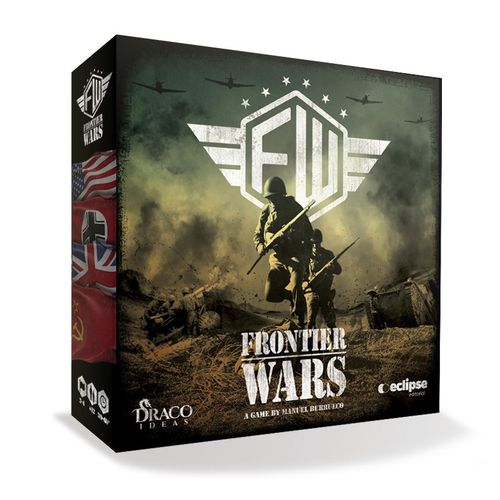
Frontier Wars
Frontier Wars Rulebook
Table of Contents
Table of Contents
1. Game Contents
- 30 Attack Orders cards
- 30 Defense Orders cards
- 30 Tactical Orders cards
- 4 Reference cards
- 100 miniatures in four colors: 20 artillery, 40 infantry, 20 tanks & 20 planes
- 24 tiles
- 16 Construction tiles
- 16 Medal tokens
- 1 Victory token
- 20 Flag tokens
- 1 Card deck board
- 1 Battle board
- 1 Turn order board
- 4 Faction sheets
How to Play
1. Selecting Factions
There are 4 factions in the game: UK, Germany, USSR & United States
Each faction includes:
- 4 construction tiles: 1 Headquarters, 1 Factory & 2 Encampments.
- 25 miniatures: 10 infantry, 5 tanks, 5 artillery & 5 planes.
- 5 faction markers: portraying your faction's flag. One is used for the turn order board, one to mark the current resistance of your Headquarters on your faction sheet, another one to mark your Headquarters tile on the map, and the last two are used when conquering your opponents Headquarters.
- 1 Reference card: with the game sequence and the Attributes Chart of your troops.
- 1 Faction Sheet: with unique skills for each faction. This sheet has two sides, and with them you will determine the game mode. Before your start the game, the players must decide which side to use. All players must use the same side of their sheets.
- Faction skill: Exclusive and unique for each faction. It has no activation cost and applies for the entire game.
- Special skill: Can only be used once per round. You must discard a resource card of any kind. If you don't have cards to discard, you cannot use this skill.
2. Preparing Resource Cards (90 cards)
Separate the cards into piles, according to their type: Attack Orders (red), Defense Orders (blue), and Tactical Orders (green). Shuffle each deck separately and leave them face down on their reserved spaces of the resource decks board.
3. Setting Up the Board
Go to page 10 to select a scenario and choose one fitting the current number of players. Each player will place their headquarters tile according to the scenario description, and will then deploy their initial troops according to the instructions on their faction sheets. Each player draws the number of resource cards indicated by their faction sheet, from any of the resource card decks.
Unless the scenario states otherwise, the maps are surrounded by sea to all effects and purposes.
4. Victory Conditions
The first player to achieve one of the following 3 objectives will be the winner of the game:
- Destroying every opponent's Headquarters (page 8).
- Earning as many Victory Points (VP's) as indicated by the scenario (page 10).
- Completing the 'definitive weapon' investigation in the arms race (page 9).
Game Sequence
The game is played for an undefined number of rounds. Each round has several phases, during which the players will take turns to play. At the end of every round a new one starts, until a player reaches one of the victory conditions. These are the phases each round:
Turn Sequence
- Calculate turn order — Each player counts the star symbols they control, as well as their Merits. Each star gives 1 VP.
- Drawing resource cards — Draw 1 card from any pile. Draw 1 extra card for each city tile you control.
- Reinforcements — Deploy a unit of your choice at HQ, an infantry unit at each activated Encampment, and a mechanized unit of your choice at each active Factory tile.
- In turn order — Use an attack orders card. Move all the troops you want. Construct buildings. Solve Conflicts. Defenders may use defense orders cards.
- Tactical phase — In turn order, each player may play a tactical orders card.
- Arms race — You may add one resource card to your Research Deck, as long as you have enough Merits to do so.
- Upkeep phase — Eliminate any excess units on the map. Discard any excess cards from your hand.
1. Turn Order
The turn order will change during the game. At the start of each round, count each player's victory points and adjust the turn order track accordingly. Victory points (VP) are represented by star symbols shown on different game elements, each star is worth one VP.
- During the first round the players are tied on victory points. To break this tie, or any other, you must follow the predetermined order shown on the turn order board, indicated by the tie-breaker arrow.
- In subsequent rounds, the players count the number of stars (VP's) under their control. To do this, count the VP's from your factories and encampments, cities and airport tiles, as well as any other strategic point you control. Remember that you need to have at least one unit on the tile to consider it under control.
The player with the highest score will be the first to move and so on, until the player with the lowest score plays their turn last.
In this case the turn order will be: Germany, USA, UK and USSR.
Nobody would count these stars, since they are in frontier tiles or no-man's land.
The buildings and/or city tiles and airports in frontier tiles don't count (if you solve a battle and there are surviving troops from both factions, that tile is considered a frontier tile (see Frontier, page 8)).
If you have enough VP's to win the game during this phase, you win automatically and the game ends. If two or more players are tied for victory, continue playing until someone breaks the tie. VP's can only be counted during this phase, so if a player earns enough VP's to win the game in a different phase, but loses them before reaching this phase, that player will not be declared winner.
2. Drawing Resource Cards
In this phase, all players draw one resource card, plus one additional card for each city tile they control.
If a city is in a frontier tile, nobody gets the extra card.
Each player decides from which resource deck to draw their cards: attack, defense or tactical orders, with the option of drawing several cards from the same deck if you want to.
3. Reinforcements
During this phase, the players will deploy new units from their reserves, following the turn's order. Each player's reserve is formed by every troop that has not been deployed on the map. Add one unit for every factory, encampment or headquarters under your control.
Factories and encampments must be active for this, so there must be at least one infantry unit on the tile, and must NOT be located in a frontier tile.
- Headquarters allow you to add one unit of any type: mechanized or infantry. One unit per headquarters.
- Active Factories allow you to add one mechanized unit: artillery, tanks or planes. The player decides what mechanized unit to add each round. One unit per factory.
- Active Encampments: allow you to add one infantry unit. One unit per encampment.
If you don't have enough units in your reserve to deploy, you lose those units but you can choose which building will not receive reinforcements. If you use a production card and don't have enough units in your reserve, the effect of the card is lost.
4. Player Turn
Now, each player takes turns in the preset order. Play your full turn before passing the turn to the next player. You may do one, several or each one of the following actions, in strict order:
Using Attack Orders
You may have resource cards of three types: attack, defense or tactical orders, but you can only play one attack and one tactical card per round. On the other hand, you can use one defense orders card for each battle you are involved in. Resource cards discarded due to a faction skill don't count as used cards.
At this point of the round, the active player can play one attack orders card. The effects are explained in the card's description; in case of conflict, the cards text overrule the rulebook.
Movement
All armies are formed by four types of units: infantry, tanks, artillery and planes. All of them can move and attack independently. Each unit can move as many tiles as indicated by their movement value. You can move as many of your units as you want during your turn, but you can only do one movement action per unit each round.
Characteristics
| Unit | Casualties Priority | Movement | Attack Initiative | Defense Initiative |
|---|---|---|---|---|
| Infantry | 1 | 1 | 1 | 1 |
| Tanks | 2 | 2 | 2 | 1 |
| Artillery | 3 | 1 | 0 | 3 |
| Planes | 4 | 3 | 1 | 0 |
| Headquarters | — | 0 | 0 | 5/3 |
Planes can fly over enemy units without engaging with them, except artillery units. They can also fly over water tiles, as long as they don't end their movement there. To all effects, it is considered that the game map is surrounded by water. Planes can also carry up to two units of infantry and/or artillery. Transported units must all board the plane on the same tile, but they can do it after moving to that tile. They will land automatically on the tile where the plane ends its movement. Units cannot move after being transported, regardless of having moved before boarding the plane. If a plane is involved in battle, you must declare if it's currently transporting units or not.
Any unit that ends its movement on a tile with enemy troops will start a battle, which will be solved after all the movements are over, according to the game sequence.
Place all involved units on the tile, so it's clear which ones are part of the battle.
Building Constructions: Factories and Encampments
At the start of the game, each player has a limited number of construction tiles they can build. Once all of them have been placed, you cannot build anything else, although you can conquer your opponent's constructions to increase that number.
To build a factory or encampment, you must replace an infantry unit on the board with the construction you want to build (the sacrificed infantry unit returns to your reserve), provided it adheres to the following rules:
- You cannot build in city, airport or swamp tiles.
- There cannot be more than one construction per tile (factory, encampment or headquarters).
- There cannot be a battle or be a frontier tile.
You may decide what construction to build: factory or encampment, and you must have in your reserve the corresponding construction tile to place on the map.
When you build a construction, it is considered inactive until an infantry unit occupies that tile. If you are occupying the tile with troops other than infantry, you would be in control of the tile and building, but the building is considered inactive. Inactive buildings will NOT generate new troops during the reinforcement phase. It may happen that you build a construction but have no troops remaining on that tile, in which case you would not control the building.
Remember, you need two infantry units to build and activate a construction (since one of them will be lost). Once built, a construction remains on its tile until the end of the game.
Whenever a player builds a construction, they earn one medal (page 8).
Solving Battles and Defense Orders
Before solving a battle, the defender can use one defense orders card, the effect of which will be applied before proceeding with the battle. The effect of the card is described in the card's text. You can use only one card per battle.
Cards discarded due to faction skills do not count as used cards.
If there are several battles, the attacker decides which one to solve first.
All army troops have one resistance point. If any unit receives one impact in battle, take it off the map and return it to your reserve for later use. When constructions are under attack, and there are no troops left to defend them, turn the construction tile around and leave it on the map to show it has been destroyed. Destroyed buildings will not produce new reinforcements or give VP's, but will also not return to your reserve.
To solve a battle you have to consider who the attacker is and who the defener is. The player invading a tile with their troops will be considered the attacker, while the other player will be the defender.
- The attacker's troops will use the attack initiative.
- The defender's troops will use the defense intiative.
The battle chart (page 6) shows that the same units may have different initiative for attack and defense.
When solving a battle, all attacking and defending units will make one attack. If there are troops from both factions remaining after solving a battle, it is considered a tie, and the map tile becomes a frontier tile.
Starting with the highest initiative troop, and in descending order, each unit makes one attack. Every time a unit attacks, it causes one casualty. If two units have the same initiative, they attack simultaneously and both of them cause one casualty.
Because of this, it could happen that both of them are eliminated at the same time, or that lower initiative troops are eliminated before making their attack.
There is a specific priority in which casualties are caused, as detailed in the battle chart, so units must be eliminated according to that priority. The first casualties are always infantry units, then tanks, followed by artillery units and finally planes.
When solving a battle, if there are two units of the same type from the same faction, but with different initiative values, caused by the use of cards or other factors, first eliminate the troop with the highest initiative that has NOT attacked yet.
This way, units with high initiative will eliminate troops with lower initiative values before they can attack. There are troops with 0 intiative, meaning they will always attack last.
Use the battle chart in your first games: place the battling units over their respective positions for the attacker and defender, and make one attack with each unit from left to right. Cause casualties with each unit's attack. Once you reach the right side of the chart and all units have performed one attack each, the battle is over.
When a player wins a battle it earns one medal (page 8), either as attacker or defender.
Casualties return to the player's reserve on their faction sheets for later use.
Battle Resolution Example
Attacker: 1 tank, 2 infantry units, 1 artillery.
Defender: 1 artillery unit, 2 infantry units.
Resolution: check the initiative for each unit according to their use in battle (attack or defense). By doing this, we have the initiatives for the attackers: 2, 1, 1 and 0 respectively. The defending units would have 3, 1 and 1 respectively.
In this example, the defender decided not use defense orders cards. So:
a) The unit with the highest initiative attacks first. In our example the defending artillery has the highest initiative, so it attacks first and causes one casualty. According to the battle chart and casualties priority, the first unit eliminated must be an opponent's infantry (that returns to the owner's reserve).
b) The next unit to attack is the attacker's tank (with 2 initiative), which also eliminates one of the opponent's infantry units.
c) Then is turn for the infantry from both the attacker and the defender, who have the same initiative. Because of this, both of them attack simultaneously. Since the first casualties are always infantry units (as indicated by the casualties priority chart), they eliminate each other.
d) Finally, it's the attacker artillery's turn to perform one attack. The only unit remaining in the defender's side is the artillery unit, which is eliminated.
Result of the battle: The attacker has one tank and one artillery left. The defender has been eliminated, so the attacker wins the battle and earns one medal.
Repairing Destroyed Constructions
Destroyed constructions may be repaired in the same way they are built, but wil remain in their current tile. To repair a construction, you must spend one infantry unit on that constrution's tile, which returns to your reserve.
Repairing a construction does not give medals.
Frontier or Ties
After solving a battle on a map tile, if there are troops remaining from both factons, it becomes a frontier tile. In subsequent rounds, units in a frontier will not engage in battle, unless any of the players adds new troops to that tile. If so, that player will become the attacker and the battle will be solved as usual, with both players being able to play orders cards normally. If any of the players decides to withdraw some troops, the battle is avoided. If a player withdraws all of its troops from a frontier tile, the rival faction will automatically gain control of the tile.
Sometimes, a third faction will join the battle for control of a frontier tile. In this case, there would be only one attacker and two defenders, both of which could play a defense orders card. When solving the battle, each player may assign their impacts to the faction they prefer, following the initiative and turn order as usual. Casualties will also follow the priority chart normally. In this type of battle, it may happen that one faction suffers no casualties, while another faction suffers all of them.
If a fourth factions joins the fray, apply the same rules. That is: one attacker and three defenders, up to three defense cards and each faction will apply casualties following the initiative and turn order as usual.
Constructions on frontier tiles will not produce reinforcements and do not give VP's for turn order calculations. In the same way, cities and airports will not give benefits if they are frontier tiles.
Headquarters
During the game, your headquarters represent your base from where you lead the battle. For this reason, they are considered special buildings.
- Reinforcements: During the Reinforcement phase, headquarters allow you to deploy one reinforcement unit of any type: infantry, tanks, artillery or planes. Headquarters always get reinforcement, even if in frontier tiles.
- Battles at headquarters: during a battle, the headquarters' garrison will also participate. When defending, this garrison has initiative equal to the headquarters current resistance value. Each time it receives an impact, its resistance and initiative will lower by 1 point. When attacking, headquarters will have an intiative value of 0. This could happen if after suffering an attack at headquarters, the defending player adds troops, i.e: after receiving one reinforcement unit.
Headquarters Resistance Points track: 5, 4, 3, 2, 1, 0.
If a players loses control of its headquarters, that player is eliminated from the game. Turn the headquarters tile on the board, to show it has been destroyed, and take back the owner's faction marker. From that moment on, the player will lose control of its troops, which will remain on the board as neutral troops (they cannot move, but will defend the position as usual, without defense orders cards). The player who destroyed the headquarters receives all resource cards from the eliminated player, discarding any face up cards, and receives 3 medals for their achievement, instead of the usual 1.
- Repairing headquarters: you may repair a rival's headquarters tile following the standard procedure: by spending one infantry unit. Place one of your faction markers on the building to mark it as yours. Repaired headquarters recover all resistance points and will give you the following benefits:
- Deploy reinforcements at your new headquarters as usual.
- Receive one extra resource card each round.
- Also, while you have at least one headquarters tile under control, you cannot be eliminated from the game.
Medals
Medals are awarded for your heroic acts during the game. Each medal marker has two sides: the first time you receive a medal, draw one medal marker. The second time, turn it over to show its other side; each side adds one medal. Having two medal markers means you have 3 or 4 medals, depending on their shown sides.
Players receive medals each time they win a battle, either as attackers or defenders.
Eliminating troops from a tile with cards does not earn medals.
If a battle is solved because one side withdraws their troops, or for similar reasons, and there is no battle in the end, nobody receives medals. In case of a tie, nobody receives medals.
You will also recieve one medal when building a construction. But you won't receive any for repairing or conquering a construction, or if you built it using the effect of a resource card.
- 1 medal earned
- 2 medals earned — Turn the marker to its black side
- 3 medals earned — Take a second medal marker and place it white side up
- 4 medals earned — Turn the second medal marker to its black side
5. Tactical Phase
Using Tactical Orders
Following the turn's order, each player may use one tactical orders card. The effects are explained in the card's description.
Arms Race
You may do research for technological breakthroughs that allow the construction of the 'ultimate weapon', which will force your rivals to surrender, thus, giving you victory.
To do it, each player may add one card from their hand to their secret research deck, if they want to. This deck can never have more cards than the number of medals from that faction. These cards are hidden to the rest of players, and will only be shown if a player manages to build the ultimate weapon.
Resource cards with research values 1, 2 & 3.
Don't forget that the black sides from medal markers are worth two medals.
Each resource card has a numeric value at their lower right corner for this purpose. If you have enough research points to fulfill the scenario requirements, you immediately win the game. Just turn your cards around and show them to the other players. If two players reach the required amount at the same time, the tie-breaker arrow from the turn order track will determine the winner. By default, you will need 15 research points, unless the scenario states otherwise.
Upkeep: Removing Excess Troops
During this phase of the turn, you will have to do upkeep of your troops. Each player may have up to 3 units on each tile. Any excess troops must be removed from the board and returned to each player's reserve. Following turn order, each player removes any excess troops. The player may decide which troops are removed.
Frontier tiles allow for only 2 units per player in battle, so all excess troops must be removed. The USSR's faction skill allows them to have one additional unit per tile, in both cases.
Discard: Removing Excess Cards
The starting hand limit for all factions is 4 cards, but it is possible to increase this limit during the game. During this step, discard any excess cards over your current limit.
You may increase your card limit by 1 for each airport tile under your control.
Mission Notebook
Appendix
- Neutral Tile: This is the standard tile, with no special rules or restrictions. You can build here.
- City Tile: Draw 1 extra resource card for each city tile you control. Also, count VP's for every star on your city tiles. You cannot build here.
- Airport Tile: Increase your card hand limit in 1 for every airport tile you control. Also, count VP's for every star on your airport tile. You cannot build here.
- Strategic Point Tile: The player controling this tile count's VP's for every star on the tile. You can build here.
- Starting Tile: It is a neutral tile that has been marked on the scenario map, to indicate where to place the HQ's during setup.
- Lake Tile: This is a water tile to all effects and purposes. You cannot build or stay on this tile.
Scenarios
Each scenario lists the number of players, an operation (map) name, the estimated duration, the tile composition of the map, and the victory conditions. Unless noted, maps are built by combining the listed number of city, airport, strategic point, starting and neutral tiles (plus any sea tiles) according to the printed map layout.
Learning — Operation Compact 2
- Players: 2
- Duration: 30-45 minutes.
- Tiles: 11 (2 cities, 1 airport, 2 strategic points, 2 starting points and 4 neutral tiles).
- Victory: 10 victory points or 15 research points or destroying rival HQ's.
Learning — Operation Compact 3
- Players: 3
- Duration: 30-45 minutes.
- Tiles: 16 (3 cities, 1 airport, 3 strategic points, 3 starting points and 6 neutral tiles).
- Victory: 10 victory points or 15 research points or destroying rival HQ's.
Learning — Operation Compact 4
- Players: 4
- Duration: 45-60 minutes.
- Tiles: 17 (2 cities, 2 airports, 4 strategic points, 4 starting points and 5 neutral tiles).
- Victory: 10 victory points or 15 research points or destroying rival HQ's.
Operation Tane Ost
- Players: 2
- Duration: 30-45 minutes.
- Tiles: 15 (2 cities, 1 airport, 2 strategic points, 2 starting points and 8 neutral tiles).
- Victory: 10 victory points or 15 research points or destroying rival HQ's.
Operation Varsity
- Players: 2
- Duration: 30-60 minutes.
- Tiles: 23 (6 sea, 2 cities, 1 airport, 2 strategic points, 2 starting points and 10 neutral tiles).
- Victory: 12 victory points or 17 research points or destroying rival HQ's.
Operation Fork
- Players: 2
- Duration: 30-60 minutes.
- Tiles: 22 (6 sea, 2 cities, 1 airport, 2 strategic points, 2 starting points and 9 neutral tiles).
- Victory: 11 victory points or 16 research points or destroying rival HQ's.
Operation Brevity
- Players: 2
- Duration: 30-60 minutes.
- Tiles: 16 (2 cities, 2 strategic points, 2 starting points and 10 neutral tiles).
- Victory: 11 victory points or 16 research points or destroying rival HQ's.
Operation Kutúzov
- Players: 3
- Duration: 30-60 minutes.
- Tiles: 19 (3 cities, 1 airport, 3 strategic points, 3 starting points and 9 neutral tiles).
- Victory: 10 victory points or 15 research points or destroying rival HQ's.
Operation Gunnerside
- Players: 3
- Duration: 30-60 minutes.
- Tiles: 16 (3 cities, 1 airport, 3 strategic points, 3 starting points and 6 neutral tiles).
- Victory: 10 victory points or 15 research points or destroying rival HQ's.
Operation Paper Clip
- Players: 3
- Duration: 30-60 minutes.
- Tiles: 21 (4 sea, 4 cities, 3 strategic points, 3 starting points and 7 neutral tiles).
- Victory: 10 victory points or 15 research points or destroying rival HQ's.
Operation Urano
- Players: 3
- Duration: 30-60 minutes.
- Tiles: 21 (3 cities, 3 airports, 3 strategic points, 3 starting points and 9 neutral tiles).
- Victory: 11 victory points or 16 research points or destroying rival HQ's.
Operation Greif
- Players: 3
- Duration: 45-90 minutes.
- Tiles: 22 (4 cities, 3 airports, 3 strategic points, 3 starting points and 9 neutral tiles).
- Victory: 11 victory points or 16 research points or destroying rival HQ's.
Operation Chastise
- Players: 4
- Duration: 45-90 minutes.
- Tiles: 28 (4 cities, 3 airports, 3 strategic points, 3 starting points and 15 neutral tiles).
- Victory: 12 victory points or 17 research points or destroying rival HQ's.
Operation Tatsinskaya
- Players: 4
- Duration: 60-120 minutes.
- Tiles: 23 (1 sea, 4 cities, 3 strategic points, 3 starting points and 7 neutral tiles).
- Victory: 10 victory points or 15 research points or destroying rival HQ's.
Operation Epsom
- Players: 4
- Duration: 60-120 minutes.
- Tiles: 24 (2 sea, 3 cities, 3 strategic points, 4 starting points and 12 neutral tiles).
- Victory: 10 victory points or 15 research points or destroying rival HQ's.
Operation Zeppelin
- Players: 4
- Duration: 60-120 minutes.
- Tiles: 23 (3 cities, 2 airports, 4 strategic points, 4 starting points and 10 neutral tiles).
- Victory: 11 victory points or 16 research points or destroying rival HQ's.
Operation Biting
- Players: 4
- Duration: 60-120 minutes.
- Tiles: 23 (3 cities, 2 airports, 4 starting points and 14 neutral tiles).
- Victory: 11 victory points or 16 research points or destroying rival HQ's.
Operation Borodino
- Players: 4
- Duration: 60-120 minutes.
- Tiles: 23 (4 cities, 1 airport, 4 strategic points, 4 starting points and 10 neutral tiles).
- Victory: 11 victory points or 16 research points or destroying rival HQ's.
Operation Neretva
- Players: 4
- Duration: 60-120 minutes.
- Tiles: 24 (4 cities, 2 strategic points, 4 starting points and 14 neutral tiles).
- Victory: 12 victory points or 17 research points or destroying rival HQ's.
Operation Bagatrion
- Players: 4
- Duration: 60-120 minutes.
- Tiles: 24 (4 cities, 4 strategic points, 4 starting points and 12 neutral tiles).
- Victory: 12 victory points or 17 research points or destroying rival HQ's.