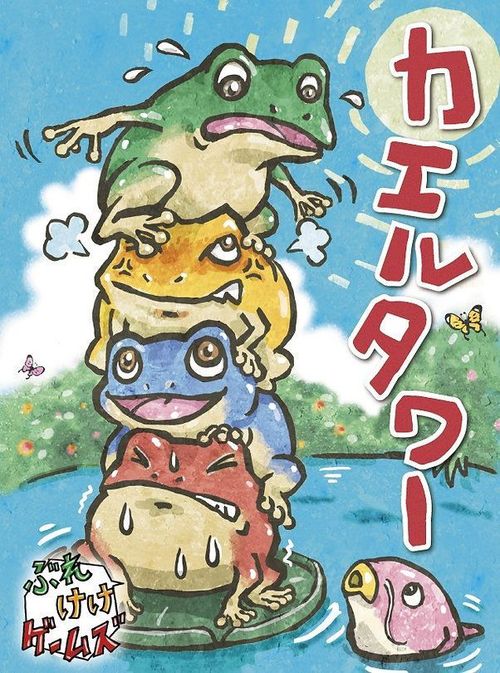
カエルタワー (Frog Tower)
カエルタワー (Frog Tower) Rulebook
Table of Contents
Table of Contents
Components
- 75 Pond cards
- 66 Frog cards: 21 green, 16 blue, 16 yellow, 9 red, 4 rainbow
- 9 Leaf cards
- 10 Starting Leaf cards
- 5 Quick reference cards
- 21 Score cards: 12 1/3-point cards, 8 3/5-point cards, 1 WIN card
- 2 Japanese rulebooks and 2 English rulebooks
Additional Pond cards (optional, not used in a standard game):
- 4 Crayfish cards
- 4 Crayfish rule cards
Setup
- Each player receives a number of Starting Leaf cards according to the number of players, and places the cards in front of them as follows:
| Players | Starting Leaf cards |
|---|---|
| 2 players | 4 cards |
| 3 players | 3 cards |
| 4 players | 2 cards |
| 5 players | 2 cards |
Leave the space below the Starting Leaf cards empty for placing Frog cards. This space and the Leaf cards are called the players' Garden. Return the remaining Starting Leaf cards to the box. The Starting Leaf cards will be considered as Leaf cards for the rest of the rules.
- In a standard game, the Additional Pond cards (Crayfish cards and the Crayfish rule cards) will not be used, so return them to the box (see page 4). All remaining Pond cards are shuffled face down and spread out in the centre of the table (it is okay if the cards overlap each other). The entire spread of cards is called the Pond. Randomly take out a number of Pond cards according to the number of players, as follows, and place them aside. Leave the cards you have placed aside face down without looking at their faces.
| Players | Cards set aside |
|---|---|
| 2 - 3 players | 12 cards |
| 4 - 5 players | 6 cards |
Leave a space for a general Holding area for players to play cards into.
-
Sort the score cards by type. Place them side by side so that the 1/3/5 points and WIN sides are visible. The score cards have different points on the front and back, but they should not be flipped over during the game. During the game, take the cards as necessary to track your score. If you run out of score cards, use a convenient substitute.
-
Each player receives one Quick reference card and places it in front of them. Return the unused Quick reference cards to the box.
The person who has seen a frog most recently is the starting player.
Flow of the Game
Players take turns clockwise, starting from the starting player. The game ends when there are no more cards in the Pond or when one of the players has created a Legendary Frog Tower.
Flow of a Turn
On your turn, choose one card from the Pond and flip it face up. The flipped card is placed in the Holding area.
Note: At this point, you may not place the flipped card in your own Garden.
Then, the player whose flip it is can choose one of the following:
- a) Flip another card
- b) Stop flipping and take cards
a) Flip Another Card
Choose one card from the Pond and flip it face up. The flipped card is placed in the Holding area.
- If there is a card of the same type as the flipped card in the Holding area, you have busted. You will distribute cards (see below) and your turn will end.
- If there is no card of the same type in the Holding area, choose a or b again.
b) Stop Flipping and Take Cards
Take all the cards in the Holding area and place them face up in your Garden.
Example: Emma flips over a red, a Leaf, and a green. She decides to stop flipping and take the cards from the Holding area. She places the Frog card in her Garden and places the Leaf card next to her Leaf card.
Card Type
There is an icon on the bottom left of the card that indicates the type of card:
- Red
- Yellow
- Blue
- Green
Important: Rainbow frogs are considered red, yellow, blue, and green frogs. If a rainbow frog is in the Holding area with other frogs (including Rainbow frogs), it will be considered a bust.
One more! icon: When you flip over a card with this icon, you must carry out a) Flip another card (if possible).
Important: If you bust and the card you flipped over has a One more! icon, you must carry out a) Flip another card before distributing cards. If the card you flipped over has the One more! icon again, repeat the same process.
Flower icon: Used with the optional Flower Collection rule. Ignore this icon in the standard game.
Examples
-
Example: It's Lucas' flip, so he flips over a Pond card. The card is green. This card has a One more! icon. Lucas must choose b, so he flips over another card in the Pond. [Sic: the printed example says "b" here; the One more! rule above requires "a", and the example then continues as if "a" was chosen.] It's a red card. Lucas chooses a and decides to flip over another card. It is green. Lucas busts because he has flipped over 2 cards of the same type (green).
-
Example: Sophia flips over blue, green, and rainbow. The rainbow card is considered to be the same type of card as red, yellow, blue, and green, so she busts.
-
Example: Noah flips over green, Leaf, Leaf, and busts. The last card he flipped over had the One more! icon, so he must flip over one more card for the Holding area. The Holding area now has green, Leaf, Leaf, and blue.
Distributing Cards
When a player busts, the cards are distributed. Starting from the player to the left of the player who busted, each player selects and takes one card from the Holding area in clockwise order and places it face-up in their own Garden. If they take a Leaf card, place it next to the Leaf card in their hand. Repeat this until there are no cards in the Holding area.
Note: The player who busts can take a card from the Holding area if there are any cards remaining when it [the printed note ends here; the source box is cut off at the page edge, so the remainder of the sentence is not legible in the source]
Example: Noah busts, and there are green, Leaf, Leaf, and blue cards in the Holding area. Emma, who is on his left, takes a Leaf. Next, Lucas takes a Leaf, Sophia takes a blue, and Noah takes the last green.
Distribution Rules for the 2-Player Game
The opponent of the player who busted chooses one card from the Holding area and places it in their own Garden, then chooses another card, discards it and places it back into the box.
In other words, the opponent takes one card, discards one card, and the player who busted takes one card, repeating this cycle until there are no more cards in the Holding area.
Example: When there are three cards in the waiting card area: (1) the opponent takes one card into their Garden; (2) the opponent takes another card, discards it and returns it to the box; (3) the failure player takes the remaining card into their Garden.
Completing the Frog Tower
Once either a or b has been completed, all players check their Gardens. If you have four or more Frog cards and a Leaf card in your Garden, you must complete a Frog Tower.
Important: You must complete the Frog Tower immediately, even if it is not your turn to flip cards.
Select four Frog cards from your Garden and place them vertically on top of a Leaf card as shown in the image. The Frog Tower is now complete. Your score points depending on the number of colours the Frog Tower contains. Refer to the points per number of colours of the Frog Tower as follows, take the corresponding score card, and place it on top of the Frog Tower.
Frog Tower Scoring
| Colours in the Frog Tower | Score |
|---|---|
| 1 colour | WIN |
| 2 colours | 1 point |
| 3 colours | 3 points |
| 4 colours | 5 points |
- The order of the cards does not matter.
- A completed Frog Tower cannot be destroyed or replaced.
- Frog cards and Leaf cards not used in the Frog Tower remain in the Garden.
- Even if there are four or more Frog cards in the Garden, the Frog Tower is not completed if there are no Leaf cards.
- A Rainbow frog is considered to be a frog of one of the following colours: red, yellow, blue, or green. If there are two Rainbow frogs, they can be considered to be frogs of different colours (for example, rainbow, rainbow, green, and yellow are considered to be all four colours). However, a single-colour Frog Tower that includes a Rainbow frog does not qualify for the WIN card. In this case, take a 1-point score card. [3]
Important: A Frog Tower containing a Rainbow frog is not considered a one-colour Frog Tower.
When a one-colour Frog Tower that does not contain a Rainbow frog is completed, or there are no more Pond cards, proceed to End of the Game. Otherwise, it is the next player's turn to flip.
Flowchart
The flowchart on page 3 of the source shows the following steps, as printed:
- Flip the card.
- Check for the presence of the same type of waiting card.
- None: continue (return to flipping); or end.
- Yes (failure): distribution of cards.
- Place a card in your Garden.
- All players turn their Garden into a tower if they have four or more cards in it.
Note: the flowchart's branch labels are small and partly overlapping in the source; the layout above follows the printed labels.
End of the Game
The game ends when one of the following occurs:
- One or more players complete the Legendary Frog Tower (one-colour Frog Tower).
- There are no cards remaining in the Pond.
Completing the Legendary Frog Tower
If one or more players build a Frog Tower using only one-colour Frog cards without any Rainbow frogs, they have completed the Legendary Frog Tower. The game ends immediately, and the player who completed the Legendary Frog Tower wins the game. If multiple players complete the Legendary Frog Tower at the same time, all of those players share the victory.
No Cards Remaining in the Pond
As soon as all the Pond cards have been taken, add the cards that were set aside in the game setup to the Pond and continue flipping. The game ends when that player's turn ends. If no player has completed a Legendary Frog Tower, all players go to Scoring.
Scoring
Add up all your score cards on your Frog Tower. Remaining Frog cards and Leaf cards in the Garden do not count for points. The player with the highest total score wins the game. If there are multiple players with the highest score, the player with the fewest completed Frog Towers wins the game. If the number of completed Frog Towers is the same, the players share the victory.
Optional Rules
You can experience different game variants by adding the following changes to the normal rules.
Flower Collection Rule
Cards with a Flower icon add to your score at the end of the game. The icons are a green flower, a pink flower, a purple flower, and a yellow flower.
| Types of flowers collected | Points |
|---|---|
| 1 type | 0 points |
| 2 types | 1 point |
| 3 types | 3 points |
| 4 types | 5 points |
- Count the types of flowers on all cards in your Frog Tower and Garden.
- The flowers do not need to be in the same Frog Tower.
- No matter how many flowers of the same type you have, only count them once.
Example: At the end of the game, there are 2 green flowers, 2 yellow flowers, and 1 blue flower. Since there are 3 types of flowers, you get 3 points.
Crayfish Rules
Game setup: Before spreading out the Pond cards face-down, add the 4 Crayfish cards to the Pond cards. Choose one Crayfish rule card and place it where everyone can see it (you can choose randomly or choose one together).
Flow of the game:
- When you flip over a Crayfish card, immediately carry out the effect of the Crayfish rule card.
- The effect occurs to all players, not just the player who flipped over the Crayfish card.
- After carrying out the effect, discard the flipped Crayfish card to the game box.
- After carrying out the effect, the player continues flipping.
- Place any cards obtained by the Crayfish effect directly in your Garden, not in the Holding area.
Crayfish Card Effects
Pass to the Right: Each player holds their Garden cards in their hand so that the other players cannot see the faces of the cards. Then, when ready, all players pass one card of their choice to the player on their right. Then, all players place their cards back in the Garden.
- Players who have no cards in their Garden do not pass cards to other players, but they must receive cards.
- Leaf cards are not held in hand.
Pass to the Left: Each player holds their Garden cards in their hand so that the other players cannot see the faces of the cards. Then, when ready, all players pass one card of their choice to the player on their left. Then, all players place their cards back in the Garden.
- Players who have no cards in their Garden do not pass cards to other players, but they must receive cards.
- Leaf cards are not held in hand.
Everyone Flips: Each player chooses one card from the Pond face-down, and once all players are ready, they flip the card over and place it in their Garden.
- If there are not enough cards in the Pond for all players, ignore the effect (do not use cards that have been set aside).
- If a Crayfish card is flipped over, ignore the effect and discard it. [4]
Pick from the Right: Each player holds their Garden cards in their hand so that the other players cannot see the faces of the cards. Then, when ready, all players pass one card of their choice to the player on their left. Then, all players place their cards back in the Garden.
- A player with no cards in their Garden will not have cards for their left neighbour to draw. They must still draw from the hand of the player to their right if possible.
- Leaf cards are not held in hand.
Crayfish Rule 2
This variant is similar to the Crayfish Rules variant, except for the following changes:
- Game setup: Shuffle the four Crayfish rule cards face-down and set them aside.
- Flow of the game: When you flip over a Crayfish card, choose one of the face-down Crayfish rule cards, flip it over, and immediately use the effect of that rule card. [5]