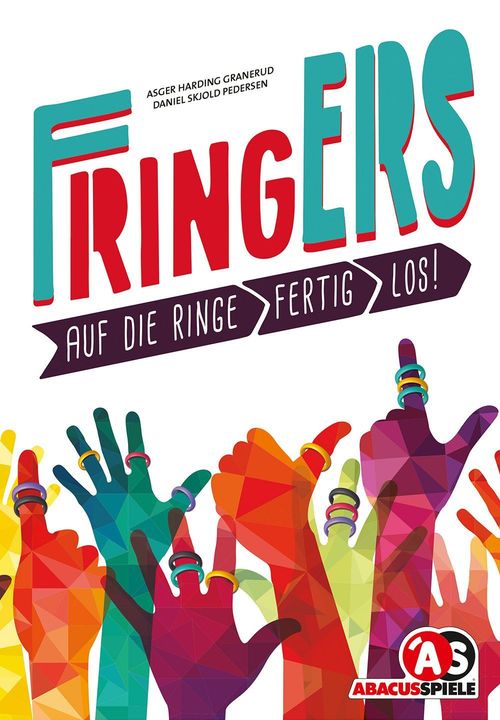
Fringers
Fringers Rulebook
Table of Contents
Table of Contents
Game Materials
- 61 rings
- 50 finger rings (10 in each of the 5 colours): red, yellow, turquoise, purple and black
- 10 time-rings (in white)
- 1 glittering ring (for the Bling-Bling variant only)
- 40 objective cards
- 10 green objective cards
- 15 yellow objective cards
- 15 red objective cards
- 1 cloth bag
- 1 sand timer with a running time of about 30 seconds
Game Description
FRINGERS is a cooperative game – you play with others against time and win or lose as a team. Before the game begins, each player puts a few rings on the fingers of his right hand. All players act simultaneously, trying together to ensure that everybody fulfils the objective card lying in the middle of the table before the sand timer runs out. This means that the rings on your right hand have to be arranged exactly as depicted on the objective card. However, you may not rearrange the rings by yourself, but always have to pass one at a time to your left neighbour. If you manage to do this in time, you'll all win; if the sand timer runs out, you all lose.
Set-Up of the Game
Immediately following is an explanation of the basic rules for the easy game using the green objective cards. The particulars for the game with the yellow and red objective cards and the rule modifications for the difficulty levels medium and difficult will be described later on.
- Put as many time-rings as there are players in one row in the middle of the table. Place the sand timer in front of the first time-ring of the row.
- Throw 5 finger rings per player – 1 ring each in red, yellow, turquoise, purple and black – into the cloth bag.
- In turn, each player sticks his right hand into the cloth bag (this also applies to left-handers) and, without looking into the bag, puts around 5 rings on any fingers – at least on three fingers. To do so, just reach into the bag and pull your hand out if you think you have put on enough rings. It doesn't matter whether a finger holds one or more rings or whether somebody has slightly more or fewer than 5 rings. The last player, however, has to put on all remaining rings from the bag – no rings may be left in the bag after this.
- Shuffle the green objective cards and put the top card face down in the middle of the table.
Note: Leave the yellow and red objective cards in the box for now.
Course of the Game
When all players are ready, reveal the objective card in the middle of the table.
Then immediately turn over the sand timer, place it in the first time-ring – and the game begins!
All players play simultaneously, observing the following rules:
- Always wear your rings on the fingers of your right hand, keeping the palm of your hand towards the middle of the table (i.e., with your thumb to the left).
- You may never move the rings on your right hand onto other fingers of this hand by yourself.
- You may use your left hand only for passing rings one at a time to your left neighbour (i.e., in clockwise direction). In doing so, you may pass only the ring closest to the fingertip. Whenever you pass a ring, you have to immediately put it on one of the fingers of your left neighbour's right hand. You may not put the ring you are passing on top of another ring of the same colour.
(Illustration caption: Player BLUE passes the red ring from his right hand to the right hand of player GREY.)
You constantly need to keep an eye on the sand timer. It must not run out before all players have fulfilled the objective card. Pay attention to turning the sand timer over on time and placing it in the next time-ring before it runs out – this gives you more time again. Anybody may do this anytime. If the sand timer runs out at any time during the game, the game is immediately over and all of you lose! If there are no more time-rings available, you may no longer turn the timer over – hurry up to fulfil the objective card in this final round or you all lose.
Once you have only the rings on your right hand in the exact arrangement as they are shown on the objective card, you have fulfilled this card. Put your right hand on the table; you no longer participate in the game and are skipped by the other players. However, you are still allowed to turn over the sand timer and to cheer the others on. The players who are still in the game have to move closer together and might have new neighbours now.
Important: The last 3 players always have to remain in the game until all of them have fulfilled the objective card. So, in the three-player game, all players remain in the game the entire time.
Note: Talk to one another, be loud and have fun! Tell your right neighbour which ring you need on what finger right now, since you may not put the rings on your own fingers or move them by yourself from one of your own fingers to another one... but don't forget to provide your left neighbour with rings!
End of the Game
As soon as all players have fulfilled the objective card, provided that the sand timer has not run out yet, the game ends and all players win together.
As a reminder: If the sand timer runs out at any time during the game, the game ends immediately and all players lose together.
If you fail, play the easy game again, this time with a new green objective card. Once you are successful, try out the game with a yellow objective card and, if you succeed again, proceed to the game using a red objective card.
The Colours of the Objective Cards
The green objective cards are the easiest ones to fulfil. Each finger shows 1 ring in a different colour.
The yellow objective cards are a bit harder to fulfil than the green objective cards. The yellow objective cards show 2 rings on one of the fingers, and one finger is empty. Make sure you observe the correct colour order of the rings on this finger.
The red objective cards are even a bit harder to fulfil than the yellow objective cards. The red objective cards can show up to 3 rings on one finger; and in addition, 1 or 2 fingers are crossed out. To start out, you may have rings on the crossed-out fingers; but during the game, no more rings may be put on them.
Increase the Degree of Difficulty
There are three different difficulty levels: easy, medium and difficult. Once you have succeeded in the easy game, you can increase the degree of difficulty by playing with the following rule changes:
Easy
During the set-up, 1 objective card for all players is placed in the middle of the table.
Medium
During the set-up, each player is dealt 1 objective card face down in front of him, instead of putting 1 objective card for all players in the middle of the table. When the game begins, each player reveals his objective card and leaves it face up in front of him. Now everybody has to fulfil his own objective card in order to win. Don't forget to tell your right neighbour what you need in order to fulfil your objective card!
Difficult
As in the game with the medium degree of difficulty, each player gets his own objective card. But in order to fulfil it, he has to stack all the rings depicted on any one finger of his right hand. The order of the rings on this finger, going from palm to fingertip, has to be the same as the order depicted on the objective card from the thumb to the pinkie (the order palm to tip also has to be the same for each depicted finger, if applicable). To do this, you need to change your thinking and communicate well!
Start each difficulty level with the green objective cards and then, after you have succeeded, proceed to the game with the yellow objective cards and, later on, to the red objective cards.
In addition, you can adjust the difficulty level of the game by changing the number of time-rings available. Each time-ring less makes the game harder; every additional time-ring makes it easier.
Game Over Several Rounds
a) Choose a difficulty level and an objective card colour and play 3 times in a row, each time with a new objective card (or objective cards). In order to win, you may not lose any of the rounds.
b) Shuffle the objective cards of all colours together and form a face-down draw pile. Play the easy game over several rounds until you reach 10 points or lose a round. Depending on the objective card colour, you score a specific number of points for a round you have won – green: 1 point, yellow: 2 points, red: 3 points. Before each round, you draw the top card from the draw pile as the new objective card. Once you reach a total of 10 points or more, you win. If you fail in a round, you lose.
Variant: Bling-Bling
At the set-up, throw the glittering ring into the cloth bag, along with the other rings. Play with one time-ring less than usual.
The player who wears the glittering ring on one of his fingers may pass his rings also to his right neighbour. It doesn't matter on which finger he has the glittering ring. Once he passes the glittering ring, this special ability changes to its new owner.
Important: As long as a player still has the glittering ring, his objective card is not considered fulfilled, even if he has all the other rings in the correct position.
When the last 3 players who are still in the game have arranged their rings correctly, the player with the glittering ring still has to put this ring on the sand timer, in order for all of you to win the game. To do this, the glittering ring has to be in the top position on one of his fingers, of course; otherwise, you need to keep playing until he is able to put the glittering ring on the sand timer and all players have fulfilled the objective card.
Further Variants
These are only a few of the variants, which can be played with FRINGERS. There are many ways to adapt FRINGERS to your game group's needs. Create your own variants and send them to us, if you like. We will collect your ideas and publish them on our website: www.abacusspiele.de.