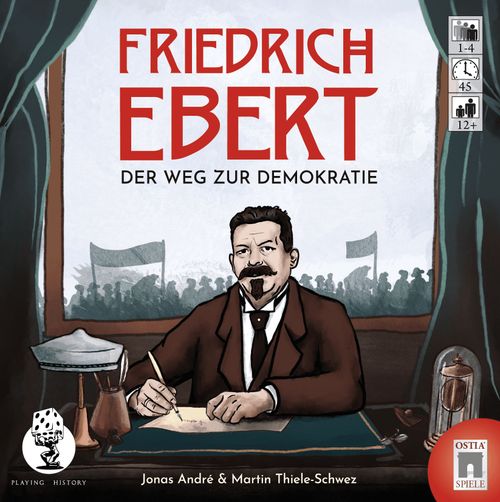
Friedrich Ebert: Der Weg zur Demokratie
Friedrich Ebert: Der Weg zur Demokratie Rulebook
Table of Contents
Table of Contents
Material
- 220 game cards:
- 136 history cards (Geschichtskarten), divided by chapter and numbered for sorting, consisting of:
- 117 letters (Briefe), each with a text side (Textseite) and a back (Umschlag / envelope side)
- 4 title cards (Titelkarten), one per chapter
- 11 milestones (Meilensteine): 2 in Chapter I, 3 each in Chapters II, III and IV
- 4 golden target letters (goldene Zielbriefe), one per chapter
- 2 round overview cards (Spielübersicht)
- 4 tracker cards (Anzeigekarten für Spannung), one per group, double-sided, each with the logo of its group
- 12 cards "Persönliche Erlebnisse" ("Personal Experiences"), whose reverse side is "Unterstützung" ("Support")
- 51 resolution cards (Auflösungskarten), double-sided and numbered consecutively
- 15 invitations (Einladungen): 3 types, 5 of each
- 136 history cards (Geschichtskarten), divided by chapter and numbered for sorting, consisting of:
- 50 round markers:
- 42 influence markers (Einflussmarker), double-sided, showing the logo of each group, plus Joker markers
- 4 tension markers (Spannungsanzeiger), double-sided (1 as reserve)
- 4 "Spiel verloren" ("Game Lost") markers
The envelope backs of the letters are colour-coded by group: SPD (Chapters I to IV), Supporters of the Monarchy (Anhänger der Monarchie, Chapter I), Population (Bevölkerung, Chapters II to IV), Military (Militär, Chapter II), Revolutionaries (Revolutionäre, Chapter III), Opponents of the Republic (Gegner der Republik, Chapter IV). Special letters (Besondere Briefe: Ereignisse) carry an "EILT!" (urgent) note.
Round overview card (Spielübersicht)
Round sequence:
- Each group: raises tension by +1, and adds 1 letter from its draw pile to its row (if the row is full: +1 tension; special cases: invitation and "EILT!" letters).
- Open 2 letters and read them aloud.
- Resolve 1 letter (from the front position) and distribute influence markers according to the resolution card.
- Use influence markers (see reverse side).*
- Resolve a milestone when full.
* If applicable, resolve "Persönliche Erlebnisse" (personal experiences) cards; see Phase 4.
You have lost the game if tension reaches the "Game Lost" marker. You have won the game if you resolve the golden target letter.
Reverse side, "Einflussmarker einsetzen" (Use influence markers): see Phase 4 below.
Game Goal
Friedrich Ebert is a cooperative game: you win or lose together. You finish a game of "Friedrich Ebert" successfully by fulfilling all milestones and then resolving the golden target letter that this unlocks. If tension in one social group rises too strongly beforehand, you have lost immediately!
A game covers one of 4 chapters from the life of Friedrich Ebert. You have won the whole game once you have successfully completed all 4 chapters. You may play the chapters individually and in any order.
Note on the variants: the rules for the variant "Personal Experiences" are marked in violet and the rules for the variant "Flexibility" are marked in brown. If you are playing for the first time, you can ignore these rules. For a more interesting and demanding game, we recommend playing with the "Personal Experiences" cards. For more variety, you can use the "Flexibility" rules; however, the sequence of events then deviates considerably from the historically correct order.
Setup for Chapter I
Prepare the following material for Chapter I:
Prepare the following material for Chapter I:
- 2 "Game Lost" (Spiel verloren) markers
- 2 tension markers (Spannungsanzeiger)
- The stack of resolution cards (Auflösungskarten)
- Tracker cards (Anzeigekarten) for SPD and Supporters of the Monarchy (Anhänger der Monarchie)
- Influence markers for SPD, Supporters of the Monarchy and Jokers
- Invitations: "Parteisitzung" (Party Meeting, SPD) and "Demonstration" (neutral)
- Letters, events and milestones, as well as the golden target letter for Chapter I
- The "Personal Experiences" cards (variant)
You do not need the remaining material in this game; put it back in the box.
The reverse side of the title card briefly explains how to distribute the material.
Setup in detail (3-player example, Chapter I)
The illustrated setup on page 4 of the rulebook gives a quick overview of a three-player game of Chapter I. The steps A to I are explained below.
Decide who among you takes the role of Friedrich Ebert (from now on just "Ebert"). Ebert receives the history deck and turns the title card over.
Example: Michael is the 1st person and, as "Friedrich Ebert", is responsible for all actions concerning the history deck, including the milestones and the allocation of influence markers. Heike, as the 2nd person, is responsible for the SPD cards and the resolution stack, and Martin, as the 3rd person, for the "Supporters of the Monarchy" cards. When "you" draw cards from a group's stack, the person responsible for that group takes the top card: Heike takes the top card of the SPD stack, and Martin takes the top card of the "Supporters of the Monarchy" stack. As soon as "you" need a resolution card, Heike finds it and reads it aloud.
A. Build the history deck. Form the history deck (Geschichtsstapel) with the title card, the letters, milestones and the golden target letter. Turn all cards to their text side and sort them by number (01, 02, 03 ...), so that title card 01 lies at the bottom and the letter with the highest number lies on top. Then turn the whole stack over so that the title card with the introduction text is on top.
B. Distribute the material. Distribute the history deck, the influence markers, the resolution cards and, for the groups involved, the tracker cards and invitations according to the number of players as follows:
| Number of players | 1. Person (Ebert) | 2. Person | 3. Person | 4. Person |
|---|---|---|---|---|
| 4 | History deck, influence markers | SPD | Supporters of the Monarchy | Resolution cards |
| 3 | History deck, influence markers | SPD, resolution cards | Supporters of the Monarchy | |
| 2 | History deck, influence markers, SPD | Supporters of the Monarchy, resolution cards | ||
| 1 | All materials |
Give the Supporter of the Monarchy the neutral invitations (opened side: "Demonstration").
It is your task to manage the material given to you. You carry out all actions named in these rules that concern a group whose material has been handed to you.
C. Lay out the resolution cards. Place the resolution cards as a stack. Within the resolution cards you can page through them like a book, by turning over the top card each time and placing it to the left of the stack.
Important: the resolution cards are NOT shuffled. They always stay in the order of their numbering. Check them before the start of a game and sort them by the numbers printed on the cards if necessary.
D. Ebert's letters. Ebert places the title card in front of himself, leaving a little room beside it for cards with a lasting effect. Then Ebert takes the following letters (without changing their order!) and hands them out, without turning them over, according to envelope colour to the SPD and to the Supporters of the Monarchy, until the first milestone "Erster Mai" ("First of May") appears.
Variant "Flexibility" (brown in the original): the SPD and the Supporters of the Monarchy then place the first letter of their stack with the envelope side up to the side, shuffle the other letters without turning them and place the first letter back on top of the stack. This is then your first draw pile.
Ebert lays out the remaining cards of the history deck in front of himself, so that the milestone "First of May" (Erster Mai, also written "1. Mai" on the card) lies face up on top.
E. Prepare each group's play area. For each group, lay out its tracker card for tension (Anzeigekarte für Spannung). To the right of it, place your draw pile (Nachzugstapel), and to the right of that the stack of your invitations (Einladungen). To the right of these is the place for your discard pile (Ablagestapel). Leave an area below these cards where you can lay up to 5 letters side by side.
If you are responsible for more than one group, you must form a separate play area for each group, and you may never place material of one group in the play area of another.
F1. Starting letters and tension. Ebert names, using the overview below, how many letters each group places in its play area and how high the tension in the group is at the start.
| Group | SPD | Supporters of the Monarchy |
|---|---|---|
| Starting cards | 0 | 1 |
| Tension at start | 0 | 1 |
Each group draws its letters individually from its draw pile and places them with the envelope side up in its own play area. The letters are still unopened and are not turned over. Letters are always pushed into the play area from the left, so that any letters already there each move 1 position to the right. The letter furthest to the right is in the "front position" (vorderste Position).
F2. For each group, take a tension marker and use it to mark the tension in effect at the start on the group's tracker card. If the tension is "0", place the marker next to the card.
G. Difficulty. Decide together which difficulty you want to play and place one "Game Lost" marker on the tracker card of each group accordingly. For an easy game, place the markers on space 10; for a medium game on space 9; and for a hard game on space 8. Ebert turns the title card face up again.
If you have little experience or want an easier start, we recommend skipping the section on "Personal Experiences" below. In this case, put the "Personal Experiences" cards back in the box. The same information is printed on the reverse side of the title card.
I. Personal Experiences (variant). Ebert lays the golden target letter down sideways in front of himself, unopened. Then he takes the 12 "Personal Experiences" cards, shuffles them and places 3 cards with the "Personal Experiences" side face up on the golden target letter. Below them he places the next 3 cards with the "Support" side face up, so that each one is assigned to one "Personal Experiences" card.
Place the next card, with the "Support" side face up, in the middle of the table where everyone can see it. You do not need the other "Personal Experiences" cards; return them to the box.
The additional display then looks as follows. The "Support" card in the middle is available to you from the start of the game. The other "Support" cards may only be used once you have fulfilled the task on the "Personal Experiences" card above them.
Note: "Personal Experiences" and "Support" cards are never turned over during a game; they always stay on the side that was laid out. A detailed explanation of each card can be found in the glossary at the end of the rules.
Start. Play Chapter I as a tutorial to get to know the game. The rules are the same for all chapters, but the setup differs slightly, because 3 instead of only 2 social groups are involved. The setup for the other chapters is explained in the section "Setup for the Further Chapters".
Game Flow
Now you are ready to experience history!
Ebert reads the introductory text on the title card aloud to set the mood for the chapter.
The game runs in rounds until you resolve the golden target letter or the tension in one group has grown too high. Each round consists of the following phases:
- All groups raise their tension and draw 1 letter.
- Open 2 letters and read them aloud.
- Resolve 1 letter and distribute influence markers.
- Use influence markers.
- Check whether the milestone has been fulfilled.
Phase 1: All groups raise tension and draw 1 letter
You raise the tension of each group by 1 step. To do so, move the tension marker on the group's tracker card 1 step forward (clockwise). If you have to move a tension marker onto the space with the "Game Lost" marker, you have lost the game immediately!
Then draw the top letter of each group's draw pile and add it, without turning it over, to the group's row of letters from the left. Shift the letters already in the row to the right without changing them (open letters stay open, unopened letters stay unopened).
Special cases:
- Each row can hold at most 5 letters (open or unopened). If a group's row already holds 5 letters, you do not add a new letter. Instead, raise that group's tension by one further step.
- If a group's draw pile is empty but there are fewer than 5 letters in its row, take an invitation from your play area and add it to the row from the left, like a new letter, unopened.
Then check whether the top letter of the draw pile of one or more groups bears an "EILT!" note (urgent). In that case, open that letter immediately and resolve it before you proceed to the next phase. If several letters are marked "EILT!", open and resolve them clockwise, starting with the SPD. Always resolve one letter completely before opening the next.
If you overlook an "EILT!" note and only notice the letter later in your display or on a draw pile, resolve it as soon as you notice it. Interrupt the phase or action you are in, if necessary, and continue it after the "EILT!" letter has been resolved.
Phase 2: Open 2 letters
You open a total of 2 letters from one or several groups by turning them from the envelope side to the text side, without changing the letter's position in the row. You decide on one of the rows of letters and must always open the unopened letter furthest to the right in that row. In rare situations where fewer than 2 unopened letters are available, you open only 1 letter, or none. You may open the golden target letter only if it is in the front position.
Ebert decides which 2 letters are opened. You may consult together beforehand. Open only one letter first, then decide which letter to open second.
Special cases:
Some letters refer to events that only make sense historically if other events have already happened, or have not yet happened. For this reason some letters show the symbols "?" (question mark) or a padlock. When you open a letter with one of these symbols, check immediately whether the letter stays in the row or must be removed:
- If the letter shows the "?" symbol, Ebert checks the cards with a lasting effect (Karten mit dauerhaftem Effekt) to see whether one of them shows the "X" symbol with the same letter. If so, the newly revealed letter is placed on the discard pile immediately.
- If the letter shows the padlock symbol, Ebert checks whether the letter could already be resolved. If a card with a lasting effect shows the "key" symbol with the same letter, the open letter stays in the display as usual. If you do not yet have a card with this lasting effect, the letter cannot be brought into play yet: turn it face down again and place it under the draw pile.
- If you have removed the open letter from the row because of a symbol, draw a new letter from the draw pile (or, failing that, an invitation) and add it from the left, so that the gap closes. If this makes an "EILT!" letter the top card of a draw pile, resolve that event immediately.
- Once you are certain that a card no longer has a lasting effect that matters later in the game, you may put the card into the box.
Example: The letter "Risse in der Partei" (Rifts in the Party) is initially locked by its padlock symbol (marked B) and is placed face down under the draw pile, unopened, if the card with the matching key symbol (B) is not in the area of lasting-effect cards. The letter can be drawn again later and is then checked again. When the card showing the X symbol (marked C) on the right has been resolved, the letter "Risse in der Partei" goes onto the discard pile. The thematic hint on the letter is that Ebert's approval of the war credits (the key symbol) must already have taken place for the letter to make historical sense; once the USPD has split off from the SPD (the "?" symbol), it no longer makes sense to appeal for unity in the SPD, and the letter must be removed (the X symbol).
Note on symbols: if you notice later that you overlooked a symbol, carry out the instructions belonging to the symbol immediately after the fact.
Phase 3: Resolve 1 letter and distribute influence markers
Choose an open letter in the front position to resolve now. You may therefore not resolve letters further back in a row, and you may not resolve unopened letters.
If the golden target letter is in the front position, resolve the golden target letter now and you have won immediately!
Together you may consider the letter beforehand. In the end Ebert must make the decision and take responsibility for it. The colour-marked symbols in the lower part of the letter give you a hint as to what consequences resolving the letter may have. If the symbol of a group is highlighted, you receive at least 1 or several influence markers of that group. If the warning symbol (Achtung) is marked, additional tension arises, but you may perhaps also acquire several influence markers.
If you decide on an invitation, you receive, as shown, 1 influence marker of the corresponding group, and you return the invitation to the corresponding invitation stack (not to the discard pile).
Resolving a letter by its number: all other letters are resolved as follows. Find the resolution card with the number printed on the letter from the stack of resolution cards and read it aloud.
Example: Ebert decides to resolve the letter "Wahl in den Parteivorstand" (Election to the Party Executive) and to declare a corresponding candidacy. The letter refers to resolution card number 13. Heike reads resolution card 13 aloud.
The resolution card states which consequences occur. As a rule you receive 1 or more influence markers; sometimes tension rises within a group, or a lasting effect is triggered. Carry out the instructions on the resolution card from top to bottom. If, while doing so, you have to move a tension marker on a tracker card onto the "Game Lost" marker, you have lost the game immediately!
If the resolution card has a lasting effect (the key symbol or the X symbol, which you have not yet resolved), place it in the row of cards with lasting effects in Ebert's play area, so that the lasting effect is clearly visible. If the resolution card has no lasting effect, return it to the stack of resolution cards. Pay attention to the numbering of the cards.
Examples of the X symbol as a lasting effect: If the resolution card shows the X symbol, Ebert immediately checks whether a letter with the letter given next to the symbol lies open in one of your rows. If not, place the resolution card face up, in the row of lasting-effect cards at Ebert's, after its full resolution. If the letter with the letter given next to the symbol lies in a row, place that letter on the discard pile. As described above when opening a letter, close the gap in the row of letters and draw a letter from the draw pile. If an "EILT!" card then appears as the top card of the draw pile, resolve it immediately.
Ebert gives the influence markers stated on the resolution card to the persons responsible for the respective group. Ebert keeps Jokers for himself. Then place the resolved letter on the discard pile of the corresponding group.
Example: You receive one influence marker "SPD" and one influence marker "Joker". Michael, as Ebert, gives the SPD influence marker to Heike and keeps the Joker.
Example: Tension is raised by 1 step on the SPD tension tracker.
Note on the neutral invitation: a neutral invitation "Demonstration" shows an influence marker with an empty circle. This means that you receive 1 influence marker for the group in whose row the invitation lies. In Chapter I this is the group "Supporters of the Monarchy" (in the later chapters it is one of the groups Military, Revolutionaries or Opponents of the Republic).
Phase 4: Use influence markers
You may use influence markers in the following ways:
- Return 1 influence marker to the supply with Ebert and reduce the tension in the group of the influence marker by up to 2 steps.
- Return 1 influence marker to the supply with Ebert and place any letter from the row of the group of the influence marker back under the draw pile of that group, without turning it over. Clarification: you may choose any letter, not only the letter in the front position.
- Place 1 influence marker on a matching space of the current milestone.
- Variant "Personal Experiences" (violet in the original): place 1 influence marker on a matching space of a "Personal Experiences" card (see below).
Consult together on how to use the available influence markers. When the consultation is finished, the SPD begins and uses all of its influence markers. The other groups then follow clockwise, and finally Ebert uses the Joker markers. A Joker marker may be used for all groups, as if it were an influence marker of the corresponding group.
Important: it is not possible to keep influence markers. You must immediately use all influence markers you have just received. If you cannot or do not want to use a marker, it lapses without effect and you must return it unused to the supply with Ebert! Influence markers on milestones stay where they are.
Each influence marker acquired in this round can be used only once!
Variant "Personal Experiences" (violet in the original):
You may fulfil the task of one or several "Personal Experiences" cards. You can collect influence markers on the cards one at a time, even if the task is not yet completely fulfilled. If the task consists of additional tension steps, you must fulfil the task completely at once. You may distribute neutral tension as you wish or assign it to one group alone (exception: the task expressly requires that the tension in the SPD rises).
Once the task is fully completed, return the "Personal Experiences" card to the box and place the card beneath it, "Support" (Unterstützung), in the middle of the table. It is available to you immediately, even during the current resolution phase.
In this variant you may choose the order in which you fulfil the milestones and "Personal Experiences" cards and use the influence markers.
Example: In the situation shown on the left, Heike moves the SPD tension marker 3 steps forward and Martin moves the tension marker for the Supporters of the Monarchy 2 steps. The task of the card shown is thereby fulfilled, and the support "Annahme verweigern" (Refuse Acceptance) is available at once. Martin, as Ebert, returns a Joker to the supply and uses "Annahme verweigern" to remove all cards from the row of SPD cards and place them under the draw pile.
Once you have fulfilled all 3 "Personal Experiences" cards, you have unlocked the golden target letter and place it under the history deck. If the history deck is already empty, add the target letter to the SPD's draw pile as its bottom card.
Phase 5: Check whether the milestone has been fulfilled
Ebert checks whether the current milestone is fulfilled. This is the case when each depicted space carries a matching influence marker. If at least 1 free space remains, begin the next round with Phase 1.
If all spaces on the milestone are occupied, you have fulfilled the milestone and now resolve it.
Example: When you distributed the influence markers, you occupied the last space, and so fulfilled this milestone.
Return the influence markers from the milestone to the supply with Ebert. Turn the milestone over and place it first next to the history deck. Read its text aloud and carry out the instructions from top to bottom. You must completely carry out one instruction before you may proceed to the next instruction.
The instructions on a milestone are carried out in this order:
- Remove invitations. Remove all invitations from the rows of your groups as indicated, by placing them envelope side up back on your corresponding stack. Close any gaps in your rows by shifting the letters to the left.
- Use influence markers. The same rules apply to raising tension, lasting effects (key or X symbols) and influence markers as to resolving letters in Phase 3. If you have to move a tension marker onto the "Game Lost" marker, you have lost immediately. Then distribute the influence markers and use them as described in Phase 4, to reduce tension, to move letters under the draw pile or to place them on "Personal Experiences" cards.
- Add new letters. Carry out the instructions for adding letters as in the game setup: Ebert gives each group all letters of the corresponding colour, without changing their order. The distribution ends as soon as the next milestone becomes visible or the stack is empty. Place the new letters unopened under the current draw pile of your group. If a group has no draw pile, form a new draw pile from the letters it has just received.
Variant "Flexibility" (brown in the original): if you are playing this variant, carry out the following for each group: take the top letter of the current draw pile and set it aside. Then shuffle the rest of the draw pile, including the new letters, without altering the cards (unopened letters stay unopened and open letters stay open). Make the shuffled letters ready as the draw pile. Finally place the letter you set aside back on top of the draw pile.
Example "First of May": you receive 1 influence marker each for the SPD and the Supporters of the Monarchy. As soon as you have used the influence markers, add the next cards of the history deck to the draw piles of the groups until the next milestone appears.
Clarification: you may not use influence markers that you receive when resolving a milestone for the next milestone. The next milestone is only unlocked once you have fully resolved the previous one.
If the resolved milestone has a lasting effect (the key or X symbol, which you have not yet resolved), place it in Ebert's play area so that the lasting effect is clearly visible. If the milestone has no lasting effect, put it in the box.
Now a new milestone lies ready on top of the history deck, which you must fulfil, or you have unlocked the golden target letter and added it to the SPD's draw pile. In the latter case there is no further milestone, and you can concentrate on reaching and resolving the golden target letter. Then begin the new round with step 1, raising tension and drawing letters.
Successful completion of the chapter
You have successfully completed the game, and with it the chapter, immediately when you resolve the golden target letter in Phase 3. Congratulations!
Clarifications: If the golden target letter is in the front position and is opened, simply resolve it. It does not matter whether other open or unopened letters remain in your rows or draw piles. It is enough that you resolve the golden target letter according to the usual rules. We recommend that you sort the history cards and resolution cards back into the correct order before putting them away, so that you can start straight away the next time.
Strategic hints
Only by fulfilling the milestones can you unlock the golden target letter and successfully complete the chapter. But you must not concentrate only on the milestones; you must also always keep the tensions in the social groups in view. Otherwise you lose the game early, because the tensions grow too high and the tension marker on a tracker card reaches the "Game Lost" space.
Pay attention to the small preview on the letters, which shows what influence markers you may receive. The warning symbol indicates a particular risk. It may be worthwhile to use 1 influence marker to remove such a letter from the row and put it back under the stack. Then you do not have to resolve it so soon. On the other hand, many influence markers may beckon if you can survive the threatening tensions...
It is advisable to resolve these letters at a time when the tension in all groups is low.
Setup for the Further Chapters
The other chapters are prepared in the same way as Chapter I. The sequence of events is identical in all chapters; in Chapters 2 to 4, however, 3 groups are involved, so that you must control the tension in an additional group.
The third group next to SPD and Population is, depending on the chapter:
- 1914-1918 (Chapter II): Military (Militär)
- 1918-1919 (Chapter III): Revolutionaries (Revolutionäre)
- 1920-1925 (Chapter IV): Opponents of the Republic (Gegner der Republik)
Prepare influence markers for the 3 groups involved, as well as Jokers. Form the history deck for the respective chapter according to the numbering on the history cards. You also need, in every game, the stack of resolution cards, as well as 3 tension markers and 3 "Game Lost" markers.
Distribute the material as shown in the following overview. Each group receives its tracker card as well as the matching invitations. For the group next to SPD and Population, you use the neutral invitations. You receive 1 influence marker of the respective group (Military, Revolutionaries, Opponents of the Republic) whenever you resolve a neutral invitation.
The distribution of material depends on the number of players. The rulebook gives one table per chapter; in each table the third group is the one named for that chapter (Chapter 2: Military; Chapter 3: Revolutionaries; Chapter 4: Opponents of the Republic).
Chapter 2 (1914-1918):
| Number of players | 1. Person (Ebert) | 2. Person | 3. Person | 4. Person |
|---|---|---|---|---|
| 4 | History deck, influence markers | SPD, resolution stack | Population | Military |
| 3 | History deck, influence markers | SPD, resolution stack | Population, Military | |
| 2 | History deck, influence markers, SPD | Population, Military, resolution stack | ||
| 1 | All materials |
Starting values: SPD 0 starting cards, starting tension 1; Population 0 starting cards, starting tension 1; Military 1 starting card, starting tension 3.
Chapter 3 (1918-1919):
| Number of players | 1. Person (Ebert) | 2. Person | 3. Person | 4. Person |
|---|---|---|---|---|
| 4 | History deck, influence markers | SPD, resolution stack | Population | Revolutionaries |
| 3 | History deck, influence markers | SPD, resolution stack | Population, Revolutionaries | |
| 2 | History deck, influence markers, SPD | Population, Revolutionaries, resolution stack | ||
| 1 | All materials |
Starting values: SPD 0 starting cards, tension 1; Population 0 starting cards, tension 1; Revolutionaries 1 starting card, tension 2.
Chapter 4 (1920-1925):
| Number of players | 1. Person (Ebert) | 2. Person | 3. Person | 4. Person |
|---|---|---|---|---|
| 4 | History deck, influence markers | SPD, resolution stack | Population | Opponents of the Republic |
| 3 | History deck, influence markers | SPD, resolution stack | Population, Opponents of the Republic | |
| 2 | History deck, influence markers, SPD | Population, Opponents of the Republic, resolution stack | ||
| 1 | All materials |
Starting values: SPD 0 starting cards, tension 0; Population 0 starting cards, tension 1; Opponents of the Republic 1 starting card, tension 2.
Note: the starting values are the rulebook's "Startkarten" (starting cards) and "Spannung zu Beginn" (starting tension) rows, transcribed in the order SPD, Population, third group.
Glossary of the "Persönliche Erlebnisse" and "Unterstützung" Cards
Jokers may, as usual, replace influence markers of any kind. So if 2 identical influence markers are required, you may instead use 1 influence marker of a group and a Joker, or 2 Jokers, to use the support. If a task requires Jokers, you must use Joker influence markers. Where you may use any influence markers, this is marked with a (?) symbol. Cards marked with the ∞ symbol remain available to you until the end of the game. All other support cards ("Unterstützung") can be used only once; after use, return them to the box.
Each row below shows the "Persönliche Erlebnisse" task and its reverse-side support ("Unterstützung").
| # | Persönliche Erlebnisse (task) | Unterstützung (support) |
|---|---|---|
| 1 | Place 2 Jokers on this card. | Geheime Absprache (Secret Agreement): You may exchange 3 identical or different influence markers for 4 Jokers. |
| 2 | Distribute a total of +5 tension in any division across all groups. | Annahme verweigern (Refuse Acceptance): For one Joker you may, once, return all letters of one row individually under the draw pile, beginning with the card in the front position. Invitations are returned to the other invitations. |
| 3 | Place 1 SPD influence marker on the card and distribute a total of +3 tension freely across all groups. | Entspannung (Relaxation): For 2 identical influence markers you may reset the tension markers by a total of 6 steps on one or several tracker cards. |
| 4 | Distribute a total of +2 tension across all groups and immediately draw 2 additional letters from any groups, following the rules of step 1 of a round. You draw the first letter, then decide from which group the second letter is drawn. You do not advance a tension marker when drawing letters, unless additional tension is triggered because the row of letters is already full. If an "EILT!" letter appears, resolve it immediately, before you continue the resolution phase. | Gefallen einfordern (Call in a Favour): You may place different influence markers on the spaces of this card (also singly) and later use them additionally when resolving a letter or a milestone. Jokers are not allowed. |
Symbol Key
The symbols used in the rules, named as they appear in the German text:
- Tension (Spannung) (zig-zag icon): the tension marker on a tracker card; "+1" means one step forward.
- "Game Lost" (Spiel verloren) (round marker): reaching this space on a tracker card ends the game immediately.
- Padlock (Schloss): on a letter, the letter is locked until a card with the matching key symbol is in play.
- Key (Schlüssel): on a card with a lasting effect, it unlocks letters with the same letter.
- Question mark (?): on a letter, the event has become obsolete once a certain event has taken place; check for the X symbol with the same letter.
- X: on a resolution card or milestone, a lasting effect; on a letter, it marks a letter to be removed.
- Warning symbol (Achtung, red triangle): additional tension arises when this letter is resolved.
- EILT! (urgent stamp): urgent letter or invitation, resolved immediately when it appears on top.
- Joker: a wild influence marker that may stand in for influence markers of any group.
- ∞: the support card stays available until the end of the game.
- (?) (in the glossary): any influence markers may be used for this card.