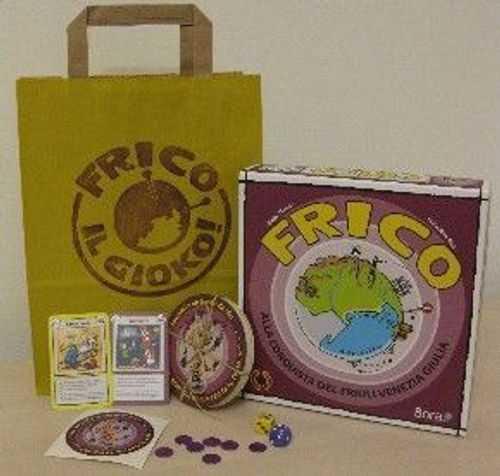
FRICO
FRICO Rulebook
Table of Contents
Table of Contents
The Board
The board represents the most coveted region in the world, currently contested between Triestines and Friulians, with various outsiders ready to take advantage of any distraction by the two disputants: Friuli Venezia Giulia. Venezia Giulia in particular has been distorted by a powerful magnifying lens, for obvious reasons of display of the territories.
There are 18 typically Friulian™ territories in tocai yellow, 18 typically Triestine™ territories in teran violet, 5 Bisiacaria territories chosen among the municipalities of the Bisiacaria according to population size, and 2 independent territories: Pordenone and Gorizia.
The Trento-Trieste bridge, as the best schools teach, starts from the Karst and passes right over the Friulian Alps, connecting the territories of Basovizza, Opicina, Monrupino, Tarvisio, Tolmezzo and Ravascletto, exactly as if they were neighbours.
Bisiacaria, Gorizia and Pordenone are neutral territories.
Bisiacaria allows armies to pass through and stop on its territories, as well as fighting on them, as long as nobody touches its things, otherwise they get themselves a proper telling-off!
Gorizia and Pordenone, on the other hand, forbid any kind of passage, stopping or fighting within their borders. They are two territories that become active exclusively in the five-player game.
The Armies
There are 3 groups of armies in blue, green and violet. These make up the famous clanfadori, the Triestine army. Each group of armies corresponds to a Triestine ceppo (stock): bobe (blue), legere (green), nagane (violet). You may assign the colours and stocks however you like, dear.
Then there are 3 groups of armies in red, orange and yellow. These make up the fearsome trattori, the Friulian army. Each group of armies corresponds to a Friulian stock: cjargnei (red), citadìns (orange), contadìns (yellow).
Each single army is represented by a small plastic frico. These pieces will from now on be called frichetti. Every box also contains a few larger frichetti, which we will call frichettoni, each worth 5 armies.
Finally, there is one crenellated frichetto, which serves only to mark the capital chosen by a player and does not count as an army.
Goal of the Game
Put an end to the legendary rivalry between Friulians and Triestines. Which of the two peoples is destined to dominate the world?
In games with two players, you win by conquering the enemy capital, that is Udine or the rione of San Giusto. A capital, like the other territories, is conquered by entering it with at least one of your own armies, after having defeated any enemy armies present.
In games with more than two players, each player chooses their own capital before the start of the game, after placing all the armies on their own territories, and places the crenellated frichetto on it. The capital can no longer be moved.
A player whose capital is conquered, unless they hold a reconquest card (explained later) with which to recover it immediately, loses all their armies and all their cards, and their territories become free.
The winner is the first player to conquer all the enemy capitals.
Alternatively, in games with an even number of players, it is also possible to form alliances between Triestines and between Friulians, and end the game with the victory of one of the two blocs.
FRICO variant "cattivissima": if you are particularly hardened players who love very long games, you may use this variant: the player whose capital is conquered is not automatically eliminated from the game, but keeps their cards and the armies on their other territories. However, they can no longer receive reinforcements (not even from cards), since these used to come precisely from the capital. They may however try to reconquer their capital, thereby fully re-entering the game.
Setup
Before you start, the Triestine players drink an otavo and the Friulian players drink a taj.
Then:
-
Each player chooses which armies they wish to represent (bobe, legere, nagane for the Triestines, or cjargnei, contadìns, citadìns for the Friulians).
-
If the number of players is even (2, 4 or 6), the Triestines and the Friulians must be in equal numbers. So if there are two Triestines, one of the two must be the furlan. Do not worry, nothing happens, do not be afraid, everything passes. Likewise, if there are two Friulians, one of the two must be a Triestine, but no fear, the desire to be active will return to you. Similarly, if there are 4 players, 2 will be Friulians and 2 Triestines; if 6 players, 3 Friulians and 3 Triestines. In short, you have understood, dear.
To begin, the Triestines divide the 18 typically Triestine™ territories equally between them, and the Friulians the 18 typically Friulian™ territories. A die is rolled to decide who chooses first, then players proceed clockwise, choosing one territory at a time, on which one army is placed, until all the Triestine and Friulian territories are occupied in this way. Then, following the same order, the remaining armies are placed one at a time on your own territories.
In the case of an odd number of players (3 or 5), you may choose the starting territories without regard to the Friulian/Triestine distinction. With 3 players, each will have 12 territories. With 5 players, each will have 8 (Attention: in the 5-player game Gorizia and Pordenone also become conquerable, and at the start 2 territories of your choice in Bisiacaria may be taken, so that the territories to be divided at the start of the game are 40 and not 36).
Finally, in the case of a single player, they must play both the Triestines and the Friulians. Before each move, they must however immerse themselves in the role. So before moving the Friulians they must drink a taj of tocai and eat a little frico, before moving the Triestines they must drink a bicer of teran and take a bite of panin de porzina senape e kren. The game ends when the player passes out. If the last glass was tocai, the Triestines win; if it was teran, the Friulians win. In any case, the player loses (their senses, as well as the game).
And you will say: yes, but with how many armies per player do we start? Well, just a moment, dear!
With 1-2 players, each starts with 30 armies. 3 players: 25 armies each. 4 players: 20 armies each. 5 players: 15 armies each. 6 players: 10 armies.
-
Shuffle the two decks of cards separately: one typically Friulian™ deck with tocai-coloured backs and one typically Triestine™ deck with teran-coloured backs. Deal 1 face-down card to each player. The typically Triestine™ cards are intended only for those representing the Triestines, the typically Friulian™ cards only for the Friulians. Place the two face-down decks beside the board, or wherever you think best. Somewhere under the spritz at Barcola, otherwise the bora might blow them away. When a deck runs out, the discarded cards are shuffled and a new deck is formed.
-
No, dear, enough, I think we're there. You are ready. Ask your opponents whether they surrender. If they have surrendered, you have won without a fight and may go to an osmiza or a frasca.
How to Play
READ THE RULES CAREFULLY BEFORE STARTING TO PLAY!
No cheating, no futizi (tricks) or ad hoc rules are allowed.
On their turn, each player carries out the following operations:
-
Draws a card from their own deck.
-
Takes the reinforcements to which they are entitled, that is 1 for every 3 territories owned (the count must include any Bisiacaria territories), and distributes them on their own territories of choice. No reinforcements are given on each player's first turn. Attention: reinforcements may only be placed on your own territories that are not isolated from your capital. That is, it must ideally be possible for the reinforcements, starting from the capital, to reach the destination territory passing only through your own territories.
-
Plays, if they wish, one or more cards. Attention: each turn, only one card per category may be played, that is only one Culture card, one Heroes card, one Places card and one Weapons card. In this way the maximum number of cards playable by each player per turn is four.
-
Attacks, if they wish, one or more adjacent enemy territories.
-
Moves, if they wish, armies from one or more territories to other adjacent ones.
Steps 3), 4) and 5) do not have to be carried out in this order. However, it is not possible to make attacks with armies that have been moved in the same turn, and it is not possible to move armies after they have carried out conquests. In practice, individual armies may cross only one border per turn. Petrol costs money, and given the climate of war in Friuli Venezia Giulia, Slovenia has closed its borders and you cannot fill up there any more. The only exception to this rule is the arrival of reinforcements, which may fight immediately.
Examples:
a) Barcola has 5 armies and attacks Roian. It conquers it and moves 3 armies to Roian. These three armies may not make any further attacks or moves. The 2 armies remaining in Barcola, however, may still both attack and move, since they have not yet crossed any border.
b) Lignan has 5 armies and moves 2 to Maran. From Maran it will not be possible to make attacks, since the two armies that arrived from Lignan have already crossed a border. If other armies were already present in Maran, these may make moves, but not attacks (moves are "individual" for each army, attacks are "collective" and therefore involve all the armies present). The 3 armies remaining in Lignan, having made no moves, may attack or move to another territory. In this example b), if the player had wanted to attack from Maran, they should have done so before moving the 2 armies from Lignan to Maran.
- Cheers or curses, depending on how the turn went. Only Friulian players are granted the otherworldly curse. The Triestines may choose between "remengo tuo/suo", "vaca mastela", "orco tocio" and "ma vara che cul che te ga".
The player's turn ends when they no longer feel like attacking or moving troops, or when the others have grown tired and threaten to beat them up if they do not move. The turn of the next player then begins, and the count of cards played by each player returns to zero.
Attacks: The Pupoli Begin (or the longhi, or the brawls, whatever)
By tradition, an attack from one territory against an adjacent one must begin by throwing longhi (verbal jabs). For example, if Servola wants to attack Borgo, the player must declare something like "Servola attacks those troublemakers from Borgo", depending on the player's imagination. To start an attack, it is enough to have even a single army on the territory.
The attack consists of one or more battles between the armies present on the two territories and is carried on until the attacker conquers the enemy territory or decides to give up. In the latter case, the attack may not be repeated in this turn. In the event of conquest, the attacker must decide immediately how many armies to move onto the newly liberated territory. It will not be possible to move further armies between the two territories later in this turn. An attacker may also decide not to occupy the territory, in which case it is considered free and can be conquered by the first armies that enter it.
Battles take place as follows: The attacker rolls the die first. Then the defender rolls. The difference between the two rolls is calculated, and this determines the number of armies lost by the player who obtained the lower score. In case of a tie, both players roll the dice again without losing any armies. It is not possible to lose more armies than the opponent actually has present.
Example: Codroipo (3 armies on the territory) attacks Feagne (2 armies on the territory). First battle: Codroipo rolls 3 on the dice, Feagne 6. So Feagne has a +3 bonus, but can remove only 2 armies from Codroipo, since it takes part in the battle with only 2 armies. Second battle: Codroipo rolls 6, Feagne 1. Codroipo has a +5 bonus, but since it has only one army left it can remove only 1 army from Feagne. Each side is left with 1 army. Codroipo rolls 4, Feagne 2. Codroipo wins.
If, as in the example, a player wins the attack while remaining with a single army, the player may decide to move their army there, thereby leaving the starting territory free. If the attacker loses the attack, their territory remains theirs.
Free territories can be conquered by the first armies that enter them. Conquering a free territory counts as a move, so it will not be possible to launch attacks from that territory afterwards. An attacker who loses an attack may immediately reconquer the territory lost by moving armies from an adjacent territory.
Joint attacks: it is possible to attack an enemy territory from two or more of your own territories at the same time. The defender decides which armies to remove from the attacker, should they lose any. Remember that this type of attack, if it does not succeed, may lead to the loss of all the territories engaged in the attack.
Strategic retreat: the defender may, only at the start of an attack and therefore before any bonus card has been played, withdraw all their troops onto one of their own adjacent territories, thereby ceding their territory to the attacker, who may decide whether to occupy it with their armies or leave it free.
Fortune favours the bold: during battles, the player (attacker or defender) who rolls a 6 on the die may draw a card from their own deck. The 6 must be genuine, that is, not due to any bonus cards (example: a 5 on the die with a +1 bonus card does not allow drawing a card). The card drawn may be used immediately. Furthermore, rolls for long-range attacks, killer cards, infiltrator cards, the Bisiacaria cannon, or the preliminary rolls for the possible malus of cards are not taken into account. Finally, if a reroll card is actively being used, only the second roll counts.
Moves
It is possible to move your armies from one territory to another adjacent one at any moment during your own turn. The only restriction on moves is that each army may not cross more than one border per turn, so it will not be possible to move armies that have already moved or that have made conquests. It is also possible to move all the armies from one of your own territories, leaving it free.
Bisiacaria
As mentioned previously, Bisiacaria is a territory that is initially autonomous, free and neutral. However, it accepts the passage of foreign troops across its territories, provided they do not become too annoying and noisy. The Bisiacs, if bothered, fire the cannon of the fortress of Monfalcone at whoever has dared to disturb them. And when are they disturbed? Every time someone attacks and conquers one of their five territories.
In practice: If a Bisiacaria territory is free, armies may enter it without problems. If an enemy army is present on a Bisiacaria territory, in order to station there it will be necessary to attack. In case of conquest, the invader must reckon with the wrath of the Bisiac cannon, rolling a die and losing an army from the occupied territory if a 6 comes up. Once conquered, the Bisiacaria territory counts as one of your own territories in every respect.
Bisiacaria bonus: the player who manages to place their armies on all five Bisiacaria territories will be invited to drink and celebrate with the Bisiacs, and will gain access to the cannon of Monfalcone. They may then fire once per turn, starting from that same turn, at an enemy territory of their choice, capitals included, causing the loss of a number of armies equal to the result of one die roll.
Cards
There are 80 cards in all: 40 typically Triestine™ cards, intended solely for the Triestines, and 40 typically Friulian™ cards, intended solely for the Friulians.
The two decks are divided into four categories, recognisable from the symbol in the top left corner:
- Heroes (Eroi): various historical/mythical characters important to each people.
- Culture (Cultura): typical elements of the Friulian or Triestine cultural tradition.
- Weapons (Armi): weapons, more or less, strictly linked to local folklore.
- Places (Luoghi): some sites of notable military interest.
Each player may use, in each turn, only one card per category. Therefore, each turn, the maximum number of cards playable is four. This limitation also applies to any cards played in defence, that is, not during your own turn.
The power of a card is indicated by the symbol in the top right corner and by its description. The bonuses granted by cards are all cumulative. This means that if a player plays four cards, three with a +1 bonus in attack and one reroll, they will have a total bonus of +3 and may also reroll the die if the result does not satisfy them. In short, the opponents will be practically crapping themselves.
Bonus Cards
Give a bonus to your die score, in attack or in defence, as indicated on the card. Bonus cards must be played right at the start of your attack (or defence) on a territory, never halfway through, and last for all the rolls of the present attack. Once the attack is over (whether or not the enemy territory is conquered), the card has no further effect on the player's subsequent attacks (or defences).
Reroll Cards
They allow you to reroll the die (your own or the opponent's, as indicated on the card itself) if you think you can obtain a more favourable result. The second roll does not add to the first, but replaces it and must be considered final. Reroll cards must be played like bonus cards at the start of an attack, whether in attack or in defence; they last for all the die rolls and have no effect after the end of the attack.
Cattivone Cards
Cattivone cards may be played at the start of an attack, whether in attack or in defence, and allow you to eliminate during the battles a number of enemy armies equal to the result of the die. Example 1: the attacker rolls a 4, the defender (with a cattivone card) rolls a 2. As per the rules, the defender will lose 2 armies. But, thanks to the cattivone card, the attacker will also lose 2 armies. Example 2: the attacker (with a cattivone card) rolls a 4, the defender a 2. The defender will not lose 2 armies, but 4. Like bonus and reroll cards, cattivone cards last for all the rolls of the present attack and have no effect after the end of the attack.
Long-Range Attack Cards
They allow you to strike a distant enemy territory, instantly destroying a number of armies equal to the roll of a die. A territory left without armies after a long-range attack is not conquered automatically, but is considered free and will be conquered by the first player to enter it. Long-range attacks do not count as moves, so a territory that has made a long-range attack may still make moves or attacks afterwards. Long-range attack cards may be played at any moment during your own turn, even in the middle of an attack. Long-range attack cards are rendered ineffective by shield cards, and may not be played against enemy capitals.
Killer Cards
They instantly kill enemy armies in the quantity indicated by the roll of a die, all of them located on a single territory. They may be played at any moment during your own turn, even in the middle of an attack, but may not be played against enemy capitals. Exactly as with long-range attacks, a territory left undefended after a killer attack is considered free and will be conquered by the first player to enter it.
Landing Cards
They allow you to attack a coastal territory from one of your own coastal territories (or from several of your own, in the case of joint attacks). The effect of the card ends at the conclusion of the attack. In case of victory, your armies may conquer the enemy territory exactly as in a normal attack.
Thief Cards
They allow you to steal or eliminate (depending on what is indicated on the card) a random card of an opponent, but not those that the opponent is actively using at the moment. Thief cards may be played at any moment during your own turn, even during an attack. The stolen card, regardless of which population it belongs to, becomes yours and may be used immediately.
Spy Cards
They allow you to spy on all of an opponent's cards. They may be played at any moment during your own turn, even during an attack.
Reinforcement Cards
These are additional armies, in the number indicated on the card. Reinforcement cards may be played at any moment during your own turn, and also at any moment during an attack, including by the player who is being attacked (in which case the reinforcements must necessarily be placed on the territory being attacked). Reinforcements may only reach your own territories that are not isolated from your capital. Therefore reinforcements may not be placed on free territories.
Movement Cards
These are cards that allow you to move up to 5 armies between two individual territories in your possession, even if they are distant or isolated from the capital. These armies, having been transported, may attack or move further in the same turn. Some movement cards also allow you to move enemy armies, from one single enemy territory to another. However, armies may not be moved onto free territories. Movement cards may be played at any moment during your own turn, and also at any moment during an attack, including by the player who is being attacked (only to move armies towards the territory being attacked, or enemy armies from the territory attacking it). It is not possible to move armies from enemy capitals.
Resurrection Cards
These bring back to life armies lost in an attack. They are placed in the same territory they belonged to (even if isolated from the capital) and continue the ongoing attack (so any bonuses from cards played remain valid). Resurrection cards may only be played immediately after losing all the armies of a territory, and may be played by both the defender and the attacker. They are also valid for long-range attacks, killer cards and the Bisiacaria cannon. When using them, it is important to remember the number of armies present in the territory at the start of the attack. Special case: if a territory is bombarded (by long-range attack, killer or the Bisiacaria cannon) and subsequently attacked, only the armies present before the last attack will rise again. If instead the bombardment takes place during the attack, all of them will rise again.
Block-the-Bulls Cards (Carte blocca i manzi)
These are cards that make your territories impossible to attack for one turn. They must be played at the end of your own turn and last until your next turn.
Reconquest Cards
They recover a territory just lost. They must be played at the end of an attack, at the moment when the winning opponent decides with how many armies to occupy it. Those armies are converted into yours. If the opponent, at this point, also has a reconquest card, they may play it and the armies will once again become theirs.
Infiltrator Cards
They allow you to infiltrate an enemy territory, capital excluded, with a number of extra armies equal to the roll of a die. These armies do not come from one of your own territories, but are new reinforcements, which begin the attack immediately against the enemy troops present. The attack must be carried on until conquest or defeat. In case of conquest, the infiltrators may not make further attacks in this turn. The card must be played during your own turn. Since they are infiltrators, the target territory may also be one that is not adjacent to your own.
Shield Cards
They cancel a long-range attack card. They have no effect, however, on killer cards or on the Bisiacaria cannon. A shield has effect on a single long-range attack.
Combo
Some cards have greater effects if used together with other cards or in certain territories. Other cards influence how the opponents' cards work. All these special rules are described on the cards themselves.
Malus / Striganze
Some cards may work badly. Where indicated, a die must be rolled before the card can be used, to assess whether it will have the hoped-for effect. Example: the Tran de Opcina was born unfortunate, as everyone knows. It is a good means of transport, but if the preliminary die roll comes up 1 or 2, the tram is broken and the card must be discarded.
Cultural Appendix: Card Guide
The publisher's appendix, which explains the cultural references on the cards. It has no rules effect; the card rules are given above and on the cards themselves.
Although it starts out as a game of battles, pupoli and longhi, the real final aim of FRICO is to contribute to the mutual cultural knowledge of the inhabitants of our region, Friuli Venezia Giulia.
We believe one of the best methods of learning is based on fun. Learning by playing is what we have done since childhood. In our small way, we hope to have stimulated players, whether they are bobe, legere, nagane, citadìns, contadìns or cjargnei, to deepen their knowledge of the many Triestine and Friulian cultural elements present in the game.
We therefore think it useful to present in this appendix a short guide to the FRICO cards.
Trieste
Heroes (Eroi)
- San Giusto. The patron saint of Trieste, celebrated on 3 November, who died a martyr in the year 303. He was tied to ropes and weights and drowned in the waters of Trieste. From his story comes the famous saying "Giusto iera un e anche quel i lo ga negà" ("Giusto was one, and they drowned him too").
- Pinguin Marco. A famous penguin (yes, in fact she was a female) of the Trieste Aquarium, smuggled "clandestinely" into the Giulian capital during the return voyage of the motor ship Europa from South Africa in 1953. Until the 1980s it was very common to see her strolling along the shores, to the curiosity of tourists and the joy of children.
- Mikeze e Jakeze. The bell-ringing statues of the town hall clock. Their names derive from the Slovene Mihec (Michael) and Jakec (Jacob). The ones there today are copies; the originals are in the Museum of History and Art at San Giusto.
- Voio. "Voio xe morto in guera cole mudande in tera" ("Voio died in the war with his underpants on the ground") is the answer given to children who insist on too many requests (voio in dialect means "I want"). It is the Triestine version of "lerba voglio non cresce nemmeno nel giardino del re" ("the herb 'I want' does not grow even in the king's garden").
- Gigi Pirola. The protagonist of a famous, extremely educational nursery rhyme: "Gigi, Gigi pirola ga perso una zavata, su mare come mata la ghe coreva drio. Cori su per Servola, zo per Montebel, la ga trovà un capel, la ga trovà un baul e dentro iera Gigi che se gratava el cul." (Gigi, Gigi the top has lost a clog; the sea like a madwoman ran after it. Up through Servola, down through Montebello, she found a hat, she found a trunk, and inside was Gigi scratching his backside.)
- La Cavalla Zelante. A song by Lorenzo Pilat, a well-known Triestine singer-songwriter, with a simple and direct message: "Io tengo una cavalla che camina zelante, che camina e se strassina col cul. Bira, mi no bevo più bira, perchè bira me fa mal." (I have a mare that walks zealously, walks and drags itself along on its backside. Beer, I no longer drink beer, because beer makes me ill.)
Weapons (Armi)
- Tran de Opcina. The tram line that symbolises Trieste, which runs from the centre up to the Karst plateau. Built under Austria in 1902, it is famous for the continuous accidents and breakdowns that have occurred throughout its history, celebrated in a famous song.
- Nero. In Trieste, "nero" is what the rest of Italy calls an espresso. The name is due to the colour of the drink. One might object that all types of coffee are black, but so it is.
- Cocal. The seagull, one of the most widespread animals in the Giulian capital. The cocai of the Pedocin and of the other bathing establishments are particularly annoying, often the protagonists of raids at the expense of bathers' sandwiches.
- Stropacul. The fruit of the dog rose, so called for its renowned astringent effects.
- Capo in B. Another type of Triestine coffee. The capo, a diminutive of cappuccino, is in fact what the rest of Italy calls a caffè macchiato. "In B" means the drink is served in a glass and not in a cup. Why? Various schools of thought cite aesthetic, cultural, historical, health-related and thermodynamic reasons, but perhaps it is just to confuse people.
- Mandriol peloso. The hairy rose chafer, and also a famous folk song: "molighe el fil che svoli / quel mandriol peloso / voleva che lo sposo / e inveze lo go lassà." The song refers to the habit of children of tying a thread to a leg of the beetles to make them fly in circles. The hairy beetle here, however, indicates a miserly suitor (peloso, hairy, but also meaning stingy), playing on the double meaning of this word.
- Ursus. A pontoon built in 1914 and more than 80 metres high. To some an example of industrial archaeology, to others a modern Eiffel Tower, for now simply a floating rusty crane. Epic was its escape from the port a few years ago, pushed by a bora at 200 km/h and recovered, not without difficulty and considerable skill, by tugboats.
Culture
- No se pol. A typical Triestine attitude aimed at nipping in the bud any desire for change, creating a thousand difficulties for people of good will. Why? Because "no se pol, no se ga mai fato" ("it can't be done, it has never been done"). An expression that has become the emblem of Triestine immobilism.
- Dio no xe furlan. A saying that ends with "e se no paga ogi paga doman" ("and if he doesn't pay today, he'll pay tomorrow"). It means that all accounts, sooner or later, come to a head. Curiously, the Friulians have the same saying, which however starts from the supposed Friulianness of God. It is probable that the Triestine version was born later, as a denialist response.
- Sburtar radicio. An expression that well highlights Triestine cheerfulness even in the face of a theme such as death. Once buried, indeed, we will all push the radicchio up from underground.
- Barcolana. A sailing regatta held every year on the second Sunday of October. It has around 2,000 boats taking part, which makes it one of the most crowded regattas in the world, if not the first of all.
- Olimpiade dele clanfe. A summer event that awards the king and queen of the clanfe, dives made for the purpose of producing the most voluminous splash possible.
- Monon Behavior. An ironic scientific publication that deals with research on Triestinity in all its forms. Over time its scope has widened, because of the boundlessness of the monade.
- Rampigada Santa. A cycling race held on the queen of Triestine climbs: the Scala Santa, with an average gradient of 16% and peaks of 23%. The aim of the event is to promote a new sustainable mobility in the city, demonstrating that its orography is not a limiting factor.
- Osmiza. A type of tavern typical of the Triestine Karst, where the producing families may sell their own products directly (and exclusively) for a short period (originally eight days a year: "osem" in Slovene means exactly eight, hence the name).
Places (Luoghi)
- Barcola. The Triestine seafront, which foreigners mistake for a pavement, and which in summer becomes the permanent home of 90% of the local population, day and night. Of particular interest is the area of the so-called "Topolini" (Little Mice), which owe their name to the semicircular shape which, seen from above, recalls Mickey Mouse's ears.
- Miramar. Miramare Castle is probably the most famous tourist destination in Trieste. Built by Maximilian of Habsburg in 1860, it proved fatal for those who lived in it: Maximilian was shot in Mexico, Charlotte, his wife, went mad, and Amedeo of Aosta, who lived there later, died in captivity. Hence the legend of the curse of Miramare.
- Muja. Muggia, the first city of the Istrian peninsula, in its architecture proudly displays the period spent under the Most Serene Republic of Venice. Like Venice, it is famous for its Carnival, the most heartfelt in the province of Trieste.
- Ponte Curto. The bridge joining the banks of the Ponterosso canal, whose construction was accompanied by much controversy. It owes its name to the fact that, at the time of laying, the calculations of its length turned out not to be entirely accurate.
- Melara. A controversial work of popular architecture, a jewel of socio-Le Corbusian design to some, a suffocating quadrangular wedge of concrete to others.
- Grotta Gigante. A karst cave open to tourism since 1908. It contains the largest natural cave chamber in the world.
- Sincrotrone. An international, multidisciplinary centre of research of excellence specialising in the generation of synchrotron light and high-quality free-electron lasers, and their applications in materials science. UFO stuff, basically.
- Monte Grisa. Home of the Marian Temple, whose trapezoidal shape, designed to recall the letter M in homage to the Virgin Mary, has instead given rise to the ironic name "formagin" (little cheese).
Udine
Heroes (Eroi)
- Sants Ermacore e Fortunât. The patron saints of Udine, martyrs at Aquileia in the year 70, beheaded in secret in prison for fear that revolts might break out among the people, who were very attached to them.
- Il Plevan di Malborghet. The parish priest of Malborghetto, protagonist of a well-known folk song and promoter of effective contraceptive methods: "E il plevan di Malborghet al è stât tre dîs in tal liet cun la massarie che par no lassale plene lui le à rot il fîl de schene cun la manarie." (The parish priest of Malborghetto spent three days in bed with the housemaid, and so as not to leave her pregnant he broke her spine with a rolling pin.)
- Florean e Venturin. The statues of Cacus and Hercules that stand in Piazza Libertà in Udine, dedicated to the tenth labour of the hero: stealing the red oxen of Geryon. Once the theft was carried out, Hercules was in turn robbed on the road back, by the giant Cacus, who spat fire and flames from his jaws. In the final clash the Greek hero got the better of the giant and recovered the livestock.
- Lis Aganis. The Anguane or Agane are water nymphs typical of Alpine mythology, particularly well known in Carnia. They are represented with female features, young and attractive or old, but always with at least one or more non-human traits. According to tradition they are protectresses of water and of fishermen, and they are benevolent spirits.
- Il Marsian di Mortean. On 11 February 2012 several motorists declared that they had seen a creature about four metres tall walking along the Napoleonic road, near Mortegliano. The mobile phones and cameras stopped working, depriving us of the mugshots. One hopes however that the alien follows the fashion for selfies.
- Cjalcjut. Belonging to the world of the Carnic sbilfs, woodland sprites. The Cjalcjut is a little spirit that sits on the stomach of sleeping people, preventing them from breathing. Also present in Triestine tradition, under the name Cinciut.
- Krampus. Devils disguised as the companions of Saint Nicholas. Legend has it that, long ago, the young men of the mountain villages, dressed in furs and animal horns, terrorised and robbed the neighbouring villages. Among them hid the devil, later defeated by Bishop Nicholas. Since then the young men parade along the village streets no longer to plunder, but to bring gifts and "beat the naughty children".
Weapons (Armis)
- Litorine di Cividât. The historic Udine–Cividale single-track, non-electrified railway line, inaugurated in 1882.
- Neri. "Il neri", at any hour of the day, is a glass of red wine.
- Il Purcit di Sant Antoni. The Piglet of Saint Anthony, by tradition, was free to wander the village and receive food from everyone. In the end the parish priest ate it. To be like the Piglet of Saint Anthony means always to be out and about, drinking and partying.
- Frico. Probably the most famous Friulian dish, disc-shaped, based on cheese cooked in a pan with butter or lard. It gives the game its name and the shape of the pieces used. In short, we are very fond of it.
- To agne. An exclamation meaning "Your aunt!". It is used as an emphasis of "no!".
- Frecis tricolôrs. The Tricolour Arrows, the Italian National Aerobatic Squadron based at Rivolto.
- Panole. The maize cob, an ever-present feature of the typical Friulian landscape.
- Tocai. A typical white wine. After the famous and contested doctrinal conflict with the Hungarian Tokaj, similar in name but not in taste, since 2008 the wine has been called simply Friulano, as Europe considered the Hungarian nomenclature to be older. Friuli thus has its international martyr for the ethylic cause.
- Ploie. Rain, a constant element in the life of Friulians, so much so that there are a thousand ways to name it: montanade, sglavin, scravaç, sbivicje, plovisine, aurin, etc.
- Il cjapiel di alpin di Zico. Zico was the most beloved footballer in the history of Udinese, so much so that, when the FIGC considered the possibility of not allowing his registration, some threatened secession from Italy by displaying the sign "O Zico o Austria" ("Either Zico or Austria"). Very famous and highly sought after is the photo of the champion paying homage to the Alpini, wearing their hat with feather.
Culture
- Fasìn di bessôi. We do it ourselves. Doing things for oneself is the cornerstone philosophy of the average Friulian, who will never allow themselves to be stopped by any difficulty.
- Diu al è furlan. "Se nol paie vuê al paie doman" ("If he does not pay today, he pays tomorrow"). The same meaning as the Triestine saying, except that this time God bears the trademark of typically Friulian™.
- Lis blestemis. Curses, for Friulians, are nothing other than punctuation.
- Friuli Doc. A celebration of local culture, tradition and food and wine, held every year in September.
- Fogolârs Furlans. Associations scattered throughout the world, made up of Friulian emigrants or their descendants.
- Pignarûl grant. The great bonfire of the Epiphany. It is lit at Tarcento after the torchlight procession led by the Old Man Venerando, who, according to the direction of the smoke, will draw omens for the new year.
- FELICI ma furlans. The first television series in Friulian. Recounting the lives and misadventures of the Homo furlanus, it aims to solve the age-old dilemma of the absence of the word "happiness" in the Friulian language.
- Marilenghe. The Friulian language, recognised as historic and protected. Over the years it has evolved numerous variations, at least as many as the cardinal points. Among the idioms related to it, stands out (hear, hear) the Tergestine dialect, spoken in Trieste until 1700.
- Scjaraçule Maraçule. A typical dance dating back to before 1500, used to evoke rain. By the look of it, over the years someone must have overdone this ritual.
Places (Lûcs)
- Lignan. A town of 7,000 souls which in the summer season swarms with tourists from half of Europe. Among the various attractions, it is home to the only Zoo in the region, the Parco Zoo Punta Verde.
- Puint dal Diaul. The symbol of the city of Cividale. It is said that the devil collaborated in its construction in exchange for the soul of the first creature to cross it. On the day of the inauguration, the Cividalesi made an animal cross first, and so tricked him.
- Risultive. At the meeting point between the high and low plains, that is between a permeable and an impermeable type of soil, the water accumulated in the underground aquifers re-emerges, giving rise to the fertile risorgive (springs).
- Codroip. Codroipo, a town famous throughout the region for its administratively prosecutable anagram.
- Vençon. Venzone, a medieval town declared a national monument in 1965, where the famous pumpkin festival was held every year, now in doubt for lack of funds.
- Lât di Curnin. A small alpine lake located within the nature reserve of the same name. Here the reintroduction project of the griffon vulture, a species once nesting in the region and later driven away by human disturbance, was successfully carried out.
- Mortean. Mortegliano, a town that boasts the highest bell tower in Italy, at 113 metres.
- Sant Denêl (dal Friûl). San Daniele, the sacred home of prosciutto, famous throughout the world.
- Bordan. Bordano, a town that invites you to see its collection of butterflies with no ulterior motives. It is in fact the home of the House of Butterflies.