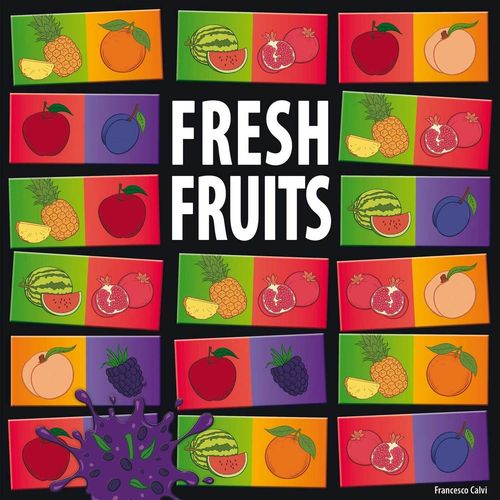
Fresh Fruits
Fresh Fruits Rulebook
Table of Contents
Table of Contents
Contents
- 52 double tiles with fruits. Each tile shows either two fruits or one fruit and one empty space.
- 16 single fruits. You need these during the game to fill the empty spaces on the double tiles.
- 24 order cards. These show the orders for which you earn points at the end of the game. There are three order card categories (A, B, C). One card from each category is laid out during the game.
- 4 overview cards. The overview cards show the maximum basket size (= your fruit display), the ideal arrangement of the fruits by weight, and an overview of the scoring at the end of the game.
- 30 "Crushed" tiles. Use these tiles to mark which fruits have been crushed.
The following fruits of different weights are available:
- Light: purple background: plum, blackberry
- Medium: orange background: orange, apricot
- Heavy: red background: apple, pomegranate
- Very heavy: green background: melon, pineapple
Aim of the Game
Purchase the required fruits and bring them home safely! This isn't as easy as it sounds, though. The heavy fruits mustn't be placed on top of the light ones, of course, and you naturally also need to buy the fruits that Aunt Helga wants. Who will manage to arrange the desired fruits in their basket so that as few as possible are crushed and the lighter ones are placed on top of the heavier ones? The player who best fills the orders will receive the most points and win.
Game Setup
- Sort the order cards by the letter on their backs (A, B, C). Turn over one random card from each pile. Lay the three cards out face up on the table for everyone to see. You can return the remaining order cards to the box, as you won't need them for this round.
- Find the double tiles featuring an empty space; there are 16 in total. Shuffle them without looking at them and deal one to each player.
- Put the remaining double tiles back with the other double tiles, shuffle them, and place them face down in a pile. Lay out as many double tiles from the pile face up as there are players, plus one (so one more than the number of players).
- Sort the single fruits by type and place them next to the double tiles as a general supply pile.
- Everyone takes an overview card. Then you're ready to get started!
Basket size: Your basket is the fruit display in front of you. Imagine an area that is a certain number of fruits wide and high. You can place your double tiles anywhere in this area.
- If there are two or three players, the basket is 6 x 4 fruits (NOT double tiles!) in size.
- If there are four players, the basket is 5 x 4 fruits (NOT double tiles!) in size.
Example: If there are two players, each of you has an area of 6 by 4 fruits to lay out your fruits.
(The overview cards have a front side for 2 and 3 players and a back side for 4 players; the booklet shows the four-player game setup on the back of the overview card.)
How to Play
Take it in turns to play, in clockwise direction. The last person to eat a melon is the starting player in the first round.
When it's your turn, take one of the double tiles laid out face up and place it in front of you so that it fits in your basket.
Instead of picking up a tile from the center, you can alternatively play the double tile with an empty space that you received at the start of the game. To do this, take one of the double tiles from the tiles laid out face up and return it to the box. Then place your double tile with an empty space in your basket, take a single fruit, and place it on the empty space.
Once you've placed a tile, it's the next player's turn.
Rules for Placing Double Tiles
- A double tile can be rotated any number of times before it is placed in your basket.
- Once you've laid out a double tile, its position can no longer be changed.
- A double tile can be placed anywhere in the basket, but must be at least next to one other double tile that you've already placed in your basket. This does not apply to the first double tile, of course!
- Beginners' level: The bottom row in your fruit display is the bottom of your basket. The first double tile doesn't have to be placed in the bottom row, so you don't have to decide right away which position it will have in the basket. Its position will be determined over the course of the game depending on how you place the next tiles.
- For experienced fruit stackers: The bottom row in your fruit display is the bottom of your basket. The basket must now be filled from the bottom up. The first double tile has to be placed in the bottom row. This is the only row in which double tiles may "float" entirely in the air. In all other rows, there must always be another double tile beneath it. You can place a horizontal tile above a vertical one, though, so that the vertical tile is below just half of it.
- Double tiles can never be placed so that they extend over the sides of the basket (6 by 4 fruits if there are two or three players, and 5 by 4 fruits if there are four players).
- If you place a double tile featuring an empty space in your basket, you must immediately take a single fruit from the general supply pile and place it on the empty space. If a fruit type is no longer available in the general supply pile, then you cannot take it.
- If two fruits are placed on top of each other vertically and the upper fruit is heavier than the lower fruit, then the lower fruit is crushed. Crushed fruit remains in your basket, but can no longer be used to fill orders. Crushed fruit also earns you minus points at the end of the game. Only the fruit directly under the heavier fruit is crushed. If the fruit underneath this is also lighter than the heavier one, this fruit is not crushed.
(The booklet illustrates the placement rules with a diagram of tiles A to D; the examples are described in the text above.)
Placing double tiles, an example:
- Beginners' level: There is already a tile featuring an apricot and an orange in the basket. Tiles B, C and D can be placed in the basket, as they are next to one other double tile that you've already placed in your basket.
- For experienced fruit stackers: First, tile A had to be placed in the bottom row. Tile B cannot be placed, as it would be left "floating" in the air. Tile C can be placed in the basket, because it would not "float" entirely in the air.
Tip: To earn as many points as possible, arrange the fruits in the basket according to their weight: place the fruits with a green background in the first (bottom) row, the fruits with a red background in the second row, the fruits with an orange background in the third row, and the fruits with a purple background in the fourth (top) row (see the overview card).
End of the Round
Once each player has had a turn, there is one double tile remaining in the center of the table. The starting player takes this and places it in their basket. Then they draw new tiles again (number of players plus one additional tile) and lay them out face up in the center of the table. Now the round is over, and the next player (clockwise direction) is the new starting player.
Play continues until all players have completely filled their baskets or they cannot add any more fruit.
End of the Game
The game ends when none of the players can place a double tile, either because their basket is full or because it is blocked so that they cannot place any more double tiles.
Now it's time for Aunt Helga to hand out the rewards! You'll receive points depending on how well you fill her orders:
- "Don't crush the fruit!" (minus points for crushed fruit): You'll receive three minus points for each crushed fruit. Place a "Crushed" tile on each crushed fruit.
- "Sort the fruits by weight!" (plus points for fruits in the correct row): You'll receive one plus point for each fruit that is not crushed and is in the correct weight row (see the overview card).
- "Buy the fruits we need!" (order cards): You'll receive the points indicated for each order you fill. Several players may be able to fill the same order card. Crushed fruit does not count when filling orders. You can fill Category A order cards more than once, but the same fruit cannot be used more than once for the scoring.
The Order Cards
Category A: At the end of the game, you'll earn five points if you've laid out the fruits depicted in exactly the same order and orientation (horizontal or vertical) as shown on the card. You can fill Category A orders more than once. Each fruit can only be used for one combination, though.
Category B: If you have at least three of the fruits shown on the card at the end of the game, you'll earn three points.
Category C: If you have at most two of the fruits shown on the card at the end of the game, you'll earn four points.
Winning
The player with the most points wins.
If there's a tie, the tied player with the least crushed fruit in their basket is the winner. If there's also a tie on this, the tied player who placed more fruit in the correct weight rows in their basket is the winner. If there's still a tie, the tied players share the victory.
Sample Scoring
- -6 points for 2 crushed fruits
- +11 points for the 11 fruits in the correct weight rows (3 green, 3 red, 2 orange, 3 purple)
- +9 points for filled order cards
- = 14 points
(The booklet's sample-scoring illustration shows this calculation.)