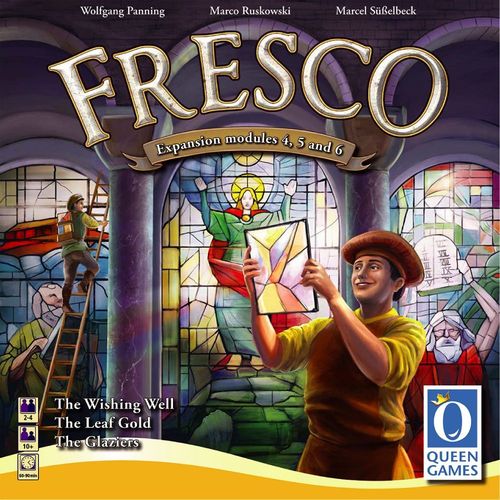
Fresco: Expansion Modules 4, 5 and 6
Fresco: Expansion Modules 4, 5 and 6 Rulebook
Table of Contents
Table of Contents
Overview
When combining several modules it may be easy to get lost. In order to keep a better overview we provide the following additional components:
- Paints depot – When the brown and pink paints are not used, cover these two paint pots with the lids.
- Bank – keep all coins here.
- Reserve board – store used glass tokens of module 6 here.
For a good overview, place the various boards next to the main game board: the paints depot, the bank, the reserve board, the display board for the leaf gold, the Wishing Well board and the glaziery board.
Module 4 – The Wishing Well
The painters are happy – when the bishop is paying them a visit, or when they receive a finder's reward and some paints free of charge. Could there be any truth in the old well at the market being a wishing well?
This module affects the rules of:
- Planning actions – Apply Lucky Pennies
- Market: Acquire Wishing Cards
- Performing actions – Use your Wishing Cards
Additional components
- 20 Lucky Pennies
- 20 Wishing Cards
- 1 Wishing Well board
Changes in setup
Place the Wishing Well board next to the game board. Shuffle the Wishing Cards and place the pile face down on its designated space. Place all Lucky Pennies on the Wishing Well board; this is the general supply.
Give 3 Pennies to each player. The players hide their Pennies behind their large screen.
Wishing Well board: storing space for Lucky Pennies; Wishing Well with spaces for 2 Lucky Pennies; designated space for Wishing Cards.
Changes in game play
You may apply your Lucky Pennies when planning your actions (Phase 2: Planning actions) and use them when performing your action at the market.
Planning actions – Apply Lucky Pennies
Each player who deploys at least 1 apprentice to the market may place a maximum of 2 Lucky Pennies on the market symbol of their action sheet.
Example: Red deploys 3 apprentices to the market and places 2 Lucky Pennies on the market symbol.
Market: Acquire Wishing Cards
First, the active player may throw one Lucky Penny (or two, if they had placed two on their action sheet) from their action sheet into the Wishing Well. For each Penny thrown they draw one Wishing Card form the face down pile, not showing it to the other players and hiding it behind their large screen. Next, they perform their action at the market as planned or forfeit the action. Only two Pennies may be thrown into the Wishing Well during one game round. If two Pennies are already in the Wishing Well, no more Wishing Cards can be drawn during this round. All players put any Lucky Pennies still on their action sheet back behind their large screen.
The player throws one Lucky Penny into the Wishing Well and then draws the top Wishing Card from the pile.
Performing actions – Use your Wishing Cards
Each card represents a bonus for one apprentice at a particular location as shown on the card.
Exception: You do not need an apprentice for the busker.
Each apprentice may use only one Wishing Card during a game round.
Each Wishing Card may be used only once during the game. It may be used during the same round it was acquired or later; once used it is removed from gameplay.
Example: Location: Studio. Bonus: The apprentice is given a tip – 1 Thaler and 1 Lucky Penny.
Note: Interplay with other modules: In a given situation, you may use a Wishing Card even if you benefit already from another bonus of some other module – even if it is the same bonus.
The Wishing Cards in detail
You may use the following cards only if you had deployed at least one apprentice to that particular location:
- (3x) Lucky guy – Market: You receive 2 Lucky Pennies from the general supply. Place them behind your large screen.
- (3x) Free paint – Market: When buying a market tile you are given the tile shown on the card additionally and cost-free, if it is on offer at that market booth. You do not need an extra apprentice for this free tile. You may not use this card when "closing down a market booth".
- (2x) The bishop pays a visit – Cathedral: You may move the bishop 1 extra space in any direction without paying.
- (2x) Praise of the bishop – Cathedral: The bishop's bonus is increased by 1 point.
- (3x) Tip – Studio: You receive 1 extra Thaler and 1 Lucky Penny.
- (2x) Alchemy – Workshop: The apprentice blends 1 extra paint. Exchange 3 basic colors (yellow, red, blue) in any combination against 1 orange, green or purple paint.
- (2x) Finder's reward – Theater: Besides improving your mood you find 3 Thalers.
You do not need an apprentice in order to use the following card. It is played during phase 1 after choosing your get up time.
- (3x) Busker – After adjusting your mood, it is increased by 1 space subsequently. Each player may use only one busker during a game round.
Preparing the next game round
Put any Lucky Pennies from the Wishing Well back into the general supply.
End of the game and final scoring
Prior to final scoring, all players discard all of their Lucky Pennies still behind their screen and receive 1 Thaler for each Penny.
2-player game
Leonardo never owns any Lucky Pennies.
Module 5 – The Leaf Gold
The bishop wants to refine the paints used for the Fresco. He decides from one round to the next which paint is refined with leaf gold.
This module affects the rules of:
- Market: Buy paints and acquire leaf gold
- Cathedral: Restore the fresco with gilded paints
Additional components
- 1 display board for the leaf gold
- 24 leaf gold tiles
- 2 gold market tiles – 1 each, used for the game board side for 4 players and for 3 players respectively
- 6 wooden discs (red, blue, yellow, green, purple, orange). Put them in the bag, together with the market tiles.
- 1 basket tile
Changes in setup
Place the leaf gold tiles on the display board, next to the game board. Place the basket tile and the appropriate gold market tile on the market.
Randomly draw a wooden disc from the bag and place it in the basket. The color of this disc indicates which paint should be refined with leaf gold during this game round.
Changes in game play
Market: Buy paints and acquire leaf gold
The arrows of the gold market tile point at two market tiles. The player buying such a tile additionally receives as many leaf gold tiles as shown, cost-free. They simply take the leaf gold from the supply and hide it behind their large screen.
Market III: At market booth III one leaf gold tile is offered together with one blue and one yellow paint.
Market IV: At market booth IV you even get two leaf gold tiles when buying the two red paints.
Cathedral: Restore the fresco with gilded paints
If a player restores a segment of the fresco which contains this round's refined color, among others, they may discard 1 leaf gold tile additionally to the required paints. Depending on the bishop's position, they gain extra victory points:
- The bishop is standing on the segment to be restored: 3 victory points
- The bishop is standing adjacent to the segment to be restored: 2 victory points
- The bishop is standing at some other place: 1 victory point
Example: The bishop wants the yellow paint to be refined. The player owns the required paints and additionally 1 leaf gold.
These victory points are awarded additionally to the bishop's bonus points as known from the basic game: The player sums up their victory points for the restored tile, for any leaf gold and any bishop's bonus points and advances their master painter on the victory points track accordingly.
| Fresco tile | Leaf gold | Bishop's bonus | Total | |
|---|---|---|---|---|
| Example A | 7 VP | 3 VP | 3 VP | 13 VP |
| Example B | 7 VP | 2 VP | 2 VP | 11 VP |
| Example C | 7 VP | 1 VP | / | 8 VP |
You may not use any leaf gold when restoring the altar.
Preparing the next game round
Draw a new wooden disc from the bag and place it in the basket – only thereafter put the former disc back into the bag.
End of the game and final scoring
Prior to final scoring all players discard all of their leaf gold tiles from behind their screen and receive 1 Thaler for each tile.
2-player game
Leonardo never acquires any leaf gold tiles.
Module 6 – The Glaziers
While the fresco is shining in its new glory, restored by the skilful hands of the master painters, the bishop expresses his long held desire – new stained glass windows. No easy task, but thank God the glaziery offers help.
This module affects the rules of:
- Planning and performing actions: The glaziery – acquire glass tokens
- Cathedral: Restore the fresco or altar
Additional components
- 1 glaziery board with a production bench and storage spaces for glass tokens and window tiles
- Reserve board for depositing played glass tokens
- 26 glass tokens: 5 green, 6 red, 7 blue and 8 yellow
- 18 window tiles
- 1 altar window
- 4 action tiles "Glaziery"
- 1 linen bag
Changes in setup
- Place the glaziery and the reserve board next to the game board.
- Shuffle the 18 window tiles and place the pile face down on its designated supply space. Draw the top six tiles and place them face up on the production bench. The production bench shows the costs of the window tiles, between 0 and 3 Thalers.
- Place the altar window on the window opening next to the altar.
- Put all glass tokens in the bag and randomly draw 2 glass tokens per player. Then, place the glass tokens on the designated storage spaces of the glaziery board, sorted by color.
- Give each player 1 "glaziery" action tile (in their player color), which they keep behind their small screen.
Changes in game play
Planning and performing actions: The glaziery – acquire glass tokens
A new location is introduced in phase 2 and a new action: The glaziery.
Planning actions: During this phase of the game players now may plan to perform actions at the glaziery. If they want to do so, they cover one location of their choice on their action sheet with their "glaziery" action tile. During this round, a player may not go to the location covered with their glaziery action tile; they go to the glaziery instead. One additional apprentice is imprinted on each of the two top slots of the action tile. This means the player may perform the action "acquire glass tokens" twice without having to deploy any apprentices there. However, if they want to perform this action thrice, they have to deploy an apprentice to the third slot.
Example: This round, the player cannot deploy any apprentices to the studio, but to the glaziery instead. The player performs 7 actions in total – two are imprinted on the glaziery action tile.
Performing actions: The active player may buy 1 available glass token for each of their apprentices at this location. The purchase price for glass tokens is as follows:
- 1 blue or 1 yellow glass token: 1 Thaler
- 1 red or 1 green glass token: 2 Thalers
The players put any glass tokens they bought behind their large screen. If there are no more glass tokens on the glaziery board, the players cannot buy glass tokens during this round anymore.
Example: Blue and yellow glass tokens cost 1 Thaler each, red and green ones 2 Thalers each.
Cathedral: Restore the fresco or altar
Restore the fresco – renew windows:
12 of the 25 fresco segments are next to a window. If a player is restoring one of the 12 fresco segments next to a window, they must subsequently, and additionally, renew the adjacent window by placing there a window tile from the production bench of the glaziery.
The player takes 1 of the 6 window tiles from the production bench and pays its cost (0 – 3 Thalers). Then, they place the window tile on the game board next to the recently restored fresco segment.
Example: 13 fresco segments do not have a window. 12 fresco segments are next to a window. The player claims the tile from the restored fresco segment and places the window tile on the empty space of the wall.
Move the window tiles to the right of the now empty space down towards zero costs. Reveal the top window tile from the pile and place it at the end of the row. The victory points awarded for renewing the window are shown on each window tile. Each window also has its particular combination of 2 or 3 glass panels.
If the player fails to discard a glass token of the corresponding color for each glass panel, they suffer the following penalties:
- each missing yellow glass token: 2 VP
- each missing blue glass token: 4 VP
- each missing red glass token: 6 VP
- each missing green glass token: 8 VP
Please note: You can renew a window without discarding any glass tokens at all – but you will suffer many penalty points.
The player adds their victory points for the restored tile, the renewed window tile and any bishop's bonus points, then deducts any penalties for missing glass and advances their master painter on the victory points track accordingly.
Please note: If the calculated total is negative, the master painter does not have to go back on the victory points table but remains where he is.
Examples of window renewal:
- A: The player buys the window (yellow/yellow/green) paying 2 Thalers.
- B: A new window (red/green/red in this case) is revealed and placed at the end of the row.
- C: Move the window tiles up to fill the empty space.
| Fresco tile | Window tile | Bishop's bonus | Penalty for missing glass | Total | |
|---|---|---|---|---|---|
| Example A | 7 VP | 7 VP | 3 VP | / | 17 VP |
| Example B | 7 VP | 7 VP | / | - 8 (green missing) | 6 VP |
| Example C | 7 VP | 7 VP | / | - 14 (no glass) | 0 VP |
| Example D | 7 VP | 9 VP | / | -18 (no glass) | 0 VP * |
* Calculated exactly the result is -2, but is considered 0.
Restore the altar – renew window:
The altar window consists of 4 glass panels, one of each glass color. If the active player restores the altar, they may subsequently and additionally contribute renewing the altar window by discarding up to 4 glass tokens (no more than 1 of each color). For each discarded glass token the player gains 1 victory point. They add their victory points for restoring the altar and the altar window and advance their master painter on the victory points track accordingly.
Example: The player discards these 3 paints and 3 glass tokens. They gain a total of 6 VPs: 2 VPs (basic VPs for yellow/red/blue), 1 VP (wildcard orange), 3 VPs (3 glass tokens of different colors).
Preparing the next game round
The players remove their "glaziery" action tile from their action sheet, if applicable, keeping it behind their small green [sic: printed as "small green" in the source; elsewhere the rules say "small screen"]. Remove any glass tokens remaining on the glaziery board and put them on the reserve board.
Draw 2 glass tokens per player and put them on the glaziery board. If the supply in the bag is exhausted, refill the bag with the glass tokens from the reserve board.
2-player game
Leonardo never acquires any glass tokens and no glass tokens are drawn for him. If he restores a fresco segment next to a window opening he renews the window with the window tile costing no (0) Thalers. Leonardo still gains the victory points as shown on this window tile.