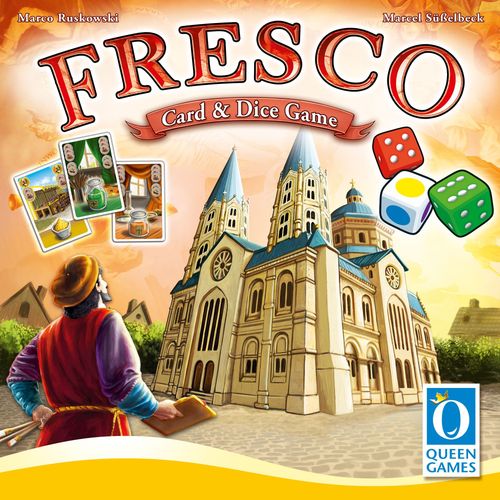
Fresco: Card & Dice Game
Fresco: Card & Dice Game Rulebook
Table of Contents
Table of Contents
Part 1: Card Game
Contents
- 42 Market cards with identical rear side
- 42 Workshop cards with three different rear sides
- 25 Fresco cards with identical rear side
- 20 Action tiles
- 12 tiles "The bishop's favorite color"
- 1 First player palette
- 1 Display board
- 1 Rules booklet
Game Set-Up
- Sort the cards by their rear sides, creating five stacks. Shuffle each stack separately.
- Put the market cards face down in the designated slot of the display board, this is the draw pile.
- Put the three piles of workshop cards in the other three slots of the display board.
- Put the fresco cards face down on the designated space of the display board, this is a second draw pile. Reveal the four top cards, and place them to the right of the draw pile.
- Make sure for some space next to the market cards draw pile and each of the three workshop cards pile; a discard pile will be formed on each of these spaces during the course of the game.
- Mix the tiles "The bishop's favorite color", and place them face down as a draw pile next the draw pile of the fresco cards. Then, reveal the top tile, and place it next to the pile.
- Mix the action tiles and place them face down on the designated space of the display board as just another draw pile. Then, reveal the three top tiles, and place them next to the pile.
Determine the first player randomly. They take the palette and keep it in front of them. Beginning with the first player and continuing clockwise, each player draws five market cards as their initial hand, one after the other. You are now ready to start the game.
Gameplay
The players perform their turns in clockwise direction.
A player's turn consists of 3 phases (Phase 1: Draw market card; Phase 2: Swap hand cards / Restore a section of the fresco / Pass; Phase 3: Check hand limit). The active player performs all three phases in that order, then their left neighbor becomes the next active player etc.
Phase 1: Draw market card
The player must draw one card from market cards draw pile, adding it to their hand.
Phase 2: Swap hand cards or Restore a section of the fresco or Pass
The player must decide for one action: They may swap their hand cards or they may restore a section of the fresco. If they cannot perform one of these actions or don't want to, they have to pass.
Swap hand cards
The player plays any number of their hand cards in front of them, face up. The cards show market and/or workshop icons. Depending on the icons shown, the player draws market cards or workshop cards from the respective draw pile, and adds them to their hand. Some market or workshop cards show both icons, and in that case the player must decide between the market draw pile or one of the workshop draw piles.
Some cards show more than one market or workshop icon. When a player plays one of such cards, they draw as many cards of that type as the number of icons. As there are three draw piles for workshop cards, the player may decide for each icon from which pile they want to draw.
Hint: The player should draw one card after the other, look at it, and then decide from which pile to draw next (possibly from another workshop pile).
Once the player has finished drawing cards, they put their played cards on the corresponding discard piles, sorted by type. If at any time during the game a draw pile gets exhausted, mix that discard pile and use it as the new draw pile.
Restore a section of the fresco
The fresco cards are showing paints of three different colors. When, during phase 2, the player wants to restore a section represented by one of the four face up fresco cards on display, they must have the corresponding paints on their hand.
Then, the player needs to play the required cards from their hand face up, showing these paints. They take the card of that fresco section from the display and keep it in front of them, the lowest victory points value (red number) pointing to the center of the gaming area.
If any of the played cards is showing the bishop's icon, the card of the just restored fresco section is rotated by 90 degrees counter-clockwise per bishop's icon, i. e. to the next higher victory points value.
If the player had used the current favorite color of the bishop, as shown by the face up tile on the display board, they may rotate the card of the just restored section additionally by 90 degrees to the next higher value.
Note: A card can be rotated no more than three times. Any additional rotations are forfeited.
If the player has restored any sections before, they place the new card over-lapping on the cards they have restored before, making sure that only the victory points pointing to the center are visible.
Important: A player may restore more than one section during their turn, provided they can play the required paints.
As a reward for their successful restoration the player takes one of the three action tiles from the open display, and keeps it in front of them. These tiles provide various advantages (see "Action tiles").
After the player has restored one or more sections, they put their played cards on the corresponding discard piles. Finally the player replenishes the open display to three action tiles and four fresco cards.
If the player had used the bishop's favorite color for their restoration, they remove that tile from the game and reveals a new one from the draw pile. Once that draw pile is empty, there are simply no more bishop's favorite colors.
Hint: The different shapes of the windows indicate onto which pile a workshop card must be discarded.
The market cards with halved paint bottles
Some market cards do not show a paint in the center only, but also a halved paint bottle on either edge of the card. These cards are used for blending paints during restoration. These cards are discernable by their color blending icon in both upper corners.
For example, a player may play one blue and one yellow market card with the blending icon as "green" instead of one green card. Several paints may be blended this way for a restoration.
When blending paints, a player must play more cards, but is rewarded with more victory points, because the cards used for blending create a bishop's icon. This allows the player to rotate the fresco card of the just restored section once more, thus giving them more victory points.
Pass
If the player chooses not to restore any section of the fresco, they may pass and proceed with phase 3.
In case the player has only one or two hand cards, they must draw from the market cards draw pile to replenish their hand to three cards.
Phase 3: Check hand limit
The player may not have more than seven hand cards in this phase. They must discard any excess cards of their choice onto the corresponding discard piles.
Action tiles
There are four kinds of action tiles:
- Rotate tile (1 victory point): You may use this action tile when restoring a section of the fresco, and it lets you rotate the fresco card to the next higher victory points value. You remove the tile from the game subsequently. However, if you do not use it during the game and still own it at the end of the game, you will score one victory point for it.
- Additional restoration tile (cards plus fresco icon): You may use this action tile during phase 2. After swapping hand cards, you are allowed to restore one or more sections of the fresco additionally. You remove the tile from the game subsequently.
- Ask-for-a-paint tile: You may use this action tile at any time during your turn. You name the color of a paint, then ask the other players for it. Each player holding this card (not an action tile) on their hand must give it to you. If a player owns several copies of that card, they must give only one. If a player owns no copy of that card at all, they must show you their hand briefly. Either way you remove the tile from the game subsequently.
- Paint substitute tile (1 victory point, shown with the paint colors): You may use such a tile when restoring a section of the fresco instead of the required card. You remove the tile from the game subsequently. However, if you do not use it during the game and still own it at the end of the game, you will score one victory point for it.
End of the game
When at least one player has restored a fifth section of the fresco (five cards in a 4-player-game) or a sixth section (six cards in a 2- or 3-player-game), this is the final round of the game. Continue the current game round as usual, until the right neighbor of the first player has performed their final turn. Then, proceed to the final scoring.
Final scoring
Each player totals the victory points of their fresco cards pointing to the center of the gaming area plus those of their action tiles (if any). The player with the most victory points is the best painter and winner of the game! In case of a tie for the most points the tied players share the victory.
Example: A player totals their victory points. Counting the points on the cards of their restored sections of the fresco, the result is 20. They add one victory point from their action tile, and end up with 21 victory points.
Part 2: Dice Game
You are painters, and by order of the bishop the cathedral's fresco needs to be restored. The fresco is divided into 5 sections, and each section requires a different combination of paint. The artists may not always acquire the correct paints, and will have to paint portraits of the city's nobles at their studio instead. Victory points are awarded for completed fresco segments as well as for portraits. The bishop is watching closely though, and may award extra points. The painters are very competitive, and will even place bets on the result of a competitor's restoration attempt. The game ends once one player has painted 5 portraits or restored 5 segments of the fresco, and the player who earned the most victory points is the winner.
Game components & setup
Components:
- 20 Fresco tiles, 4 each of 5 fresco sections
- 16 Portrait tiles, 8 female & 8 male portraits
- 12 Betting tokens, 3 each in Red, Yellow, Green, and Blue
- 4 Painter boards in Red, Yellow, Green, and Blue
- 4 Painter pieces in Red, Yellow, Green, and Blue
- 1 Bishop piece
- 1 Favor tile (+/-1)
- 1 First player palette
- 6 dice in different colors (pips)
- 2 Color dice
- 1 Game board
- 1 Rules booklet
Setup:
-
Place the game board in the center of the playing area, and place all the dice, favor tiles, and the bishop piece next to it.
-
Each player selects a player color and takes the following in that color: painter piece, painter board, and 3 betting tokens.
-
Each player places their painter piece on the stairs in front of the victory points track. Note: There is no given order on the stairs.
-
Each player places their painter board in front of them and puts the 3 betting tokens on the designated space.
-
Sort the fresco tiles by the shape of the icon on them, then stack them in numerical order with the two lowest valued tiles on top and the highest on the bottom. Place each stack on the designated section of the playing board. In a game with 3 players, return the topmost tile of each stack to the game box. In a game with 2 players, return the two topmost tiles to the game box.
-
Use the following portrait tiles based on the number of players (return unused tiles to the game box):
- 4 Players - You will use all 16 tiles.
- 3 Players - Remove the 4 tiles with the HHHH icon.
- 2 Players - You will use only the 8 tiles with the HH icon.
Shuffle all the remaining tiles together and make equal stacks of face down tiles in the 4 designated spaces of the game board. Turn over the top tile of each stack.
-
Randomly choose a first player and give them the palette.
Gameplay
Play starts with the first player and continues in a clockwise direction. Each player's turn consists of the following 4 phases:
- Phase 1: Assign favor tile
- Phase 2: Place bishop piece
- Phase 3: Place bets and roll dice
- Phase 4: Score victory points
Phase 1: Assign favor tile
The favor tile is awarded to the player who is currently in last place on the victory point track, or is the only player on the stairs (if more than one player is still on the stairs, it is not awarded). The tile is kept in front of the player for the round and awards a benefit when restoring the fresco. (see: Roll dice).
Phase 2: Place bishop piece
The active player takes the bishop piece and places it on one of the 5 bishop spaces of the game board. This shows that the player wants to restore the fresco tile next to the bishop.
Phase 3: Place bets and roll dice
To restore a fresco tile, the active player will roll the dice three times and will need to match exactly the number shown next to a tile. Before they roll the dice, the other players may place bets on how successful they think the player will be.
Place bets
The other players may place a bet on one of these three events to happen. There is one betting token related to each event.
- The active player has successfully restored the fresco tile marked with the bishop piece.
- The active player has successfully restored one of the other fresco tiles not marked with the bishop piece.
- The active player has not restored a fresco tile, but painted a portrait instead.
Before each of their 3 die rolls, each of the non-active players will have a chance to place a bet on the result. They may only place one bet, and will earn more victory points for placing the bet earlier. The active player will only roll the dice after all players have made the decision whether or not to bet for each of the 3 dice rolls.
- When placing the bet before the first roll, that player puts the betting token face down in the first (left) slot on the upper edge of their painter board. If their bet is successful, they will gain 3 victory points.
- When placing the bet before the second roll, that player puts the betting token face down in the second (middle) slot on the upper edge of their painter board. If their bet is successful, they will gain 2 victory points.
- When placing the bet before the third roll, that player puts the betting token face down in the third (right) slot on the upper edge of their painter board. If their bet is successful, they will gain 1 victory point.
Roll dice
The active player will roll the dice exactly 3 times (with a chance to bet before each roll). The first roll, they will use all the color and quality dice. After rolling, they will set aside one quality die. In addition, they may also set aside one or both of the color dice if they match the color of the quality die. One color die doubles the value of the quality die, and two will quadruple it.
After doing this three times, the player will total the result to see if they were successful.
Important: If the active player is currently holding the favor tile, they may increase or decrease their total by 1.
If the active player's total is 8, 13, 16, 19 or 24, they take the top fresco tile from the stack next to that number, then puts it on their painter board, colored fresco side face up.
If the active player's total is 9 - 12, 14 - 15, 17 - 18 or 20 - 23, they take the top portrait tile from the stack next to that number and place it face down on their painter board. If their total is less than 8 or more than 24 the roll was unsuccessful, and they receive nothing.
Important: If a player's roll matches either a tile they have restored already, or an empty portrait space, they receive nothing.
Example of a player's turn: It is the Red player's turn. She places the bishop piece on the bishop space next to the number 16. Before she rolls the dice, all players have a chance to place a bet; the Green player places a bet tile in the first slot of their painter board. Red then rolls the dice and sets aside the blue 6 quality die, but no color die. Before Red rolls a second time, the Blue and Yellow players decide to place bets as well. She rolls a second time and sets aside the yellow 4, which adds to her first roll to give a total of 10. She therefore must roll a 6 or double 3 on the final roll. She is lucky: With her third roll, she can put aside the "green" color die and the green die with a 3, which doubles the green die to a 6. Red has managed to roll 16 exactly, and takes the corresponding fresco tile, which is worth 5 victory points. She places the tile on her painter board. Because the bishop is on the 16 space, she gains 3 more bonus victory points, and advances her painter by 8 spaces.
Phase 4: Score victory points
The active player scores victory points first. If they managed to restore a fresco tile, the player scores the number of victory points printed on the tile.
If the player managed to restore the fresco tile where they had placed the bishop, they gain a bonus of 3 victory points.
If the player fails to restore a fresco tile, but instead painted a portrait, they receive the points on the portrait tile instead, they gain the victory points imprinted on that portrait.
Then, the other players gain victory points in turn order if they have placed a successful bet.
- If a player placed their bet before the first die roll, they gain 3 victory points.
- If a player placed their bet before the second die roll, they gain 2 victory points.
- If a player placed their bet before the third die roll, they gain 1 victory point.
In case the active player managed neither to restore the fresco nor to paint a portrait, they score no victory points.
The players mark their victory points on the victory points track. If a painter piece lands on an occupied space, the piece is advanced to the next unoccupied space. This means that a player may gain one or even more additional victory points.
Example (continued): Now, in turn order the other players check which of them will gain any victory points. Green reveals his betting token in the first slot of his painter board. His bet was that Red would restore the tile at the bishop's position successfully; this bet was correct, and he scores 3 victory points by advancing his painter 3 spaces. Next, Blue reveals his betting token in the second slot of his painter board. His bet was that Red would have to take a portrait tile - he scores no victory points. Finally, Yellow reveals her betting token. She placed the same bet as Green, but gains 2 victory points only because she had placed her bet later. [Transcriber's note: the source text of this sentence is garbled; "placed her bet later" is the transcriber's reading of the intended meaning.] She advances her painter by 2 spaces.
End of the game
As soon as one player has restored all 5 sections of their fresco, or painted a fifth portrait, the game will end at the end of the current round (all players take equal turns). As a bonus, any player who meets either of these conditions (not just the first) takes one face up portrait tile from the game board immediately and scores the printed value.
Likewise, the game has reached its final round as soon as one player has put the fifth portrait tile on their painter board at the end of their turn. Immediately, as a bonus they take one of the face up portrait tiles from the game board as well and gain the imprinted victory points.
Continue the current game round as usual, until the right neighbor of the first player has performed their final turn. If any other players assemble all 5 fresco tiles or paint their fifth portrait, they also receive the bonus of one additional portrait tile.
Note: If a player draws a 5th portrait as a bonus, they do not receive an additional bonus portrait.
On their final turn, each player receives a wedding bonus for each pair of male and female portraits, scoring the points on the portraits a second time.
The player with the most victory points at this time starts recording their victory points, followed by the player with the second most etc. until all players have scored their bonus victory points.
The same rule applies as above: If a painter piece lands on an occupied space, the piece is advanced to the next unoccupied space.
The player with the most victory points is the greatest painter and winner of the game!
Example: The player painted their final fresco segment, scoring 5 points for the tile and 3 bonus points for the bishop being present. Since this was their 5th fresco segment, they take a bonus portrait of their choice, worth 2 points, and advance their painter a total of 10 spaces. Finally, they score a wedding bonus of 3+2 for their pair of male and female portraits, advancing their painter an additional 5 spaces.