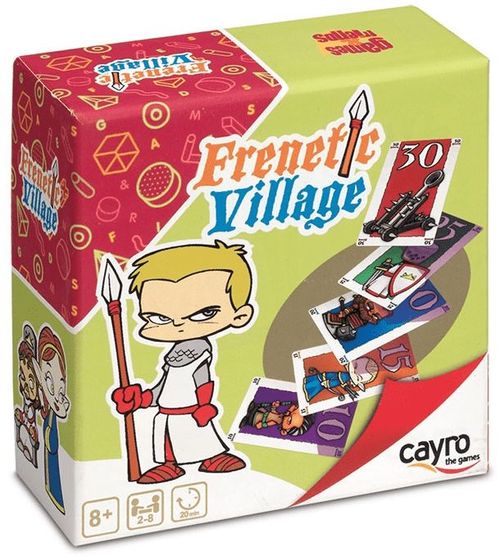
Frenetic Village
Frenetic Village Rulebook
Table of Contents
Table of Contents
Setup
Shuffle the 62 cards of the deck and deal 5 to each player. The remaining cards are placed face down in the centre of the table, within reach of all players, forming the draw pile.
You are now ready to start playing Frenetic Village.
Turn Order
The player with the most hair on their ears starts (the sheet describes this as one of the most original ways of choosing the starting player). Whenever possible (you will soon see why) play continues clockwise. Each time a player wins a round, that player starts the next round.
The player who begins the round first draws a card from the draw pile and then must play or discard another card from their hand, since a player may hold only 5 cards in hand.
Discarding
If the card you have drawn (or another card in your hand) is of no use for your play, you may discard it. The card is placed in front of you face up, forming your own discard pile. The last card you discarded must be on top of the pile and be the only visible card. This means each player has their own discard pile in front of them.
As soon as a card is placed on a player's discard pile, any other player who is interested in that card may try to take it. To do so, they must cover it with their hand. If several players want the card, the fastest to cover it keeps it. The player who obtains the card must discard another card, and play continues from that player.
A player may not try to draw the card that is left visible on a discard pile after this action. Nor may a player take the card from another player's discard pile when it is not that player's turn.
If the draw pile runs out, all players' discard piles are collected, shuffled, and placed in the centre again to be drawn from.
Actions
The deck has two types of cards: army cards and action cards. Action cards are used to interact with opponents and may be:
- Skulls: if this card is placed on the discard pile of any other player, you have removed all of their troops. That player must place all their cards face down at the bottom of the central draw pile. They must then draw 5 new cards.
- "Pallá pacá" card: if you leave this card on another player's discard pile, you exchange one card with that player.
- "Pallá pacá" hand: when you place this card on another player's discard pile, you exchange all cards with that player.
- Two cards to the deck: when you place this card on another opponent's discard pile, you remove two cards at random from their hand and place them face down in the central deck without anyone looking at them. That player must quickly draw two other cards before the next player's turn begins.
- Three cards to the deck: the same as the previous card, except that three cards are taken and placed in the deck instead of two.
- One card: when you place it on another player's discard pile, you remove one card from their hand and keep it. The attacked player draws another card to get back to 5, and you discard one card.
- Wildcard: it can replace any card with respect to its value and its race. However, it is not an action card. A player may hold both wildcards in hand.
End of the Game
The game ends at the moment a player has achieved any one of these three combinations:
- 5 consecutive cards of the same race (like a straight in poker),
- 5 cards of the same value,
- 5 consecutive cards, each of a different race, which is called an "invincible ladder".
If you have gathered any of these combinations in your hand, on your turn draw a card and place it face down on your discard pile, so that all players know you have come to dominate them.
Optional Scoring and Victory Variants
You may play that whoever wins 5 battles is the winner of the game.
You may also play that when a player wins, the other players add up their cards, and after a set number of battles the player with the lowest total wins.
Or the winning player adds up points from the cards they have won in battle, and after a set number of battles the player with the most points is the winner.
You may agree in advance how you will play and how victory will be achieved.
Translation Notes
- The sheet's words "valoro" (for "valor", value) and "cartasen" (for "cartas en") are typographical slips, read here as "value" and "cards in".
- The sheet's card names and terms, including "pallá pacá", are kept as printed.