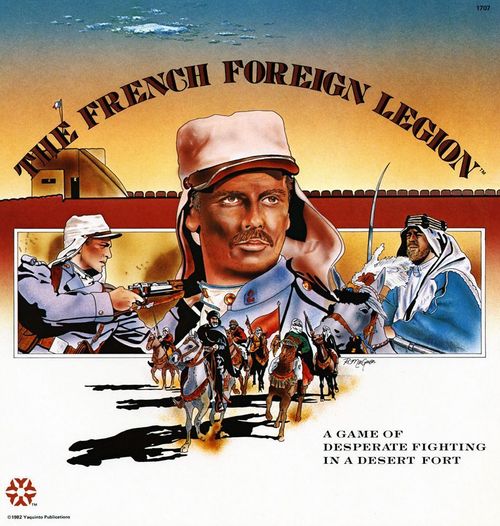
French Foreign Legion
French Foreign Legion Rulebook
Table of Contents
Table of Contents
- Introduction to the Game
- 1. The Game Equipment
- The Basic Game Rules
- 2. Set Up and Preparation for Play
- 3. The Basic Game Sequence of Play
- 4. General Game Procedures and Rules
- 5. The Mix Sequence Units Phase
- 6. The Movement and Melee Phases - How to Move and Melee
- 7. The Fire Phases - How to Fire
- 8. The Stun Removal Phase
- 9. Victory Conditions - How to Win
- The Optional Rules
- 10. Gates, Doors, Windows - Closing, Opening, Locking, Unlocking, Forcing, and Breaking
- 11. Character Unit Attitudes - Cover Definitions
- 12. Mounted Bedouin Organizations
- 13. Defender Melee Modifier
- 14. Machinegun and Cannon
- 15. The Siege Options
- 16. Night
- 17. Command Control and Morale
- 18. Wounds
- The Scenarios
- 19. Les Allemands - The German Mutiny
- 20. The Negotiations
- 21. The Surprise Night Attack
- 22. The Returning Patrol
- 23. Treachery
- 24. Reduced Gameboard
- 25. Character Unit Sheet
- Game Card
Introduction to the Game
Each player has tremendous latitude in the original set up of the forces, and during the game, the movement and deployment of the playing pieces is purely determined by the players' own views of how to achieve victory. The game rules merely set out the sequence of activity during each Turn, and define the limitations of the game mechanics. The rules in no way dictate how each player handles his forces. You, as a player, are in command, and your decisions will ultimately determine victory or defeat.
These rules need not be memorized, but should be carefully and thoroughly read. The rules should be used as a reference for questions that arise during the playing of a game. The rules are identified by a number code, for quick reference. The rules do not have to be learned at one sitting. Games can and should be played using only the Basic Game Rules, with selected Optional Rules introduced as the players' mastery of the game increases.
1. The Game Equipment
The following components are used for the play of the game. Please inspect these components carefully, and familiarize yourself with them while reading through this section.
1.1 THE GAMEBOARD: The inside of the album jacket forms the gameboard. This shows an abstract representation of a small walled Legion outpost in the Sahara that is surrounded by sand.
1.11 SQUARES: The gameboard contains printed three-quarter inch squares. These are used to determine the movement and position of the playing pieces. Each square also contains, in its center, a white "Sighting Dot".
1.12 ELEVATIONS: While the gameboard is two-dimensional, it represents a three-dimensional area. To create this third dimension, color-coding is used to symbolize the different elevations found in various squares on the gameboard.
- 1.121 PALE YELLOW: Elevation Level "0" (parade ground inside the Fort).
- 1.122 SANDY: Elevation Level "0" (sand outside the Fort).
- 1.123 LIGHT BROWN: Elevation Level "1" (building rooftops).
- 1.124 MEDIUM BROWN: Elevation Level "2" (parapets on the walls).
- 1.125 DARK BROWN: Elevation Level "3" (tower tops).
Squares that contain several different Elevation Levels show only the highest of these on the Fort representation. Other Elevation Levels of these squares are shown in separate diagrams on the ends of the gameboard, outside of the normal playing area. During a game, as playing pieces are moved from one Elevation Level to another, they are placed in the appropriate square, either on the gameboard, or on the required off-board diagram.
1.13 OTHER GAMEBOARD FEATURES: The gameboard also shows thick and thin walls, crenelated walls, doors, windows, stairways and the main gate. These are identified on the gameboard under "Symbols". Also, the individual buildings in the Fort are identified.
1.2 THE PLAYING PIECES: The game includes 218 playing pieces which are die-cut and must be punched out of their frame for use. These playing pieces are called "units". These units show the various men and equipment used in the game, as well as information units that display information needed to play the game.
1.21 CHARACTER UNITS: These represent the fighting men of the opposing forces. The information on these units is: NAME, SYMBOL/WEAPON (R: Rifle; P: Pistol), FIRE NUMBER, MELEE NUMBER, and ORGANIZATION (for example "R2-2" on a Legionnaire is a Rifle with Fire Number 2 and Melee Number 2).
- 1.211 LEGIONNAIRE (BLUE): name, weapon symbol, organization, Fire number, Melee number.
- 1.212 BEDOUIN (TAN): name, symbol, organization, Fire number, Melee number.
- 1.213 LEGIONNAIRE ORGANIZATIONS: There are three Legionnaire squads, numbered 1 - 3. In addition, there are the three Legionnaire Commanders (labeled "LC").
- 1.214 BEDOUIN ORGANIZATIONS: There are five Bedouin tribes, each identified by a letter: A = Arab; B = Berber; K = Kayble; R = Riff; and T = Tuareg. In addition, there are two Bedouin Commanders (labeled "BC").
NOTE: Since Character units are often inverted during play, it is a good idea to label the back of units in pencil with the number or letter of the unit's organization.
1.22 EQUIPMENT UNITS: These represent equipment that the Character units may be using.
- 1.221 ROPE UNITS: These represent ropes with hooks on one end.
- 1.222 DYNAMITE UNITS (OP): These represent bundles of dynamite. These are not used in the Basic Game.
- 1.223 WEAPON UNITS (OP): These represent large weapons that the Character units may use. These are not used in the Basic Game.
- 1.231 MACHINEGUN UNIT: shows NAME, SYMBOL, and a FIRE NUMBER of "5x4".
- 1.232 CANNON UNIT: shows NAME, SYMBOL, a CANISTER FIRE NUMBER ("C3") and a SHELL FIRE NUMBER ("S4").
1.24 SEQUENCE UNITS: These are used to determine the order in which the Character units may be moved and fired. There are four Legion and six Bedouin Sequence units, one for each organization (Squad 1, Squad 2, Squad 3, Legion Commanders; Bedouin Commanders, Arab, Berber, Kayble, Riff and Tuareg Tribes).
1.25 INFORMATION UNITS: These are used to show information needed for the play of the game.
- 1.251 STUN UNITS: These are placed on Character units to show when they are "stunned".
- 1.252 GATE UNITS: These represent the heavy wooden gates of the Fort.
- 1.253 TUNNEL EXIT UNITS (OP): These are used to show where tunnels break the surface. These are not used in the Basic Game.
- 1.254 BREACH UNITS (OP): These are used to show where walls have been breached. These are not used in the Basic Game.
- 1.255 CLOSED UNITS (OP): These are used to show closed or locked doors or windows, or locked gates. These are not used in the Basic Game.
- 1.256 LE CAFARD UNITS (OP): These are placed on Character units to show when they "go mad". These are not used in the Basic Game.
- 1.257 COVER UNITS (OP): These are placed on Character units to show their cover Attitude (Exposed units and Full Cover units). These are not used in the Basic Game.
- 1.258 MOUNTED UNITS (OP): These are placed with Bedouin organizations to show that they are mounted. These are not used in the Basic Game.
- 1.259 MUTINEER UNITS: These are placed on Character units to show that they are Mutineers. These are not used in the Basic Game, but only for the LES ALLEMANDS and TREACHERY scenarios.
1.26 BLANK UNITS: The units with no symbols or words printed on them are not required to play the game. They are provided to replace other units that may be lost or misplaced, or to substitute for any information units that may temporarily run short during a game.
1.3 GAME CARDS: Printed on each Card is the most frequently needed and used information used in playing the game. Two identical Game Cards are provided so that each player has one available for reference during play.
1.4 RULEBOOK: This book contains all the rules of the game, various scenarios, a reduced copy of the gameboard, and the Character Unit Sheet (a list of all the Character units in the game, plus background information on the Legionnaires).
1.5 PLASTIC BAGS: Two plastic bags are included for the separation and storage of units after they are punched out.
1.6 DIE: One standard six-sided die is included.
1.7 OTHER: A pencil is required for some of the Optional Rules. A straight edge is also needed to help determine Lines of Sight. These are not provided in the game, but must be supplied by the players.
The Basic Game Rules
The Basic Game Rules present FRENCH FOREIGN LEGION in its simplest form. After reading the Basic Game Rules, new players should play a few games to familiarize themselves with the mechanics of play, and to develop some expertise. After this experience, some or all of the Optional Rules may be introduced as desired, and additional scenarios may be tried.
2. Set Up and Preparation for Play
2.1 SIDE SELECTION: Each player rolls the die. Roll again to break ties. The player with the high roll can choose which side to command, the other player taking the other side.
2.2 GAMEBOARD SET UP: Select a smooth, flat surface on which the gameboard can be opened up. The players should sit opposite each other across any two sides of the gameboard. All doors and windows inside the Fort are considered to be Open in the Basic Game, and cannot be Closed. The Gate units are Closed during the Basic Game, and cannot be Opened. Place as shown in the Gate squares.
2.3 CHARACTER UNIT SET UP:
2.31 LEGION SET UP (FIRST): The Legion player places 30 of his 33 Character units as desired on any of the Fort squares. The three Character units that are not used may be any one Character unit from each squad, at the Legion player's choice. There may be no more than one Character unit placed in any one square at the same Elevation Level, and all Character units must be unambiguously Faced.
2.32 BEDOUIN SET UP (SECOND): None of the Bedouin Character units are placed on the gameboard, but should be placed in groups by their organizations in any convenient area near the gameboard. Assign all of the Rope units to the various Bedouin organizations by stacking them under the Character units that will "carry" them onto the gameboard after the game starts. The Bedouin player may assign any number of Rope units, or no Rope units at all, as desired, to the various organizations.
3. The Basic Game Sequence of Play
The game starts when all Set Up and Preparation is completed. The game is played in "Turns". Each Turn is divided into five "Phases", which are performed in the order listed below. The Turn Sequence is repeated over and over until the game is completed.
3.1 THE MIX SEQUENCE UNITS FOR MOVEMENT PHASE: The Sequence units are thoroughly mixed.
3.2 THE MOVEMENT AND MELEE PHASES: Sequence units are randomly drawn one at a time. As each is drawn, the Character units in the organization printed on the drawn Sequence unit may be moved. Melee may take place during movement.
3.3 THE MIX UNITS FOR FIRE PHASE: The Sequence units are again thoroughly mixed.
3.4 THE FIRE PHASES: Sequence units are randomly drawn one at a time. As each is drawn, the Character units in the organization printed on the drawn Sequence unit may be used to fire their weapons.
3.5 THE STUN REMOVAL PHASE: Remove one Stun unit from each Character unit so marked on the gameboard.
4. General Game Procedures and Rules
The following all play a part in a number of different Phases during a game:
4.1 CONTROLLING PLAYER DEFINITION: A player always performs all moves and die rolls for all Character units commanded or for the Equipment or Weapon units they use. Thus, a player is always the "controlling" player for his own units.
4.2 CHARACTER UNIT FACING: Character units have "Facing", or a specific direction in which the units are pointing. In the Basic Game, only Character units have Facing.
4.21 UNIT FRONTS: The "front" of a Character unit is the direction in which the unit is defined to be Faced, as shown in the examples (a unit may face a square side or a square angle; the facing is shown by an arrow).
4.22: Character units must at all times be kept Facing towards a definite side or angle of the squares they occupy. Be very careful with the placement of Character units with regard to their Facing so that no chances of confusion exist.
NOTE: In all diagrams used in these rules an arrow is used to show the facing of Character units.
4.3 MORE THAN ONE UNIT PER SQUARE: No more than one Character unit may end movement in any one square at the same Elevation Level.
4.31: Character units may be moved through friendly Character units while moving, but may not remain in the same square.
4.32: Character units may occupy the same square with any number of Equipment or Information units, and/or with any one Weapon unit (Optional Rules).
4.33: Whenever a Character unit enters the same square as an opposing Character unit, movement temporarily ends, and a Melee must be resolved. A Character unit may not enter the same square as an opposing Character unit without a Melee (exception: see 6.5 Jumping and Jump Impact).
4.4 READING THE DIE: The die has the number of spots thrown read in the normal manner. "Modifiers" to this die roll are called for in the rules, and require numbers to be added or subtracted to the number actually thrown. For example, if a "5" is rolled on the die, and a Modifier of "-1" is called for, the result is "5-1=4" and the result is interpreted as if a "4" has been rolled. If more than one Modifier applies, the effects are cumulative.
4.5 CHARACTER UNIT DEFINITION AND ORGANIZATION: The Character units that a player controls are defined to be "friendly", as all are on the same side. The Character units that the other player controls are the "opposing units", or "foes". All Character units in the game are formed into groups of Character units called "organizations". Character units may only be moved or fired when the Sequence unit for their organization is drawn. For example, when the Legion Commanders Sequence unit is drawn, only the Captain Le Jeune, Lieutenant Briere, and Sergeant Major Kolb Character units are affected.
5. The Mix Sequence Units Phase
The Sequence units should be placed upside down during these Phases, and thoroughly "shuffled" and mixed so that no one knows which is which. If available, place the Sequence units in a hat or cup, shake thoroughly, then draw one at a time while the hat or cup is held out of view. This is done twice a Turn, during the Mix Sequence Units for Movement and Mix Sequence for Firing Phases.
6. The Movement and Melee Phases - How to Move and Melee
6.1 GENERAL RULES OF MOVEMENT: The Sequence units are randomly drawn one at a time. As each Sequence unit is drawn, the Character units of the drawn organization may be moved, and this is that organization's "Movement Phase". Only after the completion of the drawn organization's Movement Phase may the next Sequence unit be randomly drawn. This continues until all Sequence units have had an opportunity to be moved. Thus, from Turn to Turn, players are never sure of the exact order in which they will move the units they control.
6.11 ORDER OF MOVEMENT: During an organization's Movement Phase, the controlling player should move the Character units of that organization one at a time. They may be moved in any desired order, but it is usually easier to start at one end of the gameboard and work toward the other end; this avoids much confusion. Once a player moves a Character unit, and begins to move another Character unit, he may not return to it later to change the movement in any way. During a Movement Phase, the controlling player may move as many or as few of the Character units as desired. Movement is completely voluntary, and depends on the wishes of the controlling player.
6.12 MOVEMENT FACTORS: During a Movement Phase, each Character unit has a certain number of "Movement Factors" available, depending on the square it occupies at the start of its Movement Phase. These Movement Factors are expended by the Character unit for movement into new squares, and for other tasks.
- 6.121: A Character unit has a maximum of three Movement Factors available if it starts its Movement Phase in a desert (yellow) square, or from off the gameboard.
- 6.122: A Character unit has a maximum of five Movement Factors available if it starts its Movement Phase in any Fort square.
- 6.123: A Character unit may expend less than the maximum number of Movement Factors during a Movement Phase, but never more than the maximum number of Movement Factors. Movement Factors are not transferable from one Character unit to another, nor may unused Movement Factors be accumulated for later use.
- 6.124 MOVEMENT FACTOR EXPENDITURES: Movement Factors must be expended for a Character unit as follows:
- 6.1241: Changing a Character unit's Facing to any extent expends no Movement Factors (i.e. it is "free").
- 6.1242: Entering a new square, including squares Jumped into or entered through doors or windows, expends one Movement Factor.
- 6.1243: Going up or down stairways expends one Movement Factor.
- 6.1244: Moving through a window square side expends one Movement Factor, in addition to the Movement Factor expended for entering the new square.
- 6.1245: Resolving a Melee expends one Movement Factor, unless entering the Melee square expended the last of the moving Character unit's Movement Factors (in which case the Melee can be resolved "free").
- 6.1246: Making a Grappling Attempt expends one Movement Factor.
6.13 DIRECTIONS OF MOVEMENT: Movement from square to square must be consecutive. The square moved from and the square entered must share a common square side or square angle. Diagonal movement is allowed. A Character unit may be moved in any direction or combination of directions during its Movement Phase. Buildings may be entered or exited only through door or window square sides. Movement through a door or window may only be between the two squares sharing the door or window square sides (not diagonally).
6.14 ELEVATION CHANGES: Squares of different Elevation Levels from a square exited may be entered only by use of stairways (up or down), by Climbing Ropes (up or down), or by Jumping down (these movements are explained in detail in 6.4, 6.5, and 6.6, below).
6.15 INVERTING MOVED CHARACTER UNITS: To help remember which units have been moved, and which have not, invert each Character unit that has expended any Movement Factors as it is moved. Leave these units inverted until after they have been fired during their Firing Phase.
6.16 WATCHING MOVEMENTS: While one player is executing a Movement Phase, the other player may not move any units, only observe the other player's movements to confirm their legality.
6.2 ENTERING AND EXITING THE GAMEBOARD: Since all Bedouin Character units start the game off the gameboard, all must be brought into the playing area as the game progresses. Exiting the gameboard is less common and more restrictive.
6.21 ENTERING THE GAMEBOARD: Off-board units may be moved onto the gameboard area when their Sequence unit is drawn. All Character units of the same organization must enter the gameboard on the same Turn, and from the same side of the gameboard. The first square along the side of the gameboard that is entered expends one Movement Factor for the Character unit, then Movement proceeds normally from there. The Bedouin player may decide exactly when and where to bring each organization onto the gameboard. He may choose to hold some organizations off the gameboard to be brought on during later Turns, but at least one new organization must enter the gameboard every Turn until all have been entered. When an organization enters the gameboard, the Character units stacked with Rope units may "carry" these with them.
6.22 EXITING THE GAMEBOARD: Once placed on the Gameboard, any Character unit that exits it for any reason is out of the game, and may not be returned to play.
6.3 GRAPPLING: The Rope units may be used to "grapple" walls.
6.31: Any Character unit which starts in or enters a square containing a Rope unit may be used to "carry" it, moving the Rope unit with the Character unit. One Character unit may carry any number of Rope units during one Turn, but no Rope unit may be carried by more than one Character unit during any one Turn. If the Character unit is eliminated, the Rope unit or units remain in the square, and can be carried or used by any later Character unit that enters the square.
6.32: An individual Rope unit may be used for only one "Grappling Attempt" per Turn. Any Character unit in the Rope unit's square may be used to make the Grappling Attempt during that Character unit's Movement Phase. Grappling Attempts may be made against any wall square side, but not against square corners. The wall square side must be part of the square containing the Rope unit being used.
6.33 GRAPPLING ATTEMPT PROCEDURE: The following procedure is followed for every Grappling Attempt made:
- 6.331: A Character unit must be in the square with the Rope unit, and still have at least one unexpended Movement Factor. The announcement of a Grappling Attempt is made.
- 6.332: Determine the type of Grappling Attempt being made. If the wall side is one or two Elevation Levels higher than the Character unit used for the Attempt, this is a "1-2 Levels" type Grappling Attempt, and if the wall side is three Elevation Levels higher, this is a "3 Levels" Grappling Attempt. If the Attempt is being made to a square which is lower than the square containing the Character unit, this is a "Drop" Grappling Attempt.
- 6.333: Go to the Grappling Table on the Game Card. Find the line to the left that describes the type of Grappling Attempt being made. Then, the controlling player rolls the die for the result, reading across the proper line. The results are interpreted as follows:
- 6.3331 "YES": A successful "grapple" has been made. Place the Rope unit on the wall square side to show the location of the grappled Rope unit.
- 6.3332 "NO": The Attempt failed. If the type was "1-2 Levels" or "3 Levels", the Rope unit is kept in its original square (it fell back down). If the type was "Drop", the Rope unit is placed in the lower square (the hook failed to hold, and it fell down). Invert the Rope unit to show that it has already been used for a Grappling Attempt on the current Turn. Turn back over after all Movement Phases for the Turn are complete.
6.4 CLIMBING ROPES: Any number of Character units may "Climb" up and/or down a grappled Rope unit during the same Movement Phase or Turn, starting as soon as the successful Grappling Attempt is made. Each Climb expends one Movement Factor, regardless of whether it was up or down, or the number of Elevation Levels Climbed. Character units may only Climb if the Movement Factors to enter the new square are also available. This Climbing may only be between the two squares sharing the grappled wall square side. Climbing Character units may carry other Equipment units while doing so.
6.5 JUMPING AND JUMP IMPACT: "Jumping" requires no expenditure of Movement Factors other than the one Movement Factor required to enter the new square. A Character unit may only be Jumped down Elevation Levels, never up. Jumping is therefore defined as a downward change in a Character unit's Elevation Level while entering a new square, not using stairways or Ropes. The controlling player must announce a Jump as soon as one is made, and possible injuries must be immediately resolved.
6.51 JUMPING INJURIES: A Character unit that is Jumped into a square may be "injured" while doing so. The procedure for determining this is as follows:
- 6.511: Find the Jump Table on the Game Card. Locate the line to the left that describes the type of Jump being made (1, 2, or 3 Levels difference in Elevation from the square exited to the square entered). Then, the controlling player rolls the die for the result, reading across on the proper line. The results are interpreted as follows:
- 6.5111 "NE": No effect. No injury resulted from the Jump, and the Character unit may be moved further, if any Movement Factors still remain.
- 6.5112 "S - 1": The Jumping Character unit is "Stunned". Place one Stun unit on top of the Character unit to record this.
- 6.5113 "S - 2": The Jumping Character is "Severely Stunned". Place two Stun units on top of the Character unit to record this.
- 6.5114 "HIT": The Jumping Character unit is "Hit". In the Basic Game this always results in the elimination and removal from play of the Character unit.
- 6.512: When Jumping into a sand (yellow) square outside the Fort, the die roll is Modified by "-1" (the soft sand makes injury less likely).
6.52 JUMP IMPACT: If a Character unit is Jumped into a square containing another Character unit, there is a chance that the "Impact" will injure one or the other of these Character units. This is determined after the Jumping injuries are resolved.
6.521 JUMP IMPACT PROCEDURE: The Jump Impact Table on the Game Card is used for this resolution. Select the proper column in the Table, depending on whether the Character unit in the square Jumped into is a friend or foe. Then the controlling player for the Jumping Character unit rolls the die for the result, crossgridding the number rolled with the proper column. The results are interpreted as follows:
- 6.5211 "NE": No effect. No injury to either Character unit resulted from the Impact.
- 6.5212 "FRIEND S - 1": The friendly Character unit already in the square is Stunned. Place one Stun unit on top of the Character unit to record this.
- 6.5213 "FRIEND S - 2": The friendly Character unit already in the square is Severely Stunned. Place two Stun units on top of the Character unit to record this.
- 6.5214 "FOE S - 1": The opposing Character unit already in the square is Stunned. Place one Stun unit on top of the Character unit to record this.
- 6.5215 "FOE HIT": The opposing Character unit already in the square is Hit (eliminated in the Basic Game).
- 6.5216 "JUMPER HIT": The Jumping Character unit is Hit (eliminated in the Basic Game).
6.522 POST JUMP IMPACT SITUATIONS: After Jump Impact is resolved, the following situations may occur, and are handled as follows:
- 6.5221 NEITHER STUNNED: If the Character units are on different sides, and neither is Stunned, a normal Melee is resolved. If both are on the same side, the controlling player moves the original Character unit in the square into any open, adjacent square into which normal movement would be possible.
- 6.5222 BOTH STUNNED: If the Character units, of either side or sides, are both Stunned, the controlling player of the Jumping Character unit moves the original Character unit into any open, adjacent square into which normal movement would be possible.
- 6.5223 ONE STUNNED: If only one Character unit is Stunned, the controlling player of the Jumping Character unit moves the Stunned Character unit into any open, adjacent square into which normal movement would be possible.
- 6.5224 IMPACT MOVES: The open, adjacent square into which a Character unit is moved following Jump Impact may not be through a wall or window square side, nor into a square of a higher Elevation Level than the original square. Otherwise, the controlling player may take his choice. If this move forces another Jump and/or Jump Impact, these are again resolved for the new move. If no such adjacent square is available, the moved Character unit is eliminated.
- 6.5225 ADDITIONAL MOVEMENT FACTORS: If the Jumping Character unit is not Stunned, and still has unused Movement Factors, its movement can be continued, including additional Jumps.
6.53 EFFECTS OF STUNS: Stunned Character units, that is, any Character unit stacked with one or more Stun units, may not be moved during their Movement Phases, nor fired during their Firing Phases. A "+2" die roll Modifier applies to Stunned Character units defending in a Melee. If a Stunned Character unit is eliminated, remove the Character unit and all Stun units stacked on it from play.
6.6 CLIMBING STAIRWAYS: Any number of Character units may CLIMB up or down stairways during the same Movement Phase or Turn. Each Climb expends one Movement Factor, regardless of whether it was up or down. Each Climb changes the Character unit's Elevation Level by one.
6.61 TOWER STAIRWAYS: In the stairways in the Fort's towers, the Character unit is moved into the stairway square on the new Elevation Level to show that a Climb has been made. The Character unit expends one Movement Factor to enter the stairway square on Elevation Level "0". Then, one Movement Factor is expended to Climb. The Character unit is now placed in the stairway square on Elevation Level "1".
6.62 OTHER STAIRWAYS: On the stairways not in the towers, the Character unit may only Climb if the Movement Factors to enter a new square and Elevation Level are both available.
- EXAMPLE: CLIMBING DOWN: The Character unit expends one Movement Factor to enter the stairway square, and one Movement Factor to Climb down one Elevation Level. The Character unit is now in the stairway square at Elevation Level "1". The only way to make this move without expending the Movement Factor for Climbing would be to Jump.
- EXAMPLE: CLIMBING UP: The Character unit expends one Movement Factor to enter the stairway square. It is still at Elevation Level "1". The Movement Factor to Climb may only be expended if another Movement Factor is available to enter a new square. As long as the Character unit remains in this stairway square it is always considered to be at Elevation Level "1".
NOTE: Stairway squares may be entered or exited diagonally.
6.7 MELEE: Melees (hand-to-hand combats) are performed during the Movement Phases. A Melee occurs whenever a Character unit is moved into a square containing an opposing Character unit. For Melee, the moving Character unit is called the "attacker", and the opposing Character unit is called the "defender". A Melee expends one Movement Factor, unless the attacker's last Movement Factor was expended when the square was entered. Character units may Melee while carrying Equipment units.
6.71 MELEE PROCEDURE: Find the attacker's Melee number on the unit counter. The controlling player for the attacker then rolls the die. If the Modified die roll number equals or is higher than the attacker's Melee Number, the defending Character unit is Hit (eliminated in the Basic Game). If the Modified die roll number is lower than the attacker's Melee Number, the attacking Character unit is Hit (eliminated in the Basic Game).
6.72 MELEE MODIFIERS: The following situations can all Modify the number rolled on the die:
- 6.721 "ATTACKING UP STAIRWAY": If the attacker Climbed up a stairway just prior to entering the Melee square, the die roll is Modified by "-1".
- 6.722 "ATTACKING THROUGH WINDOW": If the attacker entered the Melee square by passing through a window square side, the die roll is Modified by "-1".
- 6.723 "ATTACKING INTO REAR": If the attacker entered the square from the defending Character unit's "rear" (directly behind), the die roll is Modified by "+1".
- 6.724 "SUCCESSIVE MELEES": For each successive Melee on the same defender during the same Movement Phase, the die roll is Modified by "+1". For example, during the Riff Tribe Movement Phase, Sabah is moved and Melees with Pvt. Stolz. Sabah is eliminated in the Melee. Then Walid is moved, and Melees again with Pvt. Stolz. Since this is the first successive Melee, "+1" is added to the die roll. Despite this, Walid is eliminated in the Melee. Now, Gaafar is moved, and Melees with the apparently indestructable Pvt. Stolz. Since this is the second successive Melee on the same defender, "+2" is added to the die roll. This may be continued as long as the controlling player can stand it, or until Pvt. Stolz is eliminated.
- 6.725 "ATTACKING A STUNNED UNIT": If the defender is Stunned, the die roll is Modified by "+2".
6.73 POST MELEE MOVEMENT: After the completion of a successful Melee, the moving Character unit may be moved further, even into additional Melees, if Movement Factors are still unexpended.
NOTE: In addition to the Charts and Tables mentioned in the text, the most important information of this rules section is summarized on the Game Card in the Movement Rates and Expenditures and the Melee Notes and Modifiers sections.
7. The Fire Phases - How to Fire
7.1 GENERAL RULES OF FIRE: The Sequence units are randomly drawn one at a time. As each Sequence unit is drawn, the Character units of the drawn organization may be fired, and this is that organization's "Fire Phase". Only after the completion of the drawn organization's Fire Phase may the next Sequence unit be randomly drawn. This continues until all Sequence units have been drawn, and all Character units have had an opportunity to be fired.
7.11 Fire may be directed at any opposing Character unit that lies in both the Firing Arc and Firing Range of the Character unit being fired (called the "firing unit"), and is not blocked by Line of Sight considerations. The opposing Character unit at which fire is directed is called the "target unit".
7.12: All Character units are fired individually. A Character unit may be fired only during its own Fire Phase, and (with the exception of Character units with pistols) only at a single target unit per Turn. Each Character unit may be fired only once (again, with the exception of pistols) per Turn.
7.13: Two or more firing units of the same organization may be fired separately at the same target unit during the same Fire Phase. However, all firing units of that organization that will be used to fire at the same target must be announced prior to any firing at that target unit being resolved. Once announced, the target may not be changed, even if the announced target unit is eliminated before all announced firing units have been fired.
7.14: Units off the gameboard may not be fired, or used as target units.
7.2 FIRING RANGES: Various weapons used by the Character units have different ranges to which they are effective. No Character units falling outside of a weapon's "Firing Range" may be designated as target units.
7.21 RIFLE RANGES: Rifles have a maximum Firing Range that extends over the entire gameboard. However, only a Firing Range of one to six squares constitutes "short range". Firing Ranges of seven or more squares constitute "long range".
7.22 PISTOL RANGE: Only the Capt. LeJeune and Lt. Briere Character units have pistols. Pistols have a short range of three squares, and no long range. Therefore, their maximum range is only three squares.
7.23 DETERMINING FIRING RANGES: The Firing Range is determined by counting the number of squares by the shortest possible route from the firing unit to the target unit, not including the square containing the firing unit, but including the square containing the target unit. For example, a diagram shows a range of four squares.
7.3 THE FIRING ARC: All Character units have a "Firing Arc", depending on their Facing. Any opposing Character unit in any squares within a firing unit's Firing Arc may be a possible target unit. No Character units falling outside this Firing Arc may be announced as target units. (Diagrams show the shaded squares that fall within the Firing Arc of a unit facing a square side, and of a unit facing a square angle: in each case the arc is the forward quarter bounded by diagonals extending from the firing unit's square.)
7.4 RATE OF FIRE: Character units with rifles may be fired only once per Turn. Character units with pistols may be fired twice per Turn, during the Character unit's Fire Phase, either at two different target units, or both times at the same target unit. One die roll by the controlling player is required each time a Character unit is fired.
7.5 LINE OF SIGHT: "Line of Sight" determines what a firing unit can "see". If the Line of Sight to a potential target unit is blocked, no fire is possible at that target unit. To check if a Line of Sight is blocked, run a straight edge (representing the line of sight) from the Sighting Dot in the firing unit's square to the Sighting Dot in the target unit's square.
7.51 AUTOMATIC UNBLOCKED LINE OF SIGHT: If the Line of Sight passes through no squares or corners of squares of Elevation Levels "1", "2", or "3" and/or containing other Character units (including friendly ones), the Line of Sight is not blocked, and firing is possible.
7.52 AUTOMATIC BLOCKED LINE OF SIGHT: Line of Sight to potential target units on a lower Elevation Level and directly adjacent to a firing unit through a crenelated wall square side or corner is automatically blocked. For example, the Line of Sight, in all the samples shown, is blocked from firing unit "A" to all other units. The reverse is also an automatically blocked Line of Sight. None of the units shown in the samples could be fired up at unit "A".
7.53 POSSIBLE BLOCKED LINE OF SIGHT - USING THE LINE OF SIGHT CHART: If the Line of Sight passes through squares or corners of squares of Elevation Levels "1", "2", or "3" and/or containing other Character units (including friendly ones), the Line of Sight may be blocked and must be checked using the Line of Sight Chart on the Game Card. The Line of Sight Chart is used to determine if the Line of Sight is blocked by intervening squares of various Elevation Levels at various locations.
- 7.531 LINE OF SIGHT CHART PROCEDURE: Along the left side of the Chart, find the Elevation Level of the firing unit. Then, along the top of the Chart, find the Elevation Level of the potential target unit. Then, determine if the possible blocking square or corner is closer to the firing unit ("CF") than it is to the target unit, exactly midway ("MW") between the units, or closer to the target unit ("CT") than to the firing unit. Crossgrid the line containing the Elevation Level of the firing unit with the proper column ("CF", "MW", or "CT") under the Elevation Level of the target unit to find the Elevation Level required to block the Line of Sight. If a number of squares fall along the Line of Sight, each must be separately checked to see if the Line of Sight is blocked.
- 7.532 LINE OF SIGHT CHART EXAMPLE: The Line of Sight between firing unit "A", in an Elevation Level "0" square, and potential target unit "C", in an Elevation Level "2" square may be blocked by square "B". The Firing Range from "A" to "B" is three squares, while the Firing Range from "B" to "C" is only two squares, so that square "B" is closer to target unit ("CT"). Crossgridding this, the Chart indicates "2+". This means that if the Elevation Level of square "B" is "2" or more, the Line of Sight is blocked. Since the Elevation Level of square "B" is only "1", the Line of Sight is not blocked, the target unit can be "seen" and firing is possible. Note that if the firing unit had been in square "D", square "B" would have been closer to the firing unit ("CF"), and the Chart would show "1+". This means that if the Elevation Level of square "B" is "1", or more, the Line of Sight is blocked, so no firing from "D" is possible.
- 7.533 BLOCKING CHARACTER UNITS: If both the firing unit and the target unit are on the same Elevation Level, an intervening Character unit on the same Elevation Level will block the Line of Sight.
- 7.534 NON-BLOCKING SQUARES: No square that is blocked may block another Line of Sight from the same firing unit. For example, the Line of Sight from "A" to "B" is blocked, so "B" will not block the Line of Sight to "C", in the diagram.
7.6 FIRE PROCEDURE: After checking the Firing Range, Firing Arc, and Line of Sight to determine that firing is possible, the fire is announced and resolved. Find the firing unit's Fire Number on the unit counter. The controlling player for the firing unit then rolls the die. If the Modified die roll number equals or is higher than the firing unit's Fire Number, the target unit is Hit (eliminated in the Basic Game). If the Modified die roll number is lower than the firing unit's Fire Number, the shot "missed", and has no result.
7.7 FIRE MODIFIERS: The following situations can all Modify the number rolled on the die.
- 7.71 "FIRING UNIT MOVED": If the firing unit was moved (expended one or more Movement Factors) during its Movement Phase, the die roll is Modified by "-1". Since the Character units were inverted as they were moved, it should be easy to tell which were moved and which were not. NOTE: Character units that were in successful Melees during Movement Phases may be fired - this does not prevent their firing.
- 7.72 "TARGET UNIT IN PARTIAL COVER": If the target unit is in "Partial Cover", the die roll is Modified by "-1". A target unit is defined to be in Partial Cover in the following cases:
- 7.721 WINDOW, DOOR, OR CRENELATED WALL: If the Target unit occupies a square, one or more of whose sides contains a window, door, or crenelated wall of the same Elevation Level as the Character unit, and the Line of Sight passes through the door, window, or crenelated wall, the target unit is in Partial Cover. (Examples are shown in diagrams.)
- 7.722 STAIRWAYS: If the target unit occupies a stairway square, it is defined to be in Partial Cover.
- 7.73 "TARGET UNIT AT LONG RANGE": If the Firing Range to the target unit is long range (seven or more squares for a rifle), the die roll is Modified by "-1".
7.8 LEADER SAVING ROLLS: The Leader Character units are relatively more valuable, and, in the game, more easily identifiable than they should be. To keep players from "picking off" all the Leaders first, a "Saving Roll" is allowed for all fire Hits on Leader Character units.
- 7.81 LEADER UNIT DEFINITION: The Leader Character units are the Legion and Bedouin Commander Character units, the Legion Sergeant and Corporal units, and the Bedouin Tribal Chief Character units. This gives a total of eight Legion and seven Bedouin Leaders.
- 7.82 SAVING ROLLS PROCEDURE: The controlling player for a Leader Character unit that is Hit by fire immediately rolls the die and consults the Saving Roll Table on the Game Card. If "1 - 4" is rolled, the Hit can be ignored. If "5" or "6" is rolled, the Hit counts (elimination in the Basic Game).
7.9 UNGRAPPLING: Once a Rope unit has been successfully grappled, it remains that way for the remainder of the game, unless a Character unit is used to "ungrapple" it. A Character unit with one or more grappled Rope units on the sides of the square it occupies may be used to automatically ungrapple one or more of these Rope units instead of being used to fire during its Fire Phase. The ungrappled Rope units are moved into the lower Elevation Level square of the two they were grappled between.
NOTE: In addition to the Line of Sight Chart, the most important information of this rules section is summarized on the Game Card in the Fire Notes and Modifiers section.
8. The Stun Removal Phase
Remove one Stun unit from each Character unit so marked on the gameboard. If the Stun unit removed is the last one on a Character unit, that Character unit is treated normally during the coming Turn. If one or more Stun units remain on a Character unit, that Character unit remains Stunned for the coming Turn.
9. Victory Conditions - How to Win
The side with the last surviving Character unit or units on the gameboard wins. Play continues any number of Turns until one side is totally eliminated.
The Optional Rules
Once players have mastered the Basic Game Rules, they may wish to try some or all of the rules found here. Each section of the Optional Rules is separate, and can be used alone, or in conjunction with other Optional Rules. All Basic Game Rules still apply when the Optional Rules are added, unless stated otherwise. The individual players may decide for themselves which of the Optional Rules to use in a particular game. The Sequence of Play is somewhat expanded when some Optional Rules are used. The complete Sequence of Play with all Options is printed on the Game Card. Simply ignore any Phases that do not apply with the rules used in a specific game.
10. Gates, Doors, Windows - Closing, Opening, Locking, Unlocking, Forcing, and Breaking
10.1 OPENING, CLOSING, LOCKING, UNLOCKING: Character units may be used to expend Movement Factors to Open, Close, Lock or Unlock doors, windows, or gates during a game. This is called changing their "status".
10.11 CHARACTER UNIT LOCATION: To be used to Open, Close, Lock, or Unlock a Character unit must be in a square that contains a door, window, or gate on its Elevation Level. For a Gate unit, the Character unit must be in the gate square in the Fort. For doors and windows, the Character unit must be inside the building.
10.12 MARKING STATUS: The status of a door, window, or gate is marked by the position and number of units placed there:
- GATE: OPEN (Gate units swung open); CLOSED (Gate units placed closed across the gate); LOCKED (both Gate units must be in the Closed position, and one Closed unit is placed).
- DOORS AND WINDOWS: OPEN (UNLOCKED): no Closed unit placed. CLOSED: one Closed unit placed. LOCKED: two Closed units placed.
NOTE: Gate units are considered to be on Elevation Level "1".
10.13 MOVEMENT FACTOR EXPENDITURE: The Character unit used to change the status of a door, window, or gate must expend Movement Factors to do so. Opening or Closing a Gate unit expends 4 Movement Factors. Opening or Closing a door or window expends 1 Movement Factor. Locking or unlocking a door, window or gate expends 1 Movement Factor. A door, window or gate must be Unlocked before it can be Opened. A door, window, or gate must be Closed before it can be Locked.
10.14 STATUS CHANGE PROCEDURE: The controlling player announces what is being done, the Character unit being used, and the Movement Factors expended during the appropriate Movement Phase. Adjust other units as necessary.
10.15 SET UP AND PREPARATION: During Set Up and Preparation for Play, the Legion player may set gates, doors, and windows as Open, Closed, or Locked, as desired.
10.16 CLOSED DOOR AND WINDOW EFFECTS ON FIRING: Closed doors and windows are pierced with a small firing slot to permit firing.
- 10.161 FIRE ARC: These small slots permit only a restricted Fire Arc from inside the building. Character units may only fire from behind a Closed door or window if in the building, Facing the door or window square side, and in the square containing the door or window square side. The Fire Arc of a firing slot is a narrow straight arc, as shown in the diagram.
- 10.162 CLOSED COVER: Only a target unit positioned to fire out a fire slot may be fired at from outside the building. If a firing unit's Line of Sight runs through the Closed door or window square side, the target unit is considered to be in Partial Cover ("-1" die roll Modifier), and, if Hit, a Saving Roll (see the Saving Roll Table on the Game Card) is allowed for the target unit. NOTE: If the target unit is a Leader Character unit, only one Saving Roll is allowed per Hit.
10.2 DOORS, WINDOWS, GATES - ATTEMPTS TO FORCE OR BREAK: The status of doors, windows and gates can affect movement through the square sides in which they are located. Movement through Open doors or windows is the same as in the Basic Game. Movement through a square side containing a Gate unit (Open or Closed) is not possible. Normal movement is also not possible through Closed doors or windows.
10.21 FORCING CLOSED DOORS AND WINDOWS: Gate units may not be Forced. The only way to Open a door or window from outside a building is to "Force" it Open by brute force. Movement is immediately possible through a forced Open door or window.
10.211 FORCING PROCEDURE: Locked doors and windows may not be Forced until they are first Broken. A Character unit may be used to make a Forcing Attempt during its Movement Phase, and expends one Movement Factor per attempt. A single Character unit may be used to make as many Forcing Attempts as its Movement Factors permit. To make an Attempt, the Character unit must be in the outside square containing the door or window, as shown in the diagram.
- 10.2111 UNOPPOSED FORCING ATTEMPT: If no opposing Character unit is directly behind the Closed door or window inside the building, the Attempt is "unopposed". The player controlling the Attempting Character unit rolls the die. If the number rolled equals or is higher than the Attempting Character unit's Melee Number, the Attempt is successful, and the door or window is Forced Open. Otherwise, the Attempt fails, and the door or window remains Closed. After a successful Attempt, invert the Closed unit covering the door or window (this shows it has been Forced).
- 10.2112 OPPOSED FORCING ATTEMPT: If an opposing Character unit is directly behind the Closed door or window inside the building, the Attempt is "opposed". In this case, both the players roll the die. Then each subtracts the Melee Number of his Character unit from the number each rolled. If the resulting number for the Attempting player is higher than that of the opposing player, the Attempt is successful, and the door or window is Forced Open (invert the Closed unit). Otherwise, the Attempt fails, and the door or window remains Closed.
10.212: Once a door or window is Forced, it is treated as Open. The inverted Closed unit is left to show that the door or window has been Forced Open, and may not be Closed again during the course of the game.
10.22 BREAKING LOCKED DOORS AND WINDOWS: Gate units may not be Broken. If a door or window is Locked, the lock must be "Broken" before an Attempt may be made to Force the door or window. Breaking Attempts are handled identically to Forcing Attempts. Once a lock is Broken, invert one of the Closed units to show that this has been done, and leave the inverted unit on the gameboard. Once Broken, a door or window may not be Locked again during the course of the game.
NOTE: The most important information of this rules section is summarized on the Game Card in the Forcing and Breaking Doors and Windows Chart.
11. Character Unit Attitudes - Cover Definitions
Character units may be placed in various Cover "Attitudes" in some circumstances. Character units are placed in a particular Cover Attitude during one Movement Phase, and remain in the Cover Attitude until it is changed during a later Movement Phase.
11.1 EXPOSED (NO COVER): A Character unit is automatically "Exposed" when it is not in Partial Cover or Full Cover, as defined in the Basic Game and below. A Character unit may also have an Exposed Attitude when it could be in Partial Cover, but sacrifices this in order to fire more effectively. The only time this is done is with Character units normally Partially Covered by a crenelated wall. The Character unit may be marked with an Exposed unit, which expends no Movement Factors. Such an Exposed Character unit may be used to fire at units below and adjacent to the crenelated wall (as defined in Rule 7.52). The lower Character units may also be used to fire at the Exposed Character unit, which is not considered to be in Partial Cover.
11.2 PARTIAL COVER: Partial Cover is as defined in the Basic Game Rules (see Rule 7.72).
11.3 FULL COVER: A Character unit is in a Full Cover Attitude when it is positioned to have Partial Cover and is also marked with a Full Cover unit (indicating that the Character unit has "ducked" completely behind the Cover). Marking a Character unit with a Full Cover unit or removing a Full Cover unit expends one Movement Factor. A Full Cover Attitude Character unit may not fire, or be fired at (if the Line of Sight passes through or into the Cover - fire is possible from other angles). They may not serve as crew.
12. Mounted Bedouin Organizations
Up to three Bedouin organizations may be "mounted" (riding horses and/or camels) when they enter the gameboard. Mounted organizations are marked during Set Up and Preparation by placing a Mounted Unit with any Character unit of the organization - this indicates that all Character units of that organization are mounted. A Mounted Character unit has five Movement Factors available in the desert or off the gameboard, and seven Movement Factors available in the Fort.
12.1 MOUNTED MELEE: If an attacking Character unit is mounted, the die roll is Modified by "+1".
12.2 MOUNTED MOVEMENT: Movement Factor expenditures for mounted Character units are the same as for dismounted Character units. Mounted Character units perform normally, except that they may not assume a Full Cover Attitude, may not Climb Ropes or stairways, may not Jump, and may not enter Tunnel or Tunnel Exit squares.
12.3 MOUNTED FIRING: If a firing unit is mounted, the die roll is Modified by "-1".
12.4 DISMOUNTING: Mounted Character units may not be dismounted individually. An entire organization must dismount at the same time. To dismount, the controlling player announces that this is being done at the start of the organization's Movement Phase. This expends no Movement Factors, but the Character units then move at normal rates. Remove the organization's Mounted unit from play. Once dismounted, the Character units remain so for the rest of the game; they may not re-mount.
13. Defender Melee Modifier
If the defender in a Melee has a lower Melee Number than the attacker, the die roll is modified by "-1". Ignore this Modifier if the attacker's Melee Number is "6".
14. Machinegun and Cannon
These heavy weapons increase Legion firepower, and should be used to balance games where the Siege Options (see Rule 15) are also used. Although these Weapon units are separate counters, they may be fired by Character units serving as "crew".
14.1 WEAPON UNIT SET UP AND FACING: The Weapon units may be set up in any Fort squares when the Legion Character units are set up. These units have Facings like the Character units. (Machine Gun unit: 5 x 4. Cannon unit: C3 S4.)
14.2 WEAPON UNIT CREWS AND UNITS PER SQUARE: A Weapon unit requires crew to be fired. To be considered as crew, a Character unit must be in the same or an adjacent square with the Weapon unit, on the same Elevation Level, and Facing in the same direction. Both Weapon units may never be in the same square, but one Character unit may be in the same square as a Weapon unit. The Machinegun unit requires a "full" crew of two Character units. The Cannon unit requires a "full" crew of three Character units. Only Legion Character units or the Sgt. Kulm Character unit may crew a Weapon unit. Other Bedouin Character units may not crew a Weapon unit. Character units in a Full Cover Attitude may not crew a Weapon unit.
14.3 MOVING AND TURNING WEAPON UNITS: Weapon units cannot be moved or turned by themselves. This must be accomplished through the use of the Movement Factors of a Character unit or units, specifically Character units that are in the same square as the Weapon unit during their Movement Phases. A Weapon unit can be moved through the use of a number of different Character units, even over a number of different Movement Phases.
- 14.31 MACHINEGUN MOVEMENT FACTOR EXPENDITURES: Double all Movement Factor expenditures for movement with the Machinegun unit. For example, 2 Movement Factors are expended to enter a new square, Climb up or down stairways, Climb up or down a Rope unit, etc. The Machinegun unit may have its Facing changed by any amount for no Movement Factor expenditure.
- 14.32 CANNON MOVEMENT FACTOR EXPENDITURE: Entering a new square with the Cannon unit expends 4 Movement Factors. Movement into a square of a different Elevation Level or through doors and windows is not possible. Changing the Facing of a Cannon unit any amount expends 1 Movement Factor.
14.4 GENERAL RULES FOR FIRING WEAPON UNITS: These rules apply to both the Machinegun and Cannon units.
- 14.41: All die roll Modifiers still apply for Weapon unit fire, except for the "Firing unit moved" Modifier. The Weapon units are always fired as if they had not moved.
- 14.42: Crew with a Weapon unit are not fired individually. The Weapon unit's fire accounts for their fire during the Turn. Character units positioned so that they could be crew may fire individually if they are not also used as crew.
- 14.43: For each Character unit less than the "full" crew available to fire a Weapon unit, the die rolls are Modified by "-1". For example, if only one crewman is available to fire the Cannon unit, which requires a "full" crew of three, all die rolls are Modified by "-2", since the Cannon unit is short two crewmen. If no crew are available, a Weapon unit may not be fired.
14.5 FIRING THE MACHINEGUN UNIT: The machinegun unit is fired the same as if five rifle-armed Character units were stacked in the same square all facing in the same direction. Firing Range, Firing Arc, and Line of Sight are all the same as for a rifle-armed Character unit. The controlling player announces the target unit or units for the five "shots" allowed for the Machinegun unit, then rolls the die for each shot. The "5x4" Fire Number on the Machinegun unit indicates that it has five "shots" (which must all be announced at the same time) at Fire Number "4".
14.6 FIRING THE CANNON UNIT: The Firing Arc and Line of Sight are both the same as for a Character unit when firing a Cannon unit. The controlling player announces if "Canister" or "Shell" is being fired, then resolves the fire.
- 14.61 FIRING CANISTER: Canister may be used at Firing Ranges of one to six squares. It is totally ineffective at Firing Ranges of seven or more squares. All Character units in the Cannon unit's Firing Arc, regardless of their Elevation Level (unless blocked), side (friendly units can be Hit), or total number are target units when Canister is fired. The Fire Number used against each target unit when Canister is fired is "3" (the "C3" on the Cannon unit).
- 14.62 FIRING SHELL: Shell may be used at Firing Ranges of four or more squares. The controlling player selects any square that can be fired into (it does not have to contain a target unit). Then, every Character unit in that square and in all eight adjacent squares, regardless of their Elevation Level (unless blocked), side (friendly units can be Hit), or total number are target units when Shell is fired. The Fire Number used against each target unit when Shell is fired is "4" (the "S4" on the Cannon unit). Figure Cover, blocked squares, etc., from the square where the Shell "explodes", not from the location of the Cannon unit.
- SHELL BLAST ZONE: The Shell is fired into square "X". All squares in the 3 x 3 block centered on "X" are affected.
14.7 SEQUENCE - WHEN A WEAPON UNIT MAY BE FIRED: If all crewmen are from the same organization, the Weapon unit may be fired during their Movement Phase. If crew are from two or more different organizations, the Weapon unit may be fired during any one of their Fire Phases, at the controlling player's choice. To avoid confusion, invert the Weapon unit after it has been fired to show that it may not be fired again during a later Fire Phase.
(Note: "Movement Phase" in the first sentence is as printed; the second sentence and the closing sentence refer to Fire Phases.)
15. The Siege Options
This section aids the Bedouin side, and should be used to balance games where the Machinegun and Cannon Options (see Rule 14) are also used.
15.1 DYNAMITE: The Bedouins have acquired a limited supply of dynamite to assist in their attack on the Fort by "Breaching" the walls. Three "bundles" of dynamite are available to the Bedouin player. Any Character unit may carry one dynamite unit.
15.11 DYNAMITE SET UP: During Set Up and Preparation for play, the Bedouin player should secretly note on a sheet of scratch paper which three Bedouin units are carrying the Dynamite units.
15.12 DYNAMITE MOVEMENT: A Dynamite unit can be carried the same as Rope units, and, in fact, can be carried in addition to a Rope unit or units. An "unlit" Dynamite unit may be picked up and carried by another Character unit, the same as with Rope units, but only the original carrying Character unit is secret - the Dynamite unit is placed on and remains on the gameboard once left by the original carrying Character unit.
15.13 DYNAMITE EXPLOSIONS: Dynamite can be "exploded" by fire, or by having the fuse "lit".
- 15.131 EXPLOSION BY FIRE: If a Character unit in a square with a Dynamite unit is Hit by fire on a Modified die roll of "6", or above, the Dynamite unit immediately explodes. If a Dynamite unit is alone in a square, it can be Hit by fire with a Modified die roll of "6" or above, and the Dynamite unit immediately explodes.
- 15.132 EXPLOSION BY FUSE LIGHTING: During a Dynamite unit carrying Character unit's Movement Phase, the controlling player may announce that the fuse is "lit" (this expends no Movement Factors). Place the Dynamite unit on the gameboard at this time, if its location was previously secret. It is usually a good idea for the Character unit to then move away from the Dynamite unit (depending on the Character unit's suicidal tendencies). The possible explosion of a lit Dynamite unit is checked during the Fire Phase of the lighting Character unit's organization. The controlling player rolls the die, and, if a "1 - 5" is rolled, a normal explosion occurs. If a "6" is rolled, the fuse is "faulty", and the Dynamite unit does not explode - it may be lighted again on a later Turn, but cannot be moved again.
15.14 EFFECTS OF DYNAMITE EXPLOSIONS: When a Dynamite unit explodes, it can breach walls, destroy gates, and cause Hits on nearby Character units. After an explosion, remove the Dynamite unit from play; each Dynamite unit may explode only once per game.
- 15.141 DESTROYING GATE UNITS: A Dynamite unit that explodes in a square that contains a Gate unit on one of its sides will "destroy" the Gate unit. Remove the Gate unit from the gameboard, and treat its square side as Open. Ramparts above the Gate unit are unharmed.
- 15.142 BREACHING WALLS: A Dynamite unit that explodes in a square that contains a wall side or sides will "breach" (blow a hole through) one of the wall sides. If there is a choice, the player who lit the fuse or caused the explosion due to fire may choose which wall side is breached, or even if any wall side is breached (if the Legion player causes an explosion by fire he will not want any wall breached). A Breach unit is placed to show the location of the breach. On the thick outer walls of the Fort, a breach is considered to be blown through the whole square, including the ramparts. On the thinner building and tower walls, a breach is considered to also affect the whole square inside of a wall, causing all floors to collapse, etc. Any breached wall is considered to be Open, and may be moved through on Elevation Level "0".
- 15.143 CHARACTER UNIT EFFECTS: Exploding Dynamite units have the same nine square Blast Zone as Cannon Shells ("X" marks the location of the Dynamite unit), except that they do affect Character units on the opposite side of a breached wall side or Gate unit.
- 15.1431: Character units on floors or ramparts that collapse due to a breach are all automatically eliminated.
- 15.1432: A die is rolled once for each Character unit in the Blast Zone that is automatically eliminated. If a "1" or "2" is rolled, there is no effect on the Character unit. If a "3" or "4" is rolled the Character unit is "S-2" (Severely Stunned) - place two Stun units on the Character unit. If a "5" or "6" is rolled, the Character unit is Hit - treat the same as if Hit by fire. (Note: the rulebook prints "that is automatically eliminated" here; this appears to be a misprint, as the die roll would otherwise be pointless for units already eliminated by 15.1431.)
- 15.144 WEAPON UNIT EFFECTS: A Dynamite Blast Zone may also eliminate Weapon units. In cases where a Character unit would be Hit, the Weapon unit is eliminated. In cases where a Character unit would not be affected or only Stunned, the Weapon unit is not eliminated or affected in any way.
NOTE: The most important information of this section of the rules is summarized on the Game Card in the Dynamite Tables section.
15.2 TUNNELS: The Bedouin player may attempt to construct up to sixteen squares of "tunnels" to get under walls and into the Fort.
15.21 TUNNEL SET UP: During the Set Up and Preparation for Play, the Bedouin player secretly marks sixteen squares of tunnels on a copy of the Reduced Gameboard (see 24). Each separate tunnel must start from the edge of the gameboard, must go in a consecutive straight line of squares, may not be placed diagonally, and must be only one square wide. Tunnel squares, being underground, are considered to be of Elevation Level "-1". Tunnels may end in any square on the gameboard except squares containing the thick outer walls of the Fort.
15.22 TUNNEL COLLAPSE: After marking all the tunnels, the Bedouin player then rolls the die once for each separate tunnel to see if it "collapses", checking the Tunnel Collapse Table on the Game Card for the results, as follows:
- 15.221: On the left of the Table, find the number of separate tunnels that were plotted. This is the line to be consulted when the die is rolled.
- 15.222: For each plotted tunnel, find the column that corresponds to the tunnel's total length in squares. Then roll the die. If the die roll equals or is higher than the number found by crossgridding the number of tunnels with the length of the tunnel, the tunnel collapses, and cannot be used in the game. For example, if three tunnels were plotted, and one of these is five squares long, the number found is "3". If "3" or higher is rolled, the tunnel collapses.
- 15.223: If two or more separate tunnels were plotted, and all collapsed, the Bedouin player may select one tunnel and treat it as if it did not collapse.
NOTE: To assure honesty in these tunnel collapse die rolls, the Bedouin player should number each separate tunnel on the gameboard copy to identify it. For example, three tunnels could be labelled as "1", "3" and "5". The Legion player could then observe the die rolls, unaware that the second and fourth rolls were for fictitious tunnels. Record the die rolls on the gameboard copy for inspection by the Legion Player when the game is over.
15.23 TUNNEL MOVEMENT: Character units move normally through tunnel squares after entering the gameboard, with three Movement Factors each when starting in a tunnel square. No mounted Character units may enter a tunnel square. To keep their location secret, write the Identification Numbers of the Tunnel squares next to the Character unit's names on a copy of the Character Unit Sheet (see 25). Change as the units are moved.
15.24 TUNNEL EXIT: Anytime after the first Character unit reaches the end of a tunnel, the Bedouin player may reveal the location of the tunnel exit, and start moving Character units out of it. Place a Tunnel Exit unit in the square. Since this is a hole in the ground, it has an Elevation Level of "-1". When a Tunnel Exit is placed, the Legion player should also be told the tunnel's path.
15.25 TUNNEL COMBAT: Firing is normal into, out of, or inside tunnels. Melee is normal, and Legion units may move down the tunnel once it has been revealed. The location of all Character units in tunnel squares (except for tunnel exit squares) must be recorded on copies of the Character Unit Sheet (see 25).
16. Night
Players may, by any mutually acceptable method, decide that a game is taking place at "night", in the darkness, instead of during daylight hours. At night, no firing may be at a Firing Range of greater than six squares. Also, at night, a die roll Modifier of "-1" applies to all firing.
17. Command Control and Morale
17.1 COMMAND CONTROL: As long as a Leader Character unit is within six squares (Firing Range) of a non-leader Character unit, that Character unit is in Command Control. A non-leader Character unit that is over six squares from a Leader Character unit is out of Command Control.
17.11 LEADER CONTROL: The three Legion and two Bedouin Commander units may control any Character units on their side. The Legion NCO's (Sgt. & Cpl.) and Bedouin Tribal Chiefs may only control Character units in their own organization.
17.12 COMMAND CONTROL PROCEDURE: At the start of each Movement Phase, the controlling player checks all Character units in the organization to be moved. All Leader units and all non-leader units that are in Command Control may move normally. The die must be rolled once by the controlling player for each Character unit that is out of Command Control. If "1-4" is rolled, the Character unit may be moved normally. If a "5" or "6" is rolled, the Character unit may not expend any Movement Factors (it can still be turned in place or assume or leave an Exposed Attitude).
17.2 BEDOUIN MORALE: The Bedouins, not being disciplined regular soldiers making a last-ditch stand, may retreat if things get too hot. The "morale" of each Bedouin tribal organization is checked during the Bedouin Morale Phase of each Turn.
- 17.21: If the Bedouin tribal organization has six or more surviving Character units (including Stunned or Wounded Character units), no die roll is required - their Morale is automatically good.
- 17.22: If the Bedouin tribal organization is reduced to five or less surviving Character units (including Stunned or Wounded Character units), their morale must be checked, as follows:
- 17.221: Find the Bedouin Morale Table on the Game Card. To the left of the Table, find the line describing the best (if any) Leader Character that is within six squares Range or less of all Character units in the organization. Al Krim is the best, followed by Sgt. Kulm, followed by the tribal Chief of that organization.
- 17.222: Roll the die. If the number rolled is one of those listed on the appropriate line, all Character units in the organization will "retreat" immediately. If the number rolled is not listed on the appropriate line, the organization continues in the game. For any organization that does retreat, immediately remove all of its surviving Character units from play - these cannot be used again during the game.
17.3 LE CAFARD ("THE MADNESS"): The long months spent in the desert outposts with the same companions, the same drab rations, and the same monotonous duties could push a Legionnaire to the brink. A sudden, surprise attack by fanatical tribesmen could easily bring on Le Cafard, and a man could go berserk.
17.31 LE CAFARD SET UP: At the start of the Set Up and Preparation for Play, the Bedouin player secretly writes a number from one to three on a sheet of scratch paper. This number indicates which (the first, second, or third) of his subsequent die rolls is valid. The Bedouin player then openly rolls the die three times in a row, secretly noting which is valid. On the valid die roll, the numbers "1-4" indicate the number of Character units affected by Le Cafard. The numbers "5" and "6" indicate that no Character units are affected. All the Legion Character units except the Commander Character units should then be placed in a cup or hat, and the Bedouin player should randomly (and secretly) draw the number of the Character units required to match the die roll. The names of these units (if any) should then be secretly noted on the scratch paper, and the units returned for normal Set Up on the gameboard.
17.32 LE CAFARD PROCEDURE: During the game, at the start of any Legion Movement Phase or Fire Phase the Bedouin player may announce "Le Cafard", and read out the name of any one of the Legion Character units he drew earlier. Place a Le Cafard unit on the Character unit to mark its "madness". No more than one of these units may be activated during any one Turn. The Legion or controlling player then rolls the die to determine the effects of the madness:
- 17.321: If a "1" or "2" is rolled, the Character unit "suicides", and is automatically eliminated.
- 17.322: If a "3" is rolled, the Character unit is dangerous to everybody. If "Le Cafard" is announced during a Movement Phase, the Character unit must be moved to Melee with the closest (one that can be reached using the fewest Movement Factors) Character unit of any side (controlling player's choice if units are equally distant), then the next closest, etc., to the limits of the Character unit's Movement Factors or ability to win Melees. If a Melee is not possible, the "mad" Character unit must be moved as far as possible towards the nearest unit. If "Le Cafard" is announced during a Fire Phase, the Character unit must be fired at the closest possible target unit (of any side). If the "mad" Character unit is part of a Weapon crew, it cannot be used as part of the crew but must be fired individually. On later Turns, the "mad" Character unit must be continued to be moved and fired as described above until eliminated.
- 17.323: If a "4" is rolled, the results are as in 17.322, above, except that the "mad" Character unit must only Melee or fire at the nearest friendly Character units.
- 17.324: If a "5" is rolled, the results are as in 17.322 above, except that the "mad" Character unit must only Melee or fire at the nearest opposing Character units.
- 17.325: If a "6" is rolled there is no effect. The Character unit may be missing a few marbles, but this has no effect on performance.
17.4 CAMERONE: On April 30, 1863, in Mexico, two officers and sixty-two Legionnaires held out against 2,000 Mexicans in the farmhouse of Camerone. This is the most celebrated occasion in the legend of the French Foreign Legion. Here was founded the tradition of fighting to the last man rather than running or surrendering. The commander of this force - Captain Jean Danjou - is the most famous officer in Legion history. On the anniversary of Camerone, the wooden hand (a sacred Legion relic) of Captain Danjou is paraded before the First Legion Regiment, and every Legionnaire hears the story of Camerone once again. Thus is perpetuated the mystique of Camerone, "When all hope fails, go forward with the bayonet."
- 17.41: At the start of any Turn where the Legion Character units are outnumbered by odds of 4-1, or more, by the Character units on any one opposing side, the Legion Character units must perform "Camerone" for that Turn, and for the remainder of the game. The Legion Character units cannot be fired, but must rely on the "bayonet" and Melee for the rest of the game. For all Legion Character units in "Camerone", the die roll is Modified by "+1" when attacking in Melee, and when defending in Melee, the die roll is Modified by "-1".
- 17.42: Mutineers may not use "Camerone". It also does not apply to victims of "Le Cafard".
18. Wounds
This section is designed for use with the Les Allemands scenario, which uses fewer Character units than the other scenarios. It can be used with the other scenarios, but makes the game last much longer.
18.1 DETERMINING WOUNDS: Any Character unit Hit in any fashion is no longer automatically eliminated. Instead, the Hit Character unit's controlling player rolls the die again to find the results of the Hit. Use the appropriate section of the Wounds Tables on the Game Card, depending on how the Hit was caused, and read the results:
- 18.11 "A SCRATCH. CARRY ON!": No effects. Treat the Character unit as if it had been missed.
- 18.12 "-1 MOVE, -1 FIRE": The Character unit is "wounded". This wound reduces the Character unit's available Movement Factors by "1", and, when firing, a "-1" Modifier applies to the die roll (this does not apply if the Character unit is used as a crewman on a Weapon unit).
- 18.13 "-1 MOVE, NO FIRE": The Character unit is wounded. This wound reduces the Character unit's available Movement Factors by "1", and the Character unit cannot be used to fire individually or serve as crew for a Weapon unit.
- 18.14 "ELIMINATED": The Character unit is eliminated, and removed from the gameboard.
- 18.15 MULTIPLE WOUNDS: If an already wounded Character unit is wounded again, the Character unit is eliminated.
18.2 MARKING WOUNDS: Copies of the Character Unit Sheet (see 25) should be available for each player. Record wounds next to the Character units' names during the game. If the wound is of the "-1 Move, -1 Fire" type, mark "-1,-1" on the Sheet. If the wound is of the "-1 Move, No Fire" type, mark "-1,0" on the Sheet.
18.3 WOUND EFFECTS ON MELEE: Regardless of type, a wound will reduce a Character unit's effectiveness in Melee. When attacking with a wounded Character unit, the die roll is Modified by "-1". When attacking a wounded Character unit, the die roll is Modified by "+1". When one Character unit in a Melee is wounded in that Melee, the controlling player for the winning Character unit may move the newly wounded unit into any open adjacent square (if no open square is available, the Character is eliminated). If the movement square involves a Jump, follow Jump and Jump Impact procedures.
The Scenarios
In addition to the game described in the Basic Game Rules (see 2), other scenarios can be used to add variety to play. Each scenario provides an alternate Set Up and Preparation for Play from that given in the Basic Game Rules.
19. Les Allemands - The German Mutiny
"The only way for us foreigners to repay our debt to France is to die for her." - Prince Dmitri Amilakvari
During the 1870 and 1914 wars with Germany, the Germans within the Legion remained loyal to France, although, as always, there were desertions. This scenario, then, is a ". . . . What if? . . . ."
19.1 CHARACTER UNIT SET UP: Only the Legion Character units are used for this scenario. Use all 33 Legion Character units. The two players are the Legion player and the Mutineer player.
19.11 LEGION SET UP (FIRST): The Legion player places all 33 Character units on the gameboard, as follows:
- 19.111: Place the three Legion Commander units inside the Officer's Quarters building in any Facings.
- 19.112: Place the Character units of any one squad inside the Barracks building in any Facings.
- 19.113: Place the Character units of any other squad on the parapets and tower tops Facing out to the desert.
- 19.114: Place the Character units of the last squad anywhere else in the Fort in any Facings, with at least one Character unit each in the Store Room and Guard House buildings.
- 19.115: If the Weapon units are used (see 14), they must be placed in parade ground squares.
19.12 MUTINEER SELECTION (SECOND): The Mutineer player now selects any twelve Pvt. Character units, any one Sgt. Character unit (not Sgt. Major Kolb; he's far too loyal), and any one Cpl. Character unit, and places a Mutineer Character unit on each to identify them as his units. No more than five Mutineer Character units may be chosen from any one squad.
19.2 GAMEBOARD SET UP: The Legion player sets up the gameboard, deciding if gates, doors, and windows are Open, Closed, Locked, or Unlocked before the Mutineer player selects the Mutineer Character units.
19.3 PLAY: The Mutineers now fight the "loyal" Legionnaires for control of the Fort. Since the number of units involved is small, it is suggested that the Wounds Option (see 18) be used in this scenario. Use Bedouin Sequence units for the Mutineer side: Arab for first squad Mutineers; Berbers for second squad Mutineers; and Kayble for third squad Mutineers.
19.4 VICTORY CONDITIONS: The side with survivors left is the winner.
20. The Negotiations
"With the bayonet, mes enfants. It's nothing but shot." - Captain Arnaud-Jacques Leroy Constantine (Algeria, 1837)
The Berber tribe is inside the Fort, acting as escorts for Al Krim, who has come as summoned to discuss the murder of three Legionnaires who were on pass in a nearby village. While the negotiations go on in the Officer's Quarters, dust rises off the edge of the gameboard. Treachery? Of course.
20.1 CHARACTER UNIT SET UP: All 33 Legion Characters are used. Any one Bedouin tribal organization (except Berbers) is not used for this scenario - the choice is up to the Bedouin player.
20.11 LEGION SET UP (FIRST): The Legion Character units are Set Up within the following limitations:
- 20.111: Place the Captain Le Jeune and Lieutenant Briere Character units inside the Officer's Quarters building in any Facings.
- 20.112: Place the Character units of any one squad inside the Barracks, Store Room, and/or Guard House buildings in any Facings.
- 20.113: Place the Character units of any other squad on the parapets and tower tops Facing out to the desert.
- 20.114: Place the Character units of the last squad anywhere in the Fort, except that one Pvt. Character unit must be placed as a "sentry" adjacent to the Officer's Quarters building.
- 20.115: Place the Sgt. Major Kolb Character unit anywhere in the Fort. Unlike all the other Legion Character units, this one is placed after the Bedouin Set Up.
20.12 BEDOUIN SET UP (SECOND): The Bedouin Character units are Set Up within the following limitations.
- 20.121: Place the Al Krim Character unit inside the Officer's Quarters building in any open square in any Facing.
- 20.122: Place one Berber Character unit in any open square adjacent to the Officer's Quarters building.
- 20.123: Place the remaining Berber Character units in any open parade ground squares in any Facings.
- 20.124: Place the Sgt. Kulm Character unit just outside the Fort, adjacent to a Gate square (he's well disguised).
- 20.125: The remaining Bedouin tribal organizations are Set Up off the gameboard, as in the Basic Game.
20.2 GAMEBOARD SET UP: The Gate units and all windows and doors are Open.
20.3 PLAY: The game starts immediately although no Legion Character units may attack for Melee during the first Turn, unless a Bedouin Character unit has "tipped their hand" by Meleeing a Legion unit during an earlier Movement Phase.
20.4 VICTORY CONDITIONS: The side with the last surviving Character unit or units wins.
21. The Surprise Night Attack
"If they are going to let the Legion die, then it will die bravely." - Colonel Joseph Conrad (Spain, 1837)
A typical desert night; chilly, quiet, and monotonous. One could almost relax, huddle inside the greatcoat, and nap. Almost, except for that pesky regulation, and its punishment - death for sleeping on watch. But wait, what was that noise?
21.1 CHARACTER UNIT SET UP: All 33 Legion Character units are used. Any two Bedouin tribal organizations are not used for this scenario - the choice of which not to use being up to the Bedouin player.
21.11 LEGION SET UP (FIRST): The Legion player may place the Legion Character units as desired in any of the Fort squares, but they are not actually placed on the gameboard. Their locations and Facings are secretly marked on a copy of the Reduced Gameboard (see 24). Each Legion organization has only one Character unit with a name starting with a particular letter. Therefore, to save space, each Character unit's location can be marked using the first letter of the name and the organization number or letters. Facing can be shown by drawing a small arrow. For example, Pvt. Romanov of the third squad can be noted as "R3" with an arrow.
21.12 BEDOUIN SET UP (SECOND): The Bedouin Character units all start off the gameboard, complete with their Rope units, etc.
21.2 PLAY: It is suggested that players use the Night Option (see 16) for this scenario.
21.21 ALERTING LEGION UNITS: The Legion units may not expend Movement Factors, be turned in place, or fire until they are "alerted". The French Character units are alerted if a successful grapple is made in a square side that contains one of the hidden Legion Character units, a Bedouin Character unit fires or explodes a Dynamite unit, a Bedouin Character unit enters a parade ground square, or a Bedouin Character unit enters a square containing one of the hidden Legion Character units, thus starting a Melee. In the last case, if the Bedouin Character unit wins the Melee and eliminates the Legion Character unit, the Bedouin player rolls the die. If a "5" or "6" is rolled, the Legion unit was eliminated "silently", and the others remain unalerted. Otherwise, they are alerted.
21.22 NORMAL GAME: Once alerted, the Legion Character units are placed in their squares and Facings on the gameboard, and normal play begins.
21.3 VICTORY CONDITIONS: The side with the last surviving Character unit or units wins.
22. The Returning Patrol
"Charge your rifles! You will fire on command, then we will charge with the bayonet, you will follow me." - Lieutenant Clement Maudet (Camerone, Mexico, 1863)
One squad, led by an Officer, has been out on patrol. The Bedouins elect to attack the Fort at just that time. Can the patrol's timely arrival save the outpost?
22.1 CHARACTER UNIT SET UP: All 33 Legion Character units are used. Any one Bedouin tribal organization is not used for this scenario - the choice being up to the Bedouin player.
22.11 LEGION SET UP (FIRST): The Legion player selects any one squad plus one of the Legion Commander Character units as the "patrol". These Character units are off the gameboard at the start of the game. The remaining Legion Character units are placed as desired in any of the Fort squares.
22.12 BEDOUIN SET UP (SECOND): The Bedouin Character units all start off the gameboard, complete with their Rope units, etc.
22.2 PLAY: The game is played normally until Turn Four. At the start of Turn Four, the Legion player rolls the die. If "1-3" is rolled, nothing happens. If "4-6" is rolled, the patrol must enter the gameboard on the next Turn, during the patrol Character units' Movement Phase. The Bedouin player is informed of this. Roll at the start of every Turn, until a "4-6" is rolled, although each failure makes the patrol's arrival that much later. When the Movement Phase comes for the arrival of the first unit or units of the patrol, the Legion player again rolls one die. This die roll determines the side of the gameboard from which all Character units of the patrol must enter: "1" or "2" is the north side; "3" or "4" is the south side; "5" is the east side; and "6" is the west side. The Legion Character units enter the gameboard in the same manner as Bedouin units.
22.3 VICTORY CONDITIONS: The side with the last surviving Character unit or units wins. The Bedouins win if all Legion Character units in the Fort are eliminated before any patrol units can enter the Fort.
23. Treachery
This scenario provides for a three-player game (Legion, Mutineer, and Bedouin).
23.1 CHARACTER UNIT SET UP: All 33 Legion Character units are used. Any three Bedouin tribal organizations are not used for this scenario - the choice of which not to use being up to the Bedouin player.
23.11 LEGION SET UP (FIRST): The Legion player places all of the Legion Character units as desired in any of the Fort squares.
23.12 MUTINEER SELECTION (SECOND): The Mutineer player now selects any twelve Pvt. Character units, any one Sgt. Character unit (not Sergeant Major Kolb) and any one Cpl. Character unit, and places a Mutineer unit on each to identify them as his units. No more than five Mutineer Character units may be chosen from any one squad.
23.13 BEDOUIN SET UP: The Bedouin Character units all start off the gameboard, complete with their Rope units, etc.
NOTE: If the Le Cafard Option is used, the Bedouin player must select these before the Mutineer units are selected.
23.2 GAMEBOARD SET UP: The gates, doors, and windows are all Set Up by the Legion player during the Legion unit Set Up.
23.3 PLAY: The game has three sides, only one of which can win. The players may talk to each other only during the Negotiation Phase of each Turn. They may make any desired alliances, or strike any deals, but they are not required to keep any of them. Depending on the deals made, various Character units may be considered friend or foe at different times, and moved through or Meleed depending on the declarations of the controlling players. The Legion and Bedouin players use their normal Sequence units to determine their Movement and Fire Phases. The Mutineer player should assign the unused Bedouin Sequence units to each of the three organizations of Mutineer units.
23.4 VICTORY CONDITIONS: Only one of the three sides can win. The side with the last surviving unit or units wins.
24. Reduced Gameboard
(A reduced-size printed copy of the gameboard, used for secretly marking tunnels, Legion locations in the Surprise Night Attack scenario, etc. Not reproduced here.)
25. Character Unit Sheet
Legion Character units (Organization, Name, Nationality, Former Profession). Each line also has a space on the printed sheet for location or wound.
| Org. | Name | Nationality | Former Profession |
|---|---|---|---|
| LC | Capt. LeJeune | French | Former Sergeant Major |
| LC | Lt. Briere | French | Actor (terrible) |
| LC | Sgt. Maj. Kolb | German | Butcher (ill-tempered) |
| 1 | Sgt. DeGroot | Belgian | Gamekeeper (&Poacher) |
| 1 | Cpl. Blondin | French | Acrobat (off for adventure) |
| 1 | Pvt. Cole | Austrian | Lawyer (Dis-barred) |
Bedouin Character units:
- A (Arab): Ch. Yusuf, Abdul, Dhabi, Fahd, Haxhi, Ihsan, Khalid, Mudar, Omar, Rus, Senji, Zayed
- B (Berber): Ch. Jaber, Abdullah, Baba, Def, Hassan, Isa, Karmal, Mohammed, Nasir, Rashid, Saddam, Talha
- K (Kayble): Ch. Raisuli, Ali, Gaafar, Chadii, Hehaz, Jedallah, Malik, Quiwain, Salim, Tarik, Umm, Zubyar
- R (Riff): Ch. Al Kabar, Barkat, Gaafar, Habib, Jawara, Mondhir, Quaboos, Rustam, Sabah, Talhi, Walid, Zia
- T (Tuareg): Ch. Al Wazan, Babrak, Diouf, Elias, Gourad, Hamed, Jabala, Kaleb, Maati, Ruhollah, Shafig, Yazid
- BC (Bedouin Commanders): Sh. Al Krim, Sgt. Kulm
MARKING WOUNDS: "-1, -1": -1 Movement Factor, -1 die roll Modifier firing. "-1, 0": -1 Movement Factor, No firing.
Game Card
The Game Card is a two-sided quick reference. Its tables (all described in the rules above) are reproduced here. "(OP)" marks Optional Rules.
Movement Rates and Expenditures
Movement Rates: Foot: Desert 3, Fort 5. Mounted (OP): Desert 5, Fort 7.
Movement Expenditures:
- 1: Enter a new square.
- 1: Go up or down Stairways.
- 1: Climb a Rope (any number of Levels).
- 1: Move through an Open Window.
- 1: Make a Grappling Attempt (1/Turn).
- 1: Enter into Melee (unless last square).
- 1: Open or Close Door or Window (inside only). (OP)
- 1: Lock or Unlock Door, Window, or Gate (inside only). (OP)
- 1: Attempt to Force or Break Door or Window. (OP)
- 1: Change Cannon unit Facing. (OP)
- 2: Enter or leave Full Cover Attitude. (OP)
- 4: Open or Close Gate unit. (OP)
- 4: Move Cannon unit into new square. (OP)
Double all Movement Factor expenditures when carrying a Machinegun unit. (OP) No Movement Factors are expended for a Character unit to change Facing, to change the Facing of a Machinegun unit, or to enter or leave an Exposed Attitude. Once a Character unit Dismounts, the entire organization must Dismount. (OP) Mounted Character units may not Climb Ropes, or Stairways, Jump, or enter Full Cover Attitude. (OP)
(Note: the card lists "2" for entering or leaving Full Cover Attitude, whereas rule 11.3 states one Movement Factor.)
Line of Sight Chart
Rows: Elevation Level of firing unit. Column groups: Elevation Level of target unit, each with CF (blocking square closer to firing unit), MW (midway between units), CT (closer to target unit). Entries give the Elevation Level at or above which the intervening square blocks the Line of Sight; "-" means no block possible.
| Firing unit | Target -1 (OP): CF / MW / CT | Target 0: CF / MW / CT | Target 1: CF / MW / CT | Target 2: CF / MW / CT | Target 3: CF / MW / CT |
|---|---|---|---|---|---|
| -1 (OP) | 0+ / 0+ / 0+ | 0+ / 0+ / 0+ | 0+ / 1+ / 1+ | 0+ / 1+ / 1+ | 0+ / 1+ / 1+ |
| 0 | 0+ / 0+ / 0+ | 1+ / 1+ / 1+ | 1+ / 1+ / 1+ | 1+ / 2+ / 2+ | 1+ / 2+ / 2+ |
| 1 | 1+ / 1+ / 0+ | 1+ / 1+ / 1+ | 2+ / 2+ / 2+ | 2+ / 2+ / 2+ | 2+ / 3+ / 3+ |
| 2 | 1+ / 1+ / 0+ | 2+ / 2+ / 1+ | 2+ / 2+ / 2+ | 3+ / 3+ / 3+ |
Melee Notes and Modifiers
- -1: Attacking up Stairway.
- -1: Attacking through Window.
- +1: Attacking into Rear.
- +1/each: Successive Melees.
- +2: Attacking a Stunned unit.
- -1: Attacker is Wounded. (OP)
- +1: Defender is Wounded. (OP)
- +1: Defender has higher Melee number. (OP) (Note: Rule 13 as printed in the rulebook states a "-1" modifier when the defender has a lower Melee Number than the attacker, ignored if the attacker's Melee Number is 6; the card's wording differs.)
- +1: Attacker is Mounted. (OP)
- +1: Legion attacking Camerone. (OP)
- -1: Attacking vs. Legion Camerone. (OP)
Wounded Melee Losers are moved into an adjacent square by the winning player. (OP)
Fire Notes and Modifiers
Weapons:
- Rifle (R): Short Range = 1-6 squares. Long Range = 7+ squares.
- Pistol (P): Range = 1-3 squares. Fires twice per Turn.
- Machinegun (OP): Full Crew = 2. Same Ranges as Rifles. Fires 5 times - Fire Number "4".
- Cannon (OP): Full Crew = 3. Canister Range = 1-6 squares. Canister Fire Number "3". Shell Range = 4+ squares. Shell Fire Number "4".
- Shell and Dynamite Blast Zone: the 3 x 3 block of squares centered on square "X".
Fire Modifiers:
- -1: Firing unit moved.
- -1: Target unit in Partial Cover.
- -1: Target unit at Long Range.
- -1: Firing at Night. (OP)
- -1: Firing unit is Mounted. (OP)
- -1: Firing unit is Wounded. (OP)
- -1/each: Crew less than Full Crew. (OP)
- -1: Target unit behind closed Door or Window (+Saving Roll). (OP)
At Night, the Maximum Range is six squares. (OP) Only a straight Firing Arc is possible from a Closed Door or Window. (OP) Rampart units must be in an Exposed Attitude to fire at the base of their Wall. (OP)
Jump Table
| Type of jump | 1 | 2 | 3 | 4 | 5 | 6 |
|---|---|---|---|---|---|---|
| 1 Level | NE | NE | NE | NE | NE | S-1 |
| 2 Levels | NE | NE | NE | S-1 | S-2 | Hit |
| 3 Levels | NE | S-1 | S-2 | Hit | Hit | Hit |
Jump into Sand: -1 Die Modifier.
Jump Impact Table
| Die roll | On Friend | On Foe |
|---|---|---|
| 1 | Friend S-2 | Foe Hit |
| 2 | Friend S-1 | Foe S-1 |
| 3-5 | NE | NE |
| 6 | NE | Jumper Hit |
Grappling Table
| Type of grapple | 1 | 2 | 3 | 4-6 |
|---|---|---|---|---|
| 1-2 Levels | No | No | Yes | Yes |
| 3 Levels | No | No | No | Yes |
| Drop | No | Yes | Yes | Yes |
Ungrappling is automatic by a Character unit that does not fire.
Saving Roll Table
| Die roll | Result |
|---|---|
| 1-4 | Merely a scratch! No harm done. |
| 5-6 | OOPS! Hit. |
Wounds Tables (OP)
Hit by fire or dynamite:
| Die roll | Result |
|---|---|
| 1 | A scratch! Carry on! |
| 2-3 | -1 Move, -1 Fire. |
| 4 | -1 Move. No Fire. |
| 5-6 | Eliminated. |
Hit in Melee, Impact, Jumping:
| Die roll | Result |
|---|---|
| 1-2 | -1 Move, -1 Fire. |
| 3 | -1 Move. No Fire. |
| 4-6 | Eliminated. |
Two Wounds = Eliminated.
Dynamite Tables (OP)
Lit Fuse Table: 1-5 Breach. Check Blast Zone. 6 Try again, later.
Blast Zone Table: 1-2 No effects. 3-4 S-2. 5-6 Hit.
If Hit by fire on a roll of "6", Dynamite Explodes. Fuse is lit during Movement Phase, check for Explosion during Fire Phase. Units on collapsed floors or ramparts are automatically eliminated.
Tunnel Collapse Table (OP)
Rows: number of possible separate tunnels. Columns: length of tunnel in squares. The tunnel will collapse if the given number or higher is rolled.
| Tunnels | 4 | 5 | 6 | 7 | 8+ |
|---|---|---|---|---|---|
| 1 | 6 | 5 | 4 | 3 | 2 |
| 2 | 5 | 4 | 3 | 2 | 2 |
| 3 | 4 | 3 | 2 | 2 | 2 |
| 4 | 3 | 2 | 2 | 2 | 2 |
Bedouin Morale Table (OP)
| Leader | Die roll |
|---|---|
| Al Krim | 6 |
| Sgt. Kulm | 5-6 |
| Chief | 4-6 |
| None | 3-6 |
These Leader units must be within 6 squares of all units in a tribe to influence Morale. Use the best Leader unit possible. Remove all units if a given number is rolled.
Forcing and Breaking Doors and Windows Chart (OP)
- Unopposed: Die roll must equal or exceed Character unit's Melee Number.
- Opposed: Both players roll the die and subtract the Melee Numbers of their Character units from the rolls. The Attempting number must be higher to succeed.
- After a Lock is Broken, the Door or Window must still be Forced.
Command Control (OP)
Check if over 6 squares from a Leader unit. If roll is "5" or "6", may not be moved.
Le Cafard Table (OP)
| Die roll | Result |
|---|---|
| 1-2 | Eliminated |
| 3 | Vs. nearest unit. |
| 4 | Vs. nearest Friend. |
| 5 | Vs. nearest opposing. |
| 6 | No effects. |
The Bedouin player may activate one Le Cafard per Turn (Movement or Fire Phases).
Sequence of Play with All Options
- Negotiation Phase. (Scenario 23)
- Mix Sequence Units For Movement Phase.
- Movement and Melee Phases.
- Mix Sequence Units For Fire Phase.
- Fire Phases.
- Bedouin Morale Phase. (OP)
- Stun Removal Phase.