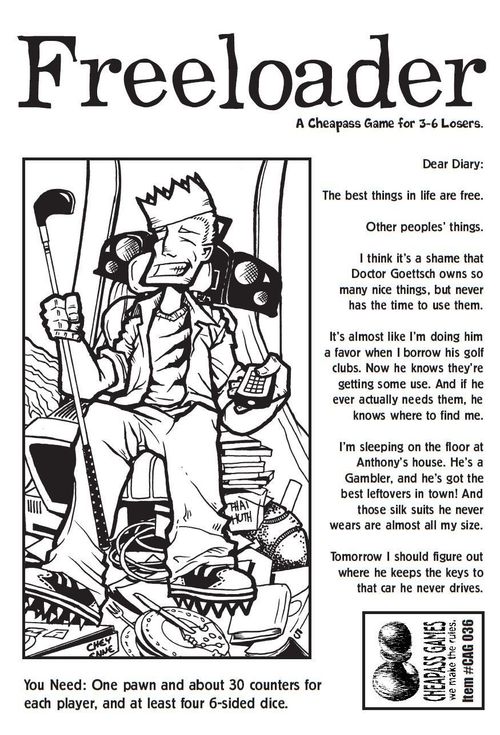
Freeloader
Freeloader Rulebook
Table of Contents
Table of Contents
What Comes With This Game
You get 6 board sections, 54 cards, and this rulebook.
What Else You Need
You will need at least four 6-sided dice, a pawn for every player, and about 30 counters that match the pawns. There is no limit to the number of counters you can use, but 30 is usually enough.
Before You Play
The first time you play, you must perform a little surgery on the boards. Each house has two corners that you have to cut off to make the boards fit together in a loop. We allow our players to do this kind of highly skilled technical work because we know you will give it the love and attention it deserves. Unlike space monkeys.
Setting Up
Arrange the six houses in a circle as shown below, in a random order. Shuffle the deck and deal a hand of two cards to each player. Put the rest of the deck in the middle of the board and then turn up one card in front of each house.
(Diagram: six house spaces arranged in a ring, with the deck and a faceup card space in the middle of the board.)
Place two counters from each player into every house (not inside the "Best Friend" or "Crash Space" circles). Distribute the pawns randomly on the board as follows: roll 1 die to place your pawn at a random Bus Stop, then roll 1 more die to move it forward 1 to 6 spaces.
Determine randomly who will go first. Play will proceed to the left.
What You're Doing
The board represents a neighborhood of six houses. Players will wander the neighborhood trying to accumulate as much free stuff from their neighbors as they can.
The counters you place in each house represent "favors" owed to you by the people in those houses. (Counters will be referred to as "favors" throughout the game.) Cards in your hand represent the items you are trying to collect. Once cards are played into your "Stuff" (onto the table in front of you) they contribute points to your score. Some cards, such as Cars, also have Special Effects.
How To Win
The game will end when someone draws the last card in the deck. (There may be a few more turns; see "Ending the Game" for the details.) To qualify to win, you must have at least one card in each of the Food, Clothing, and Shelter categories in your Stuff. (Crashing on the board counts as having Shelter.) Among those who qualify, the player with the highest point total wins. If no one qualifies, nobody wins.
On Each Turn
You have several choices on your turn. You may do exactly one of the following: Move, Draw, Place Favors, or Play Cards. Some cards have special effects which you use "as your turn." Using one of these cards counts as your whole turn, and you can't do anything else.
Turn Option 1: Move
If you choose to move, you will do the following.
First, choose whether to roll 1 or 2 dice. Some cards give you more choices; for example, if you have a Car, you can choose to roll 3 dice.
Move your pawn the amount you roll, clockwise around the board, and then do whatever it says on the space where you stop. (Note: You can't spend a turn to "sit still" and re-use the space you're on. To follow a space you have to move into it.) For the definitions of the different spaces, read the section below called "Definitions of Spaces."
Turn Option 2: Draw
When you Draw, you may take either the top card of the deck or the faceup card beside the house you are in. If you draw the faceup card, you replace it immediately with the next card on the deck, faceup. This is the extent of a Draw turn.
Turn Option 3: Place a Favor
You may place a new favor in any house (not just the one you are standing in). Placing a favor means spending some time doing something nice for someone, like taking out their trash or telling them they don't look as fat as usual.
When you place a favor in a house, you can try to become that character's "Best Friend." You can be the Best Friend of as many characters as you want, but you can only try to become someone's Best Friend when you put a favor into their house. Being a Best Friend is very useful, mostly because it makes it cheaper to get cards into your Stuff.
If the "Best Friend" space is open, you can simply mark the space with your favor when you put it in the house. This favor can be spent like any other favor in the house, but if you spend it you will lose your Best Friend status.
If someone already occupies the Best Friend space, you may challenge that player when you put a favor in the house. The current Best Friend has two options: to give up, or to fight.
If the Best Friend gives up, move his counter off the Best Friend space (it stays in the house) and replace it with the challenger's counter.
If the Best Friend decides to fight, both players roll one die, and multiply by the number of favors they have in the house. The higher total wins, and ties go to the defender. The loser must take one favor out of the house, as a penalty for fighting.
Example: Bethany wants to be the Artist's Best Friend. She places a favor in the Artist's house, bringing her total to three favors. Andrew is currently the Best Friend in that house and has only two favors. He could give up, losing nothing but his Best Friend status, but he decides to fight. Bethany rolls a 2, for a total of 2 x 3 = 6. Andrew rolls a 4, for a total of 4 x 2 = 8. Andrew wins! Bethany loses a favor from house, and despite the odds, Andrew remains the Artist's Best Friend. In your face, probability!
The Waitress' Best Friends: The Waitress has two Best Friend spots. When you challenge for Waitress' Best Friend you can choose either space to challenge. However, one player cannot occupy both of the Waitress' Best Friend spaces, so if you're already one Best Friend you can't become the other one.
Turn Option 4: Play a Card
On this kind of turn you can spend favors from the house where you are standing to play a card from your hand into your Stuff.
Card Costs: Each card has a "cost" listed on it. This is the number of favors you must remove from the house where you are standing in order to play that card. You can spend favors occupying Best Friend and Crash Spaces, but you will lose those benefits if you spend those favors.
Discounts: Most cards have discounts listed on them. You can subtract these discounts from the cost of a card if they apply to you. If a card says "(Someone's) House: -X" then that card costs X less favors if you play it while standing at that house. If a card says "(Someone's Best Friend: -Y" then it costs Y less favors if you are that person's Best Friend, regardless of where you are. We'll say this again because it's hard to remember: you don't have to be standing in someone's house to take advantage of their Best Friend discount. Furthermore, you can play any card anywhere. It's just that cards are more expensive in some places than others.
Discounts are cumulative, and can even lead to negative costs. If you play a card with a negative cost, you place new favors in that house, and yes, this does allow you to immediately compete for Best Friend. (This matters with exactly one card.)
Example: The Spare Bedroom has a base cost of 5, and is discounted –1 at the Doctor's House and –2 for the Doctor's Best Friend. If you are standing at the Doctor's House but are not his Best Friend, this card costs 4. If you are the Doctor's Best Friend, but standing at the Artist's house, the card costs 3. And so on.
Definitions of Spaces
Now, here is a list of what each board space means.
Place a Favor: These spaces tell you to either place a favor in a particular house or in a house of your choice. This is exactly like placing a favor as your turn, except you also got to move. Hooray!
Draw a Card: If you land on a "Draw a Card" space, you can draw either the top card of the deck or the faceup card at the house where you are standing. This is the same as taking a Draw turn, except you also had to move to do it. Dang!
Trade: A "Trade" space lets you do one of three things. You can trade hand-to-hand, Stuff-to-Stuff, or hand-to-Board.
If you trade hand to hand, choose a player. That player chooses a card from his hand and puts it in yours. You then choose a card from your hand and put it in his. You can give back the card he gave you, or something even more horrible.
If you trade Stuff-to-Stuff, use the same process. You choose a player, who must choose a card from their Stuff to put into yours. You then choose a card in your Stuff to put into theirs. You can return the card they gave you if you wish.
Note: Because of Stuff-to-Stuff trading, it's risky to start with only high-point cards in your Stuff. You'll learn this pretty quickly if you don't believe.
If you trade hand-to-Board, you can choose any faceup card and put it in your hand. You replace that card with a card from your hand, faceup.
Steal: If you land on the "Steal a Food" or "Steal a Clothing" space, you can take a card of that type from any player's Stuff and put it into yours. There's no defense against having Stuff stolen, so if you want to win you should protect yourself by keeping extra Food and Clothing cards. This is harder, but probably worth it.
Crashing At The (House): If you land on a Crash Space, what you can do will depend on who's already there.
If the Crash Space is open, you will place a new favor in that House, covering the Crash Space. This counts as a favor in the house and can be spent like any other favor, but if you spend it you will lose your Crash Space.
Crashing also counts as having "Shelter" in case you need it to win.
Placing this favor allows you to compete for Best Friend, but if you win and have no other counters in the house you must move your counter from the Crash Space to the Best Friend space.
If the Crash Space is occupied, you will do nothing on this space unless you are Best Friend in the house. In that case, you remove the opponent's counter from the crash space, take it out of the house, and replace it with a new one of your own.
You can, of course, crash at multiple houses.
Crashing at the Hippies': One player can't occupy more than one crash space in the Hippies' house. If all three spaces are full, the Hippies' Best Friend isn't among them, and the Hippies' Best Friend lands on Crashing at the Hippies' House, that player can choose which other player to evict.
Bus Stop: When you land on a Bus Stop you must "take the bus." This means you roll one die to jump to a random Bus stop, and then move again normally.
Cards with Special Effects
In general the special cards describe exactly what they do, but here are a few clarifications for the nitpicky:
Cars: Cars give you a faster move: when you move, you can choose to roll as many as 3 dice. Having multiple cars doesn't make you any faster.
DWI: The Draft Beer and Smooth Irish Whiskey work the same way: hand them to another player from your Stuff, and the card goes into their Stuff. If they have any cars, those cars are removed from the game. Owning the DWI cards doesn't preclude you from owning cars; the Car-killing effect only occurs when the card is handed off as described.
Extra Die: The Work-Out Clothes, Fine Italian Shoes, etc. let you roll one extra die when you move, and throw out the lowest die. These cards don't stack (more of them won't let you roll more dice), but you can use them in conjunction with Cars. The most dice you can ever roll is 3, or 4 with a Car (throwing out the lowest).
Free Favors: The text on these cards starts with "Surprise!" Instead of playing them normally, you can discard these cards in exchange for favors in a particular house. Putting these favors into play allows you to challenge just once for Best Friend (not once for each favor). Playing a card like this takes your entire turn. When you play them for favors, remove these cards from the game.
Ending the Game
The game is over (or close to over) when the last card is drawn out of the center pile. This can happen when someone draws that card, or when they draw a faceup card that is replaced by the last card in the deck.
Everyone deserves the same number of turns, so remember who went first. The game will continue until the player to the leader's right (the last player) has had a turn. If the deck empties during the last player's turn, then that's the end of the game.
Winning
As mentioned above, to qualify to win you must have at least one card in each of the categories of Food, Clothing, and Shelter. (If you are Crashing anywhere on the board, that counts as having a Shelter.)
Among the players who qualify, the player with the most points wins. Don't forget to add bonus points for matching cards like the Golfing Shoes and Golfing Hat.
If no one qualifies, then everyone loses. Yes, we like it too. If there is a tie, the tie must be settled by playing another game. May we suggest "Cube Farm"? It's time you started looking for a job.