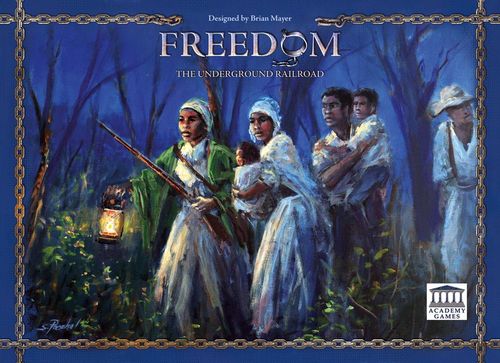
Freedom: The Underground Railroad
Freedom: The Underground Railroad Rulebook
Table of Contents
Table of Contents
- Components
- The Game Board
- Set Up
- Game Play
- 1. Slave Catcher Phase
- 2. Planning Phase
- 3. Action Phase
- 4. Slave Market Phase
- 5. Lantern Phase
- Game End & Winning
- Scoring
- One and Two Players
- Adjusting Difficulty
- Card Clarifications: Role Cards
- Card Clarifications: Opposition Cards
- Card Clarifications: Reserve Cards
- Card Clarifications: General Cards
- Historical Overview: The States' Movement
Components
- Lead Player Lantern
- 17 Support Tokens
- 13 Fundraising Tokens
- 27 Conductor Tokens
- Slave Catcher & Movement Dice
- Money
- 96 Slave Cubes
- 5 Slave Catcher Markers
- 52 Abolitionist Cards — Reserve Cards (white), General Cards (tan), Opposition Cards (red-orange)
- 6 Role Cards
- 18 Slave Market Cards
- 4 Victory Conditions Cards
- Map & Token Board
- Player Mats
The Game Board
The map is divided into Free States and Territories, Slave States, and areas whose decision was left to the Territory.
- Southern space (green) — can hold 1 slave.
- Small city — can hold 1 slave.
- Northern space (blue) — can hold 1 slave.
- Large city (Chicago, Boston, New York) — can hold up to 4 slaves.
- Regular route — the paths connecting spaces and cities.
- Slave Catcher route (colored, e.g. orange) — the path each slave catcher follows; each has a Slave Catcher starting space marked by a small circle at the top of a city with the matching colored slave catcher symbol.
- Sea lane — the route with a PAY $1 space.
- Canada — the 30 numbered spaces where freed slaves are placed.
- Other board areas: the Plantations, the Slave Market, the Period Columns (token board), and the Abolitionist Queue.
Order of Play (board summary)
- Slave Catcher Phase — Roll the Slave Catcher Dice.
- Planning Phase — Each player may purchase up to a total of two Conductor, Fundraising, and/or Support tokens.
- Action Phase — Starting with the Lead Player, a player may take any or all of the following Actions in any order:
- Gain the benefit of the player's Role Card.
- Use the Role Card's one time special ability.
- Play up to two Conductor and/or Fundraising tokens.
- Buy and resolve one Abolitionist Card.
- Slave Market Phase — Deliver slaves from the bottom-most Slave Market Card to the Plantations.
- Cleanup / Lantern Phase — Trigger/discard the last Abolitionist Card(s). Slide and fill cards. Pass the Lead Player token clockwise. If the last slave ship has delivered, the game is over.
Set Up
Role Cards
Randomly shuffle and deal a Role Card to each player. Your Role Card features the Benefits and Special Actions you receive during the game. Alternatively, players can select which roles they would like to use to help ensure a better balance to the game. Any unused cards are returned to the game box and will not be used in the game. Find the corresponding Player Mat and place your Role Card on it.
Plantations
Place slaves (tan cubes) into the lightened spaces of the plantations on the game board. These indicate the number of slaves in the plantations at the beginning of the game. The darker spaces are available for placement during the game.
The Plantation illustration is not a space for slaves to move to. A slave's first move will be into a green southern space or city.
Slave Market Cards
Create a draw deck of Slave Market Cards by selecting cards with the number in the bottom right corner that corresponds to the number of players in the game. Shuffle these cards and place them face down on the Slave Market Deck space on the game board. The remaining cards are returned to the game box and will not be used in the game.
Draw cards from this deck to fill the 3 empty spaces below the Slave Market Deck. These represent slaves being delivered to market for sale to the Plantations. Place the indicated number of slave cubes on each market card.
The Slave Market Cards serve as the game's clock: the game can never progress longer than the end of the 8th round, when the last Slave Market Card has sold its last lot of slaves.
Abolitionist Cards
There are 3 types of Abolitionist Cards: General (tan), Reserve (white) and Opposition (red-orange). If you are playing with 1 or 2 players, remove the cards that indicate they are for use with 3 or 4 players.
Separate the General and Reserve Cards into 3 Period Decks (1800-1839, 1840-1859, and 1860-1865). Then shuffle into these three Period Decks the number of Opposition Cards specified in the table below.
| Players | 1800-1839 | 1840-1859 | 1860-1865 |
|---|---|---|---|
| 1 or 2 | 3 cards | 4 cards | 3 cards |
| 3 or 4 | 4 cards | 5 cards | 3 cards |
Opposition Cards do not specify a particular Period and can appear at anytime. Place the 3 shuffled Period Decks in the matching Period Columns on the game board. At the beginning of the game, only cards from the first Period Column (1800-1839) can be used. As the game progresses, players will be able to access cards from the other Periods.
Deal 5 cards from the first Period Deck and place them on the 5 open spaces of the Abolitionist Queue on the game board. During setup, there should only be one Opposition Card. If a second Opposition Card appears in the queue, set it aside and continue filling the queue from the top of the deck until the queue is full. Then reshuffle the deck, including any Opposition Cards that were set aside.
Victory Conditions
Select the Victory Conditions Card with the number in its upper left corner that corresponds to the number of players in the game. Place this card onto the space provided in the upper right corner of the game board. The cards are double-sided: use the white side for a regular game, or the red side for a more challenging game.
Starting Funds
Each player starts the game with $8.
Lead Player Lantern
Randomly determine a Lead Player and give them the Lead Player Lantern.
Slave Catcher Markers
Place the 5 Slave Catcher Markers on their corresponding colored starting spaces on the game board. These spaces are indicated by a small circle at the top of the city featuring the corresponding colored slave catcher symbol.
Slave Catcher Dice
Place the 2 Slave Catcher Dice on the table within easy reach of the players.
Tokens
Place the grey Conductor Tokens on their corresponding spaces in the Period Columns.
Then add tokens on top of the grey tokens up to the numbers listed on the table below, according to the number of players. The totals listed include the grey tokens.
| Players | Token | Period 1 (1800-1839) | Period 2 (1840-1859) | Period 3 (1860-1865) |
|---|---|---|---|---|
| 1 | Support | 1 | 1 | 1 |
| 1 | Conductor (single/double) | 3 | 2/2 | 1/1 |
| 1 | Fundraising | 1 | 2 | 1 |
| 2 | Support | 2 | 3 | 2 |
| 2 | Conductor (single/double) | 5 | 3/3 | 2/2 |
| 2 | Fundraising | 2 | 3 | 2 |
| 3 | Support | 3 | 6 | 3 |
| 3 | Conductor (single/double) | 7 | 4/4 | 3/3 |
| 3 | Fundraising | 3 | 4 | 3 |
| 4 | Support | 4 | 8 | 4 |
| 4 | Conductor (single/double) | 9 | 5/5 | 4/4 |
| 4 | Fundraising | 4 | 5 | 4 |
Game Play
FREEDOM: THE UNDERGROUND RAILROAD consists of up to 8 rounds, each of which has 5 phases, played in the following order:
- Slave Catcher Phase
- Planning Phase
- Action Phase
- Slave Market Phase
- Lantern Phase
The players win the game if:
- they move the required number of slaves to freedom in Canada as specified on the Victory Conditions Card, and
- they purchase all of the Support Tokens in the game, and
- they finish the round without losing the game.
The players lose the game if:
- the Slaves Lost Track on the Victory Conditions Card is filled and another Slave needs to be added, or
- they do not win the game before the end of round 8.
1. Slave Catcher Phase
One of the slave catchers may get a tip on the whereabouts of some runaway slaves and move unexpectedly to capture them. There are 2 dice that determine if this happens.
The Slave Catcher Die pictures the slave catcher colored symbols and determines which slave catcher moves.
The Movement Die pictures white and black arrows to determine the direction and distance the slave catcher moves.
During the Slave Catcher Phase, the lead player rolls both dice.
If the symbol of the walking slave is rolled, then none of the slave catchers move and the phase ends. Proceed to the Planning Phase.
If a slave catcher's symbol is rolled, check the Movement Die to see the direction and distance this slave catcher moves. The white arrows indicate westerly movement and the black arrows indicate easterly movement. These arrow symbols are also pictured along the colored Slave Catcher Paths on the game board.
The appropriate slave catcher marker is moved the same number of spaces as the number of arrows on the Movement Die or until it reaches the end of its path. It only captures slaves on the final space it ends its movement. Slaves on spaces that were passed over are not captured. Captured slaves are placed consecutively on the Slave Market Cards, beginning with the bottom card and continuing upwards, cycling around to the bottom Slave Market Card again if necessary.
After a slave catcher has moved and any captured slaves have been placed on the Slave Market Cards, all players proceed to the Planning Phase.
2. Planning Phase
During the Planning Phase, each player may take up to two Tokens from the Token Board, even if they have unused or extra tokens left over from a previous round. At the beginning of the game, players may only take tokens from the first Period (1800-1839). When future Period Columns become active, players may take tokens from any of the active Period Columns.
All players may take tokens during the Planning Phase at the same time. A token may only be taken if the player has enough money available, players may not give or lend money to each other. Since the game is cooperative, players may discuss strategies and offer suggestions. If the players are not able to come to an agreement on a token choice then the lead player — or the player closest to the lead player in a clockwise direction — chooses first.
There are three types of tokens available.
Support Tokens
Support Tokens cost $10 each and remain in front of the player during the game. Money paid for Support Tokens goes to the bank. Their purchase represents the growing strength of the Abolitionist Cause and determines when future Period Columns also become active and their Tokens and Abolitionist Cards become available to the players. When the players have collectively purchased all of the Support Tokens, they have met one of the game's Victory Conditions (see Game End & Winning).
Conductor Tokens
Conductor Tokens allow players to move slaves along paths during the Action Phase. They represent the assistance that Abolitionists provided in the form of shelter, guidance and directions, for the men, women and children who risked their lives to escape slavery and make the dangerous journey northward. The number above the cube on the token is how many slaves can be moved, and the number above the arrow is how many spaces each of these slaves can move.
The cost in dollars to purchase a Conductor Token is listed above the token symbol on the Token Board, inside a gold circle. Money paid for Conductor Tokens goes to the bank.
Example: a Conductor Token costing $2 in the 1800-1839 Period allows a player to move 3 separate slaves a single space each.
Fundraising Tokens
Fundraising Tokens cost nothing and are one way in which players can raise money during the game. They represent the raising of funds and supplies to support the Abolitionist Cause.
There are two types of Fundraising tokens. The Fundraising Tokens available during the first two Periods raise $1 for each slave on a green Southern space. The Fundraising Tokens available during the last Period raise $1 for each slave in a blue Northern city.
Once all players have taken their tokens, play proceeds to the Action Phase.
Activating the Next Period
During the first two periods, when the last Support Token in the currently active Period Column is taken, the game is immediately paused and two changes take effect:
- The Abolitionist Card Deck in the currently active Period Column is removed from the game. Any of the current Period's Abolitionist Cards already in the Abolitionist Queue remain where they are. Any new cards will be drawn from the next Period's Abolitionist Card Deck.
- The next Period Column is activated and its tokens are now immediately available to be taken by all players.
3. Action Phase
During the Action Phase each player, beginning with the current lead player and continuing clockwise around the board, may take several actions.
A player may take any or all of the following Actions in any order:
- Gain his Role Card's Benefit.
- Use his Role Card's one time Special Ability.
- Play a Conductor or Fundraising Token.
- Play a second Conductor or Fundraising Token.
- Buy and resolve one Abolitionist Card.
Players may take their actions in any order. Each action must be completed before another action may be taken.
Alternatively, a player may pass their Action Phase, relinquishing all actions. Instead, the player may take funds from the bank — $3 during the first Period (1800-1839), $4 during the second Period (1840-1859) and $5 during the third Period (1860-1865).
Once a player has taken all of the actions he wishes to take, play continues clockwise to the next player. After all players have taken their actions, the games proceeds to the Slave Market Phase.
Action: Playing Conductor Tokens
These tokens allow a player to move a specified number of slaves a specified number of spaces. A player may choose to move a slave less than the movement value pictured on the token. A single slave may not be moved twice with the same Conductor Token.
While it is not possible to move the same slave twice using a single Conductor Token, a slave already moved can be moved again by using another Conductor Token, an Abolitionist Card, or as a result of the player's Role Benefit.
Slaves may move along any of the paths that connect cities and spaces on the board, regardless of color. Players may choose to move a slave in any direction, including backwards, to either gain financial aid or to draw the attention of the slave catchers on the board.
When a slave completes its movement, two things may occur based on the last space it moved into.
First, if the space has a gold circle with a number above it, the player who moved the slave receives that amount of money from the bank. This money represents aid and contributions from the local communities as the slave is on the run.
Next, if the space is connected to one or more Slave Catcher Paths, the slave has drawn the attention of slave catchers. Any slave catchers that match the colors of connecting Slave Catcher Paths move 1 space each along the matching colored path towards the slave that triggered the movement. If a slave catcher moves into a space in which there is a slave, that slave is captured and placed anywhere on the bottom Slave Market Card. If there are multiple slaves in the space, they are placed consecutively on the Slave Market Cards, beginning with the bottom card and continuing upwards, cycling around to the bottom Slave Market Card again if necessary.
Players may wish to sacrifice a slave so that others may make their way towards freedom. As always, discussion is encouraged as players work out the best strategy for taking their actions.
Example: A player is moving 2 slaves a single space each. The slave arriving in St. Louis (1) would receive $2 in aid and trigger the purple slave catcher to move one space closer towards the slave, stopping in Newport (2). The other slave that moved (3) would not receive any aid and would trigger the yellow slave catcher (4). The yellow slave catcher would move into the same space as the slave, capturing it and sending it to the bottom Slave Market Card.
Some Conductor Tokens allow slaves to move two spaces. Slaves moving two spaces may not move through spaces that contain slave catcher tokens, but they may move through a space containing another slave. As with any slave movement, only the last space the slave moved into determines if any money is gained and if any slave catchers are triggered. They do not trigger slave catcher movement or gain any money for spaces they move through.
When moving slaves, all of the small cities and spaces can only hold a single slave. A slave cannot finish its movement in a circle or oval space which already contains a slave. However, the large square cities can hold up to 4 slaves.
When moving a slave into Canada, place them in one of the spaces provided. The spaces are numbered to help track how close the players are to victory.
Example: A player is moving a slave two spaces. He moves the slave through the Southern space and finishes his move in Newport. The slave does not trigger the yellow slave catcher because he did not finish his movement on the Southern space. He receives $1 and triggers the purple slave catcher.
Token Limits
Token set up varies depending on the number of players (see Set Up). All token numbers in the game are limited; Conductor and Fundraising Tokens are removed from the game once played.
The exception is the last Conductor Token (colored grey) available for purchase in each of the Conductor token stacks. When this is played, it is returned to the Token Board and is immediately available for purchase again. Therefore players will always have access to at least one token from each of the Conductor stacks throughout the game.
Action: Playing Fundraising Tokens
These allow a player to raise funds to aid the Abolitionist Cause. There are two types of tokens available during the course of the game.
During the first two Periods, the Fundraising Tokens feature a green circle. When played, these tokens give the player $1 for each slave in a green Southern city or Southern space. (A small Southern city can hold 1 slave; a Southern space can hold 1 slave.)
During the final Period of the game, the 1860-1865 Fundraising tokens feature a blue circle. These tokens give the player $1 for each slave in a blue Northern city. The large cities of Chicago, Boston and New York can hold up to 4 slaves, and each slave in these cities raises $1. (A small Northern city can hold 1 slave; a large Northern city can hold up to 4 slaves.)
Action: Buying Abolitionist Cards
A player may purchase a single Abolitionist Card from the Abolitionist Queue during their Action Phase. The Abolitionist Queue consists of 5 cards played face up on the table on the five Abolitionist Queue spaces located on the bottom of the Token Board. Any Abolitionist Cards purchased from the Abolitionist Queue during the Action Phase are not replaced until the the Lantern Phase at the end of the round. To purchase a card, pay its cost to the bank. The cost is indicated by the number in the gold circle above the space that the card occupies.
There are 3 types of cards in the Abolitionist Deck: General (tan), Reserve (white) and Opposition (red-orange). Most cards can be purchased by a player, except for a few Opposition Cards which state they cannot be purchased.
To purchase a card, pay its cost to the bank. A card may only be purchased if the player has enough money available before the purchase and not as a result of money gained from the card. Also, players may not give or lend money to each other unless a card allows them to do so.
General Abolitionist Cards are resolved immediately when purchased and are then discarded.
Reserve Abolitionist Cards are usually placed on a Player Mat when purchased. A player may only have one Reserve Card on his Mat at a time. If a player purchases a new Reserve Card before an old one is used, the old card is discarded without being resolved.
If a Reserve Card is usable during the Action Phase, it may be used the same turn it is purchased by the player.
Opposition Abolitionist Cards negatively impact game play. Each card specifies when its effect takes place. It can take effect while the card is in the Abolitionist Queue, when the card is purchased, or when the card is removed from the Abolitionist Queue during the Lantern Phase.
Common Card Features
- Slaves and arrow icons — The player may move a specified number of slaves a specified number of spaces.
- Token with $ icon — The player may purchase a single token at full cost during the Action Phase.
- Token with a negative number (e.g. -2) — The player may purchase a single token with the shown discount.
- Token with no cost shown — The player may take a token at no cost.
- Slave catcher icon crossed out — Slave catchers do not move while the player is moving slaves.
- Swap arrows icon — Exchange the position of two cards in the Abolitionist Queue. A player cannot exchange a card with an empty space.
- +X icon — Each player receives $X from the bank.
Some General Cards allow slaves to move to indicated locations with no effect. This means that this movement does not raise money or trigger slave catchers, as normal movement would.
If an indicated location is occupied by slave catchers or filled to capacity by other slaves, the move may not be made.
Player Role Cards
Each player has a role that gives them unique benefits in the game. Each Role Card is double sided. Players begin the game with the Role Card face up on Side I.
Action: Role Card Benefits
Role Benefits are listed at the top of the card above the role's image. Players receive their benefits each round during their Action Phase. The one exception is the Shepherd's '-$1 Conductor Token Cost' discount, which can be used during the Planning and Action Phases.
Action: Role Card Special Ability
The Special Ability is listed at the bottom of the card below the role's image. A Special Ability may only be used once during the game and the phase of the game in which it may be used is indicated. Once used, flip the Role Card over to Side II to show that the Special Ability has been used. Some Role Benefits differ from Side I to Side II.
Example: The Preacher's Role Card front (Side I) reads "+$1 during Action Phase. -$1 Abolitionist Card Cost during Action Phase." with the Special Ability "At the beginning of your Action Phase, discard an Abolitionist Card from the queue. Ignore any of the card's events that may be resolved by doing so." The Role card back (Side II) reads "+$2 during Action Phase. -$1 Abolitionist Card Cost during Action Phase."
4. Slave Market Phase
During the Slave Market Phase, slaves are sold to the plantations in the South. The slaves on the bottom-most Slave Market Card are moved to available plantation spaces.
Players choose to place the slaves in any of the open spaces in one or more of the plantations. Slaves previously in the plantations can not be rearranged; only the incoming slaves may be placed freely. Once slaves have been placed they may not be rearranged later.
If there are no open spaces in the Plantations for some or all of the incoming slaves, they are instead placed on the Slaves Lost Track on the Victory Conditions Card.
If the players have to add an additional slave after the last Slaves Lost Space is filled, the players have lost the game (see Game End & Winning).
After the slaves on the bottom Slave Market Card have been placed, the card is removed from the game and the remaining cards slide one space down. A new Slave Market Card is drawn and placed in the empty space and the specified number of slaves are placed on the card.
The game has eight Slave Market Cards, one for each round in the game. The game can be won or lost before round eight, but must end at the end of round eight.
5. Lantern Phase
During the Lantern Phase the Abolitionist Card Queue is restocked for the following round. First, discard any card that is in the right most space in the Abolitionist Queue. For 1 or 2 players, discard any cards in the two right most spaces. A General or Reserve Card is simply discarded. An Opposition Card will state if it is resolved when removed and discarded. Then slide any remaining cards to the right and draw new cards to fill in the now-empty spaces, starting with the right-most empty space.
When filling the Abolitionist Queue, only one new Opposition Card from the deck may be added. Any Opposition Cards already in the queue remain. If the player draws more than one new Opposition Card they are placed to the side. Once the queue is full, take any Opposition Cards set aside and shuffle them back into the Abolitionist Period Deck currently being used. In the rare case there are only Opposition Cards remaining, they are placed in the queue.
Once the Abolitionist Queue has been filled, the game's Victory Conditions are checked. If the game is not ended, pass the Player Lantern Token clockwise to the next player. A new round begins.
Example: It is a 4 player game, the card John Greenleaf Whittier is discarded, and the two remaining cards are moved across to occupy the two right hand most spaces of the queue. Three new cards are drawn to fill the empty spaces from the least expensive (right-most space) to the most expensive (left-most space).
Game End & Winning
The players win the game if they are able to purchase all of the Support Tokens from all three Periods and move the required number of slaves (as indicated on the Victory Conditions Card) to Canada before the end of round eight.
With good play and coordination, players may fulfill the Victory Conditions and end the game before round eight. The round in which the players achieve both Victory Conditions is the last round of the game. However, the players do not instantly win — they still need to finish the round without losing. This means that the players must unload that round's Slave Market Card and deal with any Opposition Cards that may be resolved in the Lantern Phase without causing them to lose the game.
The players lose the game if they are unable to achieve both Victory Conditions before the end of round eight. Additionally, the players immediately lose the game if the Slaves Lost Track on the Victory Conditions Card is filled and another slave needs to be added.
Losing the game does not mean an end to the Abolitionist struggle. While the group was not able to bring about the changes they wanted to see through their efforts, countless others will continue their good work until all people are free from the scourge of slavery.
Scoring
Players wishing to compare how they play from game to game may keep score as follows:
- 2 points for each slave freed.
- Minus 1 point for each slave lost.
- 10 points for freeing all the required slaves.
- 10 points for purchasing all of the required Support Tokens.
- If the game was won, 5 points for each Slave Market Card still left in the queue.
One and Two Players
FREEDOM: THE UNDERGROUND RAILROAD may be played as a solo or 2-player game. When setting up the game, remove the Abolitionist Cards that indicate they are for use with 3 or 4 players. Also, during the Lantern Phase, discard any cards in the two right-most spaces of the Abolitionist Queue.
Adjusting Difficulty
For easier play, use any or all of these adjustments:
- When rolling the Movement Die, treat any triple movement results as a free slave movement result, meaning no slave catcher movement happens this round.
- During setup, leave the center Plantation (4 spaces) empty.
For more difficult play, use any or all of these adjustments:
- Start the game with all of the plantations full rather than just filled on the lightened spaces.
- Add an additional Support Token to Period 2 (the game comes with 1 additional Support Token for this purpose).
Card Clarifications: Role Cards
Agent
Card: "+$1 during Action Phase. Move 2 Slaves one space each during Action Phase." Special Action: "During the Planning Phase, remove one Slave from each of the Slave Market deliveries currently on the board and return them to the supply."
Role Special Action: Slaves removed from the Slave Market Cards on the board are put back into the supply and are available to be used again.
Conductor
Card: "+$1 during Action Phase. Move 2 Slaves one space each during Action Phase." Special Action: "During your Action Phase, use five movements for one or more Slaves. You can move one Slave five spaces or split it up amongst as many Slaves as you wish."
Role Special Action: The player gets 5 movement points and may devote it all to a single slave or split it between several slaves. (i.e. 2 slaves 2 spaces and one slave 1 space, or 1 slave 4 spaces and another 1 space.) The last space each slave moves into provides any income and triggers any Slave Catchers.
Preacher
Card: "+$1 during Action Phase. -$1 Abolitionist Card Cost during Action Phase." Special Action: "At the beginning of your Action Phase, discard an Abolitionist Card from the queue. Ignore any of the card's events that may be resolved by doing so."
Role Special Action: The player may discard a card from the Abolitionist Queue at the beginning of his or her Action Phase. This includes Opposition Cards that may not be purchased. These do not get resolved.
Shepherd
Card: "+$1 during Action Phase. -$1 Conductor Token Cost during Planning and Action Phases." Special Action: "During your Action Phase, move up to two plantation Slaves to New York, with no effect."
Role Benefit: The one exception is the Shepherd's '-$1 Conductor Token Cost' discount, which can be used during the Planning and Action Phases.
Role Special Action: When moving slaves to New York, the player may move less than 2 slaves. If the player does move 2 slaves, they may come from different plantations. Through this movement you may not exceed New York's normal 4 slave capacity.
Station Master
Card: "+$1 during Action Phase. Move one Slave Catcher one less space during Action Phase." Special Action: "During another player's Action Phase, Conductor Tokens don't move any of the Slave Catchers."
Role Benefit: When the player moves slaves he may select one slave catcher that would move as the result of a slave's movement and not move that slave catcher. This may be used for any type of action.
Role Special Action: The Station Master's special action (stopping all the slave catcher movement) only affects Conductor token movement. For the one player game, this player may target him or herself.
Stock Holder
Card: "+$1 during Action Phase. Once per Action Phase, purchase a Token after taking a Fundraising Action." Special Action: "During your Action Phase, spend three tokens."
Role Special Action: The player may play up to three tokens the round they use this special action. Players may only take tokens that are available as per the normal rules.
Card Clarifications: Opposition Cards
1850 Compromise
Card: "Fundraising Actions bring in $2 LESS than they normally would. In effect until removed from the queue."
Each Fundraising Act brings in $2 less. If a player plays 2 Fundraising tokens on their turn, both are affected. This effect lasts until the card is removed from the queue. It can be purchased to be removed.
Domestic Slave Trade
Card: "Each Slave Market delivery carries one additional Slave. In effect until removed from the queue. Can NOT be purchased."
This affects all current and future Slave Market Cards while this card remains in the queue. The slaves do not go away when the card does. Additionally, if the card comes back, new slaves are added. This card only goes away after making its way through the queue or through the effects of an Abolitionist Card or Role Card Special Action.
Dred Scott Case
Card (Dred Scott Decision): "Move 3 non-plantation Slaves back to the plantations. Resolve when removed."
The players may select which slaves get returned to the plantations. They may not come from Canada. This card may be purchased to be resolved earlier.
Elijah P. Lovejoy
Card: "Fundraising Tokens only draw funds from Large Cities. In effect until removed from the queue."
When Fundraising, only slaves in large cities count for drawing funds. This effect lasts until the card is removed from the queue. It can be purchased to be removed.
Farren Riots
Card: "Remove from the game the top Conductor and Fundraising Tokens from the current Period Column. Resolve when removed."
Remove from the game any of the top Conductor and Fundraising Tokens from the current Period Column. This does not include any grey Conductor Tokens. This card may be purchased to be resolved earlier.
Fugitive Slave Act
Card: "Up to three Slaves in spaces next to Slave Catchers are captured. Resolve when removed."
When triggered, 3 slaves in spaces connected to slave catchers are captured and sent back to the bottom-most Slave Market Card. If there are more than 3 to choose from, the players may select which slaves are captured.
Slaves not connected to the the slave catcher's path can be captured. If it is the last round of the game and there are no Slave Market Cards left, the slaves are returned to the plantations. This card may be purchased to be resolved earlier.
Gag Rules
Card: "Players may only purchase ONE token during the planning phase. In effect until removed from the queue."
This card does not prevent players from purchasing tokens during the Action Phase. This effect lasts until the card is removed from the queue. It can be purchased to be removed.
George Fitzhugh
Card: "Support Tokens cost $1 more to purchase. In effect until removed from the queue. Can NOT be purchased."
This card's effect can interact with other cards that make tokens less expensive. This card only goes away after making its way through the queue or through the effects of an Abolitionist or Role Card.
John C. Calhoun
Card: "Northern (blue) cities bring in $1 LESS than normal. In effect until removed from the queue. Can NOT be purchased."
Both large and small Northern (blue) cities bring $1 less when local funds are contributed as the result of slave movement into the space. Fundraising is not affected by this card. This effect lasts until the card is removed from the queue. This card only goes away after making its way through the queue or through the effects of an Abolitionist Card or Role Card Special Action.
Nat Turner Rebellion
Card (Nat Turner Slave Rebellion): "If Support Tokens have been purchased by the group, return one to the currently activate Action Token row. Resolve when removed."
Players can never go back a Period. Support Tokens always go on the current Period's pile. If players have no tokens, the card has no effect. This card may be purchased to be resolved earlier.
NJ Abolishes Slavery
Card: "Slaves may not be moved into or out of Northern (blue) Cities using Conductor Tokens. In effect until removed from the queue."
Players may use their roles or Abolitionist Cards to move slaves into blue Northern cities. This effect lasts until the card is removed from the queue. It can be purchased to be removed.
Reopening Trade
Card: "Add 2 Slaves to each Slave Market Card currently on the board. Resolve when removed."
The slaves are only added once, when the card is triggered. This card may be purchased to be resolved earlier. If it is the last round of the game and there are no Slave Market Cards left, place only 2 slaves into the plantations.
Card Clarifications: Reserve Cards
Period 1 (1800 - 1839)
Congress Outlaws International Slave Trade
Card: "During the Slave Market Phase, pay $3 to not load a Slave onto the newest Slave Market Card. May pay for up to 2 Slaves per card. DOES NOT DISCARD. Play from your Reserve."
During the Slave Market Phase, the owner of this card may lessen the number of slaves put on the new Slave Market Card by paying $3 to not load a slave (up to 2 slaves). This may be used repeatedly for multiple cards as this card does not discard. The card may be replaced by purchasing another Reserve card.
Levi Coffin
Card: "During any player's Action Phase, ignore the movement of one Slave Catcher if they would capture a Slave, then discard this card. Play from your Reserve."
The player may only stop the movement of a slave catcher if they would capture a slave. This may only be used once and is then discarded.
Period 2 (1840 - 1859)
Charles Sumner Attacked in Congress
Card: "+$1 UNTIL USED. During the Action Phase, give one other player money then discard this card. Play from your Reserve."
Once purchased, the owner gains $1 during their Action Phase while the card remains unused. Additionally, it may be used at any time during the Abolitionist Phase to give a single player money.
Kansas-Nebraska Act
Card: "At the beginning of the Action Phase, discard this card to switch positions of two Abolitionist Cards in the Queue. Play from your Reserve."
The player can switch any 2 cards in the Abolitionist Queue. They may not switch a card with an empty space.
Period 3 (1860 - 1865)
Civil War
Card: "During one of this player's Action Phases, ignore the movement of all Slave Catchers during a single action, then discard this card. Play from your Reserve."
The player may use this card to ignore the movement of the Slave Catchers during one action (ie. movement from a Conductor Token, Role, or an Abolitionist Card).
Card Clarifications: General Cards
Period 1 (1800 - 1839)
David Walker
Card (3 & 4 players): "Purchase two tokens at a discount of $2 each."
The player may purchase 2 tokens at a discount of $2 each.
John Greenleaf Whittier
Card: "Exchange the position of two cards in the Abolitionist Queue."
The purchasing player may exchange the position of 2 cards in the Abolitionist Queue. They may not exchange a card with an empty space.
Lane Theological Seminary
Card: "Move two slaves one space each OR purchase a token at a $2 discount."
Move 2 slaves a single space or purchase a token at a reduced cost.
The Liberator
Card: "Place one card in the Abolitionist Queue back on top of the current age's Abolitionist Deck."
The player may place 1 card from the Abolitionist Queue back on top of the current age's Abolitionist deck.
Liberty Hill
Card: "Move two slaves one space each and purchase a token at full cost."
Move 2 slaves a single space and purchase a token at full cost.
New York Manumission Society
Card (3 & 4 players): "Purchase a token at a $3 discount."
Purchase a token at a reduced cost.
Ohio River
Card (3 & 4 players): "Move three slaves one space each."
Move 3 slaves a single space.
Ripley, Ohio
Card: "Move two slaves one space each, they do not trigger Slave Catchers."
Move 2 slaves a single space. Slave catchers do not move as a result of the movement, but money is raised.
Southern Church Correspondence
Card: "Each player receives $2 from the bank."
Each player, including the purchasing player, receives $2 from the bank.
St. Catharines, Ontario
Card: "Move one slave from a northern large city to Canada."
Move 1 slave from a large Northern city to Canada.
Theodore Weld
Card: "Move one slave from any plantation to a southern space, with no effect."
Move 1 slave from any plantation to any Southern space, with no effect.
Period 2 (1840 - 1859)
Amistad Rebellion
Card: "Move two slaves from the nearest Slave Market Card directly to Canada."
The player may move 2 slaves from the bottom Slave Market Card directly to Canada.
Anthony Burns
Card: "Move one slave from a large Northern City directly to Canada."
Move 1 slave from a large Northern city directly to Canada.
Bleeding Kansas
Card: "Move two slaves from southern spaces to a large Northern City with no effect AND discard any Abolitionist Cards remaining in the $2 or $3 spots."
Move 2 slaves from Southern spaces to any 1 large Northern city, with no effects, and discard any Abolitionist Cards in the $2 or $3 spaces. Any cards removed are not triggered.
Frederick Douglass (Period 2)
Card (3 & 4 players): "Move two slaves one space each AND purchase up to two tokens at a discount of $2 each."
Move 2 slaves a single space and purchase 2 tokens at reduced cost.
Harpers Ferry
Card (3 & 4 players): "Purchase a token at a $2 discount AND discard any Abolitionist Cards to the left of this card."
Purchase a token at a reduced cost and discard any Abolitionist Cards to the left of this card. They do not trigger.
Harriet Tubman (Period 2)
Card: "Move four slaves one space each, they do not trigger Slave Catchers."
Move 4 slaves a single space. The movement does not trigger slave catchers.
Henry "Box" Brown
Card: "Move one slave from any plantation to a large Northern City, with no effect."
The player can move a single slave from any plantation to a large Northern city, with no effect.
John Brown
Card: "Purchase a token at a $5 discount AND then draw and resolve the next Abolitionist Card."
The player can purchase a token for a reduced cost and they must draw and resolve the next Abolitionist Card from the top of the current period's Abolitionist Deck. Opposition Cards are placed in the spot that this card occupied in the queue.
John Price Rescue
Card: "Move one slave from any small Northern space directly to Canada."
The player can move a slave from any small Northern space directly to Canada.
Lincoln-Douglas Debates
Card: "Purchase a token at a $3 discount."
Purchase a token at a reduced cost.
The North Star
Card: "Place one card in the Abolitionist Queue back on top of the current age's Abolitionist Deck."
The player may place 1 card from the Abolitionist Queue back on top of the current age's Abolitionist deck.
Oberlin, Ohio
Card: "Move four slaves a single space OR purchase a token at a $4 discount."
The player may move 4 slaves a single space or purchase a token for a reduced cost.
Uncle Tom's Cabin
Card: "Purchase a token at a $3 discount AND Swap the places of two cards in the Abolitionist Queue."
The player may purchase a token at reduced cost and swap the places of 2 cards in the Abolitionist Queue. The player may not swap a card with an empty space.
Vigilance Committees
Card: "Each player receives $3 from the bank."
Each player, including the purchasing player, receives $3 from the bank.
William Lloyd Garrison
Card (3 & 4 players): "Take a token for free AND move all of the Slave Catchers one space towards the nearest slave."
Take a free token and move all of the slave catchers 1 space towards the nearest slave. If there are more than 1 slave the same distance away, the players may decide which way to move.
Period 3 (1860 - 1865)
Abraham Lincoln
Card: "Move three slaves one space each AND purchase a token at a $3 discount."
The player can move 3 slaves a single space and purchase a token at a reduced cost.
Contrabands
Card: "Move up to three slaves in small Southern spaces to small Northern spaces up to two spaces away, with no effect."
The player can move up to 3 slaves from Southern spaces to Northern spaces up to 2 movements away, with no effect. Northern spaces do not include Northern cities. Slaves can move through Slave Catchers.
Cooper Union Speech
Card: "Move three slaves one space each OR purchase a token at full cost."
The player can move 3 slaves a single space or purchase a token at full cost.
Election of 1860
Card: "Receive $1 for each slave in large Northern Cities."
The player receives $1 for each slave in large Northern cities.
Follow the Drinking Gourd
Card (Follow the Drinkin' Gourd): "Retrieve one lost slave from the victory conditions card and place it back in a large Northern City, with no effect."
The player may take 1 slave from the Lost Slaves space on the Victory Conditions card and place it in a large Northern city, with no effect.
Frederick Douglass (Period 3)
Card: "Each player receives $4 from the bank."
Each player, including the purchasing player, receives $4 from the bank.
Harriet Beecher Stowe
Card: "Purchase a token at a $5 discount."
The player may purchase a token at a reduced cost.
Harriet Tubman (Period 3)
Card: "Move two slaves from any plantations in the south directly to Canada."
Move 2 slaves from any plantations in the south directly to Canada.
William Still
Card: "Move two slaves from a single large Northern City directly to Canada."
The player may move 2 slaves from a single large Northern city directly to Canada.
Historical Overview: The States' Movement
The United State's troubled past with slavery dates from before the thirteen colonies joined as a nation and continues to echo as racial tensions today. Human bondage has impacted nearly every civilization, and each of them have justified, outlawed and dealt with the issue in their own way. For the United States, the formal end to slavery began on January 1, 1863 when President Abraham Lincoln issued the Emancipation Proclamation.
The Proclamation declared all slaves within the Confederate States free, though the president could not force the Southern States to abide by the proclamation while the American Civil War raged. Though slavery would continue in the United States until the ratification of the 13th Amendment in 1865, the Emancipation Proclamation signaled to many that the tradition of slavery in the United States was coming to an end. Such a great change was not achieved by politicians and lawmakers alone. The hard work of Abolitionists, citizens who risked their safety and freedom to bring an end to slavery, served as the foundation for this move towards freedom.
From Revolution to the Age of Immediatism
In 1776, the Continental Congress adopted the Declaration of Independence announcing that the original 13 colonies considered themselves separate from the British Empire. Though the colonies had declared themselves independent and free, the slaves that inhabited the new nation were not given the same liberty. Despite the Declaration of Independence's statement that "all men are created equal", almost every state supported slavery during the founding of the nation. But the concept of slavery was falling out of fashion with many European and American statesmen, religious leaders and philosophers of the day.
The efforts of abolitionists continued throughout the American Revolutionary War. The concept of liberty, which was such an integral part of the Declaration of Independence, was often used to support arguments against slavery by revolutionary era figures such as Thomas Jefferson. In 1780, the Pennsylvania Legislature passed 'An Act for the Gradual Abolition of Slavery', which banned importation of slaves to Pennsylvania and required that all future children in Pennsylvania born into slavery be freed when they reached 28 years of age. This type of gradual abolition was a common theme for late 18th and early 19th century abolitionists. Anti-slavery advocates, such as Benjamin Franklin, were convinced that a slow transition from a slave state to a free nation was necessary.
It was believed that changing too quickly would bring about a state of chaos; something to be avoided at all costs. Several other states followed Pennsylvania's lead, and by 1804 all states north of the Mason-Dixon Line had either abolished slavery or created gradual abolition laws similar to Pennsylvania's.
Abolition activities from 1800-1835 tended to focus on three main objectives. Politically voicing opinions against slavery; giving legal aid to kidnapped free blacks and fugitive slaves; and, finally, building educational and financial support for free black communities. The 'Act for Gradual Abolition' had formed a border against slavery along the Mason-Dixon Line. Many fugitive slaves attempted to reach the North in the hope of achieving freedom and Abolitionist groups were there to assist them.
The Age of Immediatism, 1830-1860
Slavery in the South continued to expand despite the banning of the international export and import of slaves by the United States in 1808. Slavery had simply become too important to the production of cash crops, such as tobacco and cotton, which in turn had a major impact on the national economy.
Many began to feel that previous attempts at abolition were not working and additional more urgent measures needed to be taken. John Brown, for example, called for immediate action and led several skirmishes, including the raid on Harpers Ferry in 1859 where he and his followers attempted to capture munitions for use in an armed slave revolt.
A less violent alternative, that began to take hold among some circles of abolitionists, was the late 18th century concept of colonization where blacks would return to form colonies in Africa. Thousands of free black Americans settled in Africa in the following decades. These abolitionist actions intensified the controversy of race and racial integration throughout the United States.
Print media became more wide spread during this period as well. Theodore Weld, who was the editor the abolitionist paper 'The Emancipator' (1836 to 1840), helped pen the book 'American Slavery As It Is: Testimony of a Thousand Witnesses', which described the horrors of slavery through first hand accounts. The influence of this work was second only to that of 'Uncle Tom's Cabin' by Harriet Beecher Stowe. Uncle Tom's Cabin, published in 1852, was an anti-slavery novel that quickly became popular and was outsold in the United States by only the Bible. Slavery supporters were enraged by the book's content.
Additionally, the writing of escaped slaves, such as Frederick Douglass' - 'Narrative of the Life of Frederick Douglass, an American Slave' helped to solidify positions in the slavery debate. Tensions climbed between anti and pro-slavery proponents, as these books, newspapers and other abolitionist publications spread anti-slavery ideas and drew more individuals to the abolitionist cause. This tension culminated in the secession of Southern pro-slavery states from the United States and finally erupted into a open confrontation that cost hundreds of thousands of American lives - The American Civil War.
The Underground Railroad
While abolitionist groups debated the best way to achieve their anti-slavery goals, there was an immediate need for assisting fugitive slaves escape bondage. Most active in the decade prior to the American Civil War, the resistance movement known as the Underground Railroad assisted more than an estimated 100,000 slaves escape to freedom over the course of its operation. The Underground Railroad was a network of transportation routes, safe houses, and meeting points which escaped slaves could use to escape to freedom in the northern United States and Canada.
The Ohio River was one such route commonly used by fugitives. Those who took this route to freedom knew they had reached the north once their river journey brought them to the Rankin House, better known as Liberty Hill, in Ripley, Ohio. Those operating the Underground Railroad protected themselves by only being familiar with their portion of it. Operatives, known as Conductors, would provide guidance to small groups of escaped slaves along the portion of their route. Travellers typically moved at night and stayed in safe houses known as Depots or Stations during the day. These small bands would continue on until they reached their final destination and freedom. The success of the Underground Railroad also relied upon the political support and financial funding of individuals, groups and politicians.
Escaping by the Underground Railroad was far from safe for fugitive or conductor. The 'Fugitive Slave Act of 1850' stated that all escaped slaves must be returned to their master upon capture, requiring officers of the law in free states to assist in the capture of escaped slaves. This act was much more difficult for northerners to ignore than the 'Fugitive Slave Act of 1793', which simply granted slave holders the authority to recapture their escaped slaves. Underground Railroad workers, such as Harriet Tubman, who had escaped slavery to Philadelphia in 1849, were at great risk of being captured and themselves pressed to slavery or worse. Anthony Burns escaped slavery in 1853 and was arrested in 1854 in the Northern free city of Boston. His trial and return to the South generated protests in Boston and the death of a Deputy U.S. Marshal.
William Still, a conductor of the Underground Railroad, helped hundreds of slaves escape to freedom, and provided much of the detail we know today through a journal he kept that contained details and interviews with those he helped reach freedom.
On April 12, 1861 the American Civil War began with the Battle of Fort Sumter. At the onset of the war, there were an estimated 4 million slaves in the United States, about 10% of the population. The South's commanding General Robert E. Lee surrendered on April 9, 1865. In December of that same year, the 13th Amendment was ratified, officially abolishing slavery in the United States. Though the war itself was a great tragedy, it brought an end to the American institution of slavery. The work of the abolitionists helped cease an era of oppression and suffering, and gave the United States an opportunity to rebuild its social structures and pursue equality for all as stated in its Declaration of Independence.
Historical Overview written by Matt Shoemaker of the Historical Society of Pennsylvania