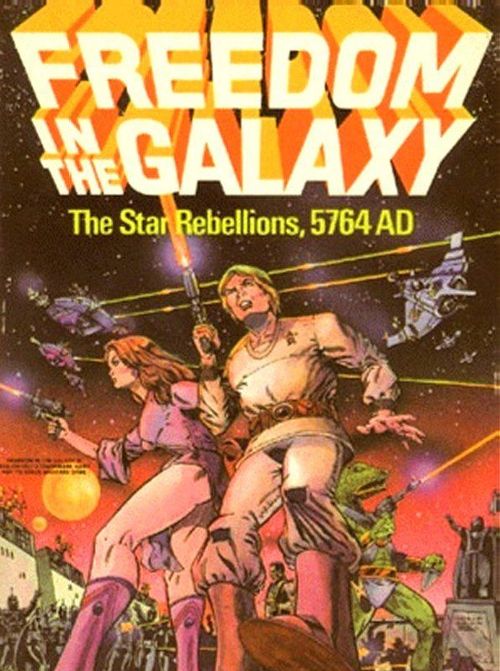
Freedom in the Galaxy: The Star Rebellions, 5764 AD
Freedom in the Galaxy: The Star Rebellions, 5764 AD Rulebook
Table of Contents
Table of Contents
- 1.0 Introduction
- 2.0 Game Equipment
- 3.0 How to Play the Star System Game
- 4.0 Star System Game Sequence of Play
- 5.0 The Galaxy
- 6.0 The Characters
- 7.0 Imperial and Rebel Military Units in the Star System Game
- 8.0 Planetary Defense Bases (PDB)
- 9.0 Movement
- 10.0 Environ Military Combat
- 11.0 Search
- 12.0 Character Combat
- 13.0 Missions
- 14.0 Possessions
- 15.0 Rebellion and Planet Control
- 16.0 Star System Scenarios (One Star System)
- 17.0 Introduction to the Province Game
- 18.0 Province Game Sequence of Play
- 19.0 Force Points and Military Units
- 20.0 Province Game Movement
- 20.1 Movement in the Interplanetary Military Movement Segment
- 20.2 Movement in the Character Movement Segment
- 20.3 Movement in the Surface Military Movement Segment
- 20.4 Interception of Military Units
- 20.5 Transporting Non-Mobile Military Units
- 20.6 Raking Attack
- 20.7 Detection in the Province Game
- 20.8 Enemy Reaction Move in the Province Game
- 20.9 Stacking and Orbit Organization
- 21.0 Hyperjumping
- 22.0 Space Combat
- 23.0 Star-Faring Races and the Domino Effect
- 24.0 Missions in the Province Game
- 25.0 Sovereigns
- 26.0 Characters' Home Planets and Royalty
- 27.0 Repairing Possessions
- 28.0 Province Game Scenarios (One Province)
- 29.0 Introduction to the Galactic Game
- 30.0 Galactic Game Sequence of Play
- 31.0 Planet Secrets
- 32.0 Galactic Events
- 33.0 Imperial Resources and Taxation
- 34.0 Rebel Resources and the Rebel Secret Base
- 35.0 Imperial Strategic Assignments
- 36.0 Imperial Atrocities
- 37.0 Missions in the Galactic Game
- 38.0 Galactic Game Campaign Scenario
- Player's Notes
1.0 Introduction
As you read these words in the comfort of your home, a momentous battle is raging. In a remote corner of the cosmos, a band of intrepid freedom-loving souls has sparked a rebellion against a despicable imperial regime, whose stranglehold encompasses dozens of star systems. Although this war is contested by beings alien to Earth, and although its sheer magnitude dwarfs the greatest wars of Earth history, the struggle involves principles that we humans hold dear — the rights to control our own destinies and live without fear. Come with us now, as we travel beyond the vision of the most powerful telescope, to an unknown portion of the universe, where the cry goes forth for Freedom in the Galaxy!
1.1 How the Game is Organized
Freedom in the Galaxy is not a simple game. The Players must familiarize themselves with many game mechanics and procedures designed to provide them with the utmost in adventure and space fantasy. To facilitate learning, the rules are organized into three distinct games, each with a different level of complexity.
Those who are unfamiliar with the game system should play the Star System Game. It introduces the basic concepts of characters, combat, and missions outlined in rules Sections 1.0 through 16.0, and uses only one star system display on the map. The Province Game is an intermediate level game. It uses one province on the game-map, comprising four to six star systems and rules Sections 17.0 through 28.0. After Players have mastered all the concepts of the Star System and Province Games, they may proceed to the Galactic Game, in which the entire game-map and rules Sections 29.0 through 38.0 are used. Unless specifically stated otherwise, all rules introduced in the Star System Game apply to the other games. Likewise, rules introduced in the Province Game apply to the Galactic Game.
Each game may be played in a number of scenarios, each depicting an action on a certain portion of the game-map. A scenario may be either a Start Rebellion scenario or an Armegeddon scenario, denoting that the scenario starts when the rebellion is only a dream in the eyes of a few idealists, or when the Rebel and Imperial forces are preparing for a final confrontation in a particular area, respectively.
1.2 Glossary of Game Terms
Active and Non-active: One of two states in which a character involved in character combat may be.
Attacking Force: In character combat, the characters, locals, creature(s) or military squad that is attacking.
Bonus Draw: Extra Action Card draws a Player may receive when resolving a mission.
Break-Off: An attempt by characters defending in character combat to escape unscathed from the attackers.
Character: A person or other intelligent being with a collection of individual attributes controlled by one Player.
Character Combat Rating: A character's skill at battling other characters or forces. On the Character Cards, referred to simply as "Combat."
Defending Force: In character combat, the characters who are defending.
Environ: An inhabited area of a planet. An Environ may be one of six types.
- Wild, any earth-type non-developed or little-developed area such a jungle, desert, plain or tundra.
- Urban, a densely populated region that has been built-up to the extent that its original ecology no longer exists.
- Subterranean, an underground populated region; created naturally or by excavation.
- Liquid, an area composed of liquid elements such as water or ammonia; with inhabitants living on the surface of the liquid, in the liquid or on the "floor" or the liquid.
- Air, an area of a planet's atmosphere populated either by lighter-than-air beings, beings that fly, or beings in floating habitats.
- Fire, an area too hot for habitation by humans and most other beings, but well suited to a few peculiar species.
Endurance Rating: A measure of a character's stamina, representing the number of wounds the character may receive before he dies.
Environ Combat Strength: The strength of a military unit when involved in military combat or some other function in an Environ.
Leader: A character who has been named by a Player to lead military units involved in military combat.
Leadership Rating: A quantification of a character's ability when leading military units.
Maneuver Rating: A quantification of a spaceship's maneuverability and ease of handling.
Mission: An attempt by a character or group of characters to achieve a certain objective beneficial to the owning Player.
Mission Group: One or more characters that are performing a single mission.
Pilot: The character controlling a spaceship that a Player is moving.
Planetary Defense Base: A network of tracking equipment and land-to-air weapons spread over a planet's surface, used by the Player that controls the planet to defend against incoming or outgoing enemy forces.
Spaceship: A craft that may carry characters, and that is piloted by characters, from one planet to another.
Special Environ: A title that collectively describes Subterranean, Liquid, Air and Fire Environs.
Terms used in the Province and Galactic Games:
Cannons: A quantification of the offensive capabilities of a Spaceship, used during a Spaceship Quest mission.
Drift: Lost in space; as a result of an off-course hyperjump.
Elite: A Rebel or Imperial military unit provided with the latest in weaponry and equipment, and plenty of it.
Force Point: A representation of men, material and capital that a Player may use towards the purchase of military units.
Hyperjump: A faster-than-light method of travelling over great distances in deep space.
Interception: The act of overtaking enemy military units as they attempt to enter or leave orbit around a planet with friendly military units.
Navigation Star: An especially bright or unique star not orbited by life-sustaining planets, used to aid interstellar space travel (hyperjumping).
Raking Attack: An attack by a Planetary Defense Base on Enemy military units that are attempting to move past its weapons to or from the surface of a planet.
Shields: A quantification of a spaceship's defensive armament, used when attacked by an enemy Fleet Detachment.
Sovereign: A named personage who controls the populace of an Environ. Gaining the support of a Sovereign may be of great aid to a Player.
Space Combat Strength: The strength and Navigation Rating of a military unit when involved in Space Combat or some other function in an Orbit Box.
Space Leadership Rating: The parenthesized Leadership rating that some characters possess, used as a measure of that character's ability when leading military units in space combat.
Star-faring Race: An intelligent race that inhabits more than one planet, as a result of colonization.
Terms used in the Galactic Game:
Rebel Secret Base: A hidden region on a planet or on a planet's satellite that the Rebel Player uses to stockpile material for the Rebel army.
2.0 Game Equipment
2.1 The Game-Map
The 22" x 34" game-map portrays a "slice" of the central portion of the galactic empire. The various circles and tracks on the map represent Star Systems, which detail political, economic, racial and geographic information on each important planet in the empire, as explained fully in Section 5.0. Also included on the map are the Game-Turn Record Track and other record-keeping aids, and a key explaining how to read the Planet Tracks.
2.2 The Cards
There are 140 cards in Freedom in the Galaxy; thirty-two Character cards (nrs. 1-32), which describe the attributes of all the important personages that took part in the rebellion, for better or worse; twenty Possession cards (nrs. 33-52), representing spaceships, robots, and other objects of aid to Rebel characters; fifteen Mission cards (nrs. 53-67), each describing a different mission that a Player may have his characters perform; thirty Action cards (nrs. 68-97), used when characters are resolving missions; twenty-nine Galactic Event cards (nrs. 98-126), used in the Galactic Game to determine a special condition or event each Game-Turn; and fourteen Strategic Assignment cards (nrs. 127-140), used in the Galactic Game to regulate the movement of Imperial forces.
2.3 The Playing Pieces
The 400 back-printed cardboard playing pieces represent the characters and military forces that may take part in the rebellion, and informational counters. All character, spaceship, and military playing pieces are usually referred to as units. The informational pieces are referred to as counters or markers.
2.31 Sample Units. The Character Unit (Front) shows the character's name, Leadership Rating and Space Leadership Rating, and card number. The back of the Character Unit shows the character's name and, if applicable, "Detected." The Imperial Spaceship Unit (Front) shows the spaceship's name, Cannons, Shields, Maneuver Rating and Maximum Passengers; the back shows "Damaged." (Note: Rebel spaceship unit values appear on the matching spaceship Possession Card.) The Imperial Military Unit (Front) shows its type (e.g. Veteran), type symbol, Space Combat Strength and Environ Combat Strength; the back shows "Mobile" for mobile types. The Rebel Military Unit (Front) shows its Environ Type, Environ Combat Strength and Space Combat Strength, and Environ Type symbol; the back shows a Rebel Control marker. The Sovereign Unit (Front) shows the sovereign's name, allegiance, Leadership Rating (and, for some sovereigns, an additional parenthesized Space Leadership Rating), Character Combat Rating and Endurance Rating; the back repeats this information.
2.32 Summary of Unit Types. The countermix includes: Characters (front shows name, card number, and ratings); Rebel Spaceships (represented on their Possession Cards, e.g. the Explorer, Nr. 33); Imperial Spaceships (e.g. Redjac's Spaceship); Rebel Military Units, one set for each of the six Environ types (e.g. Wild 2-1, Urban Elite 4-4, Militia 1-0, Line 3-2); Rebel Elite Military Units; Imperial Militia Military Units; Imperial Mobile Military Units (Patrol, Line, Veteran, Elite Army, Elite Navy); Imperial Suicide Squads (1(5)); Imperial Atrocity Units (Resolution, Peacemaker, Planet Stabilizer); Imperial Sovereigns; Neutral Sovereigns; and Rebel Sovereigns. Note: All Rebel Control markers are printed on the back of Rebel military units.
2.33 Summary of Marker Types. The countermix also includes: the PDB marker (Up on one side, Down on the other); the Loyalty marker (Loyalty on one side, Rebellion on the other, for use on the Political Track); the Rebel Control marker; and the Game-Turn/Game-Turn Phase marker; along with Planet Secret counters (Unrevealed on one side, Revealed on the other) and Rebel Camp/Rebel Camp Coup markers.
2.4 Game Charts and Tables
In the center of this rules book (and again in the center of the Galactic Guide) are four pull-out pages of charts and tables, used to simplify and illustrate certain game functions. These aids include the Detection Table, the Military Combat Results Table, the Search Table, the Squad Chart, the Irate Locals Chart, the Character Combat Results Table, the Planet Control Summary, the Force Point Cost Chart, the Hyperjump Table, and the Character Endurance Sheets.
2.5 Parts Inventory
A complete game of Freedom in the Galaxy includes:
- One rules booklet (including four pages of charts and tables)
- One Galactic Guide (including duplicate set of charts and tables)
- Two sheets of die-cut counters (200 counters each)
- One 22" x 34" game-map
- 140 playing cards
- Two six-sided dice
- One game box assembly
If any parts are missing or damaged, fill out the enclosed Complaint Card and return it to SPI for replacement. Note: The process used to manufacture counters sometimes results in images being slightly off center or in colors spilling along the edges of differently colored counters. Counters displaying such minor imperfections cannot be replaced by SPI. Only in cases where counters are not legible can SPI supply replacements.
3.0 How to Play the Star System Game
Starting Play. Choose a scenario (from Section 16.0) to play. Each scenario describes what units to set up and where to place them, and outlines what each Player must do to win the game. One Player controls the Rebel forces, which consist of characters, their spaceships, and possibly military units. He must attempt to spread the Rebel cause by having his characters perform missions and eventually cause planets to undertake rebellion, thus creating more Rebel military units with which to meet the Empire on equal terms. The other Player controls the Imperial forces. He must attempt to quash the growing rebellion, through his military might or through missions performed by his characters.
The game is played in a number of repeating sequences called Game-Turns. In each Game-Turn, the Rebel Player, and then the Imperial Player, move their playing pieces and have them carry out certain functions in the following manner.
The Rebel Player Moves His Characters and Military Units. The Rebel Player may move his characters from Environ to Environ on a planet; or if the characters have a spaceship, they may be moved from planet to planet. If the spaceship is arriving on a planet, leaving a planet, or moving from Environ to Environ on a planet that is occupied by an Imperial Planetary Defense Base (PDB), the Imperial Player may attempt to detect and damage or destroy the spaceship. If the Rebel Player has any military units, he may also move them from one Environ to another on a planet. Some military units are considered mobile, and may be moved from one planet to another. If a military unit is leaving or arriving on a planet occupied by an Imperial PDB, the PDB may attack the unit. Military units may not attack PDB's. Rebel characters may be moved with a Rebel military unit if the Rebel Player wishes.
The Imperial Player Reacts. The Imperial Player may now react to the Rebel Player's moves by moving any one Imperial military unit or any one Imperial character to each Environ occupied by Rebel military units or detected Rebel characters.
Either Player Initiates Military Combat. Either Player may declare military combat between opposing military units in the same Environ. The Player initiating the combat is termed the attacker, the opposing Player is the defender. Each Player may name a character that is present in the Environ as the leader of his military units. The Players use the Military Combat Results Table to resolve the combat.
The Imperial Player Searches for Rebel Characters. In each Environ where the Imperial Player has characters or military units, he may conduct search for detected Rebel characters in the Environ. If a search is successful, the Rebel characters are considered found and may be attacked by Imperial characters or by a squad from Imperial military units.
The Rebel Player Assigns Missions to His Characters. In each Environ where the Rebel Player has characters, he may choose missions for them to undertake, one Environ at a time. He places a Mission Card on top of the Character Cards representing the characters that are going on a mission. The characters are now considered a Mission Group. Any number of characters may be in a Mission Group, and the Rebel Player may assign up to as many missions in an Environ as there are characters. Each mission represents an attempt by the characters to gain support for their cause on the planet, to gain other characters or possessions (such as weapons or spaceships), or to damage the Imperial Player's forces.
The Rebel Player Resolves His Characters' Missions. The Rebel Player draws Action Cards to see if his missions in the Environ have succeeded. He looks at the section of the card concerning the Environ his characters are in, resolving any Action Events that may be listed on the card. Then, if a Mission Letter corresponding to one of his assigned missions is listed, the mission is completed. Each Mission Card describes how the mission is successfully completed and any special restrictions on the conduct of the mission. The effects of successful missions are implemented immediately. As long as there are missions yet to be completed, the Rebel Player may continue to draw Action Cards, up to as many as the Environ Size Rating.
The Rebel Player Receives Bonus Draws for his Missions. If any Rebel characters in an Environ did not complete their missions, and survived the Action Events, they may receive bonus draws. The Rebel Player consults the Mission Card and the cards of his characters in the Mission Group to see if they are eligible to receive bonus draws and, if so, how many they receive. He then draws the appropriate number of Action Cards, mission by mission, ignoring all Action Events, and looks for his Mission Letter.
The Rebel Player Completes His Player-Turn. The Rebel Player then proceeds to the other Environs in which he has characters, one at a time, assigning and resolving missions and receiving bonus draws. After he has finished, his Player-Turn is over.
The Imperial Player Takes His Turn. The Imperial Player now conducts his Player-Turn. He may perform all game functions the Rebel Player performed in the Rebel Player-Turn with his own characters and military units. He is subject to Rebel detection and search (when it is possible). When the Imperial Player has finished his Player-Turn, a complete Game-Turn has passed, and another begins. After a number of Game-Turns have been completed (as determined by the scenario), the game is over and a winner declared.
4.0 Star System Game Sequence of Play
Freedom in the Galaxy is played in a number of Game-Turns. Each Game-Turn represents one month (Earth reckoning) of real time. During each Game-Turn, the Players may move their characters and military units, conduct combat and perform missions. In order for the Players to carry out all these functions in a logical and fair manner, each Game-Turn is arranged in a rigid sequence. The Game-Turn is divided into two Player-Turns, one Rebel and one Imperial. The Player whose Player-Turn is in progress is often referred to as the Phasing Player; the other Player is referred to as the non-Phasing Player. Each Player-Turn is divided into three Phases, some of which are further divided into Segments. All actions by the Players must proceed strictly according to the Sequence as outlined in this Section.
1. Rebel Player-Turn
A. Operations Phase
- Movement Segment. The Rebel Player may move his characters and military units (if he has any) from Environ to Environ on a planet or, if eligible, from any Environ on one planet to an Environ on another. If characters in a spaceship are being moved to or from a planet occupied by an Enemy-controlled PDB, the Detection Routine is resolved. If military units are being moved to or from a planet occupied by an Enemy-controlled PDB, it may attack them.
- Enemy Reaction Segment. The non-Phasing Player (in this case, the Imperial Player) may move one military unit, a military unit and a leader, or one character to each Environ occupied by a Rebel military unit or detected Rebel character. However, a unit so moved must be on the same planet as the Environ it is moving to.
- Military Combat Segment. Either Player may initiate military combat between opposing military units that are in the same Environ. The Phasing Player and then the non-Phasing Player declare whether they wish to have combat. If combat is declared, both Players may name any one of their characters as a leader of their military unit(s).
B. Search Phase
The Imperial Player may conduct search for any detected Rebel characters that are not stacked with Rebel military units, if there are Imperial military units or characters in the same Environ. If a search is successful, the Imperial Player may initiate character combat against the found Rebel characters.
C. Mission Phase
All three Segments of the Mission Phase are completed in one Environ where the Rebel Player wishes to perform missions before going on to the next Environ.
- Mission Assignment Segment. Using the Mission Cards, the Rebel Player assigns missions to any of his characters in an Environ that are not stacked with military units.
- Mission Action Segment. The Rebel Player resolves all his assigned missions in the Environ by drawing Action Cards. Some of the Events on the cards may call for search, character combat, or some other function (such as completing a mission) to interrupt the drawing of Action Cards.
- Bonus Draw Segment. The Rebel Player draws extra Action Cards for eligible missions in the Environ that have not been completed, provided the characters on the mission survived the Action Card Events drawn in the previous Segment.
2. Imperial Player-Turn
A. Operations Phase
- Movement Segment. The Imperial Player may move his characters and military units as the Rebel Player did in his Movement Segment.
- Enemy Reaction Segment. The Rebel Player moves units in reaction.
- Military Combat Segment. As in the Rebel Player-Turn.
B. Search Phase
The Rebel Player may conduct search for detected Imperial characters.
C. Mission Phase
- Mission Assignment Segment. The Imperial Player assigns missions to his characters in an Environ.
- Mission Action Segment. The Imperial Player resolves all his assigned missions in the Environ by drawing Action Cards.
- Bonus Draw Segment. The Imperial Player draws extra Action Cards for eligible missions in the Environ.
3. Game-Turn Interphase
The Rebel Player checks to see if any planets are now Rebel-controlled, and then the Game-Turn is over. The Game-Turn marker is advanced one space on the Turn Record Track signalling the start of a new Game-Turn.
5.0 The Galaxy
Commentary: The game-map represents the heart of the Galactic Empire. Although Imperial control extends far beyond the edge of the map, these outlying areas are for the most part still being explored and developed, and thus have little effect on galactic politics. The stars and planets that are shown in the game are the most important economically and influentially.
General Rule: The galaxy is composed of five provinces, each of which includes four to six star systems. The star systems are connected by space routes. Each star system contains one to three planets, in the form of planet tracks, which present information exclusive to each planet. The playing pieces are placed on and moved around the various spaces of the Planet Tracks and star systems.
Note: The game-map is not a physically realistic representation of an imagined part of the galaxy, but rather a political and informational display of the Empire's domain.
5.1 The Provinces
Provincial boundary lines divide the galaxy into five provinces. The central province — the "First Province" — is the political "power base" of the Empire. Running in clockwise order around the First Province are the four outlying provinces. Each province has its own provincial government centered on a capital planet from which the Empire exercises control over the province. The First Province also contains the Throne Planet (planet 162, Orlog), the ceremonial center of the galaxy. In the Star System Game, the Players are not concerned with provinces, since they are using only a single star system. In the Province Game, a province represents the entire playing area. In the Galactic Game, in which all five provinces are used, the provinces regulate Imperial taxation and Imperial movement.
5.2 The Star Systems
The 25 circular displays on the game-map are Star Systems. At the center of each star system is a star which is named and numbered (for example, in the center of the map is Zamorax, Star 13). Note that each star number has two digits, the first being the number of the province the star is in.
[5.21] Each star system has from one to three planets. Each of these is represented by a circular ring, or partial ring, that surrounds the star (and are the Player's only concern in the Star System Game). Actually, each star system may have more planets than are shown on the map, but they are uninhabited by intelligent races and therefore have no importance in the games.
[5.22] Each star is surrounded by a Drift Area. Each star system is bordered by a Drift Two Box. All the star systems are connected by a network of space routes. None of these items affect the Star System Game. In the Province and Galactic Games, these regulate Hyperjumping (see Section 21.0).
5.3 The Planets
There are 51 planets in Freedom in the Galaxy. A planet is represented by a Planet Track arrayed in a circle or semicircle around a star. Most of the action in the game takes place on the Planet Tracks. Each Planet Track includes information about the planet's inhabitants, its political leanings, size, economic value and other specific properties.
Refer to the following key to understand what the terms and numbers on a planet mean. The sample planet for this key is Orning, which orbits the star Gelass (#24) in Province Two.
- A. The Orbit Box names and numbers the planet. Note that the first two digits of the planet's three-digit number are those of its star. Aside from identifying the planet, this box is not used in the Star System Game. In the Province and Galactic games, units may be put in orbit around the planet by being placed here.
- B. In this corner of the Orbit Box may appear the term capital, Throne, secret, or the name of a star-faring race. These terms are not used in the Star System Game. In the Province and Galactic games, they denote the important political status of the planet, making it a major point of contention between the Players.
- C. The Political Track is used to record the current loyalties of the planet's populace. A Loyalty marker is moved from space to space on the track as the Players' actions change the planet's loyalty. The five spaces on the track describe the planet's current feelings toward the Empire. The number in each space is used to assign a numerical value to each Loyalty. For example, Unrest is -2 in terms of the Empire Player and +2 in terms of the Rebel Player. The numbers are also used to identify the current strength of the Planetary Defense Base (see Case 8.11).
- D. S (Start Rebellion) and A (Armegeddon) denote where a planet's Loyalty marker is placed at the beginning of a scenario (see Case 16.1). On some planets there may appear AC in the Unrest Space of the Political Track. This means the planet is already Rebel-controlled at the start of an Armegeddon scenario.
- E. An Environ in the planet's surface, or other habitable area, or part of one of these. Each planet has from one to three Environs, each with its own characteristics. All the action in the Star System Games, and most of it in the Province and Galactic Games, takes place here.
- F. The Environ Size rates the Environ's population and geographic size. This rating defines the number of Action Cards the Player may draw when performing a mission (see Case 13.3) and the maximum number of military units a Player may have in the Environ (see Case 9.5).
- In the left hand side of the Environ appears the name of one or more races. If the name is followed by a star (as the example is), the race is a star-faring race; otherwise it is a planet-bound race. In the Star System Game, the race affects the nature of an Irate Locals attack (see Case 12.14). In the Province and Galactic Games, occurrences in Environs occupied by a star-faring race may affect other planets.
6.0 The Characters
Commentary: Central to the play of Freedom in the Galaxy are the characters. As in all great space adventures, the fate of the galaxy is not determined by armadas and armies so much as by the special contributions and astounding feats of an intrepid few. By their actions in the game, the characters inspire planetary populations to join their cause, undermine the grand plans of the enemy, and handle crises large and small.
General Rule: There are 20 Rebel characters and 12 Imperial characters in the game. The Players are assigned a portion of these characters at the beginning of each scenario. They sometimes gain more as play proceeds. Each character is represented by a card and a counter. The card is held by the Player and describes the character's attributes. The counter is used on the map to show the geographic location of the character. During the game each Player moves his characters around the map, according to the rules for Movement (Section 9.0), and has them perform Missions or lead military units in combat.
6.1 The Character Cards
The character cards serve to give each character a personality and to describe special talents or weaknesses the character may possess. The Player refers to the following values and descriptions on the card when a character is involved in some game function that may be affected by the character's attributes.
- Allegiance and Race. The character's allegiance (Rebel or Imperial) and his race appear at the top of the card.
- Name and Title. The character's name may have a title listed underneath it noting that the character is Royalty on a certain planet or is an Imperial Knight. The title has no effect on the Star System Game.
- Combat is a rating of the character's fighting ability (both hand-to-hand and with fire weapons.) It is used whenever the character is involved in combat with creatures, Enemy characters, Irate Locals, or Enemy squads. The rating may be reduced as a result of wounds received in combat (see Case 12.72).
- Endurance represents the number of wounds the character may receive in combat before he dies. The rating is used in conjunction with the character Endurance Sheet on which the character's current Endurance is recorded and changed as the character receives wounds in combat or spends time healing (see Case 13.71).
- Intelligence represents knowledge, experience and intuition. It affects the character's performance on the Gather Information, Assassination, and Coup Missions. It is also used against creatures that attack mentally and aids when searching for the Enemy or trying to hide from the Enemy (see Section 11.0, Search).
- Leadership represents the ability to lead military units in combat and other game functions. Some characters have an additional Leadership rating in parentheses. In the Galactic and Province games, this rating is used to lead military units in space combat. Leadership also affects the Start Rebel Camp, Coup, and Subvert Troops Missions.
- Diplomacy represents political tact and persuasiveness. It affects the most important mission, Diplomacy.
- Navigation represents the ability to pilot a spaceship. It is used in conjunction with, and may be affected by the Maneuver rating of a character spaceship when evading detection. In the Province and Galactic Games, it also affects Hyperjumps and the Spaceship Quest mission.
Cards representing characters a Player currently controls should be kept face up in front of him. Characters that are being moved together, or in the same Mission Group should have their cards grouped together. If a character has a possession (see Section 14.0), its card should be placed underneath the character card so that the opposing Player cannot see it until the Player wishes to declare use of the possession.
6.2 The Character Counters
The Players use the character counters to show in which Environ, Orbit Box or Drift Area a character is currently operating. The counters are placed on and moved about the game-map, according to the set-up instructions in the scenario being played and the rules for movement. The front side of each counter has the character's name and Leadership rating (identical to that on the character card) as this rating effects the strength of military units with which the character is stacked.
The back-side of each character counter has the character's name and the word "Detected." If the character is detected during the course of play, the counter is flipped over to show this condition, and flipped back to the front side when the character is no longer detected (see Case 9.3).
7.0 Imperial and Rebel Military Units in the Star System Game
Commentary: Although the characters in Freedom in the Galaxy pave the way to the Players' goals, it requires military success to secure victory. The Empire has a rigid, well organized and well lead military arm that has successfully carved out a nation in the stars through offensive strategy. It is not, however, designed to deal with partisan activity in its seemingly secure areas. The Rebel army, dwarfed in size by the Imperial forces, is composed of scattered provincial groups with no established doctrine to aid or hinder their operations.
General Rule: Both players are provided with a variety of military units. Each unit represents about one million soldiers. The differing strengths of these units is based on the amount of equipment and technological development they have been supplied with. Military units are used to gain and keep control of a planet, to hunt for Enemy characters and to destroy the Enemy's military units.
7.1 Use of Military Units in the Star System Game
Both Players may move their military units from Environ to Environ. Some military units may be moved from planet to planet. Military units may be moved in Reaction to Detected Enemy characters or Enemy military units (see Case 9.6). Combat may be initiated between opposing military units in the same Environ. Military units may search for Enemy characters and, if successful, attack them with a squad (see Case 12.12).
When playing the Star System game, only the first number on each military unit is used, as the unit's combat strength. The second number is only used in the Province and Galactic Games.
7.2 Imperial Military Units
In the Star System Game the Imperial Player receives Militia, Patrol, and Line military units. These have strengths of 1-0, 1-2, and 3-2 respectively. No other Imperial military units are used in the Star System Game.
[7.21] Militia military units have no printing on the reverse side; they are always deployed and moved with their strength face up. These units may only be moved from Environ to Environ on a single planet; they may not leave a planet.
[7.22] Patrol and Line Military units have "mobile" printed on their back side. The Imperial Player deploys and moves these units upside-down. The Rebel Player should not know what the true value of a mobile unit is, until the unit's strength must be used to execute some game function, such as a combat or search. At this time, the unit is flipped over to show the unit's strength and remains that way until the function is completed, at which time the Imperial Player flip the unit back to its mobile side. The Imperial Player may always look at the strength of his mobile units.
[7.23] Mobile military units may be moved from planet to planet; that is, from any Environ to any other Environ in the Star System, regardless of which side is face-up.
7.3 Rebel Military Units
In the Star System Game, Rebel military units come in denominations of 1-0 and 2-1 only; the latter being considered mobile (see Case 7.23) although this is not noted on the counter. No other Rebel military units are used in the Star System Game. Rebel military units are never deployed upside-down.
[7.31] Rebel military units come in six Environ types; one for each Environ type on the game-map. Thus, there are Rebel Urban units with strengths of 1-0 and 2-1; Rebel Liquid units with strengths of 1-0 and 2-1; and so forth.
[7.32] Rebel military units are created in an Environ when a planet goes into rebellion (see Case 15.41). Military units of the matching Environ type are placed in such an Environ at that time, although they are not restricted to stay there. Rebel army units fighting in their own Environ type receive benefits in combat (see Case 10.5).
8.0 Planetary Defense Bases (PDB)
Commentary: The Planetary Defense Base (PDB) represents a planet-wide network of tracking and detection equipment tied into a command and processing center. Each PDB may be supported by varying amounts of heavy weapons to attack what the base has detected. As a relatively inexpensive defensive weapon, the PDBs have proven quite successful; thus the Empire has installed them, or at least the foundation for them, on all their subject worlds.
General Rule: Every planet in the game is provided with a Planetary Defense Base (PDB), which may be used by the Player who controls the planet (see Case 15.6) to detect Enemy character spaceships and to attack Enemy military units. Each PDB may be at one of three levels of effectiveness; Level 0, 1 or 2. The higher the level, the better it is at hindering the Enemy. When a PDB at any of these levels cannot function due to some action in the game, it is considered Down. When it is operating, it is considered Up.
8.1 The PDB Marker
Each PDB is represented by a PDB marker placed on the Political Track of its planet. The counter is printed on both sides; the front side shows that it is Up, and the backside shows that it is Down.
[8.11] The current level of a PDB is shown by its position on the Political Track. For example, an Imperial-controlled Level 2 PDB would be placed on the Patriotic space of the Track; a Rebel-controlled Level 1 PDB would be on the Dissent space. A Level 0 PDB controlled by either Player would be on the Neutral space, the controlling Player being identified according to the definition of planet control (see Case 15.5).
[8.12] At the start of the game the PDB marker is placed Up on each Planet's Political Track, in accordance with the scenario instructions.
[8.13] In the Star System Game, a PDB's level may not be improved once play begins. Note that the level of a PDB has nothing to do with whether it is Up or Down; it may switch between these two states during play. In the Province and Galactic Games, a PDB's level may be improved.
8.2 Uses of PDBs
The Player that controls a planet may use its PDB to attempt detection of Enemy characters entering, leaving, or travelling about the planet in a spaceship (see Case 9.3) if the PDB is UP. He may also use it to attack Enemy military units that are entering or leaving the planet (see Case 9.2). As explained in the appropriate Case, the level of the PDB determines its effectiveness in carrying out these actions. A PDB that is Down may not be used at all, regardless of who controls the planet.
8.3 Down PDBs
When a PDB is Down (back-side of the counter facing up), it is totally inoperable until the counter is flipped back over. It may not be used for any purpose by either Player.
[8.31] A PDB may go Down as a result of a Sabotage mission (see Mission Card nr. 53) or the Action Event "Locals Raid" (see, for example, Action Card nr. 70).
[8.32] A Player who controls a planet that has a Down PDB may put the PDB Up according to the instructions in the scenario being played. In the Province and Galactic Games, a Player may put a Down PDB Up by expending a Force Point.
[8.33] When a planet is controlled by neither Player (see Case 15.5), neither Player may use the PDB, whether it is Up or Down. When one Player gains control of the planet, the PDB may be used by that Player at its current level, if it is Up.
9.0 Movement
General Rule: During the Movement Segment of his Player-Turn, a Player may move any of his characters, character spaceships, and military units. They may be moved from Environ to Environ on a planet. Characters who are being moved in a spaceship and mobile military units may be moved from an Environ to any other Environ in the star system.
Procedure: Characters, their spaceships, and military units may be moved individually or together, in which case they are called a stack of units. Unlike many other SPI games, there is no "cost" to move units, and distance is not considered; the Player simply picks up the units and places them at their destination. However, if an Enemy PDB is present, the movement of characters in a spaceship may be interrupted by the Detection Routine (see Case 9.3) and the movement of military units by an attack from the PDB (see Case 9.2). A Player may move as many or as few of his units as he wishes in his Movement Segment; however, each unit may be moved only once per Segment. When the Player has finished moving all the units he can or wishes to move, the Enemy Player may make reaction moves.
Units may be moved only to or from Environs. A unit may never be placed in an Orbit Box, Drift Area, or other portion of the star system in the Star System Game. In the Province and Galactic Games, these areas are used by the Players.
9.1 Moving on a Planet
Military units and characters may be moved from Environ to Environ on a planet. The units are considered to be moving via the surface of the planet. Thus, characters are not subject to Detection by the planet's PDB (if Enemy-controlled) and military units so moved may not be attacked by the PDB (see Case 9.2). However, if characters are being moved on a planet in a character spaceship (see Case 14.5), they are considered to be flying from Environ to Environ and thus may be detected.
9.2 Moving from Planet to Planet
Mobile military units (see Cases 7.22 and 7.3) and characters in spaceships may be moved from an Environ on one planet to an Environ on another. If a spaceship is leaving or arriving on a planet occupied by an Enemy PDB, the Detection Routine is undertaken as detailed in Case 9.3. If a military unit is leaving or arriving on a planet occupied by an Enemy PDB, the PDB may attack the military unit, in accordance with the following cases.
[9.21] A PDB attacks a moving military unit or stack of units according to the rules for military combat (Section 10.0), resolving the attack on the Military Combat Results Table (10.8).
[9.22] Regardless of the strength of the military unit(s), an attack by a Level 2 PDB is resolved on the 3-1 column of the Table, and an attack by a Level 1 PDB is resolved on the 1-1 column. A Level 0 PDB may not be used to attack military units.
[9.23] As in Environ military combat (see Case 10.2), the attacker (in this case, the Player controlling the PDB) rolls the die to see what losses the defender must take, and then the defender (the Player moving the military units) rolls the die to see what losses the attacker must take.
[9.24] Military units attacked by a PDB take losses as described in Case 10.3. After fulfilling the loss, the movement of military units may be continued.
[9.25] If a PDB incurs a loss of 2 when attacking, it is placed Down. If it incurs a loss of 3 or more, it is placed Down and reduced a level (Level 2 becomes Level 1). A loss of 1 has no effect on a PDB.
[9.26] A military unit may never attack an Enemy PDB; it may only defend against a PDB attack.
[9.27] Note that a particular military unit could be attacked twice in this manner during one move; once as it leaves a planet, and again as it arrives on another, assuming both planets are occupied by an Enemy-controlled PDB.
[9.28] In the Province and Galactic Games, a PDB does not make this type of attack on Enemy military units; instead, it may execute a Raking Attack (see Case 20.6).
9.3 The Detection Routine
The Detection Routine takes place when a character spaceship is leaving a planet occupied by an Enemy PDB, arriving on a planet occupied by an Enemy PDB, or moving from Environ to Environ on a planet occupied by an Enemy PDB. The Detection Routine is resolved using the Detection Table (9.7).
Procedure: To use the Detection Table, first determine the Evasion Value of the spaceship (as explained on the Table and in Case 14.52) then roll the die, finding the result under the appropriate column.
The column to which the Players refer to resolve detection may be changed by the level of the PDB and whether or not characters are already detected; these are explained on the Detection Table.
[9.31] Results that may be achieved in the Detection Table are the following.
- U (Undetected). Proceed with the spaceship's movement. If the characters in the spaceship are currently detected, flip the counters over; they are no longer detected.
- D (Detected). Flip all the counters of the characters in the spaceship to their detected side (do not flip over the spaceship) and proceed with their movement.
- Dd (Detected and Damaged). Flip all the characters and the spaceship over and proceed with their movement. However, when the spaceship reaches its destination, it is eliminated. The characters aboard are not harmed. (In the Province and Galactic Games, the spaceship is not eliminated; see Section 27.0).
- E (Eliminated). The ship and all characters aboard are destroyed (remove from play).
Some D results on the Table are followed by an asterisk. Ignore this in the Star System Game.
[9.32] If the Enemy PDB is at Level 0, it may still attempt to detect a spaceship. However, as noted on the Table, all Dd and E results are treated as D. A PDB that is Down may not be used for detection.
[9.33] It is possible that a spaceship would have to undergo the Detection Routine twice in one move — once when leaving a planet and again when arriving on another. However, when a spaceship is moving from Environ to Environ on one planet, the Detection Routine is resolved only once.
[9.34] Military units and any characters or spaceships moving with them never undergo Detection; they are always considered detected. The PDB could attack the military units, however (see Case 9.2).
[9.35] Detected characters moved from one Environ to another on the same planet without a spaceship are no longer detected; flip the character counters over (unless there are other detected characters already in the Environ being moved to; see Case 9.4).
[9.36] If a spaceship that is already damaged receives a Damage result during the Detection Routine, that result is instead treated as an E; the spaceship and all aboard are destroyed. This situation will occur only if a spaceship is damaged by detection as it is leaving one planet and undergoes detection again as it arrives at another (see Case 9.35).
9.4 Effects of Detection
When a character or stack of characters have the Detection side of their counters face up, all the Player's characters in that Environ are considered detected.
[9.41] The Enemy Player may make a reaction move if there are detected characters in an Environ (see Case 9.6), and may conduct search for those characters during the Search Phase (see Case 11.1).
[9.42] In addition to detection by an Enemy PDB, characters may become detected as a result of events on the Action Cards when resolving missions (see Case 13.4) or by conducting a search (see Case 11.31).
[9.43] When characters that are already detected undergo the Detection Routine, a column shift adjustment is made on the Detection Table (9.7), as explained there.
[9.44] The Assassination mission (see Case 13.2) may be performed only against a detected Enemy character.
9.5 Stacking
There is no limit to the number of units a Player may move as a single group. This group is called a stack, and may include military units, characters, and character spaceships. However, the number of military units a Player has in an Environ may never exceed its Environ Size Number. At the end of his Operations Phase, a Player may have up to two stacks of units in each Environ; one of military units and one of characters that are eligible to perform missions.
[9.51] The limit on military units in an Environ is per Player. For example, in an Environ of size 4, each Player could have up to four military units there at any one time. If a Player's stack in an Environ is ever found to exceed the limit, he must eliminate (remove) the excess units of his choice immediately. Characters and their spaceships never count toward this limit.
[9.52] If a stack includes any military units, it is moved according to the procedure for moving military units, undergoing attack by Enemy PDBs and taking part in military combat if called for. Such a stack is always considered detected.
[9.53] If a stack containing military units includes a character with a Leadership Rating of 1 or more, that character may be named as the leader of those units whenever the owning Player wishes (see Case 10.4).
[9.54] If a stack includes no military units (has only characters, possibly with a spaceship), each spaceship and its passengers is moved individually; that is, each ship would undergo Enemy detection separately.
[9.55] A spaceship may be moved only if it is stacked with military units or a character that has a Navigation Rating of one or more (see Case 14.5).
[9.56] Characters may be moved from an Environ to an Environ on another planet only if they are stacked with a spaceship or mobile military units. Note that each spaceship has a maximum number of characters it may carry (see Case 14.5); this number is the limit of characters that may be stacked with a single spaceship as it is moved.
[9.57] When a Player has finished moving all the units he wishes to in a Movement Segment, his units should be organized in two stacks in each Environ — one containing all the military units in the Environ and any characters (whether leaders or not) and spaceships accompanying those military units, and the other containing those characters and their spaceships that may perform missions. Thus, characters that were moved with military units need not be stacked with them at the end of the Movement Segment. However, if a character is stacked with a military unit during the Mission Phase, that character may not perform a mission.
9.6 Enemy Reaction Moves
During the Enemy Reaction Segment, the non-Phasing Player may make a reaction move for each Environ that contains a military unit or a detected character that belongs to the Phasing Player. The reaction move consists of moving one of his characters, or one of his military units, or one military unit and a leader (see Case 10.4) from any Environ on a planet to the Environ on the same planet that fulfills the preceding requirement for reaction.
[9.61] A reaction move may not be made from one planet to another; only from one Environ to another Environ on the same planet.
[9.62] A unit moved in reaction may be stacked with any of the owning Player's units currently in the Environ (within the restrictions of Case 9.5) and may take part in all succeeding activities in that Environ this Game-Turn.
9.7 Detection Table
| Die \ Evasion Value | 0 | 1 | 2 | 3 | 4 | 5,6 | 7,8 | 9+ |
|---|---|---|---|---|---|---|---|---|
| 1 | Dd | D | U | U | U | U | U | U |
| 2 | Dd | D* | D* | D | U | U | U | U |
| 3 | Dd | Dd | D* | D* |
Procedure: Determine the evasion value of the spaceship undergoing detection by adding together the pilot character's Navigation rating and the spaceship's Maneuver rating. Neither rating may exceed the other by more than one (see Case 14.52). Roll the die, cross-referencing the result with the proper evasion value column to yield a result.
Modifiers: If the PDB is at Level 0, treat all Dd and E results as D. If the PDB is at Level 2, shift two columns to the left. If the spaceship is already detected, shift one column to the left. In the Province and Galactic Games, military units in the Orbit Box may cause column shifts (see Case 20.7). All column shifts are cumulative.
Results: U: Undetected; D: Detected; Dd: Detected and Damaged; E: Eliminated; (*): In Province and Galactic Games, fleet detachment may attack spaceships. See Case 9.31 for a full explanation of the results.
10.0 Environ Military Combat
General Rule: Military combat may occur during the Military Combat Segment of either Player-Turn in any Environ occupied by military units belonging to both Players. Either Player may declare military combat in such an Environ, but combat is not required. If neither Player wishes to have combat in an Environ, it does not occur.
Procedure: The Phasing Player chooses the order in which he wants to resolve combats in Environs occupied by opposing military units. In each Environ, the following procedure is used.
- The Phasing Player and then the Enemy Player declares whether he wishes to have combat. If combat is declared by either Player, the Player who declared combat is termed the attacker and the other Player the defender in that particular combat.
- Each Player totals the Combat Strengths of all his involved military units and names a leader if one is present.
- These total strengths are compared as a ratio of attacker strength to defender strength. Round the ratio in favor of the defender to conform to the simplified ratios found on the Military Combat Results Table (10.8). "Shifts" to this column may be applied if a leader is present or for some other applicable reason.
- The attacker rolls the die and reads the result to the right of the slash on the appropriate line of the column to determine how many Combat Strength Points of defending units must be eliminated.
- Then the defender rolls the die, referring to the same ratio column, to determine how many Combat Strength Points of attacking units must be eliminated (the result to the left of the slash).
- Both Players remove the required number of units from among their own units to fulfill the combat results as closely as possible, without exceeding them. The Players then proceed to the next Environ where combat is possible.
10.1 Declaring Combat
In each Environ where combat is possible, the Phasing Player declares whether he wishes to have combat or not. If he does, he is the attacker in the combat. If he does not, the non-Phasing Player declares whether or not he wishes to have combat. If he does, he is the attacker in the combat. If he does not, no combat takes place in the Environ. The fact that a Player is the attacker or defender in one Environ has no bearing on his status in another Environ where combat could take place. If combat is declared by either Player in an Environ, all military units in the Environ must be involved in all the combat.
10.2 How to Use the Military Combat Results Table
Once combat is declared in an Environ, the Players follow the instructions in the preceding Procedure to resolve it. To find the proper ratio column to use on the Military Combat Results Table, compare the total attacking strength to the total defending strength as a ratio (e.g., 12 to 5, 3 to 1, or 14 to 3). Then, round the ratio in the favor of the defender to conform to one of the ratio columns listed on the Table (the preceding examples would become 2-1, 3-1, and 4-1, respectively).
[10.21] After determining the ratio column, it may be necessary to shift one or more columns in either direction if a Player has a leader advantage (see Case 10.4) or an Environ advantage (see Case 10.5). This adjusted column is used to resolve the combat.
[10.22] Note that the two extreme ratio columns on the Table (1-6 and 6-1) may be used only as a result of a column shift. Therefore, before column shifts are taken into account, the minimum and maximum ratios are, respectively, 1-5 and 5-1. Thus, if the unrounded ratio (attacker to defender) is 1 to 9, or 9 to 1, the rounded ratios would be 1-5 and 5-1, respectively.
[10.23] Each ratio column is composed of six double results that apply to the defender (the result to the right) and the attacker (the result to the left). The result of the combat is found by rolling twice (as described in the Procedure) to provide the Players with a wider variety of outcomes.
10.3 Fulfilling Combat Results
Each combat result (as determined by the opposing Player's die roll) requires a Player to remove a certain number of Combat Strength Points from his involved units by eliminating some of them (removing them from play). If, for example, a Player incurred a combat result of 2, he would have to remove units whose total Combat Strength Points equalled two as closely as possible without exceeding the figure. If a Player does not have units of the proper denomination to meet the result exactly, he removes those units that would fulfill the result most closely; but he never removes more Strength Points than called for. Thus, if the Imperial Player had two units worth three Combat Strength Points each involved in a combat in which they incurred a loss of 2, no units would be removed since to do so would exceed the combat result. If, in the same instance, he had two units worth one Combat Strength Point each, they would both be removed. Therefore, the Players will find that stronger units are much less vulnerable to combat loss.
10.4 Leaders and Combat
If either Player has a character with a Leadership Rating of one or more in an Environ where a combat is taking place, he may name that character as the leader of his military units. The character should be stacked with the military units at this time if he is not already (however, see Case 9.57). A leader shifts the combat ratio a number of columns in favor of the owning Player equal to his Leadership Rating. For example, an Imperial leader with a rating of 2 would shift the combat ratio two columns to the left if defending and two columns to the right if attacking.
[10.41] If both Players have a leader in a combat, the lesser Leadership Rating is subtracted from the greater to yield a net column shift in the superior leader's favor. If the leaders have equal ratings, neither Player receives column shifts for leaders.
[10.42] Leaders enable a Player to achieve the 1-6 or 6-1 column on the Military Combat Results Table (see Case 10.22).
[10.43] A Player may name only one leader for each individual military combat.
[10.44] The presence of a leader enables the Imperial Player to negate the penalty column shift in Special Environs (see Case 10.5) in addition to the leader's normal column shifts.
[10.45] Leaders may never be eliminated to fulfill a military combat result. However, if a Player's military units are totally eliminated in combat, the leader is attacked by a squad from the surviving Enemy military units (see Case 10.6).
10.5 Effects of Environ Types on Military Combat
All Rebel military units are classified into the six Environ types. Each unit has the name of one Environ type printed on it, and can be further identified by color. Whenever Rebel military units are involved in combat and at least one of the units shares the same Environ type as the Environ they are in, the Rebel Player receives a column shift of one in his favor on the Military Combat Results Table (to the left if he is defending, and to the right if he is attacking). For instance, if a combat were occurring in an Urban Environ, and the Rebel Player had at least one Urban military unit there, he would receive a column shift.
In any combat in a special Environ (see Case 5.3, part J), the Imperial Player receives an automatic column shift against his favor (the Imperial troops have trouble operating in such strange places). This column shift is not applied if there is an Imperial leader present. The leader may still contribute his full Leadership Rating for column shifts as well. Rebel military units do not suffer this penalty. This column shift is in addition to any awarded to the Rebel Player for having units of the same special Environ type in the combat.
10.6 Characters and Military Combat
Characters, including leaders, that are stacked with military units are never affected by combat results and never have an effect on the combat (except, of course, the leader; see Case 10.4). However, if characters are stacked with military units that are totally eliminated in a combat, the characters are immediately attacked by an Enemy squad according to the rules for character combat (see Case 12.12). The strength of the squad is determined by the strength of the Enemy military units that survived the military combat, which is then applied to the Squad Chart (12.16). If the characters survive this combat, their counters should be placed with the other Friendly character counters in the Environ, if there are any.
10.7 Rebellion and Military Combat
Under most circumstances, military combat may occur only during the Military Combat Segment of the Player-Turn. However, if a planet goes into Rebellion, thus producing Rebel military units (see Case 15.4), those units may immediately declare combat on all Imperial military units in the same Environ. The Sequence of Play is interrupted while the combats are resolved. The Imperial Player may not declare combat in this situation. Both Players may name a leader for their units if available. If no Rebel leader is present, the Rebel troops receive one column shift anyway (representing the local Rebel who raised the troops), for this special combat only. The combat is resolved according to the normal procedure. After all such combats on the planet are completed, the Players pick up the Player-Turn where they left off.
10.8 Military Combat Results Table
Combat Odds (Attacker vs Defender)
| Die | 1-6* | 1-5 | 1-4 | 1-3 | 1-2 | 1-1 | 2-1 | 3-1 | 4-1 | 5-1 | 6-1* |
|---|---|---|---|---|---|---|---|---|---|---|---|
| 1 | 8/- | 7/- | 6/- | 5/- | 5/- | 4/- | 3/1 | 3/2 | 2/2 | 2/3 | 1/4 |
| 2 | 7/- | 6/- | 5/- | 5/- | 4/- | 3/1 | 2/2 |
Key to Results: The result to the right of the slash is the number of strength points the defender must lose; the result to the left, the number of strength points the attacker must lose.
Modifiers: If a leader is present, shift the appropriate columns to the right or left (see Case 10.4). If the Rebel military units are in an Environ that matches their type, shift one column in Rebel Player's favor. If Imperial military units are in a special Environ, shift one column in the Rebel Player's favor (exception: see Cases 10.5 and 19.53).
Province and Galactic Games: If a Level 2 PDB is aiding defense in space combat, shift three columns to the left. If a Level 1 PDB is aiding defense in space combat, shift one column to the left. If the attacker has declared a determined assault, shift two columns to the left and double all combat results. All column shifts are cumulative.
*These columns may only be used if achieved by column shifts. See Case 10.2 for an explanation of chart use.
11.0 Search
Commentary: When Enemy characters are detected, the Player's forces are considered to be aware that the Enemy is present in the area. In order to actually confront the Enemy, they must be found. To do this, a Player may conduct a search.
General Rule: The non-Phasing Player may conduct search for detected Enemy characters in an Environ occupied by his own characters or military units, during the Search Phase. He may also conduct search for detected Enemy characters that are performing missions, if called for by an Action Event (see Case 13.4). Search is resolved by using the Search Table (11.4). Characters that are found by search may be attacked.
Procedure:
- The non-Phasing Player determines the Search Value of the units he is conducting search with. If they are military units, the value is the total of their Combat Strength Points plus the leader's Leadership Rating, if a leader is present. If he is searching with characters, the Search Value is the sum of their Intelligence Ratings (see Case 11.23).
- The Phasing Player determines the Hiding Value of the characters being searched for by adding the Intelligence Rating of one character in the group to the Environ Size Number and then subtracting the total number of hiding characters.
- Refer to the Search Table, cross-referencing the Search Value with the Hiding Value to yield a number. The non-Phasing Player rolls the die; if the result is equal to or less than the number, the characters have been found.
11.1 When Search is Conducted
A Player may conduct search only during the Search Phase of the Enemy Player-Turn or, if called for by an Action Event Card, and then only in Environs occupied by detected Enemy characters and Friendly characters or military units. He may conduct search in each such Environ.
[11.11] A Player may not search for Enemy characters that are stacked with military units; he may search only for characters that are alone or stacked with other characters or spaceships.
[11.12] Some Action Events allow the non-Phasing Player to conduct an immediate search for characters going on a mission (see Case 13.48). The Sequence of Player is interrupted while the search (and character combat, if found) is resolved.
[11.13] Some Action Events will make characters subject to detection while on a mission, thus making them eligible for search in the Search Phase of their next Player-Turn. Other Action Events may actually cause the characters to be found.
11.2 Which Units Search
A Player may conduct search with military units (and a leader, if present) or with characters, or with both.
[11.21] A Player may not use characters that are stacked with military units to conduct search. He may separate the characters he wishes to use from the military units immediately prior to conducting the search, and then carry it out. The characters would then not be accompanying the military units, however.
[11.22] If a character is contributing his Leadership Rating to a search by military units, he may not search as a character.
[11.23] If a Player is searching with both characters and military units, each search is resolved separately on the Search Table. Thus a Player may make a maximum of two searches in an Environ at one time. If one group succeeds in finding the Enemy characters, only that group may attack. If both groups succeed in finding the characters, both groups may attack separately. The searching Player decides who searches first.
11.3 Effects of Search
[11.31] When a Player uses his characters to conduct search, those characters are automatically detected; flip their counters over if not already detected (see Case 9.42).
[11.32] If characters succeed in finding Enemy characters during a search, the non-Phasing Player may (but is not required to) initiate character combat between the searching characters and the found characters (see Case 12.11).
[11.33] If military units succeed in finding Enemy characters during a search, the non-Phasing Player may (but is not required to) initiate character combat between a squad and the found characters (see Case 12.12).
[11.34] Once characters are found, they must be attacked immediately, if at all. After the combat is resolved, or the non-Phasing Player has decided not to attack, the characters are no longer considered found; they are still detected, however.
11.4 Search Table
| Hiding Value \ Search Value | 1 | 2,3 | 4-6 | 7-9 | 10-13 | 14-17 | 18-22 | 23+ |
|---|---|---|---|---|---|---|---|---|
| 1 or less | 1 | 2 | 3 | 4 | 4 | 5 | Found | Found |
| 2,3 | 1 | 1 | 2 | 3 | 4 | 4 | 5 | Found |
| 4,5 | - | 1 | 1 | 2 |
Procedure: Determine the search value (total military Strength Points plus Leadership rating or sum of characters' Intelligence ratings). Determine the hiding value (one character's Intelligence rating plus Environ size minus total number of characters). Cross-reference the two values to yield a number. If die roll is equal to or less than this number, the characters are found. Result of (-): no die roll, characters cannot be found. Result of Found: no die roll, characters automatically found. See Section 11.0 for further explanation.
12.0 Character Combat
General Rule: Character combat occurs when the Phasing Player's characters have been found by the non-Phasing Player's characters or military units, or when the Phasing Player's characters encounter a creature or Irate Locals while on a mission (see Case 13.4). The attacking force in character combat is always controlled by the non-Phasing Player and the defending force is always controlled by the Phasing Player. Character combat is resolved in one or more rounds, each executed by comparing the attacker's and defender's total Combat Ratings and referring to the Character Combat Results Table (12.9). Characters may receive wounds in combat, which reduces their effectiveness in future rounds of combat, and may eventually cause them to expire. In some types of character combat, the attacker may attempt to capture defending characters instead of killing them.
Once combat between characters is initiated, it may cease only if the characters on one side are all dead or captured, or if the defending Player breaks off with his characters. The attacker may never break off, and must always attack.
There is no distinct Phase in the Player-Turn when character combat takes place; it is initiated immediately upon finding characters or encountering creatures or Irate Locals. The Sequence of Play is interrupted while the combat is resolved.
Procedure:
- Determine whether the character combat will be hand-to-hand or a firefight (see Case 12.31).
- The attacker announces whether he is attempting to kill or capture, if he has a choice (see Case 12.32).
- The defender announces which of his characters will be active and which will be inactive in the upcoming round of combat. He must name at least one character as active.
- The combat differential is determined by subtracting the total Combat Ratings of all active defending characters from the total Combat Strength of the attacking force.
- The defender may attempt to break off from the combat, thus allowing his characters to escape unscathed, by using the break-off section of the Character Combat Results Table (see Case 12.5).
- Unless all defending characters have succeeded in breaking off, the attacker rolls the die and refers to the column on the Table that matches the determined differential. This column may be shifted to the left or right if capture combat is being attempted or the defender attempted to break off. He cross-references the number rolled with the column and reads the number to the right of the slash; this is the number of wounds the defenders receive. If capture combat is being undertaken, and a result with an asterisk (*) is obtained, a defending character is captured (see Case 12.8).
- Now the defender rolls the die and refers to the same column, reading the result to the left of the slash; this is the number of wounds the attacker receives. Again, if capture combat is being undertaken, an asterisk means that a defending character is captured (see Case 12.8).
- Both Players now record wounds incurred by their characters on the Endurance Sheet, distributing the received wounds among their active characters as they see fit. Each wound a character receives subtracts one from both his Combat and Endurance Ratings.
The Players repeat steps 3 through 8 indefinitely, as long as both sides have live uncaptured characters and the defender has not broken off with all his active and inactive characters.
12.1 The Attacking Force
In character combat, there are four different types of forces that the attacker could possibly consist of: characters, a squad, a creature or Irate Locals. Each of these types is referred to as an attacking force. Only one of these types will be involved in any one character combat.
[12.11] Characters that have taken part in a successful search are the attacking force in the ensuing combat (if the Player that conducted the search wishes to initiate such combat). Their attack strength is determined by adding together all their Combat Ratings (see Case 12.44), less wounds (see Case 12.72). If they are Rebel characters, combat benefits of any possessions they may have are also taken into account.
[12.12] If military units have taken part in a successful search, a squad is the attacking force in the ensuing combat. The attack strength and endurance of the squad is determined by referring to the Squad Chart (12.16). If a leader is with the military units, the squad's endurance is increased, as explained on the chart. Military units are never affected by the outcome of character combats involving squads that they have "dispatched" upon finding Enemy characters.
[12.13] When characters are going on a mission, they may draw a "Creature attacks one Mission Group" Event Card (see Case 13.45). If they do, the creature is the attacking force in character combat that is resolved immediately. The creature's attack strength and endurance may be found in the Galactic Guide.
[12.14] When characters are going on a mission, they may draw an "Irate Locals attack one Mission Group" Event Card (see Case 13.47). If so, the Irate Locals are the attacking force in character combat that is resolved immediately. The Irate Locals' attack strength and endurance is determined by looking up the race in the Environ on the Irate Locals Chart (12.17).
[12.15] When characters are going on a mission, they may draw an Event Card that causes them to be automatically found (no search is necessary). If so, the attacking force is either Enemy characters or an Enemy squad, depending on which of these the non-Phasing Player has in the Environ. If he has both, he must choose one type as the attacking force. If he has neither, the characters are not found.
[12.16] Squad Chart
| Total strength of military units in Environ | Combat | Endurance |
|---|---|---|
| 1 | 4 | 4 |
| 2 | 6 | 4 |
| 3,4 | 8 | 6 |
| 5-7 | 10 | 6 |
| 8-11 | 12 | 8 |
| 12 or more | 14 | 8 |
When Enemy characters are found by military units, consult the Chart to find the combat Strength and Endurance of the squad that will attack the characters.
Modifiers: Add two to the Endurance of the squad if a leader is stacked with military units that are generating the squad. Add two to the combat Strength of the squad if the military units in the Environ contain any elite units (Province and Galactic Games only).
[12.17] Irate Locals Chart
| Star-faring Races | Urban | Wild | Subterranean | Liquid | Air | Fire |
|---|---|---|---|---|---|---|
| Rhones | 5-4 | 4-4 | 4-4 | - | - | - |
| Saurians | 5-6 | 5-4 | 5-2 | 5-2 | - | - |
| Segundens | 6-4 | - | - | 5-2 | - | - |
| Suvans | 6-2 | - |
The first number is the Combat rating, the second is the Endurance.
| Other Races | Environ | Combat | Endurance |
|---|---|---|---|
| Anons (151) | Air | 4* | 2 |
| Ardorats (512) | Wild | 4 | 4 |
| Borks (122) | Wild | 8 | 2 |
| Calmas (322) | Subt. | 5 | 4 |
| Charkhans (223) | Wild | 5 | 4 |
| Cavalkus (541) | Air | 4* | 3 |
| Deaxins (341) | Wild |
Procedure: Find the race in the Environ where the "Irate Locals Attack" event was drawn on this chart to determine their combat Strength and Endurance rating. If the Strength is followed by an asterisk, the combat is hand-to-hand; otherwise it is a firefight.
12.2 The Defending Force
In character combat, the defending force is always characters that have been found by search or that have encountered a creature or Irate Locals while on a mission. When characters are found during the Search Phase, all characters not stacked with military units are attacked in one combat. When characters are found while on a mission, or if they encounter a creature or Irate Locals while on a mission, only the characters in one Mission Group are attacked (see Case 13.1). If more than one Mission Group is currently on missions in an Environ, the group that is attacked is determined at random (see Case 13.43).
12.3 Types of Character Combat
Depending on the nature of the attacking force, there are two weapon types in character combat: hand-to-hand, which involves fisticuffs, swordplay, clubbing, and other primitive fighting methods; and firefight, which involves energy weapons (ray guns, blasters, and such). In addition, depending on the attacker's intentions, he may initiate either kill combat or capture combat.
[12.31] When a squad is the attacking force, the combat is a firefight. When Irate Locals are the attacking force, the combat may be a firefight or hand-to-hand, as explained on the Irate Locals Chart (12.17). When a creature is the attacking force, the combat is hand-to-hand. When characters are the attacking force, the attacking Player may declare either type of combat, immediately upon finding the Enemy. The difference between hand-to-hand and firefight combat is explained in Case 12.6 and on the Character Combat Results Table (12.9).
[12.32] When characters or a squad are the attacking force, the attacking Player should declare whether he is conducting kill or capture combat. Capture combat makes the attacking forces less effective but allows them to capture Enemy characters (which is more valuable than just killing them), as explained in Case 12.8. Irate Locals and creatures always initiate kill combat.
12.4 Active and Inactive Defenders
When a Player's characters are attacked, he may split them into two groups: active and inactive defenders. At least one character with a current Combat Rating above 0 must be named as an active defender; the others may be either active or inactive, as the owning Player sees fit.
[12.41] Active characters contribute their Combat Ratings (and possession bonuses, if they are Rebel; see Case 14.2) to the defending force and suffer all combat results incurred by that force.
[12.42] Inactive characters contribute nothing to the defending force and suffer no results of the combat. They may break off from the combat more easily than active characters can (see Case 12.5).
[12.43] The Player defending in a character combat can change the active and inactive status of his involved characters before each round of combat.
[12.44] The attacking force is never divided into active and inactive parts; the entire attacking force is active.
12.5 Break-Off
If the defender wishes to break off from combat with his inactive characters or with both his active and inactive characters together in a given combat, he refers to the break-off section of the Character Combat Results Table before resolving a round of combat. The break-off section contains two rows of numbers: one is for active defenders and one is for inactive defenders. He then rolls the die once. If the die roll is equal to or less than the number listed above the proper differential column (taking into account the two-column shift for capture combat; see Case 12.8), the characters have successfully broken off.
Example: With the combat differential "+1" the defending Player rolls a 3 in his break-off attempt. His inactive characters (if any) have broken off, while his active characters have not.
[12.51] Characters that successfully break off are no longer considered found and may not be involved in the character combat.
[12.52] The defending Player may not attempt to break off with active characters only, if he also has inactive characters present: he must attempt to break off with all or none. The attacking Player may never attempt to break off.
[12.53] If active characters fail in an attempt to break off, the Players refer to the differential column one to the right when resolving the subsequent round of combat.
12.6 Resolving Character Combat
To resolve a round of character combat, the Players must first determine the combat differential. To do this, the defending Player adds the Combat Ratings of all active defending characters, taking into account possessions they may have and wounds they may have incurred previously, to arrive at a total defense strength. The attacking Player finds his attack strength in accordance with Case 12.1. The defense strength is then subtracted from the attack strength to arrive at the differential (a positive or negative number), which will correspond to one of the differential columns on the Character Combat Results Table.
If the attacker has announced capture combat, use the differential column two to the left of the actual column for all purposes. If active defending characters attempt to break off and fail, use the differential column one to the right to resolve this round of combat (therefore, if capture combat has been announced and the defender has failed to break off with his active characters, the net column shift for the combat would be one to the left).
Each Player rolls the die to determine how many wounds the other Player's force receives, as described in the procedure. If the combat is a firefight, all combat results are doubled. If it is hand-to-hand, the combat is resolved normally.
12.7 Wounds and the Endurance Sheet
After a round of combat, each Player must assign the wounds he has incurred to his characters. This is done by marking the boxes on the Endurance Sheet. He may distribute the wounds among the active characters in the combat in any manner he sees fit, as long as the number of boxes equals the number of wounds received.
Example: The Rebel characters Rayner Derban and Zina Adora fought a round of combat in which they received two wounds. This outcome could be recorded by marking two boxes for Zina Adora; by marking two boxes for Rayner Derban; or by marking one box for each of them.
[12.71] Since characters may heal their wounds (see Case 13.7), the Players should use a pencil to record wounds so that they may be erased (and Players should also be sure to make photocopies of the Endurance Sheets prior to using them).
[12.72] When the character has one or more wounds, his Combat Rating is reduced by the number of wounds he currently has. Therefore, a character may become weaker as rounds of combat pass. However, his Combat Rating may never be reduced below 0 (so, if the character has a possession which raises his rating, his rating would be equal to the addition the possession gives him).
[12.73] The number of boxes each character has on the Endurance Sheet is the same as his Endurance Rating. When all the boxes of a character are marked, that character is dead; remove the card and counter from play.
[12.74] When the attacking force is not composed of characters, the attacking Player should use a piece of scrap paper to keep track of his force's wounds. When the force has received a number of wounds equal to its endurance, it is dead or runs away; the combat is terminated in either event.
Just like characters, wounds incurred by non-character forces are deducted from the force's attack strength, unless otherwise specified.
12.8 Capture
If the attacking Player announces that he is attempting to capture Enemy characters, the Players refer to the differential column two to the left of the unmodified differential for all rounds of that combat. Whenever the attacker or defender rolls a result with an asterisk, one active defending character is captured. After recording all wounds incurred in that round of combat, the attacking Player chooses one character at random from among all active defending characters (the defending Player should fan the appropriate Character Cards and the attacking Player should draw one without looking).
[12.81] When a character is captured, his counter should be stacked with the Enemy military units or characters that captured him. He may then be moved with those units, but contributes nothing to them. If he is stacked with characters, at least one character must be assigned to guard the prisoner, which means that that character may perform no missions while he is guarding. A prisoner with military units has no effect on those units; they may be moved and conduct combat with all their normal abilities. A Player with a prisoner may assign and re-assign him to any character or military unit in the same Environ at any time during the Movement Segment of his Player-Turn.
[12.82] A captured character may be regained by the original owning Player by executing a Free Prisoners mission. The prisoner is also returned to the original owner if his counter is not stacked with Enemy units at any time (this may be a result of the Enemy Player's negligence or the unit's elimination).
[12.83] If the attacking force that captures a character is eliminated in the same combat, the character is not considered captured.
[12.84] If a character is captured and the combat is still being resolved, he contributes nothing to either side's strength.
[12.85] A Player may declare capture combat only if he is the attacker and only at the beginning of the combat. The type of combat declared at the beginning of a character combat may not be changed for the duration of that combat.
[12.86] If a Player is conducting kill combat, the asterisks on the Character Combat Result Table are ignored. Note, however, that both the attacking and defending forces may still incur wounds in capture combat.
[12.87] The Action Event, "Coup Mission Aborted," or the failure to complete an Assassination mission, may cause characters to be captured. If this happens, and there are no Enemy military units or characters in the Environ, the characters are not considered captured.
12.9 Character Combat Results Table
| Break-off Attempt | -7 or less | -6 to -4 | -3 or -2 | -1 | 0 | +1 | +2 or +3 | +4 to +6 | +7 to +10 | +11 or more |
|---|---|---|---|---|---|---|---|---|---|---|
| Active | 4 | 4 | 3 | 3 | 3 | 2 | 2 | 2 | 2 | 1 |
| Inactive | 6 | 6 | 5 | 5 | 4 | 4 | 4 | 3 | 3 |
Combat Differential
| Die | -7 or less | -6 to -4 | -3 or -2 | -1 | 0 | +1 | +2 or +3 | +4 to +6 | +7 to +10 | +11 or more |
|---|---|---|---|---|---|---|---|---|---|---|
| 1 | 4/- | 3/- | 3/- | 2/- | 2/- | 2*/- | 2/- | 1/1 | 1/1 | 1/2 |
| 2 | 4/- | 3/- | 2/- | 2*/- | 2*/- | 1/- | 1*/1 | 1*/1 | 1/2 |
The result to the right of the slash is the number of wounds the defending force receives; result to the left, the wounds the attacking force receives. *One defending character captured (if in capture combat).
Modifiers: If capture combat is declared, shift two columns to the left for all rounds of the combat, including break-off attempts. If a break-off attempt fails, shift one column to the right for this round of combat. If a creature attacks with surprise, shift to the right the appropriate number of columns for the first round of combat. All column shifts are cumulative. If the combat is a firefight, all combat results are doubled. See Section 12.0 for a complete explanation of use.
13.0 Missions
General Rule: During the Mission Phase of his Player-Turn, a Player may have his characters perform missions in the Environ they occupy. Using the Mission Cards to assign missions and the Action cards to resolve them, the Player hopes to further his cause. He may send his characters on missions to swing the populations of the various planets in his favor, to gather information and more strength with which to achieve his goals, and to hamper the Enemy Player's operations.
Procedure: The Phasing Player resolves his character's missions one Environ at a time. He completes all the steps listed below in one Environ where he has characters eligible to go on missions and then repeats this process in each other Environ where he has characters. The order in which he goes from Environ to Environ doing this is entirely up to him.
- In a particular Environ the Player assigns missions to any or all of his characters there that are not stacked with military units by using the Mission Cards. He organizes his character cards into Mission Groups, each of which will undertake a mission. He then places a Mission Card on top of each Mission Group.
- The Player then draws a number of Action Cards equal to the Environ size, one at a time, looking at the appropriate section of the card.
- As each card is drawn, the Player reads the Action Event, immediately applying its effects if applicable, then notes if any of the Mission Letters printed on the card match the missions he has assigned to his characters. If so, the effects of the mission are immediately implemented (Exception: see Case 13.5).
- After the Player has drawn as many Action cards as the Environ size permits, he may take bonus draws for those missions that are not yet completed, providing the characters survived the Action Events of the previous draws. Bonus draws are taken for each mission separately. The number of bonus draws each mission receives depends on the mission being resolved, attributes of the characters involved and their possessions (if any), and their location.
- All the bonus draws for one mission are drawn at once. The Player ignores all Action Events, looking only for the mission letter on the appropriate section of the card, and implements the effects of the mission if he finds the right Mission letter.
The Mission Phase in this Environ is now completed. After repeating this process in all other eligible Environs, the Player's Mission Phase, and his Player-Turn, is over.
13.1 Assigning Missions
The Phasing Player begins the mission procedure in each Environ by assigning missions to any of his characters that are not stacked with military units. He may assign as many eligible characters as he wishes to a single mission and may assign as many missions as there are characters. The cards representing all the characters going on a single mission should be stacked together with the mission card on top. This is called a Mission Group. No character or Mission Group may be assigned to more than one Mission group in an Environ. Some of the missions can only be assigned by a certain Player or when certain conditions exist in the Environ, as explained in Case 13.2. Characters are not required to be assigned missions; those that are not are in no way affected by missions performed in that Environ.
13.2 The Mission Cards
Each Mission Card is titled with the name of a mission (e.g., Assassination, Diplomacy, Subvert Troops, etc.) and an identifying letter for that mission. Each card tells the Players what the goal of the mission is, the effects of the mission if completed, restrictions on performing the mission, and how bonus draws may be received for the mission. Most of the Mission Cards are self-explanatory. However, a few require more explanation than could be printed on the card, so special notes on these missions appear here.
Coup (C): This mission may only be performed if the mission group includes at least one character with an Intelligence rating greater than one (although this has no effect on the outcome of the mission). If a Coup mission meets with any success (i.e., the Loyalty marker is shifted in the Player's favor as a result of the mission), a Coup marker should be placed in the Environ. A Coup mission may not be performed in an Environ with a Coup marker or without a Coup rating.
Gather Information (I): Note that this is the only mission that directly rewards the Player with Victory Points (see Case 16.19) if completed as described on the Mission card.
Diplomacy (D): Some bonus draws for this mission are dependent on the planet's current loyalty in relation to the Player before the mission began. For example, if the Rebel Player were doing a Diplomacy mission on a Patriotic planet, two bonus draws would be subtracted from his total number of draws for that mission. If he were doing the mission on a planet in Dissent, one bonus draw would be added to his total bonus draws. In the Province and Galactic Games, the presence of a sovereign may affect a Diplomacy Mission (see Case 25.3).
Subvert Troops (T) and Scavenge for Possessions (P): These Missions may only be performed by the Rebel player.
Start Rebel Camp (B): Only the Rebel Player may perform this mission. An established Rebel camp may perform any of the following missions: C, D, F, I, S, or T; it may not perform any other missions. Thus a Rebel camp is equivalent to a character for mission purposes. A Rebel camp never receives bonus draws and is never affected by Action Events, even if that event would normally abort the mission the camp is undertaking. No more than one Rebel camp may be in any one Environ at one time; a Rebel camp may never be moved. Characters may not accompany a Rebel camp on a mission.
Start Rebellion/Stop Rebellion (R): This mission is resolved differently for each Player (it is harder for the Imperial Player to succeed). Also, the result of success is different for each Player.
Assassination (A): If this Mission is aborted by an Action Event, the Phasing Player does not roll to see how his Mission Group is affected by failing to complete the Mission. In the Province and Galactic Games, the roll is also not executed if the Mission Group was attempting to assassinate a sovereign (see Case 25.3).
The following missions are not used in the Star System Game: Spaceship Quest, Summon Sovereign, Question Prisoner, and Steal Resources.
13.3 Drawing Action Cards
When resolving all the missions in an Environ, the Player draws Action Cards and reads the section of the cards that corresponds to the Environ his characters are in. He may draw a number of cards equal to the Environ size. He draws the cards one at a time, taking the action that the card dictates before drawing the next one. He may stop drawing at any time, but may not receive any bonus draws (see Case 13.6) unless he draws the maximum number of cards allowable (by the Environ size). When a card is drawn, the event on the card is resolved before mission letters on the card take effect.
Example: A group of characters in an Urban Environ with an Environ Size of Four are performing a Diplomacy mission. The Player owning the characters draws an Action Card and reads the event listed under urban, "Creature attacks characters". After resolving this action, the Player looks at the mission letters on the card under urban. He does not see a "D" (the letter for Diplomacy), so he decides to draw another card. If he draws three more (for a total of four), survives all the events listed thereon, and has not completed his mission, he may take bonus draws.
[13.31] The best way to draw Action cards is to have the non-Phasing Player fan the deck, and have the Phasing Player draw from anywhere in the deck. If the Players just draw off the top of the deck, it must be shuffled much more often and much more thoroughly. In any case, drawn cards should be returned to the deck and the deck should be reshuffled after resolving all missions in each Environ.
[13.32] Each Action Card has three sections: Urban, Special, and Wild. The Urban and Wild sections are referred to when resolving missions in an Environ of one of those types. The Special section is referred to when resolving missions in a Subterranean, Liquid, Air or Fire Environ. When reading an Action Card, only the information listed under the proper Environ is used; the rest of the card is ignored.
13.4 Action Events
Each Action card has an event which may affect one of the missions or the characters going on missions in the Environ.
[13.41] If the event concerns a particular type of mission, its instructions are only followed if that mission is being undertaken in the Environ and has not yet been completed; otherwise, ignore the event.
[13.42] If an event is drawn that is the same as a previously drawn event, or contradicts a previously drawn event, it is ignored. For example, if the Player drew the event that allows him an extra bonus draw on his missions, and then drew the event that prohibited any bonus draws on his missions, the latter event would be ignored. If he drew a "Creature attacks" card, all subsequent "Creature attacks" cards would be ignored in that Environ, during that Mission Phase. Exception: see Case 13.48.
[13.43] Some events state that they only affect one Mission Group. If more than one mission is being undertaken in an Environ, the Mission Group that is affected by the event is determined by chance. To do this, the Phasing Player may take one card from each Mission Group and have the opposing Player draw one blind; or the Players may assign the Mission Groups pips on the die and have the non-Phasing Player roll to see which group is affected.
[13.44] If an event aborts a mission, the characters in the involved Mission Group are no longer affected by Action cards drawn subsequently (to resolve other missions in the same Environ) and do not take part in any bonus draws.
[13.45] When a "Creature attacks" event is drawn, the Players should look up the creature named in the Environ (on the map) in the Galactic Guide. Each creature has its own description and details on how and with what strength it attacks the characters. Some of the creatures attack in ways that differ from the normal character combat procedure, or really do not attack at all. The descriptions in the Galactic Guide supercede any rules its modus operandi may seem to contradict.
[13.46] If no creature is named in the Environ when a "Creature attacks" event occurs, the card may state that the Mission Group is attacked by one or two sentry robots. In this case, the attack only takes place if the non-Phasing Player (Imperial or Rebel) controls the planet (see Case 15.5). Sentry robots are listed in the Galactic Guide.
[13.47] When an "Irate locals attack" event is drawn, the Players should look up the race named in the Environ on the Irate Locals Chart (12.17) to determine the attack Strength and Endurance of the attacking force. If more than one race is named in the Environ, the race named first is used on the chart. If the planet is currently in Rebellion or Rebel-controlled, ignore the event if the Rebel Player is conducting missions.
[13.48] When an event allows the Non-Phasing Player to conduct search for characters going on Missions, he searches for one Mission Group immediately, as explained in Case 13.43. If another card is drawn that also allows Enemy search, he may search for a Mission Group that has not yet been searched for in this Mission Phase (exception to Case 13.42). If all Mission Groups in an Environ have been searched for once (regardless of whether the search succeeded), no more searches may be conducted. If an event prohibits Enemy search for the remainder of the Mission Phase, all subsequent events that allow Enemy search are ignored.
13.5 Completing Missions
After the Phasing Player has resolved the event on an Action Card, he reads the mission letters that are listed after the proper Environ. If one or more of the letters correspond to a mission his characters are undertaking, that mission is completed; the effects of completing the mission (listed on the Mission Card) should be implemented immediately. The characters in the Mission Group that completed the mission then no longer take part in the Action Card draws. If there are other Mission Groups in the Environ still attempting to complete their missions, the Player may continue drawing Action Cards, up to the limit of the Environ size.
Example: The Rebel Player has two Mission Groups in an Environ with a size of 3; one is going on a Gain Allies mission (G) and the other on a Start Rebel Camp mission (B). He draws one Action card, resolves the Event, and notes that neither a G or B is listed. He draws a second card, completes the event, and notes that a G is listed. He completes the Gain Allies mission by drawing a new Rebel character card, then returns the Mission card to the Mission Card deck and places the new character card and the other characters in the involved Mission Group aside. He draws a third card, completes the event (which can only possibly affect the B mission Group) and does not find a B mission letter. He may now take bonus draws (see Case 13.6) for the B Mission Group only.
Some of the Missions allow for varying degrees of success, depending on how many of the appropriate Mission Letters the Player draws. These Missions are Coup (C), Diplomacy (D), Free Prisoners (F), Gather Information (I), Stop Rebellion (R), Sabotage (S), and Subvert Troops (T).
[13.51] When undertaking any of the above listed missions (C, D, F, I, R, S, or T), the Player is not required to consider the mission completed when he draws one corresponding mission letter. He may continue drawing Action Cards in hopes of getting a second (or in the case of Coup or Free Prisoners, a third or fourth) mission letter, thus increasing the favorable effect of completing the mission. Each of these Mission Cards explains what successful completion by drawing one, two or more letters entails.
[13.52] If a Player draws one mission letter for any of the above missions, and chooses to try for more, the mission is not considered completed, and the results of completion are not implemented. If, while continuing with his draws, he encounters an event that aborts the mission, or all the characters in the Mission Group are killed or captured, the mission is not completed. On the other hand, if the Player chooses to try for a second mission letter and does not get one, but the mission is not aborted and at least one of the involved characters survive, the mission would be considered completed according to the effects for one Mission Letter, and these would then be implemented (this would occur after the mission's bonus draws, if any).
Example: The Imperial Player has a Mission Group attempting a Coup mission (C) in an Environ with a size of 4. On the first Action Card draw he gets a C; he could stop now, calling the mission completed and shift the planet Loyalty marker one space in his favor, but he decides to continue. On the second draw he gets another C; he could call it quits now and shift the marker two spaces in his favor, but he demands more. On the third draw he gets the event, "Coup Mission aborted." Tough luck! The adverse effects of the Event are resolved, and the Imperial Player receives no loyalty shifts at all in his favor.
[13.53] The Stop Rebellion mission only applies to the Imperial Player. Note that there is no reason to stop when one R has been drawn, since completion requires that two R's come up on the Action Cards (this is an exception to the other missions listed above). When the Rebel Player is doing this mission, it is called Start Rebellion and only requires one Mission Letter for success.
13.6 Bonus Draws
Most Mission cards list how bonus draws may be received when undertaking the mission, after the maximum number of Action Card draws have been taken in an Environ. The Phasing Player calculates the number of bonus draws he will receive for each mission separately. He reads the instructions on the Mission Card and checks the involved character's special characteristics and their possessions. He then draws that number of Action Cards all at once and looks for the appropriate mission letter, ignoring all events. If he finds the right letter (or more than one if the mission is one of those named in Case 13.5), he completes the mission as described on the Mission Card. He may then take bonus draws for another mission in the Environ, if there are any being undertaken.
Example: The Rebel characters Scott Rubel and Rayner Derban (who possesses the Advisor Android) are going on a Diplomacy mission (D) in the Urban Environ (with a size of 3) on a planet whose Loyalty marker is currently on the Loyal space (-1 in terms of the Rebel Player, see Case 15.11). The three Action Cards drawn included one D, but the Rebel Player decided to try for more; the mission was not aborted and the characters survived the Events. The Rebel Player may now take four bonus draws for the mission: three for Rayner's Diplomacy rating, one for the Advisor Android's addition, one for the other character (Scott), and minus one for the planet's current loyalty. The Rebel Player draws the four cards and finds that one of them has a D listed in the Urban section. The mission is completed and he shifts the Loyalty marker two spaces in his favor. If he had received no D's in his bonus draws, the mission would still be successful, but the loyalty marker would only be shifted one space in his favor.
Note that although some of the Mission Cards do not state that bonus draws are available, a character's special characteristic, or the event that allows an extra bonus draw, may allow the Player to take bonus draws for that mission (for example, the Imperial character Barca will allow the Imperial Player two bonus draws on a Sabotage mission, even though that Mission Card does not list any).
13.7 Characters Who Do Not Go on Missions
Characters who are stacked with military units and characters who are prisoners, guarding prisoners (see Case 12.81) or healing may not go on missions.
[13.71] If a Player wishes to have one or more of his characters that have wounds heal those wounds, he may not assign them missions. If a character with wounds (of any number) does nothing for the owning Player's entire Player-Turn, including leading military units, piloting a character spaceship, or moving from Environ to Environ without a spaceship (exception: A character may be a passenger in a character spaceship or be moved with military units), he is considered healed; erase all wounds the character currently has on the Endurance Sheet (see Case 12.7).
[13.72] The Rebel character Doctor Sontag, and the Medi-kit of Ptolus possession may heal characters of their wounds in a turn in which the characters are active. Any wounded Rebel character(s) stacked with Doctor Sontag, or any character possessing the Medi-kit, at the beginning of the Rebel Player-Turn are immediately healed of all their wounds. The Doctor or the Medi-kit may not heal wounds between rounds of Character combat or at any other time during the Game-Turn; only at the beginning of the Rebel Player-Turn. Note: the physician may heal himself, and may perform missions on turns in which he heals.
14.0 Possessions
General Rule: There are twenty Possession Cards in the game. Each card represents an item of special use to the characters. There are four types of possessions: character spaceships, weapons, objects, and companions, as noted on the cards. Each card describes how the possession may be used and how it augments a character's attributes. Possession Cards may be acquired by the Rebel Player during the course of the game, or are sometimes given to him at the start of the game. He then may assign the possession to one of his characters to use. The Imperial Player may not acquire Possession Cards and his characters derive no benefits from Possession Cards. He does receive Imperial character spaceships, although these are not represented by a card.
14.1 Acquiring and Assigning Possessions
The Rebel Player may be assigned certain possessions at the beginning of the game, in accordance with the scenario being played, or he may gain possessions during the course of play by having his characters attempt a Scavenge for Possessions mission. If the mission succeeds (see Case 13.5), the Rebel Player draws a card from the Possession Deck.
[14.11] When the Rebel Player acquires a Possession Card, he should immediately assign it to one of his characters by placing the Possession Card directly under the Character Card. If the possession is received at the beginning of the game, it may be assigned to any Rebel character. If it is received during play, it may be assigned to any character in the Mission Group that found the possession.
[14.12] Assigning a possession to a character is not an irreversible decision; at the beginning of the Rebel Mission Phase, the Rebel Player may have his characters trade or give their possessions to any other Rebel characters stacked together in the same Environ.
[14.13] There is no limit to the number of weapon and object possessions a character may have and use at one time. A character may only have one companion possession at a time and/or one spaceship possession at a time.
14.2 Use and Loss of Possessions
Until he wishes one of his characters to use a possession, the Rebel Player may keep its identity secret from the Imperial Player. Once a character is in a situation where the Rebel Player thinks that character's possession would be useful, he simply declares that he is using the possession and shows the card. Some possessions may be used indefinitely; some may only be used once, while others may become inoperative after use. This is noted on the card.
[14.21] If a Possession Card says "Never needs repair", the Possession may be used as many times as the Rebel Player wishes.
[14.22] If a Possession Card says "May become inoperative after use," the Rebel Player must roll a die after using the possession each time according to the instructions on the card. If the possession does become inoperative, it is lost; otherwise, he may use it again. In the Province and Galactic games, inoperative possessions are not lost, as they may be repaired (see Section 27.0).
[14.23] If a Possession Card says "Lost after one use" it must be returned to the Possession Deck after its first use.
[14.24] Whenever a possession is lost (for whatever reason) it is returned to the Possession Deck, which should then be shuffled, so that the possession might be drawn again (however, see Case 14.26).
[14.25] If a character is killed, any possessions he may have are considered destroyed by the same attack that eliminated the character and are thus lost (exception: Spaceships, Case 14.55), and are not returned to the Possession Deck.
[14.26] If a Rebel character is captured, the Imperial Player may take and hold on to that character's possessions (exception: Case 14.55), but may not use them. If the captured character is subsequently freed, the Imperial Player still keeps the possession, until the end of the play.
[14.27] If a possession is being used to receive bonus draws on a mission, its use must be declared at the outset of the mission, before drawing any Action Cards.
14.3 Companions
Possession Cards nrs. 49 through 52 (Cervac Mk V, Norrocks, Charsot and the Advisor Android) are companions. These are intelligent beings that will aid the owning character by increasing one or more of the character's ratings or performing some other special function. A companion counts as one passenger on a character spaceship (see Case 14.5).
14.4 Weapons and Objects
Possession Cards nrs. 41 and 42 (High Energy Sniper's Rifle and the Assassin's Blade) are weapons. Possession Cards nrs. 43 through 48 (Helian Drug, Scanner, Scrambler, Personal Body Shield, Medi-Kit of Ptolus and Cache of Rare Gems) are Objects. These items aid their owning characters as described on their cards. Weapons and objects do not count as a passenger on a character spaceship.
Note: The effects of the Helian Drug last from the segment of the Player-Turn in which use of the drug was declared to the beginning of the same Segment in the Phasing Player's next Player-Turn.
14.5 Rebel Spaceships
Possession Cards nrs. 33 through 40 (Explorer, Galactic Freighter, Interstellar Sloop, Planetary Privateer, Solar Merchant, Star Cruiser, Stellar Courier and S-XIII) are Rebel character spaceships. Each spaceship is also represented by a counter so that it may be stacked with the characters it is carrying on the game-map. Rebel characters may be moved from Environ to Environ and planet to planet in a spaceship, as explained in Section 9.0, Movement. Each Spaceship Card has the following ratings:
- Maneuver. Used to determine the evasion value when the ship and its passengers are undergoing the Detection Routine, as explained in Case 9.3. The Evasion Value is the sum of the spaceship's Maneuver Rating and the pilot character's Navigation Rating (However, see Case 14.52).
- Passengers. This is the maximum number of characters and companion possessions that the spaceship may carry when it is being moved.
- Cannon/Shields. These values are not used in the Star System Game.
Three of the spaceships (Card Nrs. 33, 36 and 37) are owned by a particular Rebel character, as noted on the card. See Case 14.53 for details.
The S-XIII Spaceship (Card Nr. 40) has additional special properties explained in Case 14.58.
[14.51] Like other possessions, a spaceship may be assigned and re-assigned to Rebel characters. The Rebel character who currently owns the spaceship is considered the pilot; his Navigation Rating is used in conjunction with the spaceship's Maneuver Rating to determine the Evasion Value when undergoing detection (and in the Province and Galactic Games when Hyperjumping, see Case 21.2). A character with a Navigation Rating of "0" may not pilot a Spaceship (including the S-XIII).
[14.52] When determining a spaceship's and pilot's Evasion Value, the ship's Maneuver Rating may not exceed the pilot's Navigation by more than one, and vice-versa. If one rating is more than one greater than the other, the greater rating must be reduced until it is only one greater. For example, if Scott Rubel (Navigation Rating of 5) is piloting the Interstellar Sloop (Maneuver Rating of 2), their Evasion Value would be 5, since Scott's rating must be reduced to 3 before the two ratings are added together (Exception: see Case 14.58).
[14.53] If a spaceship Possession Card states that the spaceship is owned by a particular character, the ship should be assigned to the character, if the Rebel Player receives that character at the start of the game (as noted in the scenario). If such a character (Ly Mantock, Boccanegra, or Tourag) is received during the course of play, and the ship that character owns is not yet in play, the spaceship should be found in the Possession Deck and assigned to that character. If the spaceship is already in play, the character receives no "free" spaceship. Once a spaceship has been assigned to a character for this reason, the Rebel Player is under no restriction to keep the spaceship assigned to that character (Case 14.51 still applies).
[14.54] If a spaceship is damaged during the Detection Routine, it and its passengers may be placed at their destination, but the spaceship is then lost (see Cases 9.31 and 14.24). If a spaceship is eliminated during the Detection Routine, it (and everything aboard) is lost.
[14.55] If a character who owns a spaceship is killed or captured while in an Environ, his spaceship may be immediately re-assigned to any characters that he is stacked with or may be stacked with any friendly military units in the Environ (exception to Cases 14.25 and 14.26).
[14.56] If a character with a spaceship is eligible to be moved in reaction (see Case 9.6) he may be moved in his spaceship, but no other characters may be moved with him. Exception: In play of the Province Game, if a character with spaceship is in an Orbit Box, he may be moved with any passenger characters during a reaction move, rather than jettisoning them out the airlock.
[14.57] A spaceship may carry characters and companion possessions (up to its Passenger Rating) and any number of weapon and object possessions. A spaceship may not carry another spaceship. Each spaceship must be piloted and moved separately, unless moved with military units.
[14.58] The S-XIII spaceship does not have its Maneuver Rating reduced when it is undergoing detection with an inferior pilot (exception to Case 14.52); the S-XIII always uses its full Maneuver Rating when determining the Evasion Value.
[14.59] If the counter representing a spaceship is ever not stacked with Rebel characters or military units, either because the Rebel Player moved the units away without the spaceship or all the characters or military units were killed, captured or eliminated, the spaceship is immediately lost (see Case 14.24).
14.6 Imperial Spaceships
The Imperial Player is provided with one or more Imperial character spaceships at the beginning of the game, as described in each scenario. Each spaceship is represented by a counter (but not a card) which contains the same numerical ratings that are found on the Rebel character spaceship Cards. All Imperial spaceships are identical to each other except for one; Redjac's spaceship. This spaceship may only be piloted by the character Redjac. If, at any time, Redjac's spaceship is not stacked with Redjac, it is removed from play. All other Imperial spaceships may be piloted by any Imperial character with a Navigation rating above 0.
[14.61] The Imperial Player may receive a spaceship during play only if he has less spaceships currently in play than he started with. If this is the case, any Imperial character who is an Imperial Knight (as noted on the card) and is on an Imperial-controlled planet (see Case 15.5) at the end of the Imperial Player-Turn may receive a spaceship (stack the Spaceship counter with the character counter).
[14.62] Imperial characters that are not Knights may not initially receive a spaceship; but once in play, a spaceship (other than Redjac's) may be reassigned to any Imperial character.
[14.63] Once lost, Redjac's spaceship may not be returned to play. Redjac would receive a regular Imperial spaceship instead, if he were eligible to receive one.
[14.64] Imperial spaceships are subject to all the restrictions of Rebel spaceships, as explained in Case 14.5.
15.0 Rebellion and Planet Control
Commentary: Key to victory for the Rebel Player is provoking a planet to rebellion, which means its populace has wholeheartedly decided to throw off the yoke of Imperial hegemony and will give what it can to drive all Imperial forces from the planet. In this way the Rebels hope to gain complete control of the planet, which requires not only popular acceptance, but absolute control over all official military and political institutions on the Planet. The Imperial Player, of course, endeavors to maintain his iron-hand rule over all his subject worlds.
General Rule: A planet may be controlled by the Imperial Player, the Rebel Player, or neither Player. A Player who controls a planet may use its PDB and his characters are in less danger when on missions. Control is dependent on whether or not a planet is in rebellion, and which Player's military units are on the planet. The Rebel Player may attempt to place a planet in rebellion when it is a state of unrest. Once a planet is in rebellion, the Imperial Player may attempt to stop it.
15.1 Moving the Loyalty Marker
The Political Track of each planet has a loyalty marker which is placed on one of the five spaces at the beginning of the game (as directed by the scenario instructions). During play, the marker is moved from space to space on the Political Track as a result of certain missions the Players may undertake. If the counter is moved to the left, it is being moved in the Imperial Player's favor; if moved to the right, in the Rebel Player's favor.
[15.11] Each space on the Political Track has a name and a number. The former serves to identify the planet's current disposition toward the Empire; the latter to define the current loyalty in regard to whatever Player must refer to it. For example, Patriotic is +2 for the Imperial Player and -2 for the Rebel Player. Neutral is 0 for both players.
[15.12] The Loyalty marker may be moved as a result of a Diplomacy or Coup mission; see the appropriate Mission Card. Some Action Events may also move the Loyalty marker.
[15.13] If the Loyalty marker is on the Patriotic or Unrest space of the Political Track, and a shift to the left or right respectively, is called for, it is ignored. However, if the Loyalty marker is on the Unrest space, the Planet may be placed into Rebellion (see Case 15.2).
[15.14] When a planet is in a state of Rebellion or Rebel Control, the Loyalty marker is not used on the Political Track (see Cases 15.52 and 15.53). Instead, a Rebellion marker (the backside of a loyalty marker) or a Rebel Control marker (the backside of any Rebel military unit) is placed on the track. If this occurs, the planet's Loyalty may not be changed.
[15.15] If a Planet is in a state of Rebellion Stopped, a Loyalty marker and a Rebel Control marker are used on the Political Track (see Case 15.54). If this occurs, the planet's Loyalty may be changed.
15.2 How a Rebellion is Started
During his Mission Phase, the Rebel Player may assign the Start Rebellion mission to a Mission Group if they are on a planet that is in a state of Unrest only (however, see note below). The Rebellion mission may not be completed if the Loyalty marker is on any space besides Unrest. If the Start Rebellion mission is completed, the Loyalty marker should be flipped over to its backside (remaining in the Unrest space); the planet is now in rebellion.
Note: The Rebel Player could assign the Start Rebellion mission on a planet that did not start the Mission Phase in Unrest if he was also assigning his character a mission that might shift the planet Loyalty to Unrest. In this case, the Rebellion mission could not be completed unless the Rebellion Mission Letter was drawn after the Loyalty marker was moved to the Unrest space by the other mission.
15.3 How a Rebellion is Stopped
The Imperial Player may attempt to stop a Rebellion by assigning a Mission Group on a planet in rebellion the Stop Rebellion mission. If the mission succeeds, the Loyalty marker is flipped from the rebellion side back to the Loyalty side, remaining on the Unrest space of the Political Track, and a Rebel Control marker is placed underneath the Loyalty marker to indicate that the planet is not Imperial-controlled (nor is it Rebel-controlled, see Case 15.5).
15.4 Effects of Rebellion
When a planet is placed into rebellion, the Imperial Player loses control of the planet (see Case 15.5). The Planet is now controlled by neither Player. Also, the Rebel Player immediately receives Rebel military units on the planet according to each Environ's Resource rating. If the Rebel Player wishes, he may have his newly created military units attack Imperial military units in the same Environ.
[15.41] When a planet goes into rebellion, the Rebel Player may purchase Rebel military units (Exception: see Case 15.48). He receives a number of Force Points for each Environ on the Planet equal to the Environ's Resource Rating. He may then "spend" these points as follows: a 1-0 military unit costs one Force Point; a 2-1 military unit costs three Force Points.
After buying military units, the Rebel Player places them in each Environ. Force Points from an Environ may only be spent to buy Rebel military units of the same Environ type.
Example: The planet Solvia (Nr. 432) has just been placed into rebellion. It has three Environs; Urban (with a Resource Value of 7), Subterranean (with a value of 3) and Wild (with a value of 3). In the Urban Environ the Rebel Player places three Rebel Urban military units; two 2-1's (3 Force Points each) and one 1-0 (1 Force Point). In the Subterranean Environ he places one 2-1 Subterranean military unit and in the Wild Environ he places one 2-1 Wild military unit.
[15.42] The Rebel Player may only purchase those military units named in Case 7.3. The other Rebel military units are used in the Province and Galactic Games only.
[15.43] Rebel military units that are created by rebellion are placed immediately after the rebellion takes place, even if other missions have yet to be resolved in the Environ. They are placed regardless of the presence of Imperial or other Rebel military units, and must be placed in the Environ of the same type as the units. Once they are in play however, they may be moved normally.
[15.44] The stacking restrictions for military units must be observed when placing new military units in an Environ (see Case 9.5) and this includes any Rebel military units that may already be in the Environ. If the Rebel Player has purchased too many military units to legally place in the Environ, they are withheld until the beginning of the first Rebel Operations Phase in which they may be legally stacked.
[15.45] Upon placing military units created by rebellion in an Environ, the Rebel Player may (but is not required to) declare an immediate attack by those units upon all Imperial military units that are in the same Environ; see Case 10.7 for details.
[15.46] If the Action Event "Populace goes wild," is drawn while resolving a mission, the Resource Value for that Environ (only) will be doubled if the planet is placed in Rebellion during the current Mission Phase (however, see Case 15.49). If the card comes up during a Mission Phase in which a rebellion on the planet was already started, it has no effect.
[15.47] Once a planet is in rebellion, the Loyalty marker may not be moved. In order to perform a Coup or Diplomacy mission on the planet, the rebellion would first have to be stopped.
[15.48] A planet that is placed into rebellion and then out of rebellion may be placed into rebellion again; there is no limit to the number of times this may occur. However, if a planet is placed into rebellion when in a state of Rebellion Stopped (see Case 15.54), the Rebel Player receives no military units as a result of the rebellion. He would receive military units on a planet that had once been in rebellion but was now in a state of Imperial control when the rebellion is achieved.
[15.49] If the Action Event "Populace goes wild," is drawn on a planet in a state of Rebellion Stopped, and a rebellion is then started in the same Mission Phase, the Rebel Player receives the normal number of Force Points for each Environ.
15.5 Control of a Planet
A planet may be in one of four states of control: Imperial Control, Rebellion, Rebel Control, or Rebellion Stopped. Each state is indicated on the planet's Political Track by the presence and position of the Loyalty marker, a Rebellion marker, and/or a Rebel Control marker. Actual control of a planet in each of these states is determined by which Player has military units on the planet, and whether the planet's PDB is Up or Down. Control of a planet can change instantaneously or at the end of the Game-Turn, whenever the state of affairs on that planet is altered. To determine who currently controls a planet, locate the category (state) it falls into among the following Cases. Control for each control state is summarized on the Planet Control Chart (15.8).
Note: there is a distinction between a planet's control state and the actual fact of who controls it at any given moment. For example, it is possible for a planet that is "in a state of Imperial control" to be either controlled by the Imperial Player or for it to be controlled by neither Player, depending on the circumstances.
[15.51] Planet in a State of Imperial Control
All planets are in this state at the start of play (unless an Armegeddon scenario is being played and the Political Track is marked "AC"; see Case 16.11). A planet may also be in this state as a result of the second condition in Case 15.54 being met. This state is noted by the Loyalty marker being on any space on the Political Track.
- If there are only Imperial military units, Rebel and Imperial military units, or no military units on the planet, the Imperial Player controls that planet, regardless of whether the PDB is Up or Down.
- If there are only Rebel military units on the planet and the PDB is Up, the Imperial Player controls the planet.
- If there are only Rebel military units on the planet and the PDB is Down, neither Player controls the planet.
[15.52] Planet in a State of Rebellion
A Planet is in this state when the Rebel Player has completed a Start Rebellion mission on the planet (Or, in the Province Game, as a result of the Domino Effect; or in the Galactic Game as a result of a Galactic Event). This state is noted by a rebellion marker (the flip-side of the Loyalty Marker) on the Unrest space of the Political Track.
- If there are only Imperial military units, or Rebel and Imperial military units on the planet, neither Player controls the planet, regardless of whether the PDB is Up or Down.
- If there are only Rebel military units or no military units on the planet and the PDB is Down, neither Player controls the planet. However, the Rebel Player may place the PDB Up, as described in Case 16.16. (In the Province and Galactic Games, as described in Case 19.2). This is an exception to Case 15.6.
- If there are only Rebel military units or no military units on the planet and the PDB is Up, neither Player controls the planet. However, if this condition exists at the end of an Imperial Player-Turn, the planet is now considered Rebel-controlled; replace the Rebellion marker with a Rebel Control marker.
[15.53] Planet in a State of Rebel Control
A planet is in this state as a result of the third condition in Case 15.52 being met. A planet is also in this state at the start of play of an Armegeddon scenario if the Political Track is marked AC (see Case 16.11). This state is noted by a Rebel Control marker on the Unrest space of the Political Track.
- If there are only Rebel military units, Rebel and Imperial military units, or no military units on the planet, the Rebel Player controls the planet, regardless of whether the PDB is Up or Down.
- If there are only Imperial military units on the planet and the PDB is Up, the Rebel Player controls the planet.
- If there are only Imperial military units on the planet and the PDB is Down, neither Player controls the planet.
[15.54] Planet in a State of Rebellion Stopped
A planet is in this state when the Imperial Player has completed a Stop Rebellion mission. This state is noted by a Loyalty marker on any space of the Political Track with a Rebel Control marker underneath it (regardless of whether the Rebel Player ever gained control of the planet).
- If there are only Rebel military units, Rebel and Imperial military units, or no military units on the planet, neither Player controls the planet, regardless of whether the PDB is Up or Down.
- If there are only Imperial military units on the planet, the Imperial Player controls the planet, regardless of whether the PDB is Up or Down. Immediately remove the Rebel Control marker from underneath the Loyalty marker; the planet is now in a state of Imperial Control.
15.6 Planet Control and PDB's
Only the Player who controls a planet may use the planet's Planetary Defense Base (see Section 8.0).
[15.61] A Player who controls a Down PDB may place it Up at certain times during the game, see Case 16.16.
[15.62] Control of a planet has no effect on the Level of a PDB; if an Imperial-controlled Planet has a Level 2 PDB, and the planet comes under Rebel control, it would still be at Level 2.
[15.63] For convenience, a Rebel-controlled Level 1 or 2 PDB should be placed on the Dissent or Unrest space of the Political Track, respectively. An Imperial-controlled Level 1 or 2 PDB should be placed on the Loyal or Patriotic space, respectively. A Level 0 PDB is always placed on the Neutral space, with the controlling Player determined according to Case 15.5.
15.7 Other Effects of Planet Control
[15.71] If characters are on a mission in an Environ without a creature listed, and they draw the Action Event "Creature Attacks," the event may state that they are attacked by one or two sentry robots (see Case 13.46). The attack only takes place if the Non-Phasing Player controls the planet.
[15.72] The Gather Information mission may not be performed on a planet that the Phasing Player controls if there are no Enemy characters or military units in the Environ (see the Mission card).
[15.73] An Imperial Knight character that is on an Imperial controlled planet may be given a spaceship, if the Imperial Player is eligible to receive any (see Case 14.61).
[15.74] Characters have no effect on planet control.
[15.75] A planet's Loyalty may not be changed unless the Loyalty marker is on the Political Track of the planet. Thus, neither Player may perform a Coup or Diplomacy mission on a planet that is in rebellion or Rebel-controlled. If a planet's loyalty is shifted when a planet is in a state of Rebellion Stopped (see Case 15.54), the Loyalty marker and the Rebel-control marker beneath it are moved together.
15.8 Planet Control Summary
| Planet Control State | Political Track Counters | PDB State | Imperial Only | Rebel & Imperial | Rebel Only | None |
|---|---|---|---|---|---|---|
| Imperial Control — all at start of play (unless AC) or as a result of Note 3. | Loyalty (any space) | Up | Imperial | Imperial | Imperial | Imperial |
| Down | Imperial | Imperial | Neither | Imperial | ||
| Rebellion — as a result of Start Rebellion mission, Domino Effect, or Galactic Event. | Rebellion (Unrest) | Up | Neither | Neither | Neither¹ |
- When one of these conditions exists on a Planet in Rebellion at the end of an Imperial Player-Turn, replace the Rebellion marker with a Rebel Control marker.
- When one of these conditions exists on a Planet in Rebellion during the Resource Phase, the Rebel Player may expend a Force Point to place the PDB Up, even though he does not control the Planet. In the Star System Game, the Rebel Player may place a PDB up in accordance with Case 16.16.
- The instant one of these conditions is first met on a Planet with a Stopped Rebellion, remove the Rebel Control marker; the Planet is now in the Imperial Control State.
16.0 Star System Scenarios (One Star System)
General Rule: The Star System Game of Freedom in the Galaxy can be played in two separate scenarios. Each scenario includes rules covering which characters and military units are used in the game, how many Game-Turns long the game is, and how the Players win. The Players should choose which scenario they wish to play and read Case 16.1 (which contains rules applicable to both scenarios) and the Case on their scenario. Scenario One is an introductory scenario, recommended for those who are playing the game for the first time. Scenario Two presents a particularly interesting Armegeddon play situation.
16.1 How to Use the Scenarios
The following rules apply to all the Star System Game scenarios.
[16.11] Place the Loyalty marker for each planet on the space on the Political Track marked S, if a Start Rebellion scenario is being played; or on the space marked A if an Armegeddon scenario is being played. In some areas the A may be followed by a C which means the planet is Rebel-controlled at the start of play; place a Rebel Control marker in the Unrest space instead of a Loyalty marker. Unless a planet starts AC, it is controlled by the Imperial Player.
[16.12] Each Player may place the characters and spaceships that he receives at the start of play in any one Environ on a Planet he controls. If the Player does not control any planet, the characters enter the game during the Movement Segment of the Player's first Turn "from space"; he chooses any one Environ he wishes them to go to and undergoes the Detection Routine as he places them there.
[16.13] Military units that the Player receives at the start of the game may be placed in Environs on planets he controls, in any manner he wishes. All Friendly military units placed in the same Environ should be stacked together (see Case 9.5). Imperial Mobile military units are placed upside-down (see Case 7.22). If the Rebel Player receives units, he must place them in the Environ that matches their Environ type. Place one PDB for each planet on the Political Tracks as described in the scenario.
[16.14] The Imperial Player sets up all his units that start on the map first; then the Rebel Player sets up his units. As per the Sequence of Play, the Rebel Player is the first Player in each Game-Turn.
[16.15] If the scenario states that a Player receives military units as reinforcements during the course of play, he may place them in any Environ on a planet he controls, regardless of the presence of Enemy military units in the Environ or on a planet that either Player controls if there are no Enemy military units in the Environ. If no such Environ exists, he does not receive the reinforcements at all. Reinforcements are placed at the beginning of the owning Player's Movement Segment.
[16.16] If the PDB on a planet that a Player controls goes Down for some reason or other during the course of play, he may flip it back over, making it operational at certain points during the game. On odd-numbered Game-Turns, during his Movement Segment, the Rebel Player may flip over one Down PDB marker on a planet he controls. On even-numbered Game-Turns, also during his Movement Segment, the Imperial Player may flip over one Down PDB marker on a planet he controls. Neither Player may increase the level of his PDBs.
[16.17] The winner of the game is determined by the number of Victory Points the Rebel Player has at the end of the Game. The Imperial Player does not earn Victory Points. At the end of the game the Players consult the following schedule to see how many Victory Points the Rebel Player has earned.
| Condition | Victory Points |
|---|---|
| Planet Rebel Controlled | 9 VPs |
| Planet in rebellion (but not Rebel-controlled) | 6 VPs |
| Planet in Unrest (but not in rebellion) | 3 VPs |
| Planet at Patriotic | -2 VPs |
| Imperial character killed | 1 VP |
| Imperial character captured | 2 VPs |
| Rebel character killed | -1 VP |
| Rebel character captured | -2 VPs |
| Rebel Player completes Gather Information mission (as described on the Mission Card) | 1 VP |
| Imperial Player completes Gather Information mission (as described on the Mission Card) | -1 VP |
The above Victory Points are only awarded or subtracted if the particular condition exists at the end of the game.
[16.18] In some of the scenarios a Player may win an instant victory, by fulfilling certain objectives at any point in the game. See the scenario instructions.
[16.19] The Rebel Player may gain (or lose) a maximum of one Victory Point for completing the Gather Information mission, regardless of how many times he (or the Imperial Player) actually completes the mission. Note that the VP is awarded for completing the mission by drawing the mission letter (I) twice.
16.2 Flight to Egrix
Start of Rebellion scenario. Playing Time: One Hour, six Game-Turns.
Chroniclers of the Great Rebellion agree that the conflict got its start when Frun Sentel fled from his home planet of Xan. Sentel had been driven from the planet by an Imperial propaganda campaign, designed to suppress local desire to engage in an active Rebellion. Instead of going into exile, Frun Sentel and his companions hyperjumped to Egrix, a major star system light-years away. There they hoped to encourage the unstable situation on the planet Angoff to swing to the Rebel side while the Empire turned its attention elsewhere. Although the political situation on Angoff was favorable, Sentel found the Imperium far from unprepared, as he met with a rather unpleasant welcoming committee. To avoid being captured and facing possible execution for treason, Sentel and his cohorts developed the techniques of hiding and secret influence that were to become standard Rebel tactics in the growing struggle.
[16.21] The Egrix star system is used (Star 22). Place PDB's as follows: Level 1 on Quibron, Level 2 on Angoff and Level 0 on Charkhan. All are Imperial-controlled.
[16.22] The Rebel Player receives Boccanegra, Doctor Sontag, Frun Sentel and the Planetary Privateer spaceship. These enter play "from space" (see Case 16.12). The Rebel Player receives no military units at the start of the Game.
[16.23] The Imperial Player receives Jon Kidu, Vans Ka-tie-a and an Imperial character spaceship; he receives one Line, three Patrol and three Militia military units.
[16.24] The Imperial Player receives one Line military unit each time a planet is placed into rebellion, in accordance with Case 16.15.
[16.25] The Rebel Player wins an instant victory if any Planet is ever Rebel-controlled (see Case 15.53).
[16.26] The Imperial Player wins an instant victory if all Rebel characters are killed or captured and all planets are Imperial-controlled (as they are at the start of the game).
[16.27] At the end of the sixth Game-Turn, assuming neither player achieved an instant victory, the Victory Point total is calculated. If the Rebel Player has 12 or more Victory Points, he wins the game. If he has fewer than 12, the Imperial Player wins.
16.3 The Varu Powderkeg
Armegeddon Scenario. Playing Time: 90 minutes, seven Game-Turns.
The Imperial information system on the planet Solvia was purported by its creators to be a fail-safe network of computer libraries. It was shabbily constructed to say the least. Most Solvians believed that the bulk of the project's funds went into local Imperial pockets. The androids who staffed the system would occasionally overload and perform whatever order was in front of them; and if they were cataloguing records on the Galactic Extermination Wars, the results could be fatal to nearby Solvians. With the planet Cercis driven into rebellion by Imperial persecution of the Piorads, it was only a matter of time before anti-Imperial sentiments left Cercis and infected the fellow Piorads on Solvia, already disgruntled about the crazed androids. One push in the right direction could send the entire system into revolt.
[16.31] The Varu Star System is used (Star 43). Place the PDB's as follows: Level 2 on Solvia, Level 1 on Horon (both Imperial-controlled), and Level 1 on Cercis (Rebel-controlled).
[16.32] The Rebel Player receives Vudot Vodot, Zina Adora, Kogus, Rayner Derban, and the Star Cruiser spaceship; he receives one 2-1 Subterranean military unit and two 2-1 Wild military units, placed in accordance with Case 16.13.
[16.33] The Imperial Player receives Redjac, Gelba and Redjac's spaceship; he receives three Line military units and three Militia military units.
[16.34] The Imperial Player receives one Line military unit on Game-Turns Two, Four and Six. However, if he chooses to place a Down PDB Up on one of these Turns (see Case 16.16), he receives a Patrol military unit instead.
[16.35] The Rebel Player wins an instant victory if Cercis and one other planet are both Rebel-controlled at any point.
[16.36] The Imperial Player wins an instant victory if all three planets are Imperial-controlled and at least three Rebel characters are killed or captured at any point.
[16.37] At the end of the Seventh Game-Turn, assuming neither Player has achieved an instant victory, the Victory Point total is calculated. If the Rebel Player has 20 or more Victory Points, he wins the game. If he has fewer than 20, the Imperial Player wins.
17.0 Introduction to the Province Game
After mastering the concepts of the Star System Game and using it to battle over a few planets, Players may move on to the Province Game. This uses an expanded Sequence of Play incorporating mechanics already learned with new rules covering movement from star system to star system and for a wider variety of military units and space combat. Also introduced is the Domino Effect, which shows how events on an influential planet can seriously affect other planets, and sundry other items to add to the Player's enjoyment of the game. The Province Game may be played in one of two scenarios; one takes place in Province Two and the other in Province One, the heart of the Empire.
18.0 Province Game Sequence of Play
In the Province Game, the Sequence of Play is changed somewhat from the Star System Game. Each Player-Turn is still composed of an Operations Phase, a Search Phase and a Mission Phase; however, the Operations Phase is greatly expanded, containing an entirely different set of Segments.
1. Rebel Player-Turn
A. Operations Phase
- Interplanetary Military Movement Segment. The Phasing Player may move his mobile military units from any Environ or Orbit Box to any other Environ or Orbit Box on a different planet. The movement of a military unit may be halted before or during movement if it is intercepted by an Enemy military unit. If a unit is being moved from one star system to another, it is moved by Hyperjumping. Friendly characters may be moved with military units if they start this Segment in the same Environ or Orbit Box. Non-mobile (1-0) military units may be moved if they are transported by mobile military units.
- Military Space Combat Segment. In each Orbit Box where there is an interception stack (see Case 20.4), space combat must be resolved. In addition, if both Players have military units in an Orbit Box that are not intercepted, either Player may declare space combat between those units. If the Phasing Player has military units in an Orbit Box that are not intercepted, he may declare combat between those units and an Enemy-controlled PDB (if any). If either Player has a character with a space Leadership rating in an Orbit Box where space combat is occurring, he may name that character as a leader in the combat.
- Character Movement Segment. The Phasing Player may move his characters from Environ to Environ on a planet, or, if they have a spaceship, from any Orbit Box or Environ on one planet to any Environ or Orbit Box on another; providing those characters were not moved with military units in the Interplanetary Military Movement Segment. If characters are being moved from a location in one star system to a location in another, they are moved by Hyperjumping. The movement of characters may be interrupted by the Detection Routine.
- Surface Military Movement Segment. The Phasing Player may move his military units from Environ to Environ on the same planet. If the Player has military units in an Orbit Box that are not intercepted, he may move them to any Environ on the same planet. A military unit may be moved in this Segment even if it was also moved in the Interplanetary Military Movement Segment.
- Enemy Reaction Segment. As in the Star System Game, except that the non-phasing Player may choose a unit in the Orbit Box of a planet to be moved in reaction instead of one already in an Environ on the planet if he wishes, as long as that unit is not currently in an interception stack.
- Environ Military Combat Segment. As in the Military Combat Segment of the Star System Game.
- Orbit Organization Segment. All Friendly and Enemy units in each Orbit Box are rearranged into two stacks of units; one Rebel and one Imperial.
Note: There will be many occasions during the course of play when one or more of the above Segments can be skipped entirely if the functions described therein do not have a bearing on play.
B. Search Phase
The Imperial Player may conduct search for detected Rebel characters in Environs, as in the Star System Game.
C. Mission Phase
As in the Star System Game.
- Mission Assignment Segment
- Mission Action Segment
- Bonus Draw Segment
2. Imperial Player-Turn
The Imperial Player becomes the Phasing Player and executes all the functions that the Rebel Player undertook during his Player-Turn.
A. Operations Phase
- Interplanetary Military Movement Segment
- Military Space Combat Segment
- Character Movement Segment
- Surface Military Movement Segment
- Enemy Reaction Segment
- Environ Military Combat Segment
- Orbit Organization Segment
B. Search Phase
C. Mission Phase
- Mission Assignment Segment
- Mission Action Segment
- Bonus Draw Segment
3. Game-Turn Interphase
The Rebel Player checks to see if any planets are Rebel-controlled, as in the Star System Game, and then the Game-Turn is over.
19.0 Force Points and Military Units
General Rule: In the Province Game, the Players receive military units by purchasing them according to the Force Point Cost Chart (19.7). All military units on the Chart are available to the Players, except for the Imperial units, Resolution, Peacemaker and Planet Stabilizer (these are used only in the Galactic Game). In addition, the Players may spend Force Points to increase the level of a PDB that they control, or to place a Down PDB Up, as noted on the Chart.
Procedure: Each Player may receive a number of Force Points at the beginning of the game, according to the scenario being played. A Player may also receive Force Points at the beginning of each Game-Turn during play. When a Player has Force Points to spend, he consults the Force Point Cost Chart under the appropriate section, to find the cost of each type of unit he may purchase. Within the restrictions of the following Cases and the Scenario instructions, he may purchase any type of unit in any quantity, as long as he does not exceed the number of Force Points he currently has and the limitation of the countermix. After a Player has made all permissible or desired purchases, purchased units are immediately placed on the map.
In the Province Game, neither Player may accumulate Force Points from Game-Turn to Game-Turn; if they are not spent when they are received, they are lost. This is not true in the Galactic Game (see Cases 33.2 and 34.3).
19.1 Uses of Military Units
All military units have two values, the first being the Environ Strength and the second being the space strength.
[19.11] The Environ strength is used as in the Star System Game — to search for Enemy characters, as the unit's strength in military combat in an Environ, etc.
[19.12] The space strength represents the unit's strength when involved in space combat (see Section 22.0), its Navigation rating when Hyperjumping (see Section 21.0), and its fleet detachment strength when attacking a detected Enemy spaceship (see Case 20.7).
[19.13] When a military unit is in an Environ, only its Environ strength is referred to; the space strength is ignored.
[19.14] When a military unit is being moved from planet to planet or is in an Orbit Box, only its space strength is referred to; the Environ strength is ignored.
[19.15] All military units except 1-0 military units are considered mobile. As in the Star System Game, Imperial mobile military units are deployed face-down, being revealed only when one of their strengths is required for some game function.
[19.16] The Force Point Cost Chart lists a few military units with special attributes; these are elite units (which both Players may purchase) and Suicide Squads (which only the Imperial Player may purchase). See Cases 19.5 and 19.6 for the special properties of these units.
19.2 Expending Force Points on Planetary Defense Bases
Each scenario in the Province Game lists each Planet's PDB's starting level. If the scenario indicates that a Player receives Force Points on a certain Game-Turn, he may spend any number of those Points to increase the level of any PDBs that he controls or to place a Down PDB that he controls Up. The Force Point Cost Chart lists the number of Force Points that must be expended to improve a PDB.
[19.21] When a Player spends Force Points on one of his PDBs, he should adjust its counter accordingly on the Planet Political Track to reflect the improvement (or flip the counter over if he placed it Up).
[19.22] A PDB's level may be increased by no more than one per Game-Turn (in addition to placing it Up). Therefore, a Player could spend no more than four Force Points on a single PDB in a Game-Turn: one to place it Up and three to increase its Level by one.
[19.23] In the Galactic Game, a Player must expend Force Points at the beginning of the game to improve his PDBs (rather than receiving his PDBs at set levels).
19.3 Restrictions on Purchasing Imperial Military Units
The Imperial Player receives a certain number of Force Points at the beginning of each scenario with which to purchase his military units. He must spend all these Points before commencing the first Game-Turn. He may place his purchased units in any Environs or Orbit Boxes on any planets that are Imperial-controlled at the start of play, in any manner he sees fit (but stacking restrictions in Environs must be obeyed).
[19.31] Force Points that the Imperial Player receives during the game must be spent at the beginning of the Imperial Player-Turn on military units or PDB improvement (see Case 19.2). Military units purchased in this manner may be placed in any Environ or the Orbit box of the capital planet only (if the scenario is taking place in Province One, the units may also be placed on the Throne Planet, nr. 162), at the beginning of the Interplanetary Military Movement Segment of the Imperial Player Turn.
[19.32] A military unit may be moved and take part in all game functions during the Player-Turn in which it is placed on the map.
[19.33] If the capital planet is not controlled by the Imperial Player (see Case 15.5), he may not purchase military units as he has nowhere to place them. The Force Points he was to use for this purpose are lost. In the Province One scenario, this would not happen unless the Imperial Player also did not control the Throne Planet.
[19.34] The Imperial Player is restricted in the number of elite and Suicide Squad military units he may purchase, as noted in each scenario.
19.4 Restriction on Purchasing Rebel Military Units
As explained in Case 15.4, the Rebel Player receives military units when a planet is placed into rebellion. Using the Force Point Cost Chart, the Rebel Player purchases these units with a number of Force Points equal to the resource value of each Environ on the planet. If the resource value is followed by a star (*), the Rebel Player may purchase any type of Rebel military units of the proper Environ type, except elite (4-4) units. If the resource value is not followed by a star, the Rebel Player may purchase only 1-0 and 2-1 Rebel military units of the proper Environ type.
[19.41] The above restrictions also apply to Rebel military units purchased for Environs on planets that begin the game Rebel-controlled, but not to units that enter from off-map during the course of play (see Case 19.42).
[19.42] If the scenario states that the Rebel Player receives military units equal to a given Force Point value from off the game-map on a certain Game-Turn, he may purchase any type of Rebel military units on the chart with those Force Points, including elite units. However, these units may only be of the Urban or Wild Environ type.
[19.43] The Rebel Player may not use the Force Points he receives when a planet is put in rebellion or when a planet starts the game Rebel-controlled to increase the level of a PDB or to place a Down PDB Up. He may only use the Force Points he receives from off the game-map toward PDB improvement.
[19.44] If the Action Event "Populace goes Wild" is drawn during a Mission Phase in which a planet is placed in rebellion (see Case 15.46), the resource value in that Environ is considered to have a star, even if none appears after the printed resource value. That is, the Rebel Player may purchase any type of Rebel military units (except elite) with twice the Force Points he would normally receive in that Environ.
19.5 Elite Military Units
The Force Point Chart provides both Players with elite military units. Aside from their higher space and Environ strengths, these units have the following properties.
[19.51] The presence of an elite unit in an Environ increases the strength of a squad, should Enemy characters be found in that Environ (see the Squad Chart, 12.16).
[19.52] An elite unit may repair a character spaceship (see Case 27.1).
[19.53] The presence of an Imperial elite unit in a special Environ negates the adverse column shift against Imperial units involved in military combat there (see Case 10.5). It does not negate the column shift that a Rebel unit receives in Military Combat when it is in its own Environ type.
[19.54] In the Galactic Game, Imperial elite units may commit Atrocities (see Section 36.0) and the Imperial Player must pay Maintenance for his elite units (see Case 33.4).
19.6 Suicide Squads
The Imperial Player may purchase Suicide Squad units. These are considered mobile military units (and are deployed upside-down), but do not count as a military unit for stacking purposes, and their values do not have the same meaning as those on normal military units.
Whenever Rebel characters are found in an Environ occupied by a Suicide Squad, both the Suicide Squad and all the characters are removed from play.
[19.61] A Suicide Squad has a Navigation rating of 5, but has a space combat strength of 1 and an Environ combat strength of 1. These strengths are used only when the Suicide Squad is attacked alone.
[19.62] If a Suicide Squad is stacked with other Imperial military units, its values have no bearing on any function that stack undertakes, including combat, search and detection.
[19.63] A Suicide Squad may not attack military units by itself; it may only defend. Its sole purpose is to destroy found Rebel characters and (in the process) itself.
[19.64] If a Suicide Squad is in a stack of Imperial military units that is totally eliminated in a military combat, the Suicide Squad is also eliminated.
19.7 Force Point Cost Chart
| Imperial Military Units | Force Point Cost |
|---|---|
| Militia (1-0) | 1 |
| Patrol (1-2) | 3 |
| Line (3-2) | 5 |
| Veteran (3-4) | 7 |
| Elite Army (5-4) | 9 |
| Elite Navy (4-5) | 10 |
| Suicide Squad | 10 |
| Resolution or Peacemaker* | 15 |
| Planet Stabilizer* | 25 |
| Rebel Military Units (Proper Environ Type must be purchased; cost for each Environ Type is identical.) | Force Point Cost |
|---|---|
| 1-0 | 1 |
| 2-1 | 3 |
| 2-3 | 5 |
| 4-3 | 7 |
| 4-4 (Elite) | 8 |
| Planetary Defense Bases | Force Point Cost |
|---|---|
| Place Down PDB Up | 1 |
| Increase PDB Level by One | 3 |
*Galactic Game only. See Section 19.0 for a complete explanation.
20.0 Province Game Movement
General Rule: Movement in the Province and Galactic Games of Freedom in the Galaxy is much more complex than in the Star System Game. This allows a Player more strategic options in moving his units and also allows for more interaction between the Phasing and non-Phasing Player's units. A Player may move his units during as many as three Segments of the Operations Phase of his Player-Turn.
Procedure: The Phasing Player moves his military units and characters one unit (or stack) at a time, completing the movement of one unit or stack for a Segment before beginning the movement of another. Along with the Environs that are used for movement in the Star System Game, the Orbit Box of each planet is also utilized. Whenever a unit is moved to or from a planet, it must be moved via the planet's Orbit Box, so that any enemy military units there may have the opportunity to intercept the unit (if military) or detect the unit (if a character spaceship). When a unit is being moved between Star systems, it is moved by Hyperjumping (see Section 21.0).
20.1 Movement in the Interplanetary Military Movement Segment
In the Interplanetary Military Movement Segment, the Phasing Player may move his military units (and any characters stacked with them) from an Environ to any other Environ on a different planet, from an Environ to any Orbit Box, or from an Orbit Box to any Environ. He may not move a military unit from an Environ to another Environ on the same planet, and may not move characters that are not stacked with military units.
[20.11] Moving From an Environ. If the Phasing Player is moving a military unit that is in an Environ at the beginning of the Segment, he first moves it to the Orbit Box of the same planet. Assuming there are no Enemy military units in the Orbit Box, the Player may choose to cease the unit's movement there or move it to any other in-play Orbit Box. If the destination Orbit Box is outside the star system, the unit must be moved by Hyperjumping. Assuming there are no Enemy military units in the destination Orbit Box, the unit's movement may be ceased there, or it may be placed in any Environ of the same planet. If there are Enemy military units in either of the Orbit Boxes that the military unit is being moved through, the non-phasing Player may elect to intercept that unit (see Case 20.4). A unit that is intercepted may be moved no further that Segment. If the unit being moved is not intercepted by the Enemy Player, it may continue moving as described previously.
[20.12] Moving From an Orbit Box. A military unit occupying an Orbit Box (that is not occupied by Enemy military units) at the beginning of the Segment may be moved to an Environ of that planet or to any other Orbit Box (see restrictions, Case 20.11). If not intercepted at its destination Orbit Box, the unit may be moved to an Environ of that planet. A military unit starting the Segment in an Orbit Box occupied by Enemy military units may be prevented from moving this Segment, if the non-Phasing Player elects to intercept. If not intercepted here, the unit's movement may proceed as described.
[20.13] Moving Past an Enemy PDB. If a military unit is being moved from an Environ to an Orbit Box on the same planet, or vice-versa, and that planet is occupied by an Enemy-controlled PDB, the non-phasing Player may use the PDB to execute a Raking Attack on the unit (see Case 20.6). The movement of the unit is interrupted while this is resolved.
20.2 Movement in the Character Movement Segment
In the Character Movement Segment, the Phasing Player may move his characters from an Environ to another Environ on the same planet, or, if a character possesses a spaceship, from an Environ or Orbit Box to any other Environ or Orbit Box. He may not move military units in this Segment, nor may he move characters that were moved with military units in the Interplanetary Military Movement Segment of the same Operations Phase. The non-Phasing Player may not intercept characters that are being moved in a spaceship. The Detection Routine may be initiated when moving characters in a spaceship in accordance with Cases 9.3 and 20.7. If a spaceship is being moved from one star system to another, it is moved by Hyperjumping.
20.3 Movement in the Surface Military Movement Segment
In the Surface Military Movement Segment, the Phasing Player may move his military units (and any characters stacked with them) from an Orbit Box or Environ to an Environ on the same planet only. He may not move a unit to an Orbit Box, from an Environ, or to any other planet. No interception takes place in this Segment. However a unit in an Orbit Box that begins the Segment in an interception stack may not be moved. If a unit is moved from an Orbit Box to an Environ on a planet occupied by an enemy-controlled PDB, the PDB may execute a Raking Attack (see Case 20.6). A military unit that was moved in the Interplanetary Military Movement Segment may also be moved in this Segment, providing the preceding restrictions are observed.
20.4 Interception of Military Units
During the Interplanetary Military Segment, the non-Phasing Player may intercept any military unit that the Phasing Player is moving out of or into an Orbit Box by placing any number of his military units currently in the box on top of the units that are being moved; those units may be moved no further. The non-Phasing Player may also intercept an Enemy unit that begins the Interplanetary Military Movement Segment in an Orbit Box occupied by the Non-Phasing Player's military units. When a unit is intercepted, it and the unit intercepting it are considered to be in an interception stack, identified by the fact that it now contains opposing military units.
[20.41] There is no limit to the number of times interception may occur in a single Orbit Box in a single Segment, as long as the Phasing Player continues moving units into the Box and the non-Phasing Player has at least one unit with which to intercept. If more than one Interception takes place in an Orbit Box, the involved units are all placed in a single Interception Stack.
[20.42] The Non-Phasing Player may use any number and type of military units (Exception: see Case 20.44) that are in an Orbit Box to intercept any unit or stack of units that are being moved into that Orbit Box.
[20.43] The Non-Phasing Player is never required to intercept an Enemy unit. Declining to intercept an Enemy unit does not prohibit the non-Phasing Player from intercepting a unit that is subsequently moved into the Orbit Box. However, if the Phasing Player is moving more than one military unit as a single stack, the Non-Phasing Player must intercept the entire stack, or not intercept the stack at all.
[20.44] A unit that is already in an interception stack may not be used by the non-Phasing Player to intercept another Enemy unit. The Imperial Player may not use a Suicide Squad unit or any Imperial Atrocity unit (in the Galactic Game) to intercept a Rebel military unit, unless those Imperial units are part of a stack of Imperial military units that are executing a single interception. A unit that is being transported (see Case 20.5) may not be used to intercept individually. If the unit that is transporting such a unit is used to intercept, both units must be placed in the interception stack.
[20.45] During the Military Space Combat Segment, the non-Phasing Player must attack all the Phasing Player's military units in an interception stack with the units he has in the stack, and only the units he has in the stack.
[20.46] No Interception takes place during the Character Movement Segment or during the Surface Military Movement Segment. However, units that were intercepted during the Interplanetary Military Movement Segment of an Operations Phase may remain intercepted during these other segments. Interception never occurs in an Environ.
[20.47] At the end of the Interplanetary Military Movement Segment there may be up to three stacks of units in an Orbit Box; an interception stack, a stack of the Phasing Player's units that were not intercepted, and a stack of the non-Phasing Player's units that did not intercept. During the Orbit Organization Segment of the same Operations Phase, the stacks may be rearranged, see Case 20.9.
20.5 Transporting Non-Mobile Military Units
Non-mobile military units (1-0) may ordinarily not be moved off a planet, and therefore, may not normally be moved at all in the Interplanetary Military Movement Segment. However, a 1-0 military unit may be moved in this Segment if it is being transported by a Friendly mobile military unit.
[20.51] If a mobile military unit begins the Interplanetary Military Movement Segment in the same Environ as a 1-0 military unit, the Phasing Player may have the mobile unit transport the non-mobile unit by placing the non-mobile unit atop the mobile unit and moving them as one mobile unit with a Navigation Rating equal to that of the Mobile unit.
[20.52] A non-mobile military unit may only be "loaded" for Transport during the Interplanetary Military Movement Segment before either unit has been moved. However, once a unit is transported, it may remain in that state for as long as the owning Player desires.
[20.53] A Player may "unload" a non-mobile unit being transported at any time when the two units are in an Environ by stating that he wishes to do so.
[20.54] A unit being transported does not contribute to the combat strengths of the unit transporting it. If the mobile unit were eliminated for some reason, the non-mobile unit would also be eliminated.
[20.55] A unit being transported does not count toward the stacking restrictions of Hyperjumping (see Case 21.21). The unit does however, count toward the stacking restrictions in an Environ (see Case 9.51).
[20.56] Any type of mobile unit, except a Suicide Squad unit or an Imperial Atrocity unit (in the Galactic Game), may transport a non-mobile unit. However, no unit may transport more than one non-mobile unit at a time. Non-mobile units are the only type of unit that may be transported.
20.6 Raking Attack
Whenever the Phasing Player moves a military unit or stack of military units from an Orbit Box to an Environ on the same planet, or vice versa, and that planet is occupied by an Enemy controlled PDB that is Up, the non-Phasing Player may use that PDB to execute a Raking Attack on the military unit. The Raking Attack replaces the PDB attack as described in Case 9.2 of the Star System Game.
[20.61] A Raking Attack is resolved on the Military Combat Results Table (10.8). A Level 2 PDB attacks on the 4-1 column of the Table and a Level 1 PDB attacks on the 2-1 column regardless of the strength of the military units that the Phasing Player is moving.
[20.62] A Raking Attack is a one-way proposition. That is, after the Non-Phasing Player has rolled the die to determine losses to the units being moved, there is no die roll to determine losses to the PDB; the PDB may not be harmed by executing a Raking Attack.
[20.63] Losses to military units that are the victim of a Raking Attack are determined as per normal military combat, subtracting the required amount of space Strength Points from the units.
[20.64] After a Raking Attack has been resolved, the movement of the surviving military units may be continued.
[20.65] A Level 0 PDB or a PDB that is Down may not be used to execute a Raking Attack.
[20.66] A PDB may make a Raking Attack against each and every stack of Enemy military units that are moved from an Environ to the Orbit Box (or vice-versa) of the planet that the PDB occupies. The fact that a PDB executed a Raking Attack in no way affects its ability to be used for other functions in the Game-Turn.
[20.67] The Raking Attack is not executed when characters are being moved (unless those characters are being moved as part of a stack of military units).
20.7 Detection in the Province Game
As in the Star System Game, the Detection Routine is undertaken when a character spaceship is moving to or from a planet occupied by an Enemy-controlled PDB. However, if the non-phasing Player has military units in an Orbit Box not in an interception stack, they may also be involved in a Detection Routine resolved on that planet.
- If the non-Phasing Player has a Level 1 or 2 Up PDB on the planet, he may make a one column shift adjustment to the right on the Detection Table for every three space Strength Points of non-intercepting military units he has in the Orbit Box of the planet. For example, if the non-Phasing Player has military units, (not in an interception stack), worth a total of eight space Strength Points, the Players would refer to the column two to the right of the normal column on the Detection Table.
- If the non-Phasing Player has a Level 0 Up PDB on the planet, he may make a column shift adjustment as described above. However, all Dd and E results are still treated as D (see Case 9.32).
- If the non-Phasing Player has a Down PDB or no PDB at all on the planet, he may initiate the Detection Routine using only military units in an Orbit Box. The first five space Strength Points are equivalent to a Level 0 PDB for purposes of detection. Any additional space Strength Points may provide column shifts as described above. Again, all Dd and E results are treated as D.
If, when resolving the Detection Routine under any of the three above conditions, a result followed by an asterisk (*) is obtained, the character spaceship is immediately attacked by a fleet detachment.
[20.71] A fleet detachment attack on a character spaceship is resolved by subtracting the Shield rating of the spaceship from the single highest space strength of an Enemy military unit that was involved in the detection, to arrive at a differential column on the Character Combat Results Table. The spaceship may then attempt to break-off (on the active row, as in character combat). If the Phasing Player does not choose to break-off, or fails in his break-off attempt, the non-Phasing Player rolls the die once and refers to the proper differential column on the Table (one column to the right if the spaceship failed a break-off attempt, see Case 12.53). If the result obtained is one wound, the spaceship is damaged. If the result obtained is two or more wounds, the spaceship and all aboard are destroyed.
[20.72] There is only one round of combat in an attack by a fleet detachment. The Phasing Player does not roll the die in a fleet detachment attack (except to attempt to break-off); military units are never affected by executing a fleet detachment attack.
[20.73] If a character spaceship survives a fleet detachment attack, its movement may be continued. However, the result received on the Detection Table which was followed by the asterisk still applies.
[20.74] Some asterisks on the Detection Table accompany E results. These will only allow a fleet detachment attack if the detachment was undertaken with a Level 0 PDB or no PDB. If one of these results is obtained when detection is undertaken with a Level 1 or 2 PDB, the spaceship is destroyed, as noted on the Table.
[20.75] If there are no military units owned by the non-Phasing Player involved in a Detection Routine, ignore all asterisks on the Detection Table.
[20.76] If the non-Phasing Player has less than five space Strength Points in an Orbit Box and does not control an Up PDB on the planet, he may not undertake the Detection Routine on that planet.
20.8 Enemy Reaction Move in the Province Game
The Enemy reaction move is carried out in the same manner as in the Star System Game (see Case 9.6) during the Enemy Reaction Segment of the Operations Phase. However, the non-Phasing Player may choose to move a military unit (and leader if present) or a character in a spaceship from an Orbit Box to an Environ on the same planet as his reaction move, instead of moving a unit from a different Environ on the planet. A unit that is currently in an interception stack (see Case 20.4) may not be moved in reaction. See also Case 14.56.
20.9 Stacking and Orbit Organization
During the Orbit Organization Segment of the Operations Phase all interception stacks (see Case 20.4) should be sorted so that all Rebel units are in one stack and all Imperial units in another. Units in the Orbit Box not in the interception stack should be placed in the other stack, so that at the end of the Orbit Organization Segment there are no more than two stacks of units in each Orbit Box (as opposed to three in the earlier Segments of the Operations Phase, see Case 20.47). No units are now considered intercepted.
[20.91] The stacking restrictions in an Environ are the same as in the Star System Game (see Case 9.5). However, Case 9.57 should be amended to read "When a Player has finished moving all the units he wishes to in the Surface Military Movement Segment, all his units..."
[20.92] There are no stacking restrictions on units being moved; there may be as many units in a stack as the Player wishes. However, the Hyperjump ability of units are affected by the number of military units in a stack being moved at once (see Case 21.21).
[20.93] When moving characters in a spaceship, whether by Hyperjump or within a star system, each spaceship (and its passenger characters) is moved separately. That is, two spaceships may not be moved in a single Hyperjump or be involved in a single Detection Routine. There is no limit to the number of character spaceships that may be moved with a single stack of military units.
21.0 Hyperjumping
Commentary: In the Golden Age of the galaxy the great scientific minds discovered a dimension parallel to the planes of dimension already known to exist, and soon thereafter developed a method of entering that dimension and exiting it at a pre-determined point. Distances in this alternate plane were compressed a thousandfold; giving rise to its widely used name, hyperspace. Interstellar distances shrank drastically and no longer posed the practical problems that had prevented the galactic commerce necessary to create and maintain an Empire. Ages after the decline of the Golden Age, a founding father of the current Imperial government uncovered the long-forgotten secret of hyperspace. This enabled the Imperium to quickly expand and consolidate the holdings it now rules. Hyperspace is not an altogether stable place, and so even the best navigator will sometimes find his craft exiting the turbulent dimension nowhere near its intended destination.
General Rule: When a Player wishes to move a military unit or a character in a spaceship from an Environ or Orbit Box in a star system to an Environ or Orbit Box in another star system, he must move the unit by Hyperjumping. The Player may move a military unit or stack of military units by Hyperjumping during the Interplanetary Military Movement Segment of his Operations Phase. He may move characters in a spaceship by Hyperjumping during the Character Movement Segment of his Operations Phase.
Procedure: When the Player moves a unit by Hyperjumping, he follows these steps as outlined:
- Determine the Hyperjump distance by counting Navigation Stars along the shortest possible space route that connects the unit's current position and its intended destination.
- Determine the Navigation rating of the unit; if it is a military unit, use its space combat strength; if it is a character spaceship, use the pilot's Navigation Rating.
- If the Navigation rating is greater than the distance, the unit reaches its destination safely; place it there. If the Navigation rating is equal to or less than the distance, refer to the Hyperjump Table (21.7). Roll the die to determine whether the unit reached its destination safely; if so, place it there. If not, take the action described on the Table.
Some results on the Hyperjump Table will cause a unit to be placed in Drift or Drift 2. A unit in Drift is considered to be within the confines of its destination star system but not close to the planet it was attempting to reach. A unit in Drift 2 is considered to be lost in interstellar space, attempting to get a bearing on its destination.
21.1 How to Determine the Hyperjump Distance
The star systems on the game-map are connected by lines called space routes. Some of these space routes are interrupted by a star known as a Navigation Star. When a Player is going to move a unit by Hyperjumping, he counts the number of Navigation Stars that lie between the unit's current position and its destination Environ or Orbit Box. The total number of Navigation Stars in the shortest possible such route represents the Hyperjump distance. Note: Named stars are also considered Navigation Stars.
Example: A Player wishes to move a unit from the Orbit Box of Horon (Planet 431) in the Varu star system to the Orbit Box of Lonica (421) in the Wex star system. No space route connects these two star systems directly, so the shortest possible route is achieved by tracing from Varu through the Erwind star system to Wex; a Hyperjump distance of two. If the route were traced through the Deblon star system, the Hyperjump distance would be three (because of the Navigation Star between Varu and Deblon), so this route is not used.
[21.11] When calculating Hyperjump distance, count the destination star system as a Navigation Star but not the star system of origin.
[21.12] Hyperjumping is not used to move a unit from one place to another in a single star system; it is only used when moving between star systems (exception: See Case 21.5).
[21.13] Regardless of which Orbit Box or Environ in a particular star system is being moved to or from, the Hyperjump distance is always the same. Thus, in the above example the Hyperjump distance would be two, regardless of what planet in the Varu system the unit was being moved from.
[21.14] The Navigation Stars that are counted to determine Hyperjump distance are not actually passed through as the unit is moved to its destination; any units that occupy star systems that the unit traverses while Hyperjumping have absolutely no effect on the unit.
[21.15] In the Galactic Game, Hyperjump distances may be affected by Galactic Events. Province boundaries have no effect on Hyperjumping.
21.2 How to Determine the Navigation Rating
When a character spaceship is being moved by Hyperjumping, use the pilot character's Navigation rating. If the Player wishes to move more than one spaceship to the same destination, he must execute the Hyperjump of each spaceship separately. Note that the Rebel spaceship, the S-XIII, increases its pilot's Navigation rating for this purpose.
When a military unit is being moved by Hyperjumping, use the unit's space strength as its Navigation rating. There is no limit to the number of military units that may be moved as a stack in a single Hyperjump; however, if there are over three military units in the stack, the units' Navigation rating is reduced.
[21.21] For every military unit over three that is in a stack being moved in a single Hyperjump, reduce the Navigation rating of the stack by one. For example, if five military units were Hyperjumping together, their Navigation rating would be reduced by two.
[21.22] If a character with a space Leadership rating is in a stack of military units, reduce the Navigation rating of the stack by one for every unit over four in the stack. Although characters may be moved with military units that are Hyperjumping, they do not count toward this stacking limit and in no other way affect the Hyperjump.
[21.23] If a stack of military units is being moved by Hyperjumping, and that stack contains units with differing space strengths, the lowest space strength unit in the stack is used to determine the stack's Navigation rating (see Case 20.51). Military units that are not mobile (1-0) may not be moved by Hyperjumping unless they are being transported by a Mobile military unit (see Case 20.5).
[21.24] In the Galactic Game, Navigation ratings may be affected by Galactic Events.
[21.25] The Maneuver rating of a character spaceship does not affect a pilot's Navigation rating for Hyperjump (as in Case 14.52).
[21.26] When the Imperial Player is moving one of his military units by Hyperjumping, he must flip it over so that the Rebel Player can see the space strength and thus prevent the Imperial Player from cheating while using the Hyperjump Table. After completing the Hyperjump, the unit may be flipped back on its hidden side.
[21.27] The Imperial Player may declare that all of his units utilizing interplanetary movement have a Navigation rating of two; if he does so, he does not have to show his unit strengths to the Rebel Player.
21.3 Using the Hyperjump Table
If the Navigation rating of a unit being moved by Hyperjumping is greater than the Hyperjump distance, the Hyperjump Table is not referred to.
Otherwise, subtract the Navigation rating from the Hyperjump distance to arrive at a number. Then refer to the Hyperjump Table, rolling the die and adding this number to the result of the roll. Locate the column on the table that corresponds to this sum to find how the unit fared on its Hyperjump. The results are explained on the Table and may cause the unit to be placed in a Drift or a Drift 2 Box, or to be damaged or severely damaged by the Hyperjump.
21.4 Drift
Some results on the Hyperjump Table may call for a unit to be placed in the Drift Area. If such a result is achieved, place the unit in the area surrounding the destination star marked Drift. That unit may take part in no other game functions until the Operations Phase of the owning Player's next Player-Turn. Any units in the Drift area of a star system at the beginning of the owning Player's Operations Phase must be moved by that Player; either to an Environ or Orbit Box in the same star system, or by Hyperjumping to some other star system, within the normal restrictions of the movement rules.
21.5 Drift 2
If a result of Drift 2 is achieved on the Hyperjump Table, place the unit in the Drift 2 Box of its destination star system. That unit may take part in no other game functions until the Operations Phase of the owning Player's next Player-Turn. Any units in a Drift 2 Box at the beginning of the owning Player's Operations Phase must be moved by that Player, using Hyperjumping at a distance of two to any Orbit Box or Environ in the same star system, within the normal restrictions of the Movement rules. The unit may not be moved to any other star system from the Drift 2 Box. If a unit that is being moved from a Drift 2 Box receives another Drift 2 result on the Hyperjump Table, it remains in the same Drift 2 box.
21.6 Hyperjumping and Detection
A character spaceship and its passengers that are currently detected are no longer considered detected when they are moved by Hyperjump; flip the character counters to their front side. A Player may never have his units Hyperjump between points in the same star system. Thus, detection is not negated by moving through intrasystem space.
21.7 Hyperjump Table
| Die + (Hyperjump distance - Navigation rating) | 1 | 2-4 | 5 | 6 | 7 | 8 | 9 | 10 | 11 | 12+ |
|---|---|---|---|---|---|---|---|---|---|---|
| Result | - | - | 1 | - | 2 | 1 | 2 | 1D | 2D | 2E |
Procedures: Subtract the Navigation rating from the Hyperjump distance. Roll the die, adding this difference to the actual die roll result. Find the column that corresponds with the result to determine the outcome of the Hyperjump. The Table is not used if the Navigation rating is greater than the Hyperjump distance, but is used if the two are equal (with no modification to the die roll).
Key to Results: -: Successful Hyperjump; place the units at their destination. 1: Hyperjump slightly off course; place the units in the Drift Area (see Case 21.4). 2: Hyperjump way off course; place the units in the Drift 2 Box (see Case 21.5). D: Damaged by Hyperjump; in addition to numerical result, Spaceship is damaged or, if military units, the Phasing Player must eliminate one unit in stack. E: Hyperjump Disaster; in addition to numerical result, spaceship and all aboard are destroyed or, if military units, the Phasing Player must eliminate half of the units in stack (rounded up).
22.0 Space Combat
General Rule: Space combat occurs in each Orbit Box that contains both Rebel and Imperial military units during the Military Space Combat Segment. Combat between opposing units in an interception stack is mandatory. Space combat may also occur between opposing military units in an Orbit Box and/or a PDB if the units are not in an interception stack. Space combat is resolved on the Military Combat Results Table (10.8). The Table is used and results from the Table are implemented, in the same way as for Environ military combat in the Star System Game (see Cases 10.2 and 10.3). However, units involved in space combat use their space strength to determine their combat strength and to calculate what losses must be taken.
Procedure: In each Orbit Box that contains opposing military units, space combat is resolved in the following order:
- If there is an interception stack in the Orbit Box, the non-Phasing Player must attack all the Phasing Player's military units in the stack with all of his military units in the stack.
- If one Player's military units in the interception stack are totally eliminated by the combat, any units belonging to the other Player that survived the combat are no longer considered in an interception stack and should be placed with any other units the Player has in the Orbit Box. These units may take part in the following steps of this procedure.
- The Phasing Player may declare combat between opposing military units in the Orbit Box that are not currently in an interception stack. If he declines, the non-Phasing Player may declare combat.
- If such a combat is not declared, the Phasing Player (only) may declare combat on an Enemy-controlled PDB (if there is one on the planet) with his units that are not currently in an interception stack.
22.1 Restrictions on Space Combat
[22.11] The attacking Player may never voluntarily reduce the combat ratio.
[22.12] There may be as many as two combats in a single Orbit Box in a single Space Combat Segment: one between units in an interception stack; and one between non-intercepted units in the Orbit Box or between non-intercepted units and an Enemy PDB.
[22.13] A fleet detachment attack (see Case 20.7) or a Raking Attack (Case 20.6) may not be executed during the Military Space Combat Segment.
22.2 Planetary Defense Bases and Space Combat
If a Player controls a PDB at Level 1 or 2, he may use it to aid the defense of any of his military units in the Orbit Box on the same planet, during Step 3 of the procedure. The Phasing Player may declare combat on an Enemy-controlled PDB with any of his units in the Orbit Box of the same planet that are not in an interception stack during Step 4 of the procedure.
[22.21] Aiding Defense of Military Units with a PDB. If a Level 1 PDB is aiding the defense of a Player's military units in space combat, the combat ratio is shifted one column to the left on the Military Combat Results Table. If a Level 2 PDB is aiding the defense of military units, the combat ratio is shifted three columns to the left. A PDB that is at Level 0 or is Down may not be used to aid defense. A PDB may not aid the defense of military units undergoing attack in an interception stack and may never aid an attack. A PDB is never affected by combat results achieved against units it is aiding.
[22.22] Attacking a PDB. A Level 0 PDB defends with a strength of 1 when attacked by military units; a Level 1 PDB defends with a strength of 4 when attacked; and a Level 2 PDB defends with a strength of 8. A PDB that is Down (or controlled by neither Player) defends at its current level as described above, but the combat ratio is shifted two columns to the right. Space combat is resolved normally. Both Players roll to determine the other's losses, with the PDB being placed Down if it incurs a result of two, and reduced a level for each three points of loss it incurs beyond that. For example, if a Level 2 PDB incurs a loss of 6, it is placed down and reduced to Level 1. If the PDB is already Down, a loss of 6 reduces it to Level 0.
[22.23] Restrictions on Attacking PDB. Only the Phasing Player may attack a PDB and only if he has military units that are not in an interception stack and were not involved in combat with Enemy units that were not in an interception stack. A PDB may not be attacked with a Determined Assault (see Case 22.3). A PDB may never be totally destroyed; it must always be on the Political Track in a minimum state of Level 0, Down (Exception: see Imperial atrocities, Case 36.34).
[22.24] Aiding the Defense of a PDB with Military Units. If a PDB is attacked as described in Case 22.22, and the non-Phasing Player has military units in the Orbit Box that are not in an interception stack, he may add those units' space combat strength to that of the PDB, but those units may not be used to absorb any losses incurred by the PDB in the combat. (This rule is an exception to the normal requirement that all defending units be eligible for loss.)
22.3 Determined Assault
If the attacker in a military combat has only military units worth three or more Strength Points involved in a combat, he may declare a Determined Assault immediately before rolling the die to resolve the combat. When a Determined Assault is declared, the combat ratio is shifted two columns to the left on the Military Combat Results Table, and the combat results incurred by both Players are doubled. A Determined Assault may also be declared in Environ Military Combat.
[22.31] The defender in a military combat may not declare a Determined Assault. The attacker may not declare a Determined Assault if he has any military units involved in the combat that are worth less than three Strength Points.
[22.32] A Determined Assault may be declared in any military combat situation except an attack on a PDB (see Case 22.23), within the restrictions of Case 22.31.
22.4 Leaders, Characters and Space Combat
As in Environ military combat, either Player may declare one of his characters as a leader in space combat (see Case 10.4). However, to lead military units in space combat, a character uses his space Leadership rating (see Case 6.1), printed in parenthesis on his card. If a character has no space Leadership rating, he may not be named as a leader in space combat.
[22.41] In order to be named as a leader in space combat in an interception stack, an eligible character must be in the interception stack when combat is resolved. In order to be named as a leader in space combat of units not in an interception stack, the leader must be in the Orbit Box and not in an interception stack.
[22.42] A leader may not be named as such for a PDB that is defending against an attack, unless the leader is stacked with military units that are aiding the defense of the PDB (see Case 22.24).
[22.43] If a Player's military units are totally eliminated in any type of space combat, any characters (whether leaders or not) and spaceships stacked with those military units are also eliminated (exception to Case 10.6, which still applies to Environ combat).
[22.44] The attacking Player must attack with as many military units as he has available in space combat (except, of course, if the units are in an interception stack), and the defender must defend with all his units (though he may choose which units are aiding the defense of a PDB, if that is possible).
23.0 Star-Faring Races and the Domino Effect
Commentary: The galaxy is occupied by eight star-faring races: Rhones, Saurians, Piorads, Segundens, Yesters, Suvans, Kayns, and Xanthons. Each of these races has a home planet, the world from which the race originated, except for the Rhones. The Rhones colonized so many worlds so long ago that they maintain no sense of origin. Each race has a sense of species loyalty and will put the affairs of their own kind before the events in the galaxy as a whole. A complete list of all the planets that each star-faring race occupies (including their home planets) can be found in the Galactic Guide.
General Rule: The Domino Effect represents the reaction to events on a planet by the occupants of other planets related to it either by geographic proximity or racial identity. The Domino Effect is "sparked" whenever a planet's Loyalty marker is shifted two or more spaces at once, when the planet goes into or out of rebellion, or when a planet becomes Rebel-controlled. Although the Domino Effect may be sparked on any planet, its effects are much greater when initiated on a planet occupied by a star-faring race.
23.1 The Domino Effect as a Result of Shifting a Planet's Loyalty Marker Two Spaces
When the Loyalty marker on a planet is shifted two or more spaces in the Phasing Player's favor as a result of a single Coup or Diplomacy mission (only), he may shift the Loyalty markers on other planets as follows:
- The affected planet is not occupied by a star-faring race. The Player may shift the Loyalty marker on any other one planet in the same star system one space in his favor.
- The affected planet is occupied by a star-faring race. The Player may shift the Loyalty markers on any other one planet in the same star system and on any other one planet occupied by the same race (except the race's home planet) one space in his favor.
- The planet is the home of a star-faring race. The Player may shift the Loyalty markers on any other one Planet in the same star system, on all planets in the province occupied by the same race, and (in the Galactic Game) on any one planet outside the province occupied by the same race one space in his favor.
- Restrictions: A Planet may not be placed into or out of rebellion as a result of this Domino Effect. The Rebel Player may not shift the Loyalty marker as a result of this effect on a planet that is currently Patriotic. The Imperial Player may not shift the Loyalty marker as a result of this effect on a planet that is currently Dissent, Unrest, in Rebellion or Rebel Controlled. In the Galactic Game, this Domino Effect may also be sparked by certain Galactic Events and Imperial atrocities.
23.2 The Domino Effect as a Result of Starting or Stopping a Rebellion on a Planet
When a rebellion is started on a planet, the Rebel Player may shift the Loyalty markers on other planets as follows. When a rebellion is stopped on a planet, the Imperial Player may shift the Loyalty markers on other planets as follows.
- The planet is not occupied by a star-faring race. The Player may shift the Loyalty markers on all the planets in the same star system one space in his favor.
- The planet is occupied by a star-faring race. The Player may shift the Loyalty markers on all the planets in the same star system and on any other two planets occupied by the same race (except the race's home planet) one space in his favor.
- The planet is the home of a star-faring race. The Player may shift the Loyalty markers on all the planets in the same star system, on all planets in the province occupied by the same race, and (in the Galactic Game) on any two planets outside the province occupied by the same race one space in his favor.
- Restrictions: A planet may not be placed into or out of rebellion as a result of this Domino Effect. The Rebel Player may not shift the Loyalty marker as a result of this Domino Effect on a planet that is currently Patriotic. The Imperial Player may not shift the Loyalty marker as a result of this effect on a planet that is currently at Unrest, in Rebellion or Rebel-controlled.
23.3 The Domino Effect as a Result of a Planet Becoming Rebel Controlled
The moment a planet becomes Rebel-controlled (signified by placing a Rebel Control marker on the planet's Loyalty Track, see Case 15.53), the Rebel Player may shift the Loyalty markers on other planets as follows:
- The planet is not occupied by a star-faring race. The Rebel Player may shift the Loyalty markers on all the planets in the same star system one space in his favor.
- The planet is occupied by a star-faring race. The Rebel Player may shift the Loyalty markers on all the planets in the same star system and on any other two planets occupied by the same race (except the race's home planet) one space in his favor.
- The planet is the home of a star-faring race. The Rebel Player may shift the Loyalty markers on all the planets in the same star system and all the planets occupied by the same Race one space in his favor.
- Restrictions: If a planet's Loyalty marker is currently at Unrest, it may be placed into rebellion as a result of this Domino Effect (see Case 23.47). The Rebel Player may not shift the Loyalty marker as a result of this effect on a planet that is currently Patriotic. There is no Domino Effect when the Imperial Player gains control of a planet. This Domino Effect is not sparked if the planet begins the game Rebel-controlled.
23.4 Restrictions on the Domino Effect
Restrictions applying to all three Domino Effects are listed here.
[23.41] The Domino Effect can be sparked on a planet any number of times. The only requirement that must be met is one of those listed in the General Rule.
[23.42] A star-faring race does not have to be in an Environ where a mission was completed to spark the Domino Effect; the race need only be in some Environ on the planet.
[23.43] If more than one star-faring race is on a planet, the Domino Effect is carried out twice; once for each race. However, two Loyalty shifts may never be made on the same planet as the result of this or any other type of single Domino Effect. Thus, a planet whose Loyalty marker is being shifted because it is in the same star system would only be shifted one space.
[23.44] If the Domino Effect is sparked on a capital planet or the Throne Planet, there is no special Domino Effect beside that described in the appropriate Case (Exception: see Case 23.45).
[23.45] A capital planet or the Throne Planet may never be affected by Domino Effects sparked on other planets, unless that other planet is a capital or the Throne Planet itself.
[23.46] As noted in Cases 23.1, 23.2 and 23.3, the home of a star-faring race may not be affected by the Domino Effect being sparked on a planet with the same race. However, the home planet of a star-faring race may be affected if it is in the same star system as a planet on which the Domino Effect is sparked, within the restrictions of the above Cases.
[23.47] As noted in Case 23.3, a Domino Effect sparked by a planet becoming Rebel-controlled may place another planet(s) into rebellion. If this should occur, finish implementing the Domino Effects of the first planet becoming Rebel-controlled, then carry out the effects of a rebellion being started on the second planet, including a second, separate Domino Effect as a result of that planet going into rebellion. This Domino Effect may again affect planets whose Loyalty markers were already moved as a result of the first planet's rebellion.
24.0 Missions in the Province Game
General Rule: In the Province Game the Players may have their characters perform all the missions available in the Star System Game. In addition, characters may perform the Summon Sovereign and Spaceship Quest missions. Details on the Summon Sovereign mission can be found in Section 25.0.
The Spaceship Quest Mission Card contains references to an Imperial Atrocity unit; this pertains only to the Galactic Game. In the Province Game, the mission may be used only to free a prisoner in an Orbit Box, as explained on the card. This mission receives only bonus draws; and when drawing them, the Player looks at all three Environ sections of the card for the Mission Letter, ignoring all events (exception to Case 13.32). Any number of characters may be in the spaceship going on the mission, but only the pilot's Navigation rating will affect the mission. If no Mission Letters are drawn when performing the mission, roll the die. On a roll of 3 or less, the characters and spaceship are not affected; on a roll of 4, the spaceship is damaged; on a roll of 5, the spaceship is destroyed and the characters are captured; on a roll of 6, the spaceship and all the characters are destroyed.
The Question Prisoners and Steal Enemy Resources missions are not used in the Province Games.
25.0 Sovereigns
Commentary: Some of the populations in the game are ruled by a sovereign — a personage who exerts absolute control over his Environ while willingly obeyed and respected by his subjects. Making successful contact with a sovereign is an effective way of winning his loyal followers' support.
General Rule: Twelve of the Environs on the game-map name a sovereign who supports the Imperial or Rebel cause, or is Neutral. When a certain number of rebellions have been achieved on other planets (thus waking up the isolationist leaders to the events around them), a sovereign may be summoned. Once summoned, a sovereign delivers military units to the Player and may be used by the Player as a character, in limited ways.
25.1 Summoning Sovereigns
Within the restrictions listed below, either Player may summon a sovereign by having a Mission group complete a Summon Sovereign mission in the Environ occupied by that sovereign. If the mission is successful, the Player immediately receives military units in that Environ equal in Force Points to its Resource rating, the planet's Loyalty marker is shifted one space in the Player's favor, and the counter representing the sovereign is placed in the Environ.
[25.11] A Player may have a Mission Group perform a Summon Sovereign mission only on a planet not in rebellion in an Environ occupied by a sovereign (see Case 5.3, I) who has not already been summoned or assassinated (see Case 25.3). Furthermore, either Player may attempt to summon a sovereign only if at least two planets in the province are currently in rebellion or two planets containing the same race as the sovereign's Environ are in rebellion.
[25.12] As noted on the game-map by the initials I, R, or N, a sovereign may be Imperial, Rebel, or Neutral. The Rebel Player may summon a sovereign who is Rebel or Neutral. The Imperial Player may summon a sovereign who is Neutral or Imperial.
[25.13] The Summon Sovereign Mission Card details how the mission is conducted and how bonus draws are received, as with the other missions.
[25.14] If the mission is completed successfully, the Player may immediately purchase military units equal in Force Points to the resource value of the Environ (in addition to military units that may be received by the Rebel Player when the planet goes into rebellion). These should be placed in the Environ along with the appropriate sovereign counter. Note that the counters for the Neutral sovereigns have both a Rebel and Imperial side; the counter should be placed with the side Friendly to the Player who summoned the sovereign face-up.
[25.15] When a Summon Sovereign mission succeeds, the planet's Loyalty marker is immediately moved one space in the Phasing Player's favor. Conversely, if the mission failed (the sovereign was not summoned), the Loyalty marker is moved one space in the non-Phasing Player's favor.
25.2 Capabilities of Summoned Sovereigns
Each Sovereign has three ratings printed on its counter: Combat, Endurance and Leadership. A summoned sovereign may accompany Friendly characters on a mission, but may not be assigned one by himself. A sovereign may also be named as the leader of military units in his Environ with which he is stacked.
[25.21] A sovereign may not be moved; he must remain in his original Environ. Exception: If the sovereign has a leadership rating for space combat he may be moved into the Orbit Box of his planet, per the normal rules for movement, where he may be named as a leader in space combat. Once in the Orbit Box, the sovereign may be moved only back to his original Environ, if at all.
[25.22] A sovereign may contribute his Combat rating, Endurance and Leadership rating to any Friendly characters with which he is stacked or that he is accompanying in a Mission Group. He contributes no other attributes to the outcome of the mission. A sovereign may not be assigned a possession.
[25.23] There is no Character Card for a sovereign. If a Player is conducting missions in an Environ that contains a summoned sovereign he controls, he may include him in a Mission Group merely by stating the fact. Note that sovereigns are listed on the Endurance Sheet; a sovereign may be wounded and healed, just like the Player's other characters.
[25.24] A summoned sovereign may be assassinated or captured by the Enemy Player. Unlike characters however, when a sovereign is captured, he is removed from play. No interrogation or torture of captured sovereigns is possible.
25.3 Unsummoned Sovereigns
A sovereign that has not been summoned (his counter has not yet been placed on the map) may be assassinated. If the Phasing Player has characters in an Environ in which a sovereign is named, he may assign them the Assassination mission (A). An unsummoned sovereign is always considered detected for this purpose. If the mission is successful, the sovereign's counter should be separated from the other sovereign counters; he may not be summoned and no longer has any effect on play. If the mission is unsuccessful, see Case 13.2, Assassination.
An unsummoned sovereign may also affect the number of bonus draws a Diplomacy mission performed in his Environ receives. If the sovereign is Friendly to the Phasing Player, the Player receives two extra bonus draws on a Diplomacy mission. If the sovereign favors the opposing Player, the Phasing Player receives two less bonus draws than he normally would. Neutral sovereigns and summoned sovereigns have no effect on Diplomacy missions.
26.0 Characters' Home Planets and Royalty
General Rule: If a character is on a planet which his card lists as his home planet, he may receive one extra bonus draw on each of the following missions: Assassination, Start Rebel Camp, Summon Sovereign, Free Prisoner, Gain Characters, Scavenge for Possessions, Sabotage, and, in the Galactic Game, Steal Enemy Resources.
If a character is on his home planet and is considered royalty there (as noted by the title under his name on his card), he may receive one extra bonus draw on each of the above missions, plus one extra bonus draw for each of the following missions: Coup, Diplomacy, Gather Information, Start or Stop Rebellion, Subvert Troops, and Summon Sovereign (he would receive a total of two extra bonus draws for such a mission, since it is also listed above). Also, the character's Leadership rating is increased by one (unless it is normally 0) when leading military units in combat in an Environ or the Orbit Box of his home planet. Note: A sovereign is not considered royalty for the purposes of this rule.
27.0 Repairing Possessions
General Rule: Spaceships that become damaged and other possessions which become inoperative are not returned to the Possession Deck in the Province Game; they may be repaired.
27.1 Repairing a Damaged Spaceship
A spaceship damaged as a result of the Detection Routine may not be moved at all unless stacked with Friendly military units. A damaged spaceship may be repaired by a character who is stacked with it at the beginning of the owning Player's Mission Phase. The Player rolls the die; if the roll is less than or equal to the character's Navigation rating, the spaceship is repaired; flip its counter over to the non-damaged side. An elite military unit that is in an Environ may also attempt to repair a damaged spaceship that it is stacked with at the beginning of the Mission Phase, by using its Navigation rating in the same manner.
[27.11] A character or elite military unit may not attempt to repair more than one spaceship (or any other possession) per Player-Turn (Exception: see Case 27.3), and may attempt to do so only at the beginning of the owning Player's Mission Phase.
[27.12] No more than one attempt may be made to repair a single spaceship (or possession) per Player-Turn, regardless of how many eligible characters or elite military units are stacked with the spaceship.
[27.13] A character who attempts to repair a spaceship (or any other possession) may also be sent on a mission. An elite military unit that attempts to repair a spaceship may take part in all other functions in the Game-Turn for which it is eligible.
[27.14] The S-XIII spaceship may never be repaired. If damaged it is removed from play after landing in an Environ (see Case 9.31); its card is returned to the Possession Deck.
27.2 Repairing an Inoperative Possession
As noted on their cards, the following possessions may become inoperative after use: the Medi-kit of Ptolus, Cervac Mk. V, and Norrocks. An inoperative possession may not be used at all until repaired; it may still be carried by a character. An inoperative possession may be repaired by the Rebel character that owns it or by a Rebel character stacked with him at the beginning of the Rebel Player's Mission Phase. The Player rolls the die; if the roll is less than or equal to the character's Intelligence rating, the possession is repaired; it is now as good as new. An elite military unit may not attempt to repair one of these possessions. Possessions lost after one use (as noted on their card) may not be repaired.
27.3 Yarro Latac and Repair
The Rebel character Yarro Latac may repair any number of spaceships and inoperative possessions with which he is stacked at the beginning of the Rebel Player's Mission Phase (exception to Case 27.11). Furthermore, if the Rebel Player announces that Yarro Latac is repairing a spaceship or possession, it is automatically repaired; no die roll is made.
28.0 Province Game Scenarios (One Province)
General Rule: The Province Game of Freedom in the Galaxy can be played in one of two scenarios. Each scenario includes rules covering the characters, military units, etc., that are involved in the game, as the Star System Game scenarios do. The Players have a choice of scenarios in Province Two or One. The Province Two scenario is recommended for those playing the Province Game for the first time. The Province One scenario presents the Empire on its last legs, desperately trying to stave off the inevitable (but it's still a hard fight for the Rebels).
28.1 How to Use the Scenarios
The Province Game scenarios are organized similarly to the Star System Game scenarios. Cases 16.11, 16.14, 16.18 and 16.19 apply in full to these scenarios. Other rules that apply to both scenarios are listed in the following cases.
[28.11] Before starting play, each Player purchases military units with the Force Points assigned to him at the start of the game. He may place them in any Environ or Orbit Box of any planets he controls, as he sees fit. A PDB is placed on the Political Track of each planet as described in the scenario.
[28.12] Each scenario assigns the Players certain characters and spaceships. The Rebel Player may also be able to draw a number of possessions from the Possession Deck. All these are then placed in accordance with the scenario.
[28.13] Both Players receive Force Points each Game-Turn. These may be spent to improve PDBs they control (ignore Case 16.16) or to purchase military units. Imperial military units purchased during the game must be placed on the capital planet (or, in the Province One scenario, on the Throne Planet), see Cases 19.31 and 19.33. Rebel military units purchased during the game enter play from a space route connected to the province; again, see the scenario. Of course, Rebel military units created by rebellion appear on the planet in rebellion.
[28.14] As in the Star System Game, victory is determined by the number of Victory Points the Rebel Player has earned at the end of the game. In the Province Game, the Victory Point schedule is different, but the other restrictions of Case 16.17 still apply. The Rebel Player earns Victory Points as follows:
| Condition | Victory Points |
|---|---|
| Planet Rebel Controlled | 5 VPs |
| Planet in Rebellion (but not Rebel-controlled) | 3 VPs |
| Planet in Unrest (but not Rebel-controlled) | 1 VP |
| Imperial character captured | 1 VP |
| Rebel Player completes Gather Information mission (as described on the Mission Card) | 1 VP |
| Planet at Patriotic | -1 VP |
| Rebel character captured | -1 VP |
| Imperial Player completes Gather Information mission (as described on the Mission Card) | -1 VP |
28.2 The Empire's Backdoor
Armegeddon Scenario. Playing Time: 3 Hours, seven Game-Turns.
Frun Sentel's efforts to swing the Egrix system to the Rebel cause had proven quite successful. While Sentel returned to his distant home to try to repeat his success, other rebels moved into the province to prepare for the long awaited rebel armada from the rumored secret base. After the rebellion on Angoff, the entire province woke up to the practicality of revolt; even Orning, the provincial capital, felt the tremors. The rebels hoped that if they could establish themselves on Ceison, they could influence the Yesters, the dominant race in the province. Meanwhile, on Lysenda, the fanatical and dangerous Drusers were demanding the overthrow of the current government and the establishment of a druidic republic, something neither side wished to see. One of Sentel's original companions, Dr. Sontag, inspired many other Rebels to strive for these ends, especially Agan Rafa and Bridne Murcada, who wished to return to their homes. The Empire had been bested the first time out and was not about to give in so easily this time. With the help of Saytar, who knew the moods and desires of the province as well as any rebel, the Empire deployed its forces with an eye more towards those planets which were more politically influential than those with purely military value.
[28.21] Province Two is used. Place the PDBs as follows: Level 2 on Cieson (211), Level 0 on Etreg (212), Level 2 on Quibron (221), Level 1 (Rebel Controlled) on Angoff (222), Level 1 on Charkhan (223), Level 0 on Pronox (231), Level 1 on Lysenda (232), and Level 2 on Orning (241).
[28.22] The Imperial Player receives Jin Voles, Gelba, Saytar, and Barca and two Imperial Spaceships. He may place the characters and Spaceships in the Orbit Box or any Environ of Orning.
[28.23] The Imperial Player receives 65 Force Points worth of military units (see Case 28.11). He may build no more than three elite units and one Suicide Squad with these Points.
[28.24] The Rebel Player receives Dr. Sontag, Rayner Derban, Bridne Murcada, Ly Mantok, Adam Starlight, Zina Adora, Agan Rafa, the Explorer and Interstellar Sloop spaceships, and two non-spaceship possessions (drawn at random from the Possession Deck). He may assign the possessions to any two characters, then assign the characters to the two spaceships as he sees fit, and then place the spaceships in the Orbit Boxes of any two planets in the province, except for Orning and Cieson.
[28.25] The Rebel Player may purchase nine Force Points worth of Rebel Urban military units (no elite units) and place them in the Urban Environ of Angoff.
[28.26] The Imperial Player receives five Force Points Per Game-Turn, except Game-Turn One.
[28.27] The Rebel Player receives 35 Force Points on Game-Turn Two, see Cases 19.42 and 19.43. These units must enter play by Hyperjumping on Game-Turn Two, all from one space route, as if they began the turn in either the Ribex (32) or Corusa (53) Star System. On each Game-Turn thereafter, he receives 3 Force Points. Military units purchased with these Points enter via either of the above Space Routes.
[28.28] The Rebel Player wins an instant victory if Orning, Cieson, and any other one planet are Rebel-controlled at the end of any Game-Turn. The Imperial Player wins an instant victory if, at any time after Game-Turn Two, there are no planets that are Rebel-controlled or in rebellion and there are no Rebel military units in play.
[28.29] At the end of the seventh Game-Turn, assuming neither Player has achieved an instant victory, the Victory Point total is calculated. If the Rebel Player has 15 or more Victory Points, he is declared the winner. If he has fewer, the Imperial Player wins.
28.3 Orlog Besieged
Armegeddon Scenario. Playing Time: 5 Hours, 10 Game-Turns.
The Empire had been pushed back to its core. The Emperor finally realized that the rebel military organization spewing forth from the supposedly overrated rebel secret base was anything but inconsequential. However, as usual, his brain worked too slowly. The outlying provinces were lost, and the rebel hordes inevitably looked to the central province of the Empire as their next conquest. But no longer was the Empire so ignorant of the political effects that rebellions on the outlying worlds could have on staunch Imperial supporters. And now the accursed rebels dared to venture into the areas of the Empire with which the Imperial leaders were most familiar and most eager to fight for. Even the Emperor could see what points needed protection, and what planets he could afford to sacrifice to the rebels in exchange for an eventual Imperial victory. The Empire built up the Planetary Defense Bases, organized its loyal troops, and waited. The Empire was betting that the rebels would first show themselves on Bajukai, the home of the influential Segunden race. They were right.
[28.31] The showdown is Province One. All PDBs on all 14 Planets are at Level 2 (including the Rebel-controlled Planet of Ownex, 141).
[28.32] The Imperial Player receives Telman, Redjac, and Redjac's spaceship in any one Environ on Diomas; Els Tarroff, Emperor Coreyuga, Thysa Kymbo and an Imperial spaceship in the Urban Environ of Orlog.
[28.33] The Imperial Player receives 110 Force Points worth of military units (see Case 28.11). He may purchase no more than five elite units and one Suicide Squad.
[28.34] The Rebel Player receives Boccanegra, Ran Jayma, Frun Sentel, Scott Rubel, Sidir Ganang, Onesta Woada, Odene Hobar, Vudot Vodot; the S-XIII, Planetary Privateer and Star Cruiser spaceships; and two non-spaceship possessions (drawn at random from the Possession Deck), in any Environs on Ownex (141) or Bajukai (122).
[28.35] The Rebel Player also receives five Rebel Camp markers, which he may place in any one Environ on each of the following Planets: Mimulus (111), Magro (112), Kalgar (121), Jura (151) and Icid (163). At the beginning of the Rebel Player's first Mission Phase, the Imperial Player may reveal the strength of his military units in an Environ occupied by a Rebel Camp marker. If he has the requisite number of military Strength Points, the Rebel Camp is immediately eliminated (see the Mission Card, Nr. 61). Until a Rebel Camp is destroyed by the Imperial Player, it may perform all Rebel Camp functions, as if it were created by the Mission.
[28.36] The Rebel Player may purchase ten Force Points worth of Rebel subterranean military units (twice the amount listed on the planet) and place them in the Subterranean Environ on Ownex. He may not purchase elite units.
[28.37] The Imperial Player receives three Force Points per Game-Turn, except for Game-Turn One.
[28.38] The Rebel Player receives 50 Force Points on Game-Turn Two, see Cases 19.42 and 19.43. These units must enter play by Hyperjumping on Game-Turn Two, all from two space routes, as if they began the Turn in any two star systems outside Province One directly connected to two different star systems in Province One. Each of the two groups must include at least 15 Force Points of units. On each Game-Turn thereafter, he receives 5 Force Points. Military units purchased with these points may enter play from any of the ten Star Systems directly connected to Star Systems in Province One.
[28.39] The Rebel Player wins an instant victory if the capital planet (Diomas, 152) and the Throne Planet (Orlog, 162) are Rebel-controlled at the end of any Game-Turn. If the Rebel Player has not achieved this by the end of Game-Turn Ten, the Victory Point total is calculated. If the Rebel Player has 35 or more Victory Points, he is declared the winner. If he has less, the Imperial Player wins. There is no instant Imperial victory.
29.0 Introduction to the Galactic Game
The Galactic Game allows the Players to pit the entire resources of the Empire against the full-scale efforts of the Rebellion. It makes use of the entire mapsheet, all 51 planets and five provinces. Included are rules for a Rebel secret base, Imperial Taxation and expenditure of resources, Planet Secrets (the Empire gleans the advantages of incumbency), Imperial Atrocities, and other adjustments that are necessary to play the game "full scale." The game takes about 20 hours to play to completion, although it is quite possible to reach a decision well before the end.
30.0 Galactic Game Sequence of Play
A single Game-Turn in the Galactic Game consists of two entire Game-Turns as used in the Province Game, preceded by a Galactic Stage.
1. Galactic Stage
A. Galactic Event Phase. The Rebel Player draws a Galactic Event card. The Players carry out its instructions immediately, or, if it affects later phases of the Game-Turn, the card should be kept prominently displayed.
B. Resource Phase. The Imperial Player collects taxes from a province and adjusts his Resource Track accordingly. Then both Players may expend Force Points from their respective Resource Tracks to purchase military units or improve PDBs. Units purchased are immediately placed on the Game-map.
C. Imperial Strategic Assignment Phase. The Imperial Player draws a Strategic Assignment card, which informs the Players how Imperial units will be restricted in their movement this Game-Turn.
2. First Rebel Player-Turn
All the Phases of each Player-Turn are composed of the same Segments and are executed in the same manner as those in the Province Game.
A. Operations Phase
B. Search Phase
C. Mission Phase
3. First Imperial Player-Turn
A. Operations Phase
B. Search Phase
C. Mission Phase
At the end of this Phase, the Rebel Player checks to see if any planets are now Rebel-controlled.
4. Second Rebel Player-Turn and 5. Second Imperial Player-Turn
A. Operations Phase / A. Operations Phase
B. Search Phase / B. Search Phase
C. Mission Phase / C. Mission Phase
At the end of this Phase, the Rebel Player checks to see if any planets are now Rebel-controlled.
6. Game-Turn Interphase
The Game-Turn marker is moved forward a space on the Game-Turn Record Track to signal the start of a new Game-Turn.
Note: In addition to the Game-Turn Record Track, there is also a Galactic Game Stage Track on the Game-map. The Players should keep record of what part of the Game-Turn they are currently executing by using the Stage marker on this Track.
31.0 Planet Secrets
Commentary: Devious are the ways of the Empire! Through restriction of Galactic communications, they have kept much of the galaxy's population ignorant of many Imperial programs, discoveries and, yes, weaknesses on worlds near and far. In Freedom in the Galaxy, these cover-ups are represented by Planet Secrets, which give certain planets in the game special properties outside their listed attributes that can often only be discovered by the Rebel Player at great risk.
General Rule: At the start of the game, 16 of the Planets on the map are assigned Planet Secret counters. Each counter corresponds to a description in the Galactic Guide that details how the planet differs from all other planets in the game. The Rebel Player will usually not know what a Planet Secret is until his characters are actually on that planet, ready to perform missions. All explanations of the Planet Secrets in the Galactic Guide are self-explanatory, and, unless noted otherwise, are in addition to the attributes of the planet listed on the Game-Map.
31.1 Deploying Planet Secret Counters
Before the Imperial Player sets up his characters and military units at the start of the game, he places the Planet Secret counters. All 16 counters should be mixed together in an opaque container such as a coffee mug. He then draws the counters from the container one at a time, without looking at them, and places one on the Orbit Box of each planet listed below, with the "Planet Secret" side up. When he has finished doing this, he may inspect the underside of each counter, and look in the Galactic Guide to see what the special properties of each planet are. The Rebel Player may not look at the underside of the counters until they are revealed in accordance with Case 16.2.
Planet Secrets are placed on the following Planets: Fliad (113), Tiglyf (131), Mitrith (143), Etreg (212), Quibron (221), Angoff (222), Tamset (312), Squamot (331), Midest (341), Kelta (352), Tartio (442), Liatris (512), Aras (521), Capilax (522), Scythia (531) and Anell (541). The Orbit Box of each of these planets is marked "Secret" for the Players' convenience.
31.2 Revealing Planet Secret Counters
When Rebel characters are in any Environ on a planet with an unrevealed Planet Secret counter at the beginning of the Enemy Search Phase of the Rebel Player-Turn, the counter is flipped over, revealing the Planet Secret for the remainder of the game.
[31.21] If the Rebel character Professor Mareg or the Companion Possession Advisor Android is in the Orbit Box of a planet with a Planet Secret, it is immediately revealed. This ability is noted on the character's and the Possession's respective cards.
[31.22] The Imperial Player may reveal any Planet Secret to the Rebel Player, if for some reason he thinks it would be a good idea.
[31.23] If the Rebel Player completes a Gather Information mission by drawing two I's from the Action Deck, he may demand that two Planet Secrets be immediately revealed by the Imperial Player (see Case 37.42).
[31.24] If the Rebel Player completes a Gather Information mission on the Planet with the Imperial Archives planet secret, all Planet Secrets in the game are immediately revealed (see Planet Secret nr. 5 in the Galactic Guide).
32.0 Galactic Events
Commentary: Fate plays an important role in all galactic rebellions. Although the leaders of both the Rebel and Imperial factions can plan their strategies for victory as much as they want to, there is no telling when some unforeseen economic, political or natural occurrence will strike a telling blow for one side or the other despite a Player's careful scheming.
General Rule: Before starting play, the Galactic Event deck should be shuffled and placed face-down to the side of the game-map. During the Galactic Event Phase of each Game-Turn, the Rebel Player draws the top card from the deck and places it face-up next to the undrawn portion of the deck. The Players carry out the effects of the Event on the card immediately. Some of the Events affect play throughout the entire Game-Turn or during particular phases of the Game-Turn, in which case the Players should keep the event card displayed prominently. All the Galactic Event cards are self-explanatory and their effects never last beyond the current Game-Turn. Note that there are more cards in the deck than there are Game-Turns, so that many cards will not be drawn at all during the course of play. Whenever a card is drawn, it should be placed on top of the Galactic Event Cards drawn previously. Galactic Event Cards are not returned to the deck after they are drawn.
33.0 Imperial Resources and Taxation
General Rule: In the Galactic Game, the Imperial Player receives Force Points during the course of play by taxation. During the Resource Phase of each Game-Turn, the Imperial Player taxes all the planets he controls in one Province, and then spends the Force Points earned from taxation on military units and PDBs, or saves the Force Points to spend on a later Game-Turn.
33.1 Taxing a Province
During the Resource Phase, the Imperial Player may tax every planet he controls in the province named on the Game-Turn Record Track (for example, on Game-Turn 7, he could tax Province Two). A taxable planet may provide the Imperial Player with a maximum number of Force Points equal to the sum of the resource values of all its Environs. On each such planet, the Imperial Player declares whether he is taxing it at the full resource value of its Environs, half the value of its Environs, or not at all.
- If the Imperial Player taxes a planet at its full resource value, the Loyalty marker on the planet is shifted one space in the Rebel Player's favor. If the planet is currently at Unrest, it would be placed into rebellion (with all the immediate effects).
- If the Imperial Player taxes a planet at half its resource value (rounded down), the Loyalty marker is not moved at all.
- If the Imperial Player does not tax an eligible planet at all, the Loyalty marker is shifted one space in his favor. However, the Loyalty marker may not be moved to the left of the space on the Political Track marked S (Start Rebellion) by this section.
[33.11] If the capital planet of a province is not controlled by the Imperial Player when that particular province is scheduled to be taxed, he may not tax that province at all.
[33.12] If the capital planet of Province One and the Throne Planet are not controlled by the Imperial Player, he may not tax any province.
[33.13] The Imperial Player does not undertake taxation on Game-Turn One.
[33.14] The Imperial Player receives a constant number of taxation Force Points from the Slave World, the Industry World, and the Gem World each Game-Turn, regardless of which province he is scheduled to tax; see Planet Secrets, Section 31.0. In addition, the Imperial Player may tax the Imperials Forever Planet at its maximum resource value without incurring an unfavorable loyalty shift (but only when the planet's province is scheduled to be taxed).
33.2 The Imperial Resource Track
Before starting play, the Imperial Player should place his two Credit markers on the "0" space of the Imperial Resource Track. As the Imperial Player receives taxes as described in Case 33.1, he immediately records them on the Imperial Resource Track by adjusting the positions of the markers. In this manner, the Imperial Player may accumulate Force Points from Game-Turn to Game-Turn.
[33.21] As the Imperial Player declares the amount of tax he is taking from an eligible planet, he moves the credit markers to show that this amount has been added to his current resources.
[33.22] The Imperial Player may accumulate up to 99 Force Points from Game-Turn to Game-Turn on his Resource Track (which would be noted by both credit markers on the "9" space of the Track), or he may spend acquired Force Points immediately, as described in Case 33.3.
33.3 Spending Imperial Force Points
During the Resource Phase, after the Imperial Player has completed taxing the scheduled province, he may spend any or all the Force Points on the Imperial Resource Track on Imperial military units, on Atrocity units (see Case 36.1), and to improve PDBs he controls. The Imperial Player must spend Force Points on maintenance (see Case 33.4).
[33.31] The Imperial Player purchases military units and expends Force Points to improve his PDBs in accordance with the Force Point Cost Chart (19.7), as in the Province Game.
[33.32] The Imperial Player may place purchased military units only in any Environ or Orbit Box of the capital planet in the province he is scheduled to tax this Game-Turn, on the Capital Planet of Province One, and on the Throne Planet (Exception: See Case 33.36).
[33.33] The Imperial Player may expend Force Points to increase the Level of his PDBs only in the province he just taxed and in Province One. He may expend Force Points to place a Down PDB Up in any province.
[33.34] If the capital planet of a province is not controlled by the Imperial Player he may expend no Force Points for military units to be placed there or on PDBs in the province.
[33.35] If the Province One capital planet and the Throne Planet are not controlled by the Imperial Player, he may not expend Force Points at all.
[33.36] A purchased Imperial Atrocity unit (see Case 36.1) may only be initially placed on the Capital of Province One or the Throne Planet.
[33.37] The Imperial Player may not purchase more than two Elite military units, one Suicide Squad and/or one Atrocity unit. In addition there is an absolute limit on what he may purchase by the limits of the countermix; if a particular unit is not available, it may not be purchased.
[33.38] On Game-Turn One, Imperial military units are purchased and placed somewhat differently, according to the scenario.
33.4 Maintenance
The Imperial Player must expend Force Points each Resource Phase to maintain all Imperial Elite military units and all Imperial controlled Level 2 PDBs. He must expend one Force Point for each such unit or PDB currently in play, regardless of which province they are in. These Force Points must be expended before spending Force Points on any other items.
[33.41] If the Imperial Player can not expend a Force Point to maintain an Elite unit or Level 2 PDB, either because he has no Force Points or the conditions of Case 33.35 exist, the Elite unit is automatically replaced with a Veteran military unit or, if a Level 2 PDB, becomes a Level 1 PDB. He may not neglect to maintain a unit voluntarily.
[33.42] It is suggested that the Imperial Player keep a tally on a piece of scrap paper of the number of elite military units and Level 2 PDBs he has in play, to facilitate paying maintenance.
34.0 Rebel Resources and the Rebel Secret Base
Commentary: Hidden somewhere in a remote corner of the galaxy, or perhaps right under the Emperor's unsuspecting nose, is a secret stronghold where hopeful Rebels toil ceaselessly to create a military force with which to attack the armed might of the Empire. Smuggling precious resources from Rebel planets to the base is handled with the utmost secrecy, but the eyes and ears of Orlog have sensed the existence of this factory for freedom and are searching near and far.
General Rule: When a Planet goes into Rebellion, the Rebel Player receives a certain number of Force Points, which he records on the Rebel Resource Track. He may accumulate up to 199 Force Points in this manner or he may, during the Resource Phase of any Game-Turn, purchase military units with Force Points available on his Resource Track and place them on the planet he has designated as the Rebel secret base. The location of the Rebel secret base is unknown to the Imperial Player until the Rebel Player chooses to buy military units (since he must place them on the base), or until the Imperial Player discovers the location by learning Rebel secrets.
34.1 How the Rebel Secret is Chosen
At the beginning of the game, before any of the Imperial Player's units are placed on the map, the Rebel Player should choose a planet as the Rebel secret base. He should note his choice on a piece of scrap paper, keeping it secret from the Imperial Player. He may choose any planet except one that is the home of a star-faring race or is assigned a Planet Secret (see Section 31.0), or is in a star system that has a capital planet or the Throne Planet. This leaves the following 18 planets from which to choose: Magro (112), Kalgar (121), Ownex (141), Adare (142), Charkhan (223), Pronox (231), Lysenda (232), Suti (322), Tsipa (323), Akubera (342), Lonica (421), Horon (431), Solvia (432), Cercis (433), Rhexia (441), Barak (511), Adrax (523), and Niconi (551).
34.2 How the Rebel Secret Base Is Revealed
The location of the Rebel secret base is revealed to the Imperial Player when the Rebel Player wishes to place military units purchased with Force Points from his Resource Track on the game-map. The Rebel Player simply announces the location during the Resource Phase as he places the military units on the planet (see Case 34.4).
The Rebel secret base may also be revealed if the Imperial Player is able to find it by accumulating nine Rebel secrets.
[34.21] The Imperial Player learns a Rebel secret when he completes a Gather Information mission by drawing the Mission Letter twice (as described on the Mission Card), or by completing a Question Prisoner mission. Galactic Event Card nr. 112 also reveals a Rebel secret to the Imperial Player.
[34.22] Every time the Imperial Player learns a Rebel secret, the Rebel Player must name two planets from those listed in Case 34.1 that are not the Rebel secret base. The Imperial Player may jot these planets down on a piece of scrap paper. The Rebel Player may not name the same planet more than once.
[34.23] When eight Rebel secrets have been learned by the Imperial Player, 16 Planets that are not the Rebel secret base will have been named. The Rebel Player must name the planet that has the Rebel secret base when the next Rebel secret is learned by the Imperial Player.
34.3 The Rebel Resource Track
When a planet is placed into rebellion, the Rebel Player immediately receives the total number of Force Points from that planet's Environs for the Rebel Resource Track. This is in addition to the military units that appear on the planet as a result of the rebellion. For example, if the Planet Adrax (523) were placed into rebellion, the Rebel Player would receive a total of nine Force Points worth of military units on the planet immediately and nine Force Points would be added to his resource total on the Rebel Resource Track. In this manner the Rebel Player may accumulate up to 199 Force Points with which to purchase military units and build up PDB's that he gains control of.
[34.31] The Rebel Player records his current number of Force Points on his Resource Track in the same manner that the Imperial Player records Force Points on the Imperial Resource Track (see Case 33.2). However, the Rebel Player may accumulate up to 199 Force Points (as opposed to 99 for the Imperial Player).
[34.32] When the Rebel Player wishes to record a number over 99 on his Resource Track, he flips the 10 Credit marker over, so it reads 100 Credit. When this marker is on the 0 space of the track it represents 100 Credits (plus whatever space the 1 Credit marker is on). When the 100 Credit marker is on the 10 space, it represents 110 Credits; when it is on the 20 space it represents 120 Credits; and so on.
34.4 Purchasing Rebel Military Units
During the Resource Stage, the Rebel Player may purchase Rebel military units with the Force Points on his Resource Track. These units are placed on the Rebel secret base planet. The first time the Rebel Player does this, the location of the base is revealed to the Imperial Player, if it has not been already.
The Rebel Player may also expend Force Points from his Resource Track during the Resource Phase to flip a Down PDB that he controls up (see the Planet Control Summary, 15.8) or to increase the Level of a PDB he controls.
[34.41] Purchased Rebel military units may be placed in any Environ of the Rebel secret base, regardless of the presence of Imperial military units or who controls the planet. However, stacking restrictions must be observed at all times (see Case 9.5).
[34.42] Any number of purchased Rebel military units may be placed in the Orbit Box of the Rebel secret base, but only if there are no Imperial military units in the Orbit Box and the PDB is not Imperial-controlled, or is Down.
[34.43] If, according to the Planet Control Summary, the Rebel Player controls a Planet or is eligible to place a Down PDB Up, the Rebel Player may expend a Force Point to do so. This does not reveal the location of the Rebel secret base.
[34.44] If a Rebel Control marker is on a planet with a Level 1 or Level 0 PDB, the Rebel Player may expend Force Points from his Resource Track to increase the level of the PDB according to the Force Point Cost Chart. This does reveal the location of the Rebel secret base.
[34.45] The Rebel Player does not pay maintenance on any of his military units or PDBs.
[34.46] If the Rebel secret base is destroyed (see Case 36.34), any Force Points on the Rebel Resource Track are immediately lost (reduced to zero). From this point on, the Rebel Player may begin accumulating Force Points on his Track again; however, he may not expend these Force Points on military units, he may only spend the Force Points to place a down PDB up or to improve the level of a PDB.
35.0 Imperial Strategic Assignments
Commentary: So sure is the Empire of its power and security that its military forces have, for a long time, operated on a regular schedule of assignments and tours of duty. Failing to recognize the Rebel threat, they kept up this ordered method of policing their domain until the Rebels had built up a contending military force, unrestrained by the rules of military tradition.
General Rule: At the start of the game, before any units have been set up, the Imperial Player arranges the Strategic Assignment Deck in any order he desires. The Imperial Player is restricted as to where he may move his military units and characters by the Strategic Assignment cards. During the Strategic Assignment Phase of each Game-Turn, the Imperial Player draws a Strategic Assignment card, which tells him between what two provinces he may move his military units and characters. He may not move his units across any other province boundaries. Furthermore, if a province is not named on a Strategic Assignment card, the movement of characters and military units in that province is severely restricted.
35.1 Arranging the Strategic Assignment Deck
The Imperial Player may sequence the 14 cards of the Strategic Assignment deck in any order he wishes, but once he has done so, that order may not be changed. After being arranged, the deck is placed to the side of the game-map face-down, with the first card the Imperial Player wishes to draw on top. The Imperial Player may always inspect undrawn cards to refresh his memory, but again, may not change their sequence. The Rebel Player may only look at an undrawn Strategic Assignment card if he learns an Enemy secret (see Case 37.4).
35.2 Movement Restrictions of Strategic Assignments
Each Strategic Assignment card lists two Provinces; for example, "First Province to Third Province." Units in these two Provinces are free to be moved from any planet in either of the two provinces to any other planet in either of the two provinces. If a Province is not named on the card currently in effect, Imperial military units and characters in that province may not be moved out of that province and, within the province, may be moved only to a planet in a star system that contains one of the following: A capital planet, a home planet of a star-faring race, or, if in the First Province, the Throne Planet. The Imperial Player is never required to move a unit, but if he chooses to, regardless of which planet in the Province it begins the Game-Turn on, the unit must be moved to a planet that meets the above requirements (Exception: See Case 35.3).
Example: The Second Province is not named on the current Strategic Assignment card. In this province the Imperial Player may freely move his units to or from any planets in the Gellas and Phisaria star systems (the former contains a capital planet and the latter contains the home planet of a star-faring race). He may not move units from either of these star systems to any planets in the Egrix and Ancore star systems (they do not contain any of the above named planets). Any units that start the Imperial Player-Turn in the Egrix or Ancore star systems may be moved to any planets in the Gellas or Phisaria star systems, but not to any planets in the Egrix or Ancore systems.
35.3 Exceptions to Strategic Assignments
[35.31] Regardless of what Strategic Assignment Card is currently in effect, the Imperial Player may always move his characters and military units from any capital planet or the Throne Planet to any planet on the game-map that is currently in rebellion or Rebel-controlled, but not vice versa.
[35.32] When the location of the Rebel secret base is revealed to the Imperial Player (see Case 34.2), he no longer draws Strategic Assignment Cards. He follows the restrictions of the current Strategic Assignment for the remainder of the Game-Turn, then all movement restrictions imposed by Strategic Assignment Cards on Imperial units are lifted.
[35.33] There is no restriction on how the Imperial Player may move units within the confines of a single planet. He may move units to and from the Orbit Box and Environs of a single planet freely, within the normal movement restrictions.
35.4 Drawing and Exhausting the Strategic Assignment Cards
When a Strategic Assignment Card is drawn, it should be kept visible throughout the Game-Turn as a reminder to the Players. During the Strategic Assignment Phase of the next Game-Turn, the Imperial Player should draw his next Strategic Assignment Card from the top of the deck, and place it on top of the previously drawn cards. Immediately after the fourteenth card has been drawn (on the fourteenth Game-Turn), the Imperial Player secretly chooses any six cards (except the one just drawn) and arranges them in any order he desires (unless the conditions of Case 35.32 exist). This "mini-deck" is then used as the Strategic Assignment deck for the remainder of the game. The other cards are put aside.
36.0 Imperial Atrocities
General Rule: The Action Event "Imperial Player may commit Atrocity" allows the Imperial Player to perform an act normally beyond the bounds of the rules and good taste. He may do this with special Atrocity units, Level 2 PDBs or elite military units. The effects of an Atrocity may inflict immediate wounds on characters, destroy certain military units, or even eradicate an entire planet from the game. Each type of Atrocity has a certain amount of backlash, however, represented by Loyalty shifts on the affected planet in the Rebel Player's favor, and sometimes the Domino Effect in the Rebel Player's favor.
36.1 Imperial Atrocity Units
There are three Imperial Atrocity units: Resolution, Peacemaker and the Planet Stabilizer. An Atrocity unit is a military unit with an Environ strength of 0 and a space strength of 2. An Atrocity unit may be purchased by the Imperial Player in accordance with the Force Point Cost Chart (19.7). He may purchase only one Atrocity unit per Game-Turn and only if there is one available in the counter-mix. A purchased Atrocity unit must be placed in the Orbit Box of either the First Province Capital (Diomas) or the Throne Planet (Orlog). Once in play, it may be moved to any other Orbit Box, within the restrictions of the Imperial Strategic Assignments (see Case 35.2) and the movement rules. An Atrocity unit may never be moved to an Environ.
36.2 When an Atrocity May Be Committed
When either Player is resolving missions and draws the Action Event, "Imperial Player may commit Atrocity" the Imperial Player may immediately do so on the Planet for which the Action Event was drawn (only). He chooses one from the list in Case 36.3 and applies its effects to the planet and the units on it.
[36.21] An Imperial controlled Level 2 PDB or an Elite military unit may also commit an Atrocity, although these are minor compared to the dread power of the true Atrocity units. These are listed in Case 36.3.
[36.22] If the secret Rebel base has been revealed (see Case 34.2), and the Imperial Player has a unit there capable of committing an Atrocity, he may do so whenever the Action Event is drawn, regardless of what planet missions were being resolved on at the time.
[36.23] The Galactic Event "Emperor in a Rare Mood" allows the Imperial Player to commit an Atrocity on any planet when the Action Event is drawn.
[36.24] The Imperial Player may only commit one Atrocity each time the Event is drawn. The Rebel Player may never commit an Atrocity, and would never even dream of it.
36.3 Types of Atrocities
When an Atrocity may be committed, the Imperial Player may choose one from the following, if the appropriate unit is present on the planet.
[36.31] Imperial Elite military units in Environ: May make a sneak attack by declaring an immediate determined assault on Rebel military units. It is resolved as in Case 22.3 except that only Rebel losses are doubled. Unless a leader is already stacked with a Player's military units, he may not name a leader for the combat. After resolving the attack, shift the Loyalty marker one space in the Rebel Player's favor, if possible. Only Imperial elite units may be involved in a sneak attack.
[36.32] Imperial-controlled Level 2 PDB on Planet: May strafe the planet. All of both Player's military units on the planet are eliminated; all missions currently being resolved on the planet are aborted; all of both Player's characters on the planet receive one wound; Reduce PDB to Level 1, down; Shift the Loyalty marker two spaces in the Rebel Player's favor. If the Planet is at Unrest, it is placed into rebellion. The Domino Effect may be initiated.
[36.33] Resolution or Peacemaker in Planet's Orbit Box: May release selectively deadly chemicals. All Rebel military units from special Environs are destroyed; all of both Player's non-Rhone characters receive two wounds each. Shift Loyalty marker as in Case 36.32. Or may induce mass-hypnosis on the Planet's populations. Place the Atrocity unit on the Loyalty marker. The Planet's Loyalty may not be changed by anything. Characters are not affected. When the Atrocity unit is removed (by Imperial choice, completed Spaceship Quest mission, or military combat), the Planet's Loyalty is immediately shifted as in Case 36.32.
Note: When Resolution or Peacemaker is placed on the Loyalty marker, it is still considered to be in the Orbit Box for purposes of movement, combat and missions. However, it may not be used to commit another Atrocity while on the Track.
[36.34] Planet Stabilizer in Planet's Orbit Box: May commit one of the Atrocities listed in Case 36.33 with the same effects on the Planet's Loyalty; or may halt the planet's rotation on its axis, which destroys everything on the planet and in its Orbit Box (including the Planet Stabilizer). Remove the Loyalty marker, PDB marker and all other units on the Planet Track. The planet no longer exists for game purposes. The Domino Effect is immediately initiated as if the planet had just become Rebel-controlled.
37.0 Missions in the Galactic Game
General Rule: In the Galactic Game, the Players may have their characters perform all the missions available in the Province Game. In addition, characters may perform the Question Prisoners and Steal Enemy Resources missions, and the Spaceship Quest and Gather Information missions are more detailed. The Steal Enemy Resources mission is totally explained on the Mission Card; the others require further explanation.
37.1 Question Prisoner Mission
This mission may be performed only by one character who is stacked with a captured Enemy character. The two characters may be stacked with military units and may be in an Orbit Box or Environ.
[37.11] When resolving the Question Prisoners mission, only bonus draws are received, as stated on the Mission Card; and when drawing the Action cards, the Player resolving the mission looks at all three Environ sections of the card for the Mission Letter, ignoring all Events (exception to Case 13.32).
[37.12] If the Imperial Player announces Torture when one of his characters is performing the mission, he receives the extra Bonus Draw stated on the card. However, before drawing any Action Cards he must roll the die and subtract the prisoner's current endurance rating from the die roll result. If this number is positive, the prisoner immediately receives twice that number of wounds; record them on the Endurance Sheet. If this should cause the character to be dead, the mission may not be carried out and the prisoner is removed from play.
[37.13] The Imperial Player is not required to declare Torture when he is questioning a prisoner; he may perform the mission merely by questioning the character. The Rebel Player may never declare Torture.
[37.14] If a Player completes a Question Prisoner mission, he learns one of the Enemy secrets described in Case 37.4.
37.2 Gather Information Mission
If a Player completes the Gather Information mission by drawing the Mission Letter twice, he learns one of the Enemy secrets described in Case 37.4. He does not earn a Victory Point (as in the Star System and Province Games).
37.3 Spaceship Quest Mission
The Rebel Player may have characters in a spaceship perform this mission with the aim of destroying an Imperial Atrocity unit (see Case 36.1). The mission is resolved as described in Section 24.0, but the Rebel Player must draw the Mission Letter twice to succeed in destroying an Atrocity unit. If the Mission Letter is drawn only once, the mission has failed, but the Rebel Player does not roll the die to see how the spaceship and the characters aboard are adversely affected; this die roll is performed only if no Mission Letters are drawn. The Rebel Player may attempt this mission in an Orbit Box only, regardless of the presence of other Imperial military units or characters.
37.4 Enemy Secrets
[37.41] If the Rebel Player must reveal a secret (see Cases 37.14 and 37.2), he reveals the name of two planets that do not contain the Rebel secret base (see Case 34.2).
[37.42] If the Imperial Player must reveal a secret, the Rebel Player may choose one of the following for the Imperial Player to reveal:
- All Imperial military units in a Rebel-named province are revealed. After the Rebel Player has inspected them to his heart's content they are flipped back over.
- Two planets (chosen by the Rebel Player) have their Planet Secret revealed permanently.
- The Rebel Player may look at the next Strategic Assignment card to be drawn (the one on the top of the deck.)
38.0 Galactic Game Campaign Scenario
General Rule: The full Galactic Campaign Game is up to 20 Game-Turns long and takes about 20 hours to play. It is of course, a start Rebellion scenario. Before starting play, the Players set up their units and prepare the cards according to the following cases, in order. The Victory Conditions are expressed in terms of Victory Points earned by the Rebel Player, except in the event of an instant victory by the Imperial Player.
38.1 Preparing for Play
[38.11] Place the Loyalty markers for all 51 planets on the space marked "S" on each planet's Political Track. All planets in the game are considered Imperial-controlled at the start of the play.
[38.12] Place a PDB marker on each of the 51 planets at Level 0, Down.
[38.13] Place the Game-Turn marker on the first space of the Game-Turn Record Track. Place the Stage marker on the Galactic Stage space of the Galactic Game Stage Track.
[38.14] Place the two Imperial Credit markers on the "0" space of the Imperial Resource Track and the two Rebel Credit markers on the "0" space of the Rebel Resource Track.
[38.15] The Imperial Player places all 16 Planet Secret markers on the Game-map in accordance with Case 31.1.
[38.16] The Imperial Player arranges the Strategic Assignment deck in accordance with Case 35.1.
[38.17] The Rebel Player secretly chooses a planet as the Rebel secret base in accordance with Case 34.1.
[38.18] The Galactic Event Deck and the Action Deck are shuffled and placed to the side of the game-map.
38.2 Initial Imperial Military Deployment
The Imperial Player receives all his military units and determines the state of his PDBs at the start of the play by spending Force Points. In the First Province, he may purchase 70 Force Points worth of military units and PDBs. In each other Province he may purchase 35 Force Points worth.
[38.21] The Force Points allocated to a province may be spent only on military units to be placed in that province or to improve the condition of PDBs in that province.
[38.22] The Imperial Player may expend no more than half the Force Points for a particular province on PDBs (rounded down).
[38.23] In the First Province, the Imperial Player may only purchase two elite military units with his initial Force Points. In each other Province he may only purchase one elite military unit.
[38.24] The Imperial Player may not purchase Suicide Squads or Atrocity units with his initial Force Points.
[38.25] After purchasing military units and placing PDBs at the Levels he has paid for, the Imperial Player places his military units on the map. He may place them on any planets in the appropriate province, so long as there is at least one military unit (of any type) per planet. This restriction will, of course, affect what he purchases, so care must be taken to purchase a number of military units at least equal to the number of planets in a province.
[38.26] The Imperial Player is not required to spend any Force Points to improve a PDB but, if he does, he must expend one Force Point to place it Up, before he can expend Force Points to place it at Level 1 or 2. The Imperial Player may expend Force Points to place a PDB at Level 2 even though it started at Level 0 (exception to Case 19.22).
38.3 Imperial Character Deployment
After he has deployed his military units, the Imperial Player deploys his characters as follows:
- Thysa Kymbo and Emperor Coreguya in the Urban Environ of Orlog (162).
- Dermond in the Urban Environ of Diomas (152).
- Jon Kidu in the Urban Environ of Chim (311).
- Gelba in the Urban Environ of Trov (542).
- Barca on the stack of military units in the First Province with the highest total space strength. If there is more than one stack of military units with identical and highest totals, he is placed on the stack of the Imperial Player's choice.
- Redjac, Jin Voles, Vans Ka-tie-a and Els Taroff each with a spaceship (Redjac with his own) on any four planets that are either the home of a star-faring race or have a Planet Secret. Each character and his spaceship must be placed in a different province, and may not be placed in the First Province.
- Saytar and Telman do not begin the game on the game-map, but may be acquired only by performing a Gain Characters mission during play.
38.4 Rebel Character Deployment
While the Imperial Player is deploying his military units and characters, the Rebel Player takes the following characters from the Rebel Character deck: Boccanegra, Ly Mantock, Kogus, Zina Adora, Rayner Derban and Tourag. He then takes the following spaceships from the Possession Deck: The Planetary Privateer, the Explorer, the Star Cruiser and the Solar Merchant. Then he shuffles the remaining cards in the two decks and draws cards from them at random to form the following four groups:
- Boccanegra, the Planetary Privateer, two Rebel characters and one possession.
- Ly Mantock, the Explorer, and three Rebel characters.
- Kogus, Zina Adora, Rayner Derban, the Star Cruiser and one possession.
- Tourag, the Solar Merchant, three Rebel characters, and one possession.
[38.41] The Rebel Player should declare which group he is drawing a character or possession for before he knows the identity of the card.
[38.42] If the Rebel Player draws a spaceship from the Possession Deck when drawing one of the random possessions, he must return it to the deck and draw again.
[38.43] After the Rebel Player has completed forming his character groups, and after the Imperial Player has finished deploying his military units and characters, the Rebel Player places the four groups on the Game-map. He must place one group in each province except the First Province. Within a province, the Rebel Player may place a group in any one Environ on any planet except the following types: a capital planet, a home planet of a star-faring race, or a planet with a Planet Secret.
[38.44] There are no Rebel military units deployed at the start of the game.
38.5 Victory Conditions
Victory Points are awarded to the Rebel Player (only) for the control of individual planets (only). Players must maintain a running total of the Rebel player's Victory Points. This running total will change as the Rebel Player gains (or loses) control of planets. For example, if a capital planet becomes Rebel-controlled, the Rebel Player's Victory Point total is increased by four points; should the same planet revert to Imperial-control (or be destroyed by a Planet Stabilizer), the Rebel Player's Victory Point total would be reduced by four points. The Rebel Player gains Victory Points according to the following schedule:
| Condition | Victory Points |
|---|---|
| Throne Planet or capital planet of First Province Rebel-controlled | 5 VPs each |
| Capital planet (except First Province capital) Rebel-controlled | 4 VPs each |
| Home planet of a star-faring race Rebel-controlled | 3 VPs each |
| Any other planet Rebel-controlled | 1 VP each |
[38.51] If the Rebel Player has a current Victory Point total of 26 or more at the end of any Imperial Player-Turn, he is immediately declared the winner and the game is over.
[38.52] If the Rebel Player has not achieved a current total of 26 or more Victory Points by the end of Game-Turn 20, the Imperial Player is declared the winner.
[38.53] The Imperial Player may win an instant victory in one of two ways: if all 20 Rebel characters are killed and/or captured at any time or, if at any time after the Rebel secret base is revealed (see Case 34.2), there are no Rebel-controlled planets on the game-map. If either of these conditions is met, the Imperial Player is immediately declared the winner and the game is over.
Player's Notes
by Bill Seligman
Freedom in the Galaxy is not organized to show how the Rebel player can foment Galactic Rebellion or how the Imperial can win by annihilating all the Rebels. Rather, the game shows how the Imperials can hold off the Rebels. Except in the Star System Scenarios, there is no point at which the Imperial player can sit back and say that he's won before the end of the game. If there were no limit to the number of game-turns a scenario could last, the Rebel Player would win every time.
Imperial Player. Your power is in your military units, and it is the use of these units that will win or lose the game for you, and not so much your characters' missions. The best time of the game for you is the beginning. It is relatively easy to keep most of the planets Patriotic despite Rebel efforts. But as the game progresses, and the Rebel Player begins to contest with you militarily, more and more of those Patriotic systems will find their way into Rebellion.
To have the best chance of winning the game, it is best to try to keep the early game advantage for as long as possible. You can keep the planetary loyalties in your favor for quite a while in the Galactic Game by taxing those worlds with loyalties at their respective start positions at half their Resource Value and those planets with loyalties more in the Rebel favor not at all, so that you can get the loyalty shifts. You don't need very many troops in the beginning of the game anyway, since troop combat will not be a major concern — searches and firefights will.
Those characters who have good Leadership ratings should start out the game leading, or at least accompanying a stack of military units. True, such characters are more vulnerable to Assassination missions and the like but, unless you have a large stack of powerful units, it is difficult at best to successfully find Rebel characters — and you want to kill or capture as many of them as possible.
The main purpose for your characters is to lead military units. When there is a character like Dermond who obviously cannot lead but can undertake effective Diplomacy Missions, by all means use him for that. But no character should ever go out on a mission alone (unless he has a Combat of at least 5 and you are extremely desperate). Diplomacy is the main mission you should be performing.
Gather Information is a good mission for a character if he can't do anything else. At least it will help pinpoint where the Rebel Secret Base is. But if you decide to pursue the Rebel Secret Base, do so aggressively and at the beginning of the game, so that you can build an Atrocity Unit and destroy that planet. It is always worth the loyalty shifts to destroy the Rebel Base, but it doesn't do much good if the Rebel has already spent most of his available Force Points.
At the beginning of the game, especially in the Province Scenarios, you should buy your Elite, Suicide and other valuable units before you start the game. Afterwards you won't have enough Reinforcement Points to do so, and these high-powered units are very effective for finding and firefighting Rebel characters. High-powered units are essential, since they can be very difficult to damage by Rebel troop units.
Because of his special Environ advantages, the Rebel Player's force can usually defeat an equal Imperial force of military units unless your units are all Elite Army or Navy. You want to avoid the Rebel Player acquiring any military units, but if he does so, you'll be wishing you had more 5-4s.
There is one big disadvantage to high-powered military units. They are very vulnerable to Sabotage, and to Events like "Locals Raid Opposing Forces." A good place to keep units is In Orbit — if you can at least damage the Rebel's spaceship by supporting the PDB with your military units, you've got him trapped on that planet. And you may be able to destroy a good number of his characters in a ship, but that is unlikely unless the Rebel player does not know how to look at the Detection Chart.
Try to keep your PDBs operational. A level 0 PDB is better than no PDB at all, but a level 1 PDB will provide some real protection. Try to place level 2 PDBs on planets you don't want the Rebel player to try landing on — or on planets that you wish to decoy him to, if you are that sneaky.
At the beginning of the game, while setting up, there is a temptation to spread out your units so that all the planets in the game are evenly protected. This is usually a mistake. You don't have enough forces to prevent Rebel spaceships from landing on all of your planets. The best thing to do is look for weak spots, and put quality troops In Orbit and on the planet and build up the PDB. Weak spots are easy to identify — Home planets of starfaring races, because of the Domino Effect; Capital Worlds; the Throne World; and in the Galactic Game, certain Planet Secrets.
The Domino Effect is the Rebel's best friend, and towards the end of the game almost every star system can be affected by it. If the Rebel Player gets on a Home Planet of a starfaring race, get him off fast! Once he gets planets into Unrest you cannot get them out again via the Domino Effect. And if he establishes control of a Home Planet, you are in serious trouble.
You'll have to decide which planets you are going to let the Rebel Player have, at one point or another. At the beginning, in the smaller scenarios, you can interdict all of them, but sooner or later you'll have to let one go. Let it be the one with smaller Environs, or one with no starfaring race. Remember, it is twice as hard to stop a Rebellion as it is to start one, so via Search, via Detection, via your own Diplomacy Missions, try not to let even one get started if you can help it.
Rebel Player. Much of the game appears to be in the Rebel's favor, but don't become complacent. The benefits in the rules will reward only the carefully-planning Rebel, and not the Rebel who lands on any planet and does nothing but Diplomacy and Rebellions.
Your power is in your ability to perform missions. Because you have more characters, and can perform such missions as Gain Allies and Scavenge for Possession without limit, you can have your characters continually performing effective Missions while the Imperial player is resting between every other Diplomacy Mission. Since your power is in your characters, you must note their characteristics, special abilities, and their possessions carefully. If you have Onesta Woada pilot the Interstellar Sloop trying to get past a Level 2 PDB while Detected, you deserve to lose the spaceship and all aboard. Note which characters can perform which missions best, and try to send them where they will do the most good.
To win, you'll need a well-timed, well-planned Rebellion. A well-planned Rebellion is not: Go to a Planet, do Diplomacies, do Start Rebellion, go to another planet, etc. The Imperial player will merely follow you with his military units, wiping out the troops as you go along.
Instead, you should try to get as many planets in Unrest as possible before trying even one Rebellion. The Domino Effect helps a lot, but the Imperial player is likely to be guarding Home Planets and Capital Worlds quite closely, and you'll have to be content with planets that are merely colonized by a starfaring race. You don't want to do too many Missions on one planet. Get a planet into Unrest, then move to another one. Again, a reminder — once you get a planet into Unrest, the Domino Effect of the Imperial player's Diplomacy Missions will not get it out again. When you have gotten a substantial number of planets in Unrest in one province, it is time for Rebellion. If you gain control of the planet, you'll start forcing all those planets at Unrest (and a few that are on Dissent) into Rebellion as well. If a lot of these troops show up at once, the Imperial player will probably not have enough forces to tackle them in one Game-Turn. Then you move for the Capital supported by your troops, and there goes the Imperial Player's taxes.
The disadvantage of troop units, for you, is that you don't really have the characters to spare to lead them. You should not force the military aspect of Rebellion on yourself until you are ready to slow down on mission performance to lead military units. The Rebel Secret Base should not be revealed until you feel that you don't need to perform many missions.
As you move those Loyalty counters in your favor, don't neglect the other missions available to you. If you don't want that Imperial Military unit searching for you, try Sabotage or Subvert Troops (figure out which one will give you more Bonus Draws before you assign one — which is a good idea for all missions). Feel you should be performing more missions? Try Gain Allies — especially at the beginning of the game, when the pressure of performing Diplomacies all the time is not so demanding. Need to get off a planet, or feel you're not visiting enough planets? Try Scavenge for Possessions. Got Bridne Murcada, and that Leader on that stack of Military units is bothering you? Try Assassination. There are no useless Missions — each has its time, place, and purpose.
Don't stay too long in any one Environ or planet. Sooner or later the Imperial player will build up a stack of military units strong enough to take you on. Attacking Squads are deadly. If it is difficult to leave a planet, remember that Sabotage can knock down the PDB.
Above all, do not try for the instant win. Those conditions are for unusual Events, or stupid Imperial Players. A Rebel Player who starts out trying to get Rebellions on Capital planets only is looking for a really short game — he will win or lose in five Game-Turns, and a loss is ten times more likely.
There is a lot of randomness in the game, which affects the Rebel Player more than the Imperial player since the Rebel Player must deal with such things as Action/Event Cards, Planet Secrets, and the like more than the Imperial does. But skill and planning can offset even the worst bad luck.