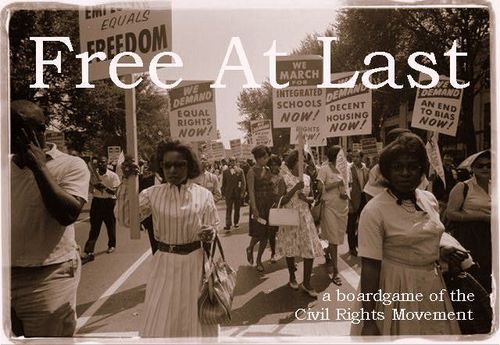
Free At Last
Free At Last Rulebook
Table of Contents
Table of Contents
2.0 Game board
2.1 States and cities. The game board shows the cities of the South where major events of the civil rights movement took place. The map is divided into ten states and there are two or three cities in each state. Washington DC is considered part of Virginia. The civil rights player has 3 goals in each city: (1) to integrate the schools, (2) to integrate public accommodations and (3) to secure the right to vote. At the start of the game all the cities' schools and public accommodations are segregated and voting rights are limited. When the civil rights player makes a protest he states the goal for his protest. If he wins the confrontation the goal is achieved and an integration marker is placed in the city. The S marker is for a successful school integration protest, an A marker is for a successful accommodations protest, and a V marker is for a successful voting rights protest. There can never be more than one S, one A and one V marker in a city.
2.2 Movement. Each city within a state is considered adjacent for purposes of movement. The segregationist leaders cannot lead confrontations outside their own state. Some civil rights leaders are national leaders and can move across state lines. The S and N units can also cross state lines, while the P, W and B units cannot.
2.3 Segregation Strongholds. Some cities are segregation strongholds. For example Birmingham is a 3 and Atlanta is a 1. If the civil rights player attempts a protest in one of these cities the city's stronghold factor is added to the segregationist player's defending units when making his confrontation die roll.
2.3.1 Destroying strongholds. If there are no segregationist player's units in a city with a stronghold defense factor and the civil rights player makes a successful protest in that city, the stronghold status is lost. Place a No Stronghold marker as a reminder that the city's stronghold defense factor will not be counted in future protests.
2.4 Freedom Track. The civil rights player keeps track of the protests he wins using the Freedom track. The marker is moved 1 space forward for every protest the civil rights player wins. There are also some events that allow the civil rights player to advance the Freedom Track.
2.5 Non-violence Commitment Track: The non-violence track is used to keep track of the level of commitment within the civil rights movement to the philosophy of non-violence. When the segregationist player wins a confrontation, the marker on the Non-violence commitment track is moved 1 space toward non-violence abandoned. The civil rights player can play his own event cards to restore the spirit to the movement. If the Non-violence track reaches Non-violence Abandoned at the end of any game turn, the segregationist player wins the game.
If the civil rights player wins a mass arrest confrontation (a confrontation initiated by the segregationist player) the civil rights player does not advance the Freedom track (unless he plays the "We Shall Overcome" event card). However, when the segregationist player wins a protest confrontation (a confrontation initiated by the civil rights player) the segregationist player does advance the Non-violence commitment track toward non-violence abandoned.
2.6 Freedom Events Track: Certain events score bonus victory points at the end of the game if the event is successful.
2.7 Year/Turn Track. The Year/Turn track is used to keep track of the game turn. Each game turn represents one year. The game begins in 1955 and ends in 1965.
3.0 Units
The game is played by placing units on the board, moving them and using them to engage in civil rights confrontations. Each unit has a number printed on it representing its strength in a confrontation. Units may be freely exchanged as necessary. For example a 5-factor B unit can be exchanged for five 1-factor B units at any time.
3.1 Segregationist player units
The segregationist player has three types of units, P units, W units and K units.
3.1.1 Police. The Segregationist player acts using P units, representing the state and local authorities that are responsible to maintain the system of segregation.
3.1.2. Whites. He also can recruit W units, which represent Citizens Councils and ordinary people who support segregation. When the Civil Rights player inflicts losses in a confrontation some of these W units will be eliminated, representing increased freedom in the city and lesser power and authority to maintain segregation. If all the W units in a city are gone and the civil rights player has a successful confrontation, P units must be taken as losses, representing segregationist politicians being voted out of office.
3.1.3 Ku Kluxers. Through an event card the segregationist player can also recruit K units, which represent radical segregationists that act outside the segregationist player's control. If a civil rights leader is activated in a state with a K unit, the K unit may attempt to attack the leader. If the attack is successful the leader is eliminated and removed from the game.
3.2 Civil Rights Player units
The civil rights player also has three types of units. Blacks, students and Northern whites.
3.2.1 Blacks. The civil rights player acts using B units, representing protestors who will engage in civil disobedience such as sit-ins at Whites-only lunch counters or freedom rides on buses using Whites-only areas in bus terminals.
3.2.2 Students. Through event cards the civil rights player can also recruit limited numbers of S units, representing SNCC students that can move across state lines to make protests.
3.2.3 Northern Whites. Certain events allow the civil rights player to place N units, representing Northern Whites coming to participate in protests. N units can move across state lines to participate in confrontations.
3.3 Stacking limits. There cannot be more than 10 units per side in a city. There is no limit to the number of leaders, but only one leader can lead or defend in a confrontation. If there are two leaders in a city during in a confrontation the player can choose who is leading his side.
4.0 Leaders
Each side has leaders that will direct the actions of their units.
4.1 Leader activation. Segregationist or civil rights leaders are activated to move or lead a confrontation by playing a strategy card for its Ops value. The first time a leader is activated for the year it costs 1 Ops to activate him. If the player wants to use the same leader a second time in the same year the second activation requires a 2 Ops value card. A third or subsequent activation in the same year would cost a 3 Ops value card.
4.2 Leadership rating and Force movement. Each leader is rated from 1 to 3. When a leader moves units that started in the same city can move with him. The leader's leadership rating is the limit of the number of units a leader can bring with him when he force moves.
4.3 Tactical rating. Each leader also has a tactical rating that reflects his ability to lead a confrontation. This tactical rating acts as a die roll modifier in any protest or arrest attacks. A leader with a 1 tactical rating gets a +1 drm to the confrontation roll.
4.4 Leader special abilities. Each leader has a special ability that he can use. These are found on the Leader special abilities chart. Some leader special abilities can be used only once per game, others only once per year and others can be used at any time.
[Source gap: the Leader special abilities chart referred to in 4.4 is not included in this document.]
5.0 Sequence of Play
Free at Last is played over a series of game turns, each representing one year. Each turn follows the following phases:
5.1 Deal strategy cards. Each player starts the year with 8 cards in his hand. Players are dealt enough cards to bring their hand total up to 8 cards.
5.2. Play strategy cards. Players alternate playing strategy cards from their hand, civil rights player first. If there is a confrontation players may play cards in their hand as confrontation cards. Players can take 6 actions per year, in addition to any confrontation cards they may have played. A player may always take a 1 Ops as an action without playing a card. If the player has cards remaining in his hand at the end of a year he can hold cards in his hand for the next year.
5.3. Check for victory. At the end of any year after 1959 the segregationist player wins if there are three states with no B units. Also the segregationist player wins if the non-violence marker is at the non-violence abandoned space. Otherwise play another year.
5.4. Hold election if election year. After the 1956, 1960 and 1964 game turns the political climate in the country may change based on the outcome of elections. Players can use their held card to support one of the candidates trying to swing the outcome of the election.
6.0 Strategy Cards
During each year the players take turns playing strategy cards from their hands. A player can use a card for 1 of 5 possible actions: (1) as a recruitment card to recruit additional units; (2) as an Ops card to activate a leader to move and direct a confrontation against the other player; (3) as an Ops to activate units for movement, but not for a confrontation; (4) as an event card to cause an event to take place; or, (5) as a confrontation card to improve the effectiveness of a confrontation.
6.1 Unit Recruitment. A player can use a strategy card to recruit additional units. The units are placed immediately on the board in any city.
| Ops value | Civil Rights units | Segregationist Units |
|---|---|---|
| 1 | 1B | 1W |
| 2 | 2B | 1W + 1P |
| 3 | 3B | 1W + 2P |
6.2 Leader activation. A player can play a strategy card as an Ops to activate a leader. The first time a leader is activated the player must use a 1 Ops value card or higher. The second time a leader is activated in the same year he must play a 2 Ops value card or higher. A third or subsequent activation of the same leader in the same year would require a 3 Ops value card. Once activated a leader can move to a new city and initiate a confrontation in that city. The leader can also initiate a confrontation while remaining in the same city. The leader can apply his tactical rating as a drm to the protest/arrest die roll. The segregationist leaders can only move within their own state. The Civil Rights leaders are either statewide leaders or national leaders. National leaders have unlimited movement. Statewide leaders have unlimited movement within their state.
6.3 City activation. A player can play a strategy card as an Ops to activate a number of cities equal to the Ops value of the card.
6.3.1 Movement. Each unit (not leaders) in an activated city can move to another city within its range of movement. P, B and W units can move to another city in the same state. S and N units have unlimited movement across state lines. K units do not move.
6.3.2 Entrenchment. Instead of moving the W units may attempt to entrench their political power in the city. If successful entrenched political power makes it more difficult for the civil rights player to win a confrontation in that city. W units that move from one activated city to another count toward an entrenchment attempt in the city they move to. The segregationist player declares which city he is trying to entrench and rolls a die. If the die roll is less than or equal to the number of W units in the city the entrenchment is successful. Place an E marker in the city. If there are no W units in a city, any E marker is immediately removed including in the midst of an extended confrontation.
6.4 Events. A player can play a strategy card as an event if the event is for his side. The Civil Rights player's events are red and the Segregationist player's events are blue. Either side can play an event that is black. When a card is played as an event the text is read and the effects of the card are applied immediately.
Occasionally event cards will allow a player to take special actions that are against the normal rules. In these cases the text of the event card takes priority over the rules. Events cannot take place before the year printed at the bottom of the card.
Once a red or blue card has been played as an event it is not placed in the discard pile but instead removed from the game. Black cards that are played as an event are placed in the shared deck discard pile and can be used again.
6.5 Confrontation cards. A player can play a strategy card during his turn after activating a leader for a protest or mass arrest, or in response to an attack by the other player. These confrontation cards give the player additional strength in the confrontation. A player keeps the confrontation card in front of him until he loses a confrontation, or until the end of the year. Then it is removed from the game. If there are equal losses in a confrontation then both sides are considered to have lost, and they lose their confrontation cards.
6.6 Held cards. A player can hold any number of cards instead of playing them. A player can also discard unplayed cards at the end of a year.
7.0 Confrontations
7.1 Sequence of confrontation. If a player uses a card to activate a leader the leader can direct an attack against the other player. When the Civil Rights player makes an attack it's called a protest. When the segregationist player makes an attack it's called a mass arrest. Each attack follows the following sequence:
- The attacker announces the city where he will attack. If the civil rights player is the attacker he announces the goal of the protest (school integration, desegregation of public accommodations, or the right to vote). If there is already a fr
[Source defect: step 1 is truncated in the source document after "If there is already a fr". The remainder of the sentence is not printed.]
-
Each player counts the number of factors he has in the city. All B units for the Civil Rights player and all P units for the Segregationist player located in the city participate in the attack. W units are not counted for calculating the attacking or defending factors, but may be taken as losses. K units do not participate in confrontations. If the segregationist player is the defender he counts the stronghold defense factor of the city where the attack is taking place and adds that to his total.
-
The attacker announces if he will attempt to affect the national media attention to the confrontation and if he will play any confrontation cards.
-
The defender then announces if he will play any confrontation cards.
-
There is a die roll for national media attention if necessary.
-
Each player rolls a die and adds to the die roll any die roll modifiers for any confrontation cards or political climate. Then he checks the result under the appropriate column on the Confrontation Results Table. The player who inflicted more losses is the winner of the confrontation.
-
Each player removes units to match his opponent's result on the CRT. The Segregationist player can remove W units before P units, but cannot remove K units as losses in a Confrontation.
-
If the civil rights player wins advance the Freedom Track marker one space and place an integration marker in the city. Place an S marker if it was a school integration protest. Place an A marker for a successful accommodations protest, and place a V marker for a successful right to vote protest. If the segregationist player wins move the Nonviolence track marker one space toward nonviolence abandoned.
[Source gap: the Confrontation Results Table (CRT) referred to in steps 6 and 7 is not included in this document.]
7.0.2 Confrontation cards. If the losing player played a confrontation card it is removed from the game. If the winning player played a confrontation card, he keeps it in front of him to use again until he loses a confrontation or the year turn ends at which time it is removed from the game. This includes confrontation cards that grant drms to confrontation rolls and media attention rolls. If the confrontation was a tie both players are considered to have lost and do not retain their confrontation cards.
7.1 Confrontation Column shifts
7.1.1. National Media. Before making an attack the attacking player may roll a die to determine national media attention to the attack. The default is normal media attention. If the player rolls a 1 or 2 there is low media attention, and if he rolls a 5 or 6 there is high media attention. If there is high media attention to the confrontation the power of the civil rights player shifts one column to the right and the power of the segregationist player shifts one column to the left. If there is low media attention the power of the segregationist player shifts one column to the right and the power of the civil rights player shifts one column to the left.
7.1.2. Entrenchment. When the segregationist player plays an Ops to activate units the W units can attempt to entrench themselves politically in the city instead of moving to another city. The entrenchment represents school board officials, local sheriffs or election officials that will act to defend segregation. The player declares which city he is trying to entrench and rolls a die. If the die roll is less than or equal to the number of W units in the city the entrenchment is successful. If the civil rights player makes a protest attack in that city the power of the segregationist player is shifted one column to the right and the power of the civil rights player is shifted 1 column to the left.
7.1.3. Removing entrenchments. If all W units are removed in a city the entrenchment markers are immediately removed. This may occur during a confrontation if it is extended. The Segregationist player may choose to take P units as losses and keep a W unit in the city to avoid losing his entrenched political power.
7.2 Avoiding a confrontation
7.2.1 Avoiding confrontation. After the confrontation has been declared but before confrontation cards have been played or the dice have been rolled the defending player can attempt to avoid the confrontation. To avoid a confrontation the player must have a leader in the city. Roll a die. If it is less than or equal to the leader's leadership rating he succeeds in avoiding the confrontation. The defender can remove his units and leader to another city in the state.
7.2.2. Consequence of successfully avoiding confrontation. If the civil rights player was the attacker place a marker as though he won the confrontation but do not advance the Freedom track. If the segregationist player was the attacker move the Nonviolence commitment track 1 space toward non-violence abandoned. Neither side loses any units.
7.2.2. Consequence of attempting but failing to avoid confrontation. If a player attempts to avoid confrontation but fails, his power shifts one column to the left, and the attacker shifts one column to the right on the CRT in the confrontation die roll.
[Source note: the section number 7.2.2 is printed twice in the source; both are transcribed as printed.]
8.0 Elections
8.1 Procedure. At the end of the 1956, 1960 and 1964 game turns the players conduct an election. Each candidate has a popularity rating reflecting the likelihood that he will win the election. If a player has a held card he can play it, and the Ops value of the card acts as a drm in the election die roll for the candidate he supports. Players place their card face down and reveal them simultaneously. Roll a die for each candidate and add his popularity rating to the die roll. The candidate with the higher total wins the election. In case of a tie roll again. Players then adjust the political climate to reflect the results of the election.
8.2 Effect on political climate. Each candidate is rated and these ratings become a drm to the civil rights player's protest rolls used in confrontations until the next election. The S rating reflects the candidate's willingness to send federal troops to enforce school integration. The A rating reflects the candidate's appointments of federal judges to grant injunctions or intervene to protect or stop protest marches for equal access to public accommodations. The V rating reflects the candidate's ability to push legislation through Congress to support the right to vote.
9.0 Leader elimination
K units are groups of radical segregationists that operate in certain states. K units do not move, but they can attack in any city within their state. If a civil rights leader leads a protest in a state with a K unit, and the leader rolls an original 6 (before any modifiers are applied) the leader may be eliminated. Roll again and if the leader rolls another 6 he is eliminated from the game.
A leader elimination attempt means the Klan is active in the state. If the leader is not eliminated, add another K unit to the state. Every additional K unit after the first unit acts as a modifier to the elimination die roll, so that if there are 2 K units in the state then on the next leader elimination attempt the leader will be eliminated on a 5 or a 6.
10.0 Free Cities
10.0.1 Free City defined. If the civil rights player has placed all three markers in a city then that city is considered a free city. The segregationist player cannot make arrests in free cities as these cities now protect civil rights. Free cities give the civil rights player a reward. Some cities allow the civil rights player to place additional B units. These units are placed immediately in any city. Other cities allow the civil rights player to add +1 or +2 to the Ops value of a played card, or draw 1 or 2 additional cards. These may be used any time. The cities in Alabama advance the Freedom Track and the cities in Mississippi increase the commitment to Non-violence.
Victory Conditions
If at the end of any year after 1959 the Segregationist has eliminated the civil rights movement in 3 states he has won the game. Also if the Non-violence track is at Non-violence abandoned at the end of any year the segregationist has won the game. Otherwise continue play for another year. The game automatically ends after the 1965 game turn. At the end of the game the civil rights player totals his points.
10.1 Freedom Track/ Non-violence Commitment Track. The civil rights player scores points equal to the space he advanced to on the Freedom Track. The Non-violence commitment track does not affect the final score as long as the civil rights movement has not abandoned non-violence.
10.2 Freedom Events Track. The civil rights player scores points for every successful event on the Freedom Event track according to the chart below. If the civil rights player fails to accomplish any Freedom Track events he scores -10. The requirements for the events are as follows:
10.2.1 Montgomery Bus Boycott successful. Play Rosa Parks or King Takes Command as an event and win an accommodations protest in Montgomery.
10.2.2 Little Rock Central High integrated. Play the Little Rock Nine as an event and win a school integration protest in Little Rock.
10.2.3 Greensboro Lunch Counters integrated. Play Greensboro Sit Ins as an event and win an accommodations protest in Greensboro.
10.2.4 Ole Miss integrated. Play James Meredith as an event and win a school integration protest in Oxford.
10.2.5 March on Washington successful. Play March on Washington as an event card and win a voting rights protest in Georgia, Louisiana, South Carolina or Florida.
10.2.6 Civil Rights Act adopted. Play Civil Rights Act Proposed as an event card and win an accommodations protest in Alabama.
10.2.7 Voting Rights Act adopted. Play Voting Rights Act Proposed as an event card and win a voting rights protest in Mississippi.
10.3 Victory. If the Civil Rights player scores 40 or more points it is a decisive victory. 36 or more points is a marginal victory. 35-32 points is a marginal segregationist victory and 31 or below is a decisive segregationist victory.
Freedom Track Events Bonus Points
| Events | Bonus points |
|---|---|
| 0 events | -10 |
| 1 event | 0 |
| 2 events | 1 |
| 3 events | 3 |
| 4 events | 6 |
| 5 events | 10 |
| 6 events | 15 |
| 7 events | 21 |