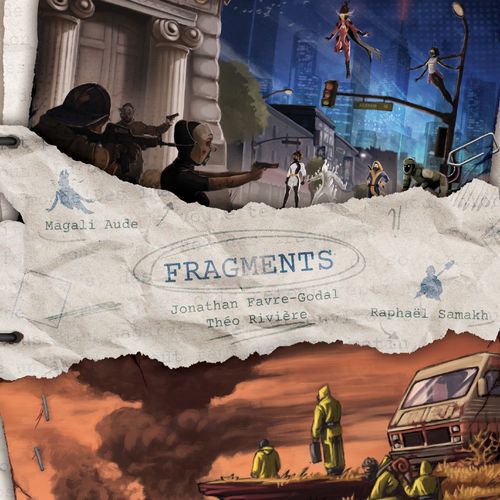
Fragments
Fragments Rulebook
Table of Contents
Table of Contents
Prologue
Flip the chosen Theme card and read it out loud. Together, agree on the words to fill in the blanks.
In turn, read your character card out loud, filling in the blanks as you wish.
Example of a game start
1 year ago the dead started rising from their graves. Institutions as we knew them were overthrown as the zombies invaded the world. We gathered 10 people and we created together a community in a camp away from the cities in the Vercors.
Many choices are possible. For the temporality, they could have chosen: 20 minutes, 10 years, a generation, etc.
My name is Valeriane, I am 50 years old. I own a bag full of trinkets from my previous life. Or I own a strong temperament that allows me to impose myself as a natural leader for this community.
The Story Begins
The person who starts the game is the last one who had a feeling of déjà-vu. Then, in turn, clockwise, each storyteller plays.
To play consists in drawing a Word card and telling a fragment of the story inspired by the word that was just revealed: a feeling, an action, a place description, the description of an action done by your character or by a secondary character… The only limit is your imagination.
Then, it is the turn of the next person to draw a Word card and tell a fragment of the story.
Positive and Negative Effects
When you draw a Word card, you reveal the back of the next card in the deck of cards. If the symbol on the back of the card on the top of the deck matches one of the two icons at the bottom of the drawn card, you must tell a fragment of the story while observing:
- A positive outcome if the symbol matches the icon (thumbs-up icon).
- A negative outcome if the symbol matches the icon (thumbs-down icon).
If the match symbol-icon indicates a positive outcome, you can let a secondary character (who is not played by a storyteller) die if the outcome has positive consequences on the story of the whole team.
If the match symbol-icon indicates a negative outcome, you can also imagine the death of a secondary character if the consequences are negative. You can also imagine a fragment of story in which the food supply of the community became spoiled and the negative impact it had on the mood of the group. The word is just a guide for your story.
Example: Théo draws the Word card "DEATH". The symbols on the back of the top card of the deck match the icon of a positive outcome or of a negative outcome; the storyteller follows that outcome as described above.
If there is no match symbol-icon, you choose the outcome of your fragment of the story.
Special Cards
The "AND NOW?" card
When the card "AND NOW?" is drawn, the game is paused. Each may speak. Assess your adventure, summarize it briefly and define, together, the direction that the second part of the adventure will take.
When this has been done, the storyteller who drew the "AND NOW?" card discards it, draws a Word card and the game goes on.
Example: Élodie says: "We have discovered that we could not trust the elders of the community and I think we have to keep looking for answers about what happened before we were born". Jonathan adds: "I agree, we must find proof of life of those aliens, otherwise our lives away from the cities, supposedly destroyed, is pointless". Théo goes on: "Let's leave our community to go to the closest city; I am sure we will find some answers there".
The "THE END IS NEAR" card
When the card "THE END IS NEAR" is drawn, that means that everyone plays one last time to try and conclude the story. The person that draws this card discards it, then draws a new Word card and plays as usual.
Once all the storytellers have played their last turn, and the "END" card is revealed in the centre of the table, the game is over.
The X Card
"The people here are more important than the game"
At any time during the game, if a person does not feel at ease with the content of a scene or the Word card drawn, they can touch the X card. The scene then stops without any further discussion and the Word card is discarded. The next person plays his or her turn as usual.
The X card is freely inspired from the X-card from John Stavropoulos.
The Vote Card
At any time, during a scene, if a person thinks that a vote from the group is required, he or she can touch the Vote card. The scene is then put on stand-by to organise this vote. The scene can then be resumed.
Example: Jonathan wishes the group to attack the city of New York as soon as possible despite the presence of the Saviours. Valériane touches the "Vote" card. Jonathan finishes his sentence and then lets her speak. Valériane explains that she finds this action dangerous and states her arguments. Then, Jonathan and the other storytellers do the same and a vote by show of hands is held to decide, whether or not, the group will launch their attack tonight despite the threat present.
The Participation Card
At any time, during a scene, if a person wishes to, he or she can touch the Participation card. When the person, whose turn it currently is, has finished his or her story fragment, the person who touched the Participation card can then:
- Further clarify a bit of the story, make an action with his or her character at the same time as the bit that was just told, etc.
Exceptionally, if a person is blocked by a Word card, but wishes anyway to continue the narration, he or she can ask for help by touching the Participation card. Another storyteller can then participate in this fragment to provide some inspiration.
Campaign Mode: Multiple Fragments
If you want, you can link in several games of Fragments with the same group or a different one. A game can follow up the story of a previous adventure in the same universe or you can embody the same characters in a different universe.
Anyhow, a campaign sheet will let you keep track of your characters and adventures throughout 4 games. Thematically, in Fragments, you have the possibility to go from one universe to another keeping in mind more or less elements from your previous adventures. This sheet can be downloaded from the publisher's website: https://grrre-games.com/home.
End of the Game
You made it to the end of the story, congratulations! We hope that you have enjoyed your immersion within this universe you created from scratch using your collective imagination. Do not wait to venture, once again, into the unknown.
Notes & Tips
-
If you worry you may forget the characteristics of your character, you may write them down on a piece of paper. However, these characteristics are here to shape the temperament, the psychological and moral profile of your character, so it is not an issue if you miss a small part of it.
For instance, your character would not act the same way if he is 45 years old and always carries a machete with him than if he is 8 years old always carrying his flashlight as he is afraid of the dark. You may take some liberties within the creation of your character, add more details, enhance his or her description or simply stick to the cards propositions.
-
It is interesting to create secondary characters within your game's group or community (not embodied by any storytellers). Thanks to these, you will be able to make them do things, have more elaborated interactions, and, furthermore, add depth to your story. They will act when you want, be extremely present or, on the contrary, be very discreet.
-
Bounce back on the ideas of each storyteller without going backwards if the story does not go where you thought it would in the first place. This is the best way to live a unique adventure.
The themes and illustrations are there to guide your story and also to inspire you. You may take all the liberties you want to get rid of them. Have fun and enjoy yourself.
Through the many game tests that were done, it happened quite often that the main story went astray much to our enjoyment. For instance, during a game "An alien encounter", our group was living one generation after an alien invasion, away from the cities in ruins. As the game went on and intriguing events happened, we went looking for the cause: an unknown disease that had transformed a part of the population. There never were any aliens. It was only a story that was told so that we would remain secluded in our isolated community.
-
Whatever the beginning, wherever you are heading, just follow the flow of your imagination. It may be difficult in the beginning to invent a little piece of story. Thematically, that can be explained by the memorial confusion or the Jump sickness. Tell yourself that each Jump projects you into an unknown universe with its own codes. It is possible that you may have a hard time describing it or interacting with it. Let yourself be guided by the descriptions and actions of the other storytellers, as the game carries on, the discomfort will fade away. Be simple at first: one sentence, a quick description… and gradually, your imagination will find its strengths!