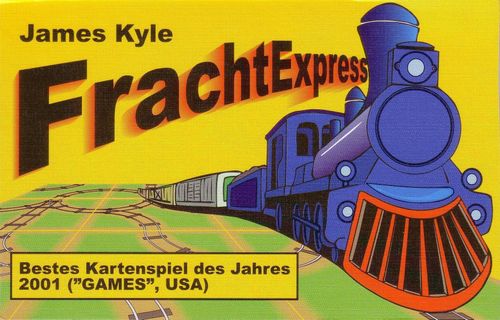
FrachtExpress
FrachtExpress Rulebook
Table of Contents
Table of Contents
Contents
50 Distance Cards 10 Stations (labeled A-J) 4 Locomotive cards 4 Objection cards (Einspruch) 2 Flight Tickets (Flugticket) 4 Small wooden locomotives
The 70 game cards are all the same size, but can be distinguished by the design on the back in addition to the different fronts.
Rules For The Basic Game
For the Basic Game the 4 Objection (Einspruch!) and 2 Flight Ticket (Flugticket) cards are not used.
Preparation
Each player takes a Locomotive card and the small wooden locomotive that matches the card color. Each Locomotive card has an outline of the Actions players can take on their turn. A replacement card is included at the end of these rules.
The 10 station cards are labeled A through J. The stations are laid out on the table face up according to the pattern in the rulebook. The dashed lines indicate where distance cards will be played during the course of the game to complete routes to the various stations. The wooden locomotives will drive on the tracks, picking up and dropping off freight cars.
All players start by placing their locomotives on station A, labeled “Start”. The words on the other stations are different events that happen when players arrive there in the advanced game, and have no significance in the basic game.
The Distance Cards
The 50 distance cards have multiple uses in the game. Besides showing the train tracks which the locomotives will drive on, they show 4 symbols in each of the 4 corners:
a) A railroad car with a value of 2 through 9. The main goal of the game is to collect cards with the highest possible total values. Additionally, this number is used to determine the distance a locomotive may travel on its turn. In this instance, usually, higher values are better than lower.
b) The symbol for “couple” (to the right below the railroad car, the symbol shows two lines joined together). The symbol also contains a letter, which refers to a specific station.
c) The symbol for “uncoupling” (to the left below the railroad car, the symbol shows two lines separated slightly). The symbol also contains a letter, which refers to a specific station.
d) An action number between 1 and 5, shown as the face of a 6-sided die. This has different meanings during the game. A high action number is always better than a lower one, however.
The Distance Cards are carefully shuffled. Each player receives 3 cards face down. The remainder of the cards become the draw pile face down on the table.
Players mutually agree on who should play first, and the game begins. The player whose turn it is will be called the Active Player in the rules for clarity.
The Game
Play proceeds clockwise around the table after the first player has completed his turn.
First, the Active Player draws a distance card and adds it to their hand. Then, he may execute one or more of the following actions, in any number and in any order (except action 6). Most of these actions involve playing cards from one’s hand, which limits the actual play possibilities somewhat.
Actions During a Turn
-
Extend the Rail System The Active Player plays one distance card face up from his hand onto an open space on the playing area. This card must attach on one edge to a card already played, i.e. beside a station card or next to another distance card that was previously played. The Active Player may turn the card any direction he wishes to direct the route of the tracks.
-
Change the Rail System The Active Player plays one distance card face up from his hand onto a distance card already played in the playing area. This is governed by the following limitations: First, no locomotive may be on the card to be covered. Second, the new card must contain the all rail lines of the old card and these must be in the same orientation on the new card as on the card being covered. Additional rail lines MAY be printed on the new card. See examples in the German rule book.
Of the three examples in the rule book, only the example on the left is allowed. In the middle example the new card is not oriented the same as the card to be covered. In the right example a locomotive token is on the card to be covered. -
Pick up a Railroad Car The Active Player may pick up a Railroad car when his locomotive token is located in the station matching the letter in the “couple” symbol on a card in his hand. When his locomotive token is in the correct station, the Active Player plays one of his cards with the corner overlapping his locomotive card so that the numbered railroad car is visible. If one or more cards are already connected to his locomotive card, simply overlap them slightly. In this way the all the values of the attached cars and the destination stations of the attached cars will be visible throughout the game. It is important to note that no more than 5 cars may be attached to a locomotive card at any time, and to note that it becomes more difficult to move a locomotive token as more cars are attached to it.
-
Deliver a Railroad Car The Active Player may deliver (uncouple) an attached railroad car when his locomotive token is located in the station matching the “uncouple” symbol on the attached car. It does not matter in which order the cars are attached to the locomotive card. Once arriving in a station, the Active Player may disconnect any car attached to his locomotive card that has an uncouple symbol matching the letter of the station. The delivered car is taken from the locomotive card (removed from a group of cards if applicable), and placed face down under the locomotive card. Once delivered, no player may look at the values of the delivered cars, not even the player owning the cars.
Additional Movement Rules
The action number of the card played must be at least as large as the number of railroad cars currently attached to the player’s locomotive. Therefore, a player may never have more than 5 railroad cars attached to his locomotive card because the highest action number on any card is 5. At switches the player decides which direction he wishes to travel. Under no circumstances may a locomotive token move backwards. A station counts as an individual move. When a locomotive token arrives at a station, all additional movement points are spent. This does not end the player’s turn, however. He may leave the station on the same turn he arrives by playing another distance card. There is no limit on the number of locomotive tokens that may be located in a station. A player may travel in any direction he wishes out of a station, even back the way he came. If a locomotive token meets another player’s token on the tracks, it rams the other player’s token. The other player’s token is pushed ahead of the active player’s token. The Active Player continues his move and moves the other token ahead of his so that it comes to rest one railroad tie past his token at the end of his movement. If he passes a switch, he may push the other locomotive any direction he chooses, even in a direction the other player does not want to move. In this case the pushed locomotive token stops on the first railroad tie past the switch. A locomotive may be pushed into a station, however it can not be pushed out of a station. Upon reaching the station, movement of the rammed token ends.
Derail
In rare cases a locomotive token may be moved beyond the last distance card played, and have to move into an empty space. If this happens, the owner of the locomotive must discard his entire hand of cards, must also discard all of his attached railroad cars, and places his locomotive token in Station A (“Start”).
- Draw New Cards The Active Player discards any card from his hand face up to the discard pile. He then draws cards from the supply deck. The number of cards drawn is equal to the action number on the discarded card (1 to 5 cards). The Active Player may take this action only once per turn, and taking this action automatically ends his turn. The Active Player may end his turn without taking this action by announcing that he has completed his turn.
Play then proceeds to clockwise to the next player at the table.
The 5 Crossings
5 of the 50 distance cards are “crossings” The following rules apply to these cards: A crossing card can only be put in an open space on the board, it can never cover another card. A crossing card can never be covered by another card. Locomotive tokens can not “turn” on a crossing, they must travel straight through. In the center of each crossing card is the symbol for the supply deck. Each time a player crosses the center of a crossing with his locomotive token, he must draw the top card of the supply deck. This card is then discarded. The player compares the action number on the drawn card with the number of railroad cars attached to his locomotive card. In order to cross the crossing the number of attached railroad cars must be equal to or less than the action number of the drawn card. If the player has more cars attached to his locomotive card than the action number on the drawn card, he must discard attached cars of his choice until the number of cars attached to his locomotive card is equal to the action number on the card drawn.
End of the Game
When the supply deck is completely empty the discard pile is shuffled and becomes the new supply deck. It is important to wait until a card is needed from the supply deck before shuffling, so that any cards played by players are included in the shuffled discards.
The game ends immediately when any player must draw a card for any reason and both the supply deck and the discard pile are empty.
At this time all players uncover their delivered railroad cars and add up the total value in the railroad car symbol on his cards. The player with the highest sum total wins the game. If this value is tied, compare the total value of the railroad cars attached to the tied players locomotive cards. The highest value wins the game.
It is recommended that players play the Basic Game at least once in order to learn the game system before trying the Advanced Game.
Advanced Game Rules
For the Advanced Game, place the two Flight Ticket (Flugticket) cards and four Objection (Einspruch!) cards beside the play area. The special actions of the stations now come into play.
Every time the Active Player moves his locomotive into a station he may choose to use the special action of the station. He must decide this before making any other actions on his turn, and must carry out the special action of the station immediately.
If a player's locomotive is pushed into a station by another player, the "pushed" player may not use the special action of the station.
With some special actions the top card of the supply deck is turned over. This card is immediately placed on the discard pile.
The Special Actions
Station A—Start
There is no special action associated with Station A. It is simply the start station at the beginning of the game and if any locomotive derails during the game.
Station B—Flight Ticket
The Active Player may take a Fight Ticket card upon arriving in Station B if one is available at the side of the play area and if the player does not already have a flight ticket in his possession.
Using a Flight Ticket
A Flight Ticket allows the Active Player to pick up his locomotive token and move it to another distance card, bypassing empty places (spaces where cards have not yet been played). Both the departure and the destination card must be in the same horizontal or vertical row in order to make the flight. There can be no distance cards played between the departure and destination card. The locomotive token "lands" on the destination card on the railroad tie closest to the departure card. In order to make the flight the Active Player must play a distance card with an action number exactly matching the number of open spaces flown over, and must play a Flight Ticket card. (The Flight Ticket card is then available for another player to draw should they arrive in Station B).
Station C—Card Robbery
The Active Player selects another player and then turns over the top card of the supply deck. The selected player must give the Active Player all of his cards which have an action number matching the action number of the card turned over. If the selected player has no cards with a matching action number, he must allow the Active Player to inspect his cards to prove this. Then the Active Player must give the selected player all of his cards with this action number (and must show his hand to the selected player if none match). If neither player has any cards which match this action number, no cards change hands as a result of this action.
Station D—Station Closing
The Active Player plays one of his cards face up over one of the stations. This station is immediately closed and locomotive tokens cannot enter it The tracks on the card covering the station are used as a normal part of the rail system, but the card can be removed under certain circumstances.
Rules for Closing a station
A station may only be closed if it is attached to the rail system, that is, if at least one distance card has already been played which connects the station to other stations or track. Additionally, there can not be a locomotive in the station to be closed. Only one station may be closed at a time. If a player lands in station D when a station is closed and wishes to close a different station, the station that is currently closed is reopened. All distance cards on the closed station are removed and placed in the discard pile. The Active Player then plays a distance card onto a different station to close it. A station can not be reopened when a locomotive token is on the distance card covering it.
Station E—Group Card Robbery
The Active Player draws one card a time from the hand of any player he chooses. He continues to do this until he has more cards than every other player. He then must play all the cards in his hand this turn or discard them. He may not take action 6 this turn, discard and draw cards equal to the action number on a discarded card.
Station F—Rapid Delivery
The Active Player may attempt to use the special action of this station to complete a rapid delivery. To complete a rapid delivery, turn over the top card of the supply deck. If at least one railroad car attached to the Active Player's locomotive card has an action number that exactly matches the action number on the card turned over, he may disconnect one of these cards and turn it face down under his locomotive card as if he had arrived in the destination station for that card. If he does not have a car with a matching action number, he must disconnect one car from his locomotive card and discard it to the discard pile.
Station G—Objection Card
If the Rapid has no Objection Card (Einspruch!) he may take one immediately upon arriving in Station F. A player may influence the special actions of another player by playing an Objection Card. If another player enters a Station, any player may prevent that player from carrying out the special action of that station by discarding an Objection Card. A player may only have one Objection card in his possession at any time. This objection can not be overruled. Playing an Objection card (or a Flight Ticket) is not considered the special action of a station, and can not be prevented with Objection cards! Also, a player can not force the Active Player to choose a specific target of card robbery by threatening to play an objection card unless the Active Player chooses a specific player. The action is either prevented or not before the Active Player announces his target.
Station H—Route Change
The Active Player plays one card from his hand to the table. He may then choose one unoccupied card in the existing rails system with an action number that matches the discarded card and move it. The card may be rotated or moved anywhere, following the rules for laying distance cards.
A previously closed station may be reopened by moving the distance card on top of it through this special action. The Active Player may repeat this special action as often as he wishes, discarding a card from his hand for each card on the board he rotates or moves.
Station I—Rapid Pick Up
If the Active Player has 4 or less cars attached to his locomotive card, he may attempt to add a car to his locomotive without being in the appropriate station. The Active Player turns over the top card of the supply deck. If he has a card in his hand with an action number that matches that on the card turned over, he may add it to his locomotive as if he were in the corresponding station. If he does not have a card with a matching action number, he must discard any card from his hand into the discard pile. Important: If the card attached to a locomotive card with this special action has Station I as its destination station, the Active Player may not immediately deliver this card, but must first leave this station.
Station J—Railroad Car Robbery
If the Active Player has no more than 4 cars attached to his locomotive card, he may attempt a Railroad Car Robbery. The Active Player selects a target player and then turns over the top card of the supply deck. The target player must give the Active Player one of the train cars attached to his locomotive card that has an action number matching that on the card turned over. If there are more than one cars attached with a matching number, the Active Player may choose which one he wishes to steal. The stolen car is attached to the Active Player ‘s locomotive card. If there is no card with a matching action number attached to the target player's locomotive card, the Active Player must give the target player a car from his own train with a matching action number if he has one. No player may steal more than one card at a time when executing this special action, and no player may have more than 5 cars attached to his locomotive card.
Variants
FrachtExpress is an open game system. Feel free to experiment with the special actions of the stations and invent new ones.
Suggested Variant Station Special Action: Hijack The Active Player may move another player's locomotive by discarding a card and moving any locomotive the number of spaces matching the action number on the discarded card. However, the locomotive token must be on a distance card in order to be moved by another player, not in a station. It is also forbidden to derail another player's locomotive.
Other variations: Feel free to modify or change the initial arrangement of the station cards at the start of the game. One suggested arrangement is pictured in the German rulebook. Another idea is to mix the station cards face down and deal them out to the players (it doesn't matter if they are not evenly distributed). Players then take turns placing individual stations in any way desired, as long as each station attaches diagonally to at least one other station.
Quick Reference Card
The following can be used as a quick reference card. It summarizes the actions a player may take on his turn.
Actions During a Turn (Summary)
-
Extend the Rail System. Add one or more distance cards to the play area. At least one edge must be aligned with a previously played card.
-
Add to the Rail System. Add a new distance card on top of an already played distance card. All tracks on the previously played card must be present on the new card.
-
Pick up a Railroad Car. Add a distance card from your hand to your locomotive card if the letter on the card in the “couple” symbol matches the letter of the station your locomotive token is currently in. Align the distance card so the railroad car symbol is facing upwards. You may have up to 5 cars attached to your locomotive card.
-
Deliver a Railroad Car. Remove any railroad car from your locomotive card if the letter on the “uncouple” symbol on the card matches the letter of the station your locomotive token is currently in. Put the card face down under you locomotive card.
-
Move the Locomotive Token. Discard a distance card from your hand. Move your locomotive token the number of railroad ties equal to the number of the railroad car on the card discarded. Action number of the card discarded must equal or exceed the number of railroad cars currently attached to your locomotive card.
-
Draw New Cards. Discard a distance card from you hand. Draw new cards from the supply deck equal to the action number of the discarded card.
Station Effects
A—Start B—Flight Ticket C—Card Robbery D—Station Closing E—Group Card Robbery F—Rapid Delivery G—Objection Card H—Route Change I—Rapid Pick Up J—Railroad Car Robbery