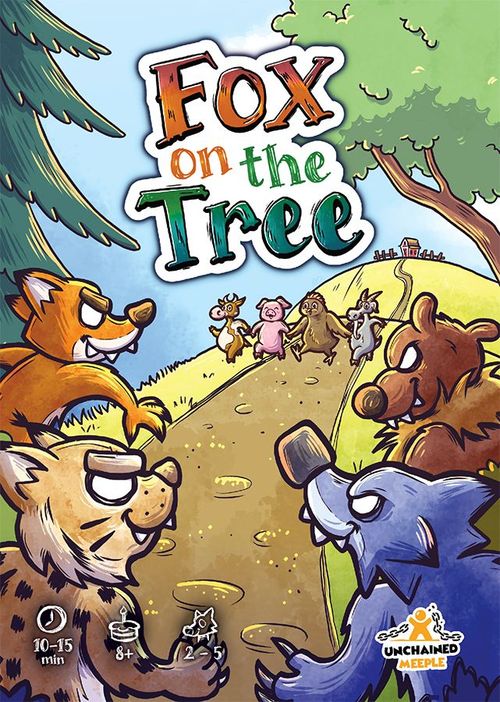
Fox on the Tree
Fox on the Tree Rulebook
Table of Contents
Table of Contents
Game Objective
In Fox on the Tree, you act as one of the unseen forces shaping a tangled storyline. Each player keeps a secret card showing two animals they want to succeed and one they want to see fail. To win, guide your favorites to their destination and make sure your unfavored one doesn't get far. Use your action tokens to block movement, force retreats, or set clever traps. Observe how others play, uncover their hidden loyalties, and outsmart them before they do the same to you.
Game Setup
Each player
- Draw 1 card from the shuffled deck, look at the card, and keep it secret from the other players for the entire game. This is your Card of un/favorite animals (see below).
- Take 3 action tokens - 1 Escape token, 1 Swamp token, and 1 Banana Peel token. Place them in front of you on the table.
In the middle of the table
- Lay out all 10 square tiles in a row with small gaps between the tiles: Farm → 8 Path tiles → Lair of Predators.
- Place all 4 farm animal standees on the Farm.
- Place all 4 predator standees in the Lair of Predators.
- Place the scoring track next to the game board tiles.
- Place all 8 animal tokens near the scoring track.
The Card of un/favorite animals
Each card shows 3 animals. Two of them are the player's favorites, which the player wants to succeed – these bring positive points at the end of the game. The third animal (crossed out) is disliked and will bring negative points – the player tries to eliminate it quickly.
Game Flow
The game consists of two main phases: In the First Phase, the farm animals try to reach the Lair of Predators, while predators try to reach the Farm. In the Second Phase, the movement is reversed. Once the game is set up, the First Phase begins. The starting player is the person who was last alone in a dark forest.
First Phase
Player's Turn
Use an action token
(see what each token does in the reference list on the last page)
At the beginning of your turn, you may use one action token according to these rules.
- Banana Peel token: Place it on a Path tile where there is no token or animal.
- Swamp token: Place it on a Path tile where there is no token (animals can be there).
- Escape token: Return any one animal from any Path tile to its starting tile and discard the Escape token.
Example: You can place a Banana Peel token OR a Swamp token on these tiles only.
Now choose either A) or B):
A) Perform a Swamp Rescue
Remove a Swamp token from a tile that has at least one animal on it. Discard the removed token.
Note: If no Swamp tokens can be removed this way, you have to move one animal instead.
B) Move one animal
Pick any animal from a tile that contains no swamp token and move that animal using either its basic or special move.
Note: If all the animals are stuck in Swamps, you'll have to perform a Swamp Rescue instead.
There can be up to 4 animals of the same "team" (farm / predators) on any tile. All animals can move forward only – farm animals towards the Lair of Predators and predators towards the Farm using the movement options below.
Farm animal:
-
Basic move: move a farm animal by 1 tile.
-
Special move – Dodge: Move a farm animal by bypassing a continuous row of any animals (at least one) that starts on the following tile. End the move either on a tile in the row with at least one other farm animal on it or on the first tile past the row.
Note: You can use the move even if there are some animals on the previous tile (as you can see in the example on the next page). If you can't end the move by following the rules above, Dodge cannot be used.
Predator:
- Basic move: move a predator by 1 tile.
- Special move – Jump: Move a predator by 2 tiles. You skip the middle tile this way (regardless of what's on it).
If the animal ends its move on a tile with a Banana Peel token, immediately move the animal 1 tile further. Then, discard the Banana Peel token.
Note: If Banana Peels are placed on several tiles in a row, a chain reaction happens - resolve their effects one by one.
In GREEN are some examples of basic moves, in RED are the special ones. See that the cow can end the Dodge move either on a friendly tile or just past the row of animals. If it ends the move just past the row, it moves two more tiles because of the chain reaction of the two Banana Peels.
After the move is done, resolve any occurring conflict between animals.
Resolving a conflict
A conflict occurs when farm animals and predators are on the same tile.
Conflict 1 vs 1: The farm animal wins if there is at least one other farm animal on the previous tile (from the direction the farm animals go). Otherwise the predator wins.
Conflict 1 vs many: The lone animal loses.
The losing animal is eliminated - take its standee off the board and place the corresponding token by the lowest unoccupied scoring track number.
Example: 1 vs many – More farm animals than predators - the wolf loses.
Example: 1 vs 1 – The farm animal is supported by another one directly behind it - the wolf loses.
The Escape
The moment an animal is to be eliminated, any player that is NOT on their turn can use their Escape token to return that animal to its starting tile instead. Then discard the Escape token.
Note: The Escape token cannot be used if the animal is still on its starting tile when being eliminated.
Reaching the final tile
When an animal reaches the final tile and there are still some other animals there, immediately resolve the conflict between them. If the newly arrived animal wins, or there is no conflict, the animal has successfully reached its destination. Set its standee aside and place the corresponding token by the highest unoccupied scoring track number.
Example: Scoring points after a conflict on a final tile.
Once you've either A) Performed a Swamp Rescue or B) Moved one animal, it is now the turn of the player to your left.
End of the First Phase
The First Phase of the game ends when all animals have either reached their destination or have been eliminated.
Second Phase
Setup
- Keep the animal tokens by the scoring track.
- The action tokens used in the First Phase remain out of the game.
- Action tokens that are still placed on Path tiles stay in place.
- Place all the predator standees on the Farm and all the farm animal standees on the Lair of Predators.
Rule changes for the second phase
- Farm animals move towards the Farm.
- Predators move towards the Lair of Predators.
- When an animal is eliminated, place its standee by the scoring track instead of a token. Note: Keep the tokens from the First Phase where they are and place the standees in a "second circle" outside the already placed tokens (see the diagram).
- The starting player in the Second Phase is the last player who took a turn in the First Phase.
Example: Placing standees by the scoring track in the Second Phase. Also a reference for the endgame scoring (explained on the next page).
End of the Game
The game ends when all the animals have either reached their destination or have been eliminated in the Second Phase. Each player adds up all the points they've earned for their two favourite animals and substracts all the points they've earned for the unpopular one. The player with the most points wins. In case of a tie, the player who has more tokens left wins. If there still is a tie, victory is shared.
Example: You favored a wolf (8 points in the First Phase and 6 points in the Second) and a pig (4 and 2 points). You unfavored a chicken (1 and 5 points). So you acquired 20 positive points for your favored ones and 6 negative points for the chicken. Your final score is 14 points.
Action Tokens – a quick summary
Banana Peel
Place it on a Path tile where there is no other token or animal.
When an animal ends its move on a tile with this token, move the animal by 1 more tile.
Swamp
Place it on a Path tile where there is no other token.
Nobody can move any animal from this tile while the Swamp token is there.
Escape
At the beginning of your turn: Return any one animal from any Path tile back to start.
During the other player's turn: Return the animal that is being eliminated back to start.