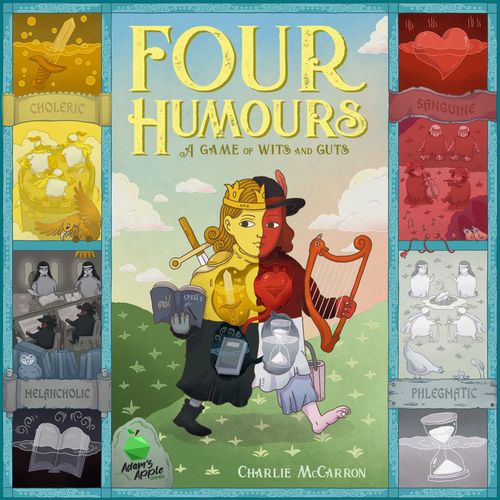
Four Humours
Four Humours Rulebook
Table of Contents
Table of Contents
- Getting Started
- Personality Potions, Inspired by the Four Humours
- Components
- Citizens of the Kingdom
- Setup - Kingdom Mode
- Setup - Fiefdom Mode
- Overview - Claim Your Medical Fame
- 1. Visit Citizens
- 2. Resolve Potions
- 3. Round Cleanup
- Examples of Winning a Scene
- Examples of Winning a Bestiary Scene
- Completing Objectives and Party Tiles
- Game Ending Conditions
- Frequently Asked Questions
- Fiefdom Mode - Specific Rule Differences
- Solo Mode (Fiefdom Only)
Getting Started
Four Humours can be played with Kingdom Mode or Fiefdom Mode. The rulebook is written firstly for Kingdom mode.
Once you master Kingdom mode, Fiefdom mode retests the skills you've learned with a couple twists specifically outlined on page 7. The solo game can only be played with Fiefdom Mode (page 8).
Watch the "How to Play" video available at www.adamsapplegames.com/fourhumours.
Players: 1-6. Playtime: 45 minutes. Ages: 10+.
Personality Potions, Inspired by the Four Humours
Choleric: Too much yellow bile makes a citizen aggressive. A knight, noble, or sorcerer wins a scene by conquering with their choleric aggression.
Sanguine: Too much red blood makes a citizen friendly. A bard, noble, or peasant wins a scene by cooperating with their sanguine friendliness.
Melancholic: Too much black bile makes a citizen moody. A bard, nun, or sorcerer either wins a scene by partnering or sneaking away in solitude.
Phlegmatic: Too much white phlegm makes a citizen patient. A knight, nun, or peasant wins a scene by patiently awaiting any result.
Components
- 36 Scene Cards (6 Bestiary Scenes)
- 1 Solo Mode Card
- 6 Kingdom/Fiefdom Boards
- 6 Potion Bags (6 colors, 1 of each)
- 24 Objective Markers (6 colors, 4 of each)
- 12 Kingdom/Fiefdom Objective Cards
- 6 Reference Cards
- 6 Party Tiles
- 5 Scene Markers
- 120 Potions (6 colors, 20 of each)
Citizens of the Kingdom
The citizens are: Noble, Knight, Peasant, Nun, Bard, Sorcerer.
Setup - Kingdom Mode
Two game modes are included. Choose one to play.
Kingdom Mode features a central board. Make your mark on the kingdom to claim your medical fame.
- Randomize the 6 Kingdom Boards into a 2x3 grid.
- Shuffle the kingdom mode Objective Cards and place 4 near the kingdom boards.
- Shuffle the deck of 36 Scene Cards. Draw 4 cards for 2-4 players (5 cards for 5-6 players) and place them near the kingdom boards as pictured.
- Place a Scene Marker on the kingdom boards to identify the location of each corresponding scene card.
- Form a column of party tiles which are ordered corresponding to the 6 kingdom boards.
- Each player takes a reference card and chooses a player color taking all the components of their color: Bag with all 20 Potions inside and 4 Objective Markers.
- Each player randomly draws 4 potions from their bag, keeping them secret from other players in their hand (or facedown on the table).
- The player who is feeling the most choleric (aggressive) is the starting player.
Setup - Fiefdom Mode
Fiefdom Mode features a single board for each player. Make your mark on your citizens to claim your medical fame.
- Give each player a Fiefdom Board, which are on the backside of the kingdom boards.
- Shuffle the fiefdom mode Objective Cards and place 4 onto the table in a row.
- Shuffle the deck of 36 Scene Cards, draw 4 cards for 2-4 players (5 cards for 5-6 players) and place them in the center of the table.
- Shuffle the Party Tiles and arrange any 6 of them as pictured.
- Follow the setup steps numbered 6-8 from kingdom mode above. See specific rules for fiefdom mode on page 7.
Overview - Claim Your Medical Fame
As medieval doctors, players use potions to secretly sway the personality of citizens on each scene card. When a player wins a scene, the winning potion is moved from the scene onto the board. Potions on the board help players complete objectives. The player with the most completed objectives is the winner.
Gameplay: The game is played in multiple rounds, each consisting of three phases:
- Visit Citizens
- Resolve Potions
- Round Cleanup
1. Visit Citizens
The starting player takes the first turn in the first round. Any future round begins with the next player clockwise from the last player who visited a citizen.
On Your Turn
Place a potion from your hand facedown onto a citizen within one of the scene cards or party tiles currently in play.
Requirements for placing a potion
- The potion must match one of the citizen's two personalities.
- Only 1 potion may be placed on each citizen.
- Each player may place multiple potions onto the same scene card (on future turns).
- Each player may not place more than 1 potion onto any single party tile in a 3+ player game, or more than 2 potions onto any single party tile in a 2 player game.
After placing a potion, draw a new potion from your bag filling your hand of potions to 4. Play continues clockwise until two scenes are completely filled with potions which triggers the end of the Visit Citizens phase.
Special Circumstances
Redraw Potions: If a player's hand contains exactly four of the same potions, they may return all four potions from their hand to their bag and redraw 4 new potions (once per turn).
Passing: If a player cannot or does not want to place a potion onto a citizen, they may instead choose to pass their turn. If all players pass consecutively, the end of the phase is triggered immediately.
Once any 2 scene cards are completely filled, proceed to Resolve Potions.
Example of Visit Citizens
Personality icons: Choleric (sword), Sanguine (heart), Melancholic (book), Phlegmatic (hourglass).
In this example, the potion must be choleric or phlegmatic when placed facedown onto a knight citizen within a scene card or party tile.
Note: When covered by a facedown potion, players see that the knight must be either Choleric or Phlegmatic based on the 2 colors used in the knight's artwork.
Example of 2 Scene Cards Filled
End the phase when any 2 scene cards are filled.
Bluffing and Table Talk
Table Talk is extremely welcome in Four Humours. Specifically, players may announce the type of potion they placed (truthfully or not), or ask other players what potion was placed. Because placing a potion is facedown and thus hidden information, placed potions must never be revealed before the end of the first phase. Use this table talk to gain cooperation and trust, gather information, and even bluff opponents to victory.
2. Resolve Potions
For each scene card in play, reveal all potions placed onto the scene card by flipping them faceup and keeping them on the assigned citizen. Evaluate the "Principles of Personality" for the potions within each scene to determine the winning potion(s).
Principles of Personality
Resolve top-to-bottom until winning potion(s) is identified.
One CHOLERIC wins. A single choleric wins the scene. If there are 2 or more cholerics on a scene card, no cholerics win. (Multiple swords are bound to start a fight.)
Two or more SANGUINES win. Two or more sanguines win the scene together (only if no choleric wins). If there is a single sanguine on a scene card, the sanguine does not win. (Lasting friendship always starts with a heart to heart interaction.)
Two MELANCHOLICS win, or one MELANCHOLIC sneaks away. Two melancholics win together or a lone melancholic sneaks away (only if no choleric or sanguines win). If there are 3 or more melancholics, no melancholics win. (Bring your book and hope to find a study buddy... and yet you're never actually alone when you're reading a good book.)
Lone Melancholic Sneaks Away - Placement Restrictions: A lone melancholic does not win but sneaks one scene away from the corresponding scene on the board. Because a lone melancholic sneaks away, continue resolving phlegmatics.
All PHLEGMATICS win. All phlegmatics win together as a reward for their patience (only if no choleric, sanguines, or melancholics win). (Life is like an hourglass. You see more clearly as the grains of sand pass.)
Note: Potions on party tiles are not resolved during the Resolve Potions phase. See Round Cleanup for party tile resolution.
Winning a Scene (See examples on next page)
Move each winning potion from its scene card to the corresponding scene within the kingdom immediately when the scene is resolved.
After all scene cards have been resolved, proceed to Round Cleanup.
3. Round Cleanup
- Any potions that did not win or sneak away from scene cards are returned to the corresponding players' bags. It is possible that a scene card has no winning potions on it or no potions on it at all when scenes are resolved.
- Before starting a new round, check the boards for any objectives newly completed this round, and resolve one party tile for each as seen on page 6.
- Before starting a new round, check to see if any Game Ending Conditions have been met (page 6). If not, discard all scene cards in play and draw new scene cards to prepare for another round of play. Update the location of the scene markers on the boards corresponding to the new scene cards.
After all steps of Round Cleanup, begin another round with Visiting Citizens.
Examples of Winning a Scene
Dungeon (heart/heart/book/sword citizens, potions placed: sanguine, sanguine, melancholic, choleric): Two cholerics do not win. Two sanguines win. Return the melancholic and choleric potions to the corresponding bags.
Laboratory (potions placed: phlegmatic, melancholic, melancholic): Two melancholics win. Return the phlegmatic potion to the corresponding bag.
Chapel (potions placed: melancholic, phlegmatic, phlegmatic): One melancholic sneaks away to an adjacent scene on the map at the player's choice. The remaining phlegmatics win.
Wheelbarrow of the Dead (potions placed: sanguine, choleric, sanguine): One choleric wins. Return all other potions to the corresponding bags.
Notes: A scene on the kingdom board may be shared by multiple potions, and a potion already on a scene does not prevent another potion from being placed there. The winning potion should be placed facedown on the Kingdom/Fiefdom board even though examples shown are faceup.
Examples of Winning a Bestiary Scene
Special Circumstances - Bestiary Scenes
The bestiary scenes, scene cards with animals not citizens, do not have corresponding kingdom scenes but do have an icon that designates a corresponding kingdom board. Follow the Principles of Personality as normal when resolving potions. Each player moves their winning potion(s) from the bestiary scene to any one scene within the corresponding kingdom board chosen independently by each player. Bestiary scenes are wild!
Single Melancholic Sneaks Away
If a player sneaks away from a bestiary scene, they place their potion onto a scene one pathway connection from the corresponding board.
Example: One sanguine potion does not win and is returned to the corresponding bag. One melancholic sneaks away to any scene one connection from the corresponding kingdom board. The remaining phlegmatics win and choose any scene within the board.
Completing Objectives and Party Tiles
During round cleanup, players complete an objective when their potions satisfy the requirements of an objective card. Place an objective marker onto a completed objective.
Each player may complete each objective only once. More than one player may complete each objective. An objective that was completed stays completed, even if the current board state shows it is incomplete.
For each objective marker added to objective cards this round, resolve one party tile starting with the next party tile in the order they were arranged during setup (top to bottom or left to right).
Resolving Potions on the Next Party Tile
Reveal the potions on the next party tile and evaluate the Principles of Personality. Move any winning potion(s) from the party tile to the corresponding board location, and then remove the resolved party tile from play.
If another objective is completed during the resolution of a party tile, it triggers the resolution of an additional party tile.
Example Objective Card
Pilgrimage: 4 Scenes Connected by Path or Bridge.
Example Objective Completion, Party Tile Resolution(s)
- In this example, the blue player completed an objective (4 scenes connected) which triggers the resolution of the first party, in this case, the Pauper's Caucus.
- Resolve the Pauper's Caucus following the Principles of Personality. (One sanguine does not win. Two phlegmatics win and place their potions onto the Pauper's Caucus on the kingdom board.)
- As a result of party resolution, the green player has newly completed an objective (4 scenes connected) and the Band Wagon is now resolved (even though there are no potions on it).
Notes: Each party tile has only one citizen type.
Since party tiles are resolved when objectives are completed, it is possible to miss the opportunity to play onto them before they are resolved.
Reminder: Players may not place more than one potion onto any single party tile in a 3+ player game, or more than two potions onto any single party tile in a 2 player game.
Game Ending Conditions
The game ends when one of the following conditions is met:
- All party tiles have been resolved (most common)
- A player cannot refill their hand to 4 potions at the end of the round
- There are not enough scene cards left in the scene deck to set up a new round
The winner is the player who has completed the most objective cards.
Tiebreakers
A tie for most objectives completed is broken by the player with the most potions on the board. If still tied, break the tie based on player potions on the board in this order:
Most Choleric > Most Sanguine > Most Melancholic
If there's still a tie, your phlegmatic spirit causes you to be totally okay with a tie game.
Frequently Asked Questions
Q: Can you wrap around the edge of the map to complete connection objectives? A: Of course not. The Earth is flat.
Q: How do you resolve a revealed potion that did not follow placement rules? A: It cannot win and is removed from the scene during resolution and returned to the corresponding player's bag. Intentionally disobeying placement rules is considered cheating and outside the spirit of the game.
Q: Can an objective be considered newly completed immediately upon the resolution of the scene? A: No, objectives are only newly completed during the round cleanup, after all scene cards have been resolved.
Fiefdom Mode - Specific Rule Differences
- The citizen type (noble, knight, sorcerer, peasant, bard, nun) containing the winning potion(s) now matters. Move your winning potion(s) onto any of the matching citizens within your fiefdom board. For example, when your winning potion is on a noble, place it onto a noble within your fiefdom. Wild spaces may always be filled by any citizen type.
- A lone melancholic sneaks one space away from the corresponding citizen on the fiefdom board.
- Since bestiary scenes do not have citizens, the background terrain color of the bestiary scene determines where a winning potion may be placed within your fiefdom.
Example Visit Citizens (Fiefdom Mode)
The lone melancholic sneaks away from a sorcerer to any adjacent citizen or to a wild space. The blue player places the phlegmatic potion onto a nun or wild space. The yellow player places their phlegmatic potion onto a peasant or wild space.
Wild Space
Any potion type may be placed onto a wild space.
Example Bestiary Scenes (Fiefdom Mode)
The lone melancholic sneaks away one space from the grassy area or to a wild space. The winning phlegmatic must be placed on a space within the grassy area or onto a wild space.
Solo Mode (Fiefdom Only)
Rival doctors are invading your fiefdom. Complete objectives before they invade your board to defend your medical fame.
Solo mode works exclusively with fiefdom mode but excludes party tiles. Complete up to four objectives to defend your medical fame. Fail to complete two objectives and the rival doctors win.
You will ultimately decide where to place rival potions, but rivals are very competitive and will follow your every move.
Setup - Solo Mode
- Set up the game for fiefdom mode taking one fiefdom board and player color components for yourself. Do not set up any party tiles.
- Find the Solo Mode card and create a 2 x 4 matrix of rival potions using a different player color. The first column of rival potions should be faceup. The second column of rival potions should be facedown.
Gameplay - Solo Mode
On your turn, Visit Citizens by placing a potion from your hand onto a citizen within a scene card. The type of potion you place determines the corresponding row of rival potions. The scene card you place onto determines the scene where rivals attempt to follow.
Rival Potion Placement Rules
- From the corresponding row of rival potions, place the faceup rival potion onto any scene card if possible (without looking at the facedown rival potion).
- Reveal the facedown rival potion. This potion must follow your placement onto the same scene card you placed your potion onto if possible, but only if the first rival potion was placed elsewhere.
If there is no legal rival potion placement, return the rival potion to the bag instead of placing it. Before playing the next turn, draw two new rival potions and refill the matrix with one rival potion faceup and one hidden facedown.
Resolve Potions (Solo Mode)
The end of the round is triggered when two scenes are filled. Resolve potions, one scene at a time, according to the Principles of Personality.
If a rival potion(s) is the winning personality, you must immediately place the rival potion(s) into your fiefdom according to normal fiefdom potion placement rules (placing onto a fiefdom citizen with the corresponding citizen type or onto a wild space). If a rival potion is not the winning personality, then it is returned to the rival's potion bag. Rival potions on your fiefdom board may prevent you from completing goals within your fiefdom.
Example Rival Placement (Solo Mode)
In this example, you place your choleric potion onto the knight within the Quizzical Bridge.
Selecting the corresponding row with the choleric potion, you first place the faceup rival sanguine potion onto any bard, noble, peasant, or sheep.
Then, because the rival did not follow your scene card placement, you must place the facedown rival potion (choleric) onto the Quizzical Bridge if possible.
Game Ending Conditions (Solo Mode)
The game ends if there are not enough scene cards left in the scene deck to setup a new round, or if you cannot refill your hand to four potions at the end of a round, or if you cannot refill the rival potions on the Solo Mode card. Your score is based on your completed objectives:
- 0-1: You lose the game and your rivals make a mockery of your medical practice.
- 2: You successfully develop superior potions.
- 3: Your fervent fans chase off your rivals for medical malpractice.
- 4: The citizens in your fiefdom bow in awe of your skills.