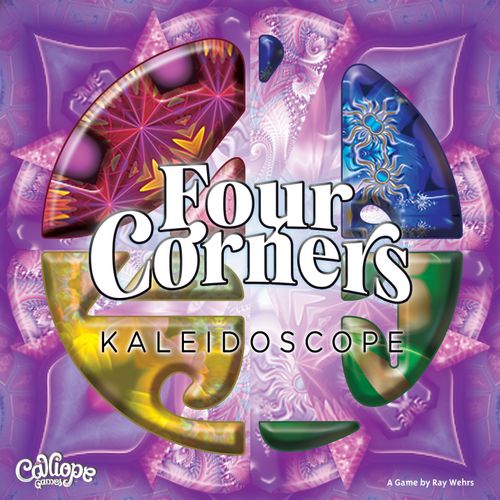
Four Corners
Four Corners Rulebook
Table of Contents
Table of Contents
Objective
Be the first player to score three secret goals.
Contents
Transcription notes: the printed component list reads "(five Rotate 1800 + three Swap Two)" and the rules text reads "Rotate 1800 Special Action tile"; "1800" is taken here as 180° (the degree sign did not extract). The printed text also refers to a "Double Swap Special Action tile" while the component list reads "Swap Two"; both are kept as printed.
- 35 Goal cards
- 78 Puzzle tiles
- 70 Standard tiles
- 8 Special Action tiles (five Rotate 180° and three Swap Two)
- 1 modular Tip-Pivot board (four 3x3 pieces)
- Rules
Setup
Assemble the Tip-Pivot game board by inserting the tab into the slot located on adjoining sides of each board quadrant. Place the assembled game board in the center of the table.
NOTE: When disassembling the board, fold the quadrants into each other like a book to avoid damaging the tabs.
Goal Cards
Shuffle the Goal cards and deal three face down to each player, then place the remaining cards in a face down deck. Players may look at their Goal cards but should keep them secret from other players.
Puzzle Tiles
Mix the Puzzle tiles face down into a draw pile to allow for random distribution among players. If table space is limited, we suggest placing the tiles into the box lid for easy access.
Each Puzzle tile has a full Center Image in the middle and four partial Corner Images.
Draw and place the top Puzzle tile on one of the four squares located in the center of the assembled game board; orientation makes no difference. If the top Puzzle tile has a Special Action on it, redraw until you can place a tile that is not a Special Action tile; then shuffle the Special Action tile(s) back into the draw pile.
Finally, players each draw three Puzzle tiles to form their hands, which are kept secret until played. If you draw more than one Special Action tile, keep one and draw replacements for any others, then shuffle the others back into the draw pile.
Players are limited to one Special Action tile in their hand at a time. If a player draws a second Special Action tile, they should first draw an additional tile and then choose and shuffle one Special Action tile back into the draw pile.
Gameplay
The last person to have looked through a telescope goes first, with play then proceeding clockwise. On your turn you must perform one of four actions:
-
Play a Puzzle tile from your hand.
- You may place a Puzzle tile face up next to a neighboring Puzzle tile already in play, meaning one that is immediately above, below, left, right, or diagonal to the tile. Alternately, you may replace a Puzzle tile already on the board. Remove replaced tiles from the game.
- A Puzzle tile may be placed or replaced in any orientation, but either its Center or one of its Corner Images must match that of a neighboring tile.
Example: This tile can be placed because two neighboring Center Images will match. This tile can be placed because two Corner Images will match.
-
Rotate exactly two Puzzle tiles on the board 90 degrees in either direction. If you have a Rotate 180° Special Action tile in your hand, you may discard it to rotate one of the two Puzzle tiles 180 degrees instead of 90 degrees.
-
Exchange the positions of two Puzzle tiles on the board, maintaining their original orientation. Both exchanged tiles must match the Center Image or a Corner Image of a neighboring tile in their new positions. If you have a Double Swap Special Action tile in your hand, you may discard it to perform a second swap, using the same or different Puzzle tiles.
-
Draw a new Goal card and then return one from your hand to the bottom of the Goal card deck. You may never end a turn with more Goal cards than you had at the start of the turn.
Ending Your Turn
In most cases, your turn ends after completing an action; however, scoring a Goal card may extend your turn as described below in COMPLETING GOALS AND SCORING.
If you finish your turn with fewer than three Puzzle tiles in hand, draw Puzzle tiles until you have three in your hand. If you draw a second Special Action tile, draw an additional tile, then choose and shuffle one Special Action tile back into the draw pile.
Play then passes to the player on your left.
Completing Goals and Scoring
During your turn, you can score Goal cards by creating a MATCHING FOUR CORNERS IMAGE or building an ICONIC SEQUENCE; however, you cannot take an action that creates a Four Corners Image or Iconic Sequence for which you do not have a Goal card.
1. A Matching Four Corners Image
When you create an intersection of four matching Image corner types, you have completed a Four Corners Image; reveal your Goal card matching that Image to score it.
Other players cannot score Goal cards during your turn.
After scoring a Four Corners Image, you must break apart the Image by turning each of that Image's four Puzzle tiles once in either direction (90 degrees) before your turn ends.
Once you have finished breaking up the Image, if the newly rotated tiles have completed another Four Corners Image, then you may reveal and score the matching Goal card. Afterward, you must break apart the new Image as described above, but you cannot rotate them to a position they previously held during your turn.
2. An Iconic Sequence
An Iconic Sequence is a four-in-a-row series of Puzzle tiles with identical Center Images neighboring one another in any direction: horizontally, vertically, or diagonally. When you create an Iconic Sequence, reveal the corresponding Goal card to score it.
After scoring an Iconic Sequence, you must break it apart by changing two of the Center Images within the sequence. One at a time, draw two new Puzzle tiles and, without changing their orientation, replace two Puzzle tiles within the sequence maintaining the placement rules. If the newly drawn Puzzle tile shows a Center Image matching one from the Iconic Sequence or if it is a Special Action, shuffle it back into the draw pile and redraw; this action must break up the Iconic Sequence.
In replacing Puzzle tiles in an Iconic Sequence, you may create and score a new complete Four Corners Image or Iconic Sequence if you have a matching Goal card. If you create a new Four Corners Image, you must rotate the four Puzzle tiles as usual. If you create a new Iconic Sequence before the second Puzzle tile is replaced in the original sequence, play the second tile into the original sequence before scoring the new sequence. Once scored, move onto replacing two Puzzle tiles in the new sequence.
After scoring, you must fully complete the process of breaking apart the Four Corners Image or Iconic Sequence before you may check to see if another scoring pattern can be scored.
IMPORTANT: You are not allowed to complete a Four Corners Image or an Iconic Sequence on the board if you do not have the corresponding Goal card. If you don't have the Goal card for a created pattern, you may not take the desired action and will need to rotate the tile in the opposite direction or play the tile in a different location within the sequence.
Scoring Duplicate Goal Cards
Each Four Corners Image or Iconic Sequence may be scored only once, even if a player has more than one Goal card matching it. A player with duplicate Goal cards must fulfill each goal separately. It is possible to score multiple goals in a single turn.
Winning
The first player to score three goals wins!
Handling Extraordinary Situations
Your games of Four Corners may create rare remarkable circumstances! When these situations occur, the following rules apply:
Simultaneous Goal Events: You may always take an action that allows you to score a Goal card, even if it creates a Four Corners Image or an Iconic Sequence that you cannot score.
If one Puzzle tile, when rotated, completes two Four Corners Images, you may score either or both Goal cards. All associated Puzzle tiles of scored Goals must be rotated 90 degrees in either direction; each tile is rotated only once.
If your action creates both a Four Corners Image and an Iconic Sequence, you may score either or both of the Goal cards, and then follow normal rules to replace two Puzzle tiles in the sequence and rotate the Puzzle tiles 90 degrees in either direction for the Four Corners Image; if only one pattern is scored, you must break up the scored pattern first.
After scoring, remember that you must fully complete the process of breaking apart the Four Corners Image or Iconic Sequence before you may check to see if another pattern can be scored.
Team Rules for Four and Six Players
When playing teams, players opposite each other in the turn sequence are teammates. For example, in a four-player game, players 1 and 3 would be teammates, and in a six-player game, players 1 and 4 would be teammates.
Teammates work to complete the same set of three goals. To do so, deal the first player on each team three Goal cards as stated in the rules above. Each of those players, in turn order, searches the Goal deck to find duplicates of the Goal cards they were dealt. They then pass the duplicate set to their teammate for reference. Be sure that the shared Goal cards are the same between teammates. If the wrong goals are shared, only the originally dealt goals count in scoring.
NOTE: In the rare event that a duplicate Goal card is unavailable, the dealt player must pull an alternate pair of matching Goal cards to complete their hand. The abandoned Goal card is removed from the game, unrevealed.
Once the goals have been shared between teammates, play commences as normal; however, communication between teammates regarding game play is prohibited.
Solitaire Rules
Objective
Complete as many of the dealt goals as possible.
Setup
Place a single board segment (3x3 grid) in front of you. Remove Special Action tiles from the game.
Randomly draw 10 Puzzle tiles and place them face down in a stack to form a draw pile. Do not look at these tiles! Flip over the top tile and place it face up in the center space of the board in any orientation, then set the tiles where they are easily accessible if additional ones are needed.
Shuffle the Goal deck. Deal four Goal cards face up, and one face down, and put them to one side of the board.
Gameplay
Draw the top Puzzle tile from the draw pile and place it face up neighboring any other Puzzle tile (orthogonally or diagonally) in play or replace a Puzzle tile already in play with it. When placing a Puzzle tile, either its Center Image or one of its Corner Images must match a neighboring tile.
Then you may rotate any two tiles on the board one turn (90 degrees) in either direction. You may choose not to rotate tiles during a turn.
Repeat until all Puzzle tiles from the draw pile have been placed.
Solitaire Scoring
Matching Four Corners Image: If you create a complete Four Corners Image that matches a face-up goal, move that Goal card to the opposite side of the board and score it (it cannot be scored again). Before flipping the next tile from the draw pile, rotate the four tiles that created the Four Corners Image once in either direction 90 degrees. Should the rotated tiles result in another completed Four Corners Image, it may also be scored. In such a case, the tiles must be rotated once again but cannot be rotated to their previous positions.
Iconic Sequence: If you create an Iconic Sequence of three tiles (not four as in the standard rules) that matches a face-up goal, move that Goal card to the opposite side of the board and score it (it cannot be scored again). Before flipping the next tile from the draw pile, immediately draw a tile and replace one of the Center Images within the sequence, matching at least one adjacent Corner Image. If a matching Center Image is drawn, discard from the game and redraw. You may score again by completing another Four Corners Image or Iconic Sequence with the newly placed tile.
Each Four Corners Image or Iconic Sequence may be scored only once, even if you have more than one Goal card matching it. Duplicate Goal cards must each be fulfilled separately. You may score multiple Goal cards in a single turn.
IMPORTANT: You are not allowed to complete a Four Corners Image or an Iconic Sequence on the board if the corresponding Goal card is not available from the selection of unscored Goals. If you don't have the Goal card available for a created pattern, you may not take the desired action and must rotate the tile in the opposite direction or play the tile in a different location within the sequence.
If you score all the face-up goals, you may flip over the face-down goal and attempt to complete it before all the tiles from the draw pile have been played. Once the draw pile is empty, the game ends with the following commendations:
- 1 goal: Optically Okay — Great start, now try again!
- 2 goals: Keen Eye — No sweat! Literally.
- 3 goals: Visionary — Awesome! Now we're talkin'!
- 4 goals: Perceptive Prodigy — Brilliant!
- 5 goals: Supreme Puzzler— You are the Four Corners™ Master!