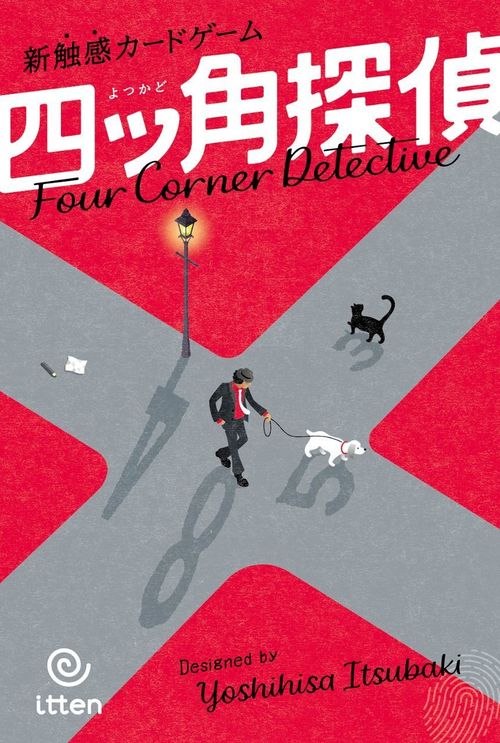
Four Corner Detective
Four Corner Detective Rulebook
Table of Contents
Table of Contents
Contents
Rulebook x1 / Standard card x1 / Cards x51 / Tokens x10 / Pencils x5 / Answer sheet x1
Goal and Cards
In this game you are a private detective of "Rounded Corners". Each card has four rounded corners with different curvature. The numbers — 3, 4, 5, 8 (mm) — indicate the corner radius. The larger the number, the rounder the corner.
Standard Card
The four numbers in the middle of the card are arranged following the arrows, counterclockwise from the notch (Kerbe). All cards have different combinations of these four numbers.
The card showing the detective and the number 3458 is for testing the corner shapes beforehand.
Setup
- Each player takes a pencil and an answer sheet. Shuffle the cards face down and mix them well. Deal five cards to each player. These five cards stay face down and lie as a stack in front of the player. This stack is called the "player stack" (Spielerstapel). The remaining cards are returned to the box.
- Place the materials and tokens on the table as shown in the illustration below.
Setup table as printed. Each row is one player count (player icons on the left). Each numbered column shows a count next to a token icon (the icons are pictorial; the manual gives no captions for them). Values are transcribed as they appear; a dash means no entry in that row.
| Players | Col. 1 (4) | Col. 2 (3) | Col. 3 (2) | Col. 4 (1) | Col. 5 (0) |
|---|---|---|---|---|---|
| 1 | 4 (cube-stack icon) | 1 (single token icon) | — | — | — |
| 2 | 4 (cube-stack icon) | 3 (cube-stack icon) | 2 (two-token icon) | — | — |
| 3 | 4 (cube-stack icon) | 3 (cube-stack icon) | 2 (two-token icon) | 1 (single token icon) | — |
| 4 | 4 (cube-stack icon) | 3 (cube-stack icon) | 2 (two-token icon) | 1 (single token icon) |
Note: the manual does not state what each column represents beyond the icons; the Setup illustration shows the physical layout. Set up according to the illustration.
Game Flow
This game is played in four rounds. Each round proceeds as follows: Deduce and secure tokens → Check answers and record points.
Deduce and Secure Tokens
-
On the command "Ready, set, go!", each player draws one card from the bottom end of their own stack. The card stays face down. Players touch the four corners to work out the four numbers.
* The top card of the player stack is not used in the game; it serves to cover the lower cards.
Rules for Deducing
- Start at the notch of the card and move your finger in the direction of the arrows over the corners. The players feel the cards under the table and may not look at them.
- For inexperienced detectives: only in the first two rounds may players look at and feel the cards (the back side only!).
- * If a player sees numbers on the front side, the card is replaced.
Answer and Take Tokens
- After deducing, enter the four numbers on your answer sheet. Note: the order starts at the notch and follows the direction of the arrows. * Players may only lay their card on the table once they have noted the numbers. (Except for inexperienced detectives.)
- In the order in which the players finish first, each player takes the largest available group of tokens. The tokens are placed in front of that player. * Once tokens have been taken, the answers may no longer be changed.
- When all players have taken tokens, the answers are checked and scored. (With five players, wait until the last player has finished.)
Check Answers and Record Points
The players show their answers in turn, starting with the player who has the most tokens. Each player reads out the four numbers on their answer sheet and turns over their card. A number that matches the card is circled. Then scoring is as follows.
Order of evaluation (as shown in the manual's illustration): 1 = the player with the largest group of tokens, then 2, 3, and 4 (the smallest group).
One to Three Numbers Correct
The player takes as many tokens as there are correct numbers and places them on their card. (The player may only use tokens lying in front of them, even if the number of tokens does not match the number of correct answers.) Record these points in the box-column (the cube icon, "Points" column). Any remaining tokens go to the next player and are available to them when they draw.
All Four Numbers Correct: Perfect Result!
The player takes all tokens lying in front of them and places them on the card. The point value equals the number of tokens. Additionally, mark a check in the thumbs-up column.
Players may only take tokens lying in front of them, even when they have more correct answers. A player with a perfect result therefore only scores as many points as the tokens in front of them.
All Numbers Wrong
Enter a zero (0) on the answer sheet. All tokens go to the next player, who checks their answer.
After scoring, all tokens are returned to the middle of the table, the played cards go into the box, and the next round starts again at Setup, step 2.
Example
Detective A has four tokens and checks first. Only two numbers match. Detective A keeps two tokens and scores two points. The other two tokens are passed to Detective B, who checks next. Detective B now has five tokens. All four of Detective B's numbers are correct, so Detective B places all five tokens on the card, scores five points and marks a check in the thumbs-up column.
End of Game
After four rounds the game ends. Players check their results and add up their points from each round. The player with the most marks in the thumbs-up column receives four bonus points. If several players are tied for the most marks, all of them receive the bonus. The player with the highest score wins.
Advanced Rules
2-Minute Speedrun (1 to 5 players and more)
Tokens and answer sheets are not used. Set a timer for 2 minutes. Each player forms their own deck of about 8 cards. As soon as the timer starts, everyone begins deducing at the same time. Players call out their numbers and check them themselves. Only cards with a "perfect result" stay in front of the player; all other cards are removed. Whoever has the most cards when time runs out wins.
Solo play: try to beat your own record.
The Detective Championship (3 or more players)
Play several players in a tournament or a small league made up of two-player rounds. The goal is to win the Detective Championship.
More Detectives! (6 or more players)
The game can be played with more than six players. The number of tokens stays the same as in the five-player game. The fifth-to-last player and every player after them cannot earn tokens. Write on the answer sheet who finished in which order, so that you keep the order in mind.