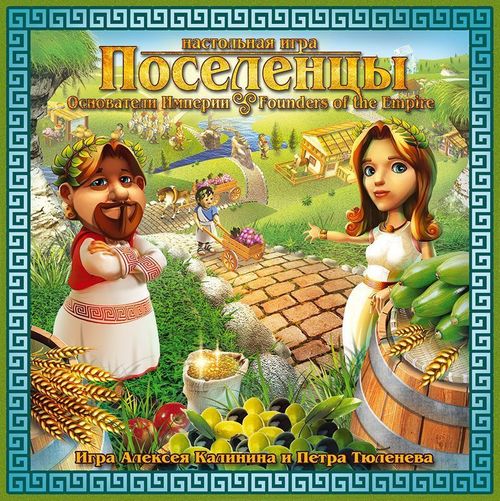
Founders of the Empire
Founders of the Empire Rulebook
Table of Contents
Table of Contents
Contents
97 square tiles:
- 24 nature tiles (green back)
- 24 village tiles (blue back)
- 24 city tiles (purple back)
- 25 victory tiles (red back)
24 tokens:
- 6 war tokens
- 6 coin tokens
- 6 carriage tokens
- 6 craftsmen tokens
Each tile shows its required resources (top left corner), its produced resources (lower part) and, on victory tiles, its victory points.
Game Setup
Divide the tiles into 4 stacks according to their backs, shuffle each stack and place them face down. When playing with two people, draw 8 red tiles from their stack; when playing with three or four, draw 12 red tiles. Place these tiles face up on the table for everyone to see. Put the remaining victory tiles into the box: they won't be needed for this game.
Decide who will be the first player. That player draws tiles from the green stack (5 tiles with two players, 7 with three players and 9 tiles with four players in the game) and places them face up on the table. Each player in clockwise order (starting from the first player) takes one of these tiles. Once the last player takes his tile, he takes another one and all other players also choose a second tile counterclockwise (the first player chooses last). Each player places his/her tiles face up in front of him/her so that they have a shared side. These tiles are the first ones in the player's nation.
The first player places three stacks of tiles in the middle of the table in a vertical column: nature, village and city. He draws two tiles from the green stack and places them face up to the right of the stack horizontally; he also adds the leftover green tile from the previous step. He does the same with the blue stack, placing two face-up blue tiles to the right of it, and then places one face-up purple tile of the purple stack. All face-up tiles should be placed so that each player has a clear view of them.
Divide the tokens by type and place them in 4 separate piles near the tile stacks. Shuffle craftsmen tokens (with a vase on its back) face down. The first player makes his turn. The turn is then passed clockwise.
Game Turn
At the start of your turn you have to open a tile from any one stack. You can then play one of your tokens. Finally you have to add one of the face-up tiles to your nation, if possible.
1. Open a tile
Choose one of the three stacks (green, blue or purple), draw the top tile and place it face up in the horizontal row to the right of the stack. If there are already five tiles in this row, remove all five and place them into the box, then the just-drawn tile becomes the only tile in the row.
Example 1: Philip chooses the blue stack. There are three tiles to the right of it. He draws the top tile, flips it face up and adds it as a fourth to the row.
Example 2: Alexander chooses the purple stack which already has five tiles to the right of it. He removes all 5 tiles and puts them in the game box, then he draws the top tile, flips it face up and places it to the right of the purple stack.
Please note:
- Each stack has its own row; only tiles from that stack can be placed there.
- There can be no more than five tiles in each row.
- 5 tiles are removed from the row only when you draw a tile from the corresponding stack.
- The removed tiles do not return to the game but players may see which tiles were removed.
- If there are no tiles left in all three stacks the game ends (see below).
2. Play a token
During the game you will receive tokens: war, coin, carriage and craftsmen. You can (but aren't obliged to) play one of your tokens right after you open a tile.
- The war token pillages one of your opponent's tiles.
- The coin token buys a resource from one of your opponent's tiles.
- The carriage token unites several of your tiles.
- The craftsman token makes one of your tiles give you points instead of resources.
The effects of all the tokens are described in detail later on.
Please note:
- On your turn you may play only one token (of any type).
- Each token that remains on your hand when the game ends gives you 1 victory point.
- You can't play a token immediately after receiving it (see below).
3. Add a tile
After you have played a token (or decided against it) you must add one of the face-up tiles to your nation. It can be a tile from any of the horizontal rows (nature, village or city) or a victory tile. You cannot take tiles from other player's nations.
The top left corner of a tile shows what resources you need to add it to your nation; the lower part of the tile shows the resource this tile produces. You need to add the tile to your nation so that the neighboring tiles (horizontally, vertically or diagonally) give it the required resources. The new tile must have at least one side fully shared with a tile that is already part of your nation.
The green nature tiles do not require any resources and can be placed anywhere. Each turn they produce one of the two possible resources. You should choose which resource is produced on each of your nature tiles before adding a new tile.
The purple city tiles immediately grant you a specific token after being added (war, coin, carriage or craftsman). You receive a token only after adding a city tile; the tile will then give only resources like any other tile.
The red victory tiles don't produce any resources but they do grant victory points.
Each tile may produce only one resource per turn.
Example: (diagram with a numbered grid of spaces 1-7) The mine can be placed on spaces 1, 2 or 3 since it would receive all the needed resources: the forest produces wood, the cliff gives stone. The mine cannot be placed on spaces 4 or 5 since the forest tile can't produce both wood and stone at the same time. The mine cannot be placed on spaces 6 or 7 since the neighboring tiles don't produce all the required resources.
If you cannot add any face-up tile to your nation, draw a green tile from its stack and add it. If the green stack is depleted you finish your turn without adding any new tiles.
You can add a new tile in place of another tile already in your nation. In this case remove the old tile and place it face down in front of you. Then add the new tile (make sure that the neighboring tiles produce all required resources for the new tile). At the end of the game you lose one victory point for each tile that was swapped that way, but sometimes this action has its own benefits and is more profitable. You don't have to swap tiles even if you cannot add a new tile.
Please note:
- You can add only one tile per turn.
- The coin and carriage tokens allow you to use distant resources and even resources from your opponent's tiles (see below). This doesn't count as a production of a resource.
- You can't move tiles in your nation to the different spaces.
- An added tile stays at the space it was added to even if a neighboring tile stopped producing one of required resources.
- You must add a tile if you can do it (but you do not have to do it by swapping).
- If possible place your most important tiles closer to yourself in order to protect them from pillaging (see below).
After adding a tile (and receiving a token if it was a city tile) your turn ends. Remove the coin tokens from your nation's tiles if there were any (see below) and pass the turn to the player on the left of you.
End of the game
The game ends at the end of a player's turn if one or more of these conditions have been met:
- there are no more face-up victory tiles;
- none of the three stacks have any tiles left;
- due to circumstance none of the players can earn any more victory points (if all the players agree).
Usually the game ends when all victory tiles have been added to the nations. After adding the last victory tile to a nation, the current player ends his turn and all participants count their victory points.
Sometimes there are victory tiles left over but all three stacks (nature, village and city) are depleted. After drawing the last remaining tile the current player ends his turn and all participants count their victory points.
Finally, it's possible that the players see they can no longer earn any more victory points. For example all remaining victory tiles require horse while all three village tiles that produce that resource have either been replaced or pillaged or occupied by a craftsman token. In this case, if all players agree, the game ends and all participants count their victory points.
Note that some players may still have craftsmen tokens on their hands – they should be given chance to play them.
Scoring
Each player counts his victory points:
- victory points as indicated on the victory tiles in his nation;
- 2 points for each craftsman in his nation;
- 1 point for every token left on his hand;
- –1 point for each swapped tile (lying face down in front of the player).
The player with the highest score wins the game. If there is a draw between two or more players the player with the most victory tiles in his nation wins the game.
Example: Philip has 4 victory tiles (1 one-point tile, 2 two-point tiles and 1 three-point tile), 1 craftsman, 3 tokens on his hand and 1 swapped tile. He receives 1 + 2 + 2 + 3 + 2 + 3 – 1 = 12 points. Alexander also has 12 points but only 3 victory tiles. Philip has pleased the gods better than Alexander and therefore Philip is proclaimed the Founder of the Empire.
Tokens
As soon as you add a city tile to your nation you take the corresponding token from the reserve. For example when you add the marketplace (produces coins), you take a coin token. On the next turns this tile won't be giving you any more tokens (only its resource) but later on you can add another tile that produces coins and take another coin token. You can have any number of any tokens on your hand. All other players should be able to see what tokens you currently have.
During your turn you can play one token right after you open a tile. You don't have to play a token. Each token that remains on your hand will grant you 1 victory point at the end of the game.
War tokens
War tokens let you attack an opponent's nation by pillaging one of his tiles. When playing this token place it on any unprotected tile of your opponent. From this moment the pillaged tile doesn't produce any resources and will not bring any victory points at the end of the game. The farthest tile from the owner in each of the vertical columns of his nation is considered unprotected. (The arrows in the illustration point at unprotected tiles.)
- If the pillaged tile contained a craftsman token, the war token is placed on top of the craftsman. The owner of the tile won't receive victory points for the craftsman at the end of the game.
- A pillaged tile can be swapped. Remove all tokens from the tile to the game box. The replaced tile gives –1 victory point at the end of the game as usual.
- If a pillaged tile is united with other tiles using a carriage token (see below) it can receive resources but it doesn't produce any itself.
Coin tokens
By using the coin token you can purchase one resource from an opponent. When playing this token place it on an opponent's tile. Till the end of your turn you can use the resource of that tile as if it was produced anywhere in your nation.
The coin not only gives you a resource it also takes it away from the opponent. If at the beginning of your turn you have a coin on your tile it doesn't produce any resources this turn. At the end of your turn, right after you add a new tile to your nation, take all coin tokens from your tiles to your hand. You can now use them to purchase resources from your opponents.
Example: Philip buys horses from Alexander and adds a war camp next to a waterfall (that has stone – another resource the war camp requires).
- The purchased resource is not considered as a production of one of your tiles.
- You can purchase a resource and not use it (nevertheless, the coin token stays at the opponent's tile until the end of his turn).
- You can only use the purchased resource on the same turn that you purchased it.
- When playing a coin token on a green tile choose which of two available resources to purchase.
- You cannot play a coin token on a tile that doesn't produce resources (victory tile, pillaged tile or the one with a craftsman token).
- If a tile with a coin is united with other tiles using a carriage token (see below) it can get resources "delivered" but still cannot produce any.
- When swapping a tile with a coin token, keep the token.
- The coin tokens you have received as a payment bring you victory points at the end of the game just like any other leftover token. Before the final scoring take all coin tokens from your tiles to your hand.
Carriage tokens
With the help of the carriage token you can move resources between your tiles. When playing this token place it in the middle of four tiles in your nation (if you don't have four tiles connected with each other you cannot play the token). The carriage token unites these four tiles and allows resources to be "delivered" between them. Now each of these tiles produces all the resources that the other united tiles produce.
Example: Philip united his cliff, forest, winery and workshop with a carriage. First he adds a mine next to his workshop since the united tiles produce the required resources. On his next turn he adds a marketplace by taking iron from the mine and "delivering" plants from the cliff.
- By using more than one carriage token you can unite more than four tiles or form separate unions. (Illustration: to the left, two carriage tokens unite seven tiles; to the right, two carriage tokens form two separate unions of four tiles each.)
- When swapping a tile, keep the carriage token in place, the new tile is united with the old ones.
- You can "deliver" resources to tiles that don't produce any resources (victory, pillaged, occupied by a craftsman token).
- The "delivered" resource is produced by the tile it was taken from; the tile it arrived at can still produce its own resource.
Craftsmen tokens
All six craftsmen tokens are different: each one corresponds to a specific resource from the village tiles. When receiving a craftsman token, you randomly pick one; then show the other players which one you got.
When playing the craftsman token place it on a village tile in your nation that produces the resource indicated on the token. This tile no longer produces its resource but will bring you 2 victory points at the end of the game.
- If you couldn't play a craftsman token on a tile with the corresponding resource it will bring you 1 victory point just like any other leftover token at the end of the game.
- Play the craftsman token face up so as to see the amount of victory points it gives.
- A tile with a craftsman token can be pillaged – in this case it will not bring victory points.
- The craftsman token can only be played on its corresponding resource tile. You cannot "deliver" a resource to a different tile and play the craftsman there.