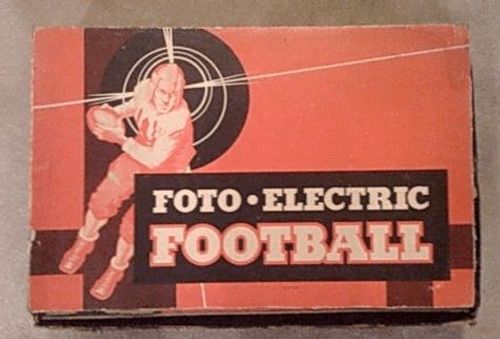
Foto-Electric Football
Foto-Electric Football Rulebook
Table of Contents
Table of Contents
Game Materials
PLAY-VIEWER, contained in large box with illuminating light bulb; Football field, with football Marker and 10-yard Marker.
SPINNER CARD—for Kicks, Returns, Field Goals, Tries for Point After Touchdown, Fumbles and Blocked Kicks, Interception Returns, and Penalties.
PLAYS—12 Offense Plays—6 Defense Formations.
-
Offense Plays (a) THE SOLID WHITE LINE shows the path of the ball carrier. (b) THE BROKEN WHITE LINE shows the ball in the air during Pass Plays.
-
Defense Formations (a) GREEN DIAMONDS are the Defense Tacklers that stop the Play when they completely cover the Path of the Solid White Line. There are 11 on each Defense Formation. (b) A RED DOT covering a SOLID WHITE LINE indicates that the ball has been Fumbled. A RED DOT covering the BROKEN line of a Forward Pass indicates that the Pass is Incomplete. When a Lateral Pass is covered by a RED DOT, the ball has been fumbled. When a tackler or RED DOT appears over the STAR at the end of a Forward or Lateral Pass, an Interception results.
SCOREBOARD—Records Downs, Quarters, number of plays per quarter and the Scores for both the Home Team and the Visitors.
Pre-Game Preparations
- If desired, the Scoreboard can be set up by attaching it to the back of the game with fasteners. See Fig. 1.
- Remove Plays and Spinner Card from plastic envelope.
- Connect the Electric Cord to any 110–120 Volt outlet (AC or DC).
Fig. 1: Diagram of the Scoreboard attached to the back of the game by fasteners.
Rules of the Game
- Players decide who will represent HOME TEAM and VISITORS.
- Toss a coin to decide which Team has the Choice of Kicking or Receiving . . . VISITOR CALLS. The receiving team kicks off to start the second half of the game.
- Team Receiving Kick-Off will take possession of the 12 Offense Plays.
- Team Kicking Off takes possession of the 6 Defense Formations. (During the game, whenever possession of the Ball changes because of failure to make Downs, Interception, Loss on a Fumble, after a Punt, etc., Plays change hands also.)
- Plastic Football is moved to the 40-Yard Line of the Kicking Team for Kick-Off.
- Turn on the switch for the Play-Viewer.
- Time each game by playing 30 Plays per Quarter or agree on a Time Period for each Quarter (i.e., 20 min.). Defense records the number of plays per quarter by moving the pointer on the scoreboard one position AFTER each play is completed. A play is not considered complete until all action (punts, interceptions, fumbles, etc.) has been concluded.
Method of Play
-
Defense Kicks Off: Defense takes Spinner Card, spins the "A" Spinner and moves Football the distance indicated on Kick-Off area.
-
Offense Returns Kick-Off (a) Team Receiving the Ball spins the "A" Spinner on Kick-Off Return area for Runback distance in all instances where the Ball is not automatically put into Play on the 20-Yard Line. (b) Football on the Field is moved to indicate the position of the Ball after the Runback, thus establishing the Line of Scrimmage. (c) The 10-Yard Marker is placed so that it extends 10 yards toward the Goal from the Line of Scrimmage. (It is now 1st down—10 yds to go for the Offense.)
EXAMPLES (All covered by Football Rules) (a) If Kick-Off Spinner stops at 45: This indicates that Ball was kicked 45 Yards. Place Ball on the 15-Yard Line. Offense then spins over Kick-Off Return area on the "A" Spinner. (b) If Spinner stops at 75: Ball has been kicked 75 Yards and would be beyond the End Zone. Offense must put Ball in play on the 20-Yard Line. (c) If Spinner stops at 65: Ball was kicked into the End Zone. Offense can either make a Touchback and put the Ball into play on its 20-Yard Line, or may elect to run it out, in which case the Kick-Off Return area on the "A" Spinner is used. (d) If Kick is Out-of-Bounds: The Kicking Team is Penalized 5 Yards and Ball is kicked again, this time from the 35-Yard Line. (e) If Spinner stops at Penalty in the Kick-Off area: There is an Offside on the Kick and a 5-Yard Penalty is called AGAINST the Kicking Team. Move the Ball back to the 35-Yard Line and Kick again. (The "B" Spinner is not used on this particular Penalty.) (f) ON SIDE KICK may be CALLED (instead of the regular kick) at the beginning of either half or after a Touchdown. It is assumed to always travel ONLY 12 yards and the ball is moved accordingly. The receiving team then spins SPINNER "B" (FUMBLES and BLOCKED KICKS). If RED, the kicking team takes possession of the ball where it lies and ignores any further action on the spinner. If BLUE, moves the ball the value shown and keeps the ball. (g) For Penalty on Runback—see 10-a Spinner Penalties.
-
Use of Play-Viewer (a) With 1st Down—10 Yards to Go: Offense Quarterback selects one of the Play-Viewer Offense Plays, and holding it so his Opponent cannot see the play, indicates he is ready. (b) Defense player selects a Defense type of Play that he believes will be most effective against the Offense selection and indicates he is ready. (c) (1) Offense Quarterback places his Play on top of the Play-Viewer FACE DOWN and away from the Slide, put in 1 of 3 positions: (a) all the way to the Left; (b) All the way to the Right; or (c) Midway between. Results will vary as the Offense is placed to the Right, Left, or Center. (Note: On the Offense Play the side that shows the Line of Play and the Name of the Play is always concealed from Opponent.) (2) Defense Player places his Defense Formation on top of the Offense Play with the Defense positions FACE UP. The Name of the Defense will be at the top, away from the Slide—USE THE LIGHTED HOLE IN THE SLIDE TO POSITION THE PLAYS. (See Figure 2.) (3) After the Offense Play is in position, the Defense may be placed on any of FIVE POSITIONS so that the GREEN bars of the Defense card are perfectly aligned with the THICK bars of the Offense card so no light shows through BOTH the Offense and Defense card as viewed through the hole in the slide. See Fig. 2. (NOTE. A total of SEVEN different alignments and SEVEN different results are possible from the combinations of placement of Offense and Defense plays. See Fig. 3.) (4) The slide is pulled out by the Offense player. The Defense player lightly places his fingers on the corners of the play near him as the slide is being withdrawn to keep the plays from shifting. In lining up the cards, Defense must not alter the original placement of Offense from Left, Right, or Center. If Offense is moved by Defense, a Penalty is called. (See #10 Penalties.) If during a play there is any disagreement over whether or not a play is stopped, reference should be made to the saw-tooth rectangle on the 10 yard line of the play. The dark lines should fall directly over each other. Also (the 5 yard interval lines) of the Defense should line up with the dark (five yard interval) lines of the Offense. When the play alignment has been verified, the examples (Fig. 4) should clear up any disagreement.
Fig. 2: Diagram of the Offense and Defense cards positioned in the Play-Viewer slide. Fig. 3: Diagrams of the seven Offense/Defense alignments and their results.
Fig. 4: Tackler positions. THESE TACKLER POSITIONS DO NOT STOP THE PLAY: Offense "I" Center, Defense "A" two positions to the left of center (-5) YD. LINE; Offense "I" Center, Defense "D" one position left of center (-4) YD. LINE; Offense "10" Center, Defense "A" two positions left of center (-5) YD. LINE. THESE TACKLER POSITIONS STOP THE PLAY: Offense "10" Center, Defense "A" Center (-7) YD. LINE; Offense "1" Center, Defense "B" one position left of center (-6) YD. LINE.
-
Play in Action: Offense Player must be certain that his Play and the Defense Formation are properly aligned in the Viewer. A slow withdrawal of the SLIDE gives a realistic animation of the Play and its results. EXAMPLE: (See Fig. 5) Offense selects OFFENSE 7, hoping to complete a LONG PASS. Defense selects the center position. ACTION: The ball carrier easily avoids two eager tacklers, cuts around them to the left, backs up to give his receiver time to get down field, then throws a long pass. The Defender catches it, tries to avoid a tackler but fails after cutting off sharply to the left. The Offense makes a net gain of 21 yards. The ball is moved down field 21 yards and the 10-yard marker is moved to the new line of scrimmage.
Fig. 5: Diagram of the Look-In / Screen Passes chart.
-
Punts: Instead of selecting an Offense Play, the Offense may Punt, using the Punt area on the "A" Spinner. (a) After a Punt, the Opponent uses the Punt-Return area on the "A" Spinner to determine how far back he can run the Punt, UNLESS the Punt went over the Goal Line or was Blocked. (b) If the Ball carried over the Goal Line: The Receiving Team may elect to put it in play on its 20-Yard Line, or may attempt a Runback. (c) If the Ball is kicked over 10 Yards Beyond the Goal Line: the Ball is beyond the End Zone and must be played from the 20-Yard Line. (d) If the Punt was BLOCKED: Defense uses the Fumble and Blocked Kick area on the "B" Spinner to determine Recovery. Yardage + or – is Gain or Loss from the previous Line of Scrimmage. When Punt is Blocked on 4th Down and Offense Recovers: If necessary Yardage is not made on Recovery, Ball goes to the Opponent and Plays are exchanged. (e) Punt (Not Kick Off) Receiver may call for a Fair Catch before the Punt. If the Punt does not entail a Penalty or Fumble, the Punt distance is reduced by 5 yards and the receiving team then spins the "A" spinner to see if the catch is good. (For Penalties and Fumbles, see 10 (b) and 11 (a).)
-
Quick Kicks: Quick Kicks can be called on any Down except on 4th Down. When Quick Kick is called, the "A" Spinner is used, and the Receiving team has the chance of return indicated by the Quick Kick Return area on the "A" Spinner.
-
Field Goal: A Field Goal attempt may be made any time the Ball is within 50 Yards of Goal. (The Field Goal area on the "B" Spinner reflects the increased difficulty of making a successful Kick as the Distance from the Goal increases.) If an attempted Field Goal is NOT GOOD, the defending team may either place the ball on the 20 yard line, first down 10 yards to go, or it may run the ball back (using Punt Return "A" Spinner) counting yardage from the goal line.
Fumbles
- Fumbles (a) Fumbles on a PUNT, QUICK KICK, POINT AFTER T.D., or FIELD GOAL are made by the Kicking Team. When they occur the Opponent uses the "Fumble and Blocked Kick" area of the "B" Spinner and the Ball is moved according to the Distance Plus or Minus as shown—measured from the previous Line of Scrimmage. Possession of the Ball after a Fumble is decided by the Color spun on the Fumble area. BLUE returns the Ball to the Team making the Fumble. RED gives the Ball to the Opponent. FUMBLE ON THE TRY FOR POINT AFTER TOUCHDOWN CANCELS THE TRY. (b) Fumbles on a FAIR CATCH, KICK OFF RETURN, PUNT RETURN or QUICK KICK RETURN are made by the Receiving Team and on an INTERCEPTION RETURN by the Intercepting Team. The Fumble is decided by the Distance, Plus or Minus, shown on the "Fumble and Blocked Kick" area on the "B" Spinner and is measured from the point the Ball was caught. Possession of the Ball after a Fumble is always decided by the Color shown. (c) On the Play-Viewer Plays: When the RUNNER (Solid White Line) is completely covered by one of the RED DOTS on the Defense Formation—the Fumble occurs at the point of the RED DOT. Note: When the dotted line portion of a FORWARD PASS is intercepted by a RED DOT, the Pass has been knocked down and is NOT A FUMBLE; when the dotted line portion of a LATERAL PASS is interrupted by a RED DOT, IT IS A FUMBLE. (d) In all cases of FUMBLE (and BLOCKED KICKS) the Team that Recovers and the Gain or Loss from the Point of the Fumble are determined by spinning over the "Fumble and Blocked Kick" area on the "B" Spinner. The Opponent of the Fumbling Player does the spinning. EXAMPLE: If "B" Spinner indicated RED, Team in possession loses Ball. Yards indicated on Spinner are figured from the point of the Fumble. "Plus" moves the Ball toward the new Goal. It is 1st Down for the Recovering Team and Plays are exchanged. If "B" Spinner indicated BLUE, Team in possession recovered his own Fumble and moves the Ball the distance and direction indicated from the Point of the Fumble.
Scoring
- Scoring
| Scoring play | Points |
|---|---|
| TOUCHDOWN (ON or OVER GOAL LINE) | 6 points |
| TRY FOR POINT AFTER T.D. (RUN, PASS or KICK)* | 1 point |
| FIELD GOAL | 3 points |
| SAFETY** | 2 points |
* Only Collegiate Rules permit the Team TRYING FOR THE POINT AFTER TOUCHDOWN to score 2 Points if the TRY is made by Running or Passing and the TRY IS SUCCESSFUL. (Note: The TRY AFTER TOUCHDOWN is attempted from the 3-Yard Line.)
** A SAFETY is made when the Defense stops the OFFENSE PLAY on or behind the Offensive Team's Goal Line. The 2 points are awarded to the Team NOT in possession of the Ball (Defense). On the next Play, the Team Scored Upon must put the Ball into play by a Free Kick (KICK-OFF or PUNT) from its own 20-Yard Line.
When Not in Use
(a) Always keep Plays in Envelope. (b) To protect Play Viewer, store Scoreboard, Plays, Spinner Card, and UNDERNEATH Game in Packing Carton. The Play Viewer will remain cool if the switch is turned off after each play. [The exact wording of this sentence is partly illegible in the photograph.]
To Replace Light Bulb
Use only a 40 watt Inside Frosted Bulb, like the one supplied with the game. Be certain that the Electric Cord is not connected to any outlet. The bulb may be reached through the trapdoor in the bottom of the game.