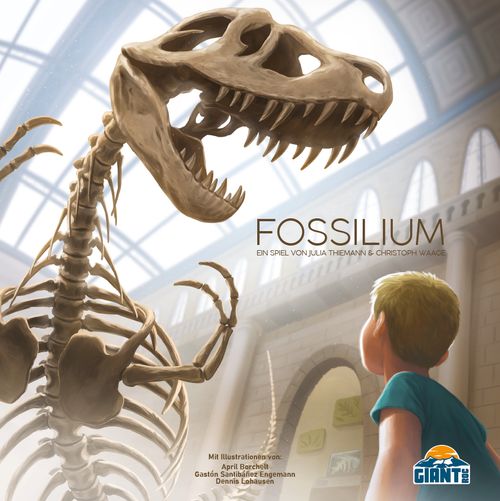
Fossilium
Fossilium Rulebook
Table of Contents
Table of Contents
Components
Shared Components
- 1 Fossil Market (double-sided: for 2-4 museums, solo game)
- 1 Action Board
- 1 Action Strip for the last round
- 1 Round Tableau
- 1 Job Market with Prestige Track
- 219 Fossil Tiles (double-sided)
- 6 Starting Fossils (double-sided)
- 7 Round Goals (double-sided)
- 3 End Game Goals (double-sided)
- 6 Job Market Goals (double-sided)
- 6 Amber pieces
- 3 Price Markers
- 51 Regular Guest tiles (double-sided: 25 small, 12 medium, 14 large)
- 67 Dino-Dollars
- 5 Fossil Stands (3D assembly)
- 3 Bags ("Excavation Sites")
- 30 "Under Construction" tiles
- 1 Ammonite tile
- 1 Round Marker (wooden cylinder)
Personal Components (per player)
- 1 Museum Tableau
- 1 Guest Track (per color)
- 6 Info Panels (double-sided)
- 8 Workers (meeples)
- 2 Wooden Cubes (Prestige Counter + Doctoral Student Marker)
- 1 Reference Sheet
- 1 Prestige Tile (+50, double-sided)
- 1 Large Pedestal tile + 2 Small Pedestal tiles
Solo Mode Components
- 19 Action Cards
- 17 Fossil Cards
Material Limits: The following tiles are considered unlimited: Dino-Dollars, Regular Guests, and "Under Construction" tiles. If you run out, substitute with suitable replacements. All other materials are limited to the quantities included in the game.
Overview
In the following section, we'll introduce you to the basic principles of Fossilium. The detailed rules follow afterward.
You want to fill the exhibition halls of your museum with fossils and info panels. Fossils consist of multiple individual pieces. These pieces are found in bags that represent the excavation sites.
The fossil pieces drawn from the bags go into your storage. From your storage, you can then display fossil pieces in your exhibition hall.
You can perform various actions by sending workers to the Action Board. Each row offers different action options.
You display the T-rex fossil pieces by sending a worker to the "Display" action. Which column you send the worker to influences which excavation sites you'll visit later, and thus which bags you'll draw fossil pieces from.
The fossil pieces from the T-rex have a dark background and the Cretaceous symbol. So you send your worker to the "Excavate" action in the 3rd column to later get more T-rex pieces.
The more total workers stand in a column, the more fossil pieces you may draw from the corresponding excavation site/bag. However, you can only keep as many pieces as you have your own workers in that column!
Setup
Before the First Game
- Attach the Action Board feet (unprinted white circles) to the circled areas on the underside of the Action Board so that the Guest Tracks fit loosely between them.
- Assemble the Fossil Stands.
General Setup
- Place the Action Board in the center of the play area. Place the Action Strip for the last round with the single-colored side face up next to it. Leave space to the right of the Action Board for the Guest Tracks.
- Place the Fossil Market with the side without the bottom track next to the Action Board. Place the Price Markers on the shops of the same type on the Fossil Market.
- Place the Job Market and the Round Tableau next to it.
- Draw 3 random Job Market Goals and place them on the empty spaces of the Job Market.
- Skip this step in your first game! Otherwise, draw 5 random Round Goals and 1 random End Game Goal and place them on the empty spaces of the Round Tableau. Place the first 2 Round Goals with the lighter side visible, the other 3 with the darker side up (as printed). Place the Round Marker above the 1st Round Goal.
- Fill the 3 Excavation Sites (see "Excavation Site Setup" box).
- 2-player game only: Choose the 1st or 3rd column of the Action Board. The excavation site and actions of the chosen column are not available during the game. Cover the column with the Action Strip for the last round. Put the corresponding bag back in the box.
- 2-3 player game only: Fill the Fossil Market. Draw 5 (2 players) or 2 (3 players) fossil pieces from each excavation site and place them from left to right in the row of the same type.
- Place the Regular Guests, Dino-Dollars, Amber, "Under Construction" tiles, and Fossil Stands within reach of all players.
- 2-3 player game only: Prepare the neutral workers: Set up 4 workers of a non-playing color on specific spaces of the Action Board (see "Neutral Worker Positions" overview).
Excavation Site Setup
- Sort the fossil pieces by their excavation sites (recognizable by the background texture).
- Attention: Fossils with a white border are Starting Fossils - keep them separate from the others!
- Place all fossil pieces of each excavation site into the matching bag.
Personal Setup
Each player performs the following steps:
a. Take 1 Museum Tableau in your chosen color and choose either side. b. Take the Guest Track in your museum's color and slide it under the entrance of the Action Board of the same color until only the "0" is visible. c. Take 8 Workers, 6 Info Panels, 1 Doctoral Student Marker, 1 Prestige Counter, and 1 Prestige Tile in your museum's color. Also take 1 large and 2 small Pedestal tiles. d. Place 4 workers on the matching symbols on your museum. Distribute the other 4 workers on the Goals of the Job Market. e. Place the Doctoral Student Marker on space "0" of your Doctoral Student Track. f. Place the Prestige Counter on space "0" of the Prestige Track. g. Draw 1 random Starting Fossil (white border) and choose one of its two sides. Place it on the Special Field of the same fossil type in your museum. h. Draw fossil pieces from each excavation site depending on player count. Keep exactly 5 total and place them in your storage. Place remaining fossil pieces sorted by type into the Fossil Market. i. Whoever most recently saw a dinosaur begins the game, receives 2 Dino-Dollars, and takes the Ammonite. In clockwise order, all others receive 3, 3, and 4 Dino-Dollars respectively. j. Take 1 Reference Sheet.
Fossil Structure
Fossil Size
- "1er" Fossils consist of 1 piece. The front and back are identical.
- "2er" Fossils consist of 2 pieces. The front and back show the 2 different illustration parts.
- "4er" Fossils consist of 4 pieces. The illustration is axially symmetrical.
- "6er" Fossils consist of 6 pieces. The front and back sides are different.
Fossil Type
- Terrestrial (light brown bones, bone symbol)
- Aquatic (blue, fish symbol)
- Botanical (green, leaf symbol)
Excavation Site
The background color and excavation symbol indicate which excavation site the fossil is from. The Plesiosaurus and Cycadales are special: their pieces are found in all 3 or 2 excavation sites respectively.
Museum Structure
- Museum Shops: Receive 1 Dino-Dollar during the Income Phase for each fossil piece of the matching type in the row.
- Museum Entrances: Receive 1 Guest during the Income Phase for each fossil piece of the matching type in the column.
- Exhibition Area: Display your fossils on these fields (in any orientation).
- Pedestal Anchors: If you display a fossil whose size and orientation exactly match the pedestal, you receive bonus prestige at the end of the game.
- Special Fields: Fossils of the matching type on these fields bring you both income and guests.
- Worker Area: Your workers stand here at the beginning of a round.
- Doctoral Student Track: Shows the number of your doctoral students. Use it to perform additional excavations.
- Storage: All fossil pieces you receive must first be stored here.
- Doctoral Student Symbols: Receive as many doctoral students during the Income Phase as visible symbols in your storage.
Game Flow
A game of Fossilium runs over 5 rounds. Each round consists of 4 phases. The last round runs slightly differently. After that, final scoring takes place. Whoever has achieved the most prestige wins.
- Income Phase
- Action Phase
- Opening Phase
- Excavation Phase
The Excavation Phase
- Choose any excavation site (bag).
- Draw as many random fossil pieces as total workers in the corresponding column, max. 6.
- Keep as many fossil pieces as you have YOUR OWN workers in the column.
- Return non-selected pieces to the bag. Pass the bag clockwise.
- Repeat for other excavation sites.
- Choose which pieces to keep and place them in your storage.
- Place pieces that don't fit into the Market (no money received).
- Return workers from Action Fields to your worker area.
- Assign permanent workers to excavation site columns if you have more than 4.
- Pass the Ammonite clockwise.
- In rounds 2 and 4: Fill the Fossil Market with 2 pieces from each excavation site.
The Income Phase
During the Income Phase, you receive Money and Guests for your displayed fossils, as well as Doctoral Students.
Museum Shops (rows): Receive 1 Dino-Dollar per fossil piece of the matching type in each row.
Museum Entrances (columns): Receive 1 Guest per fossil piece of the matching type in each column.
Doctoral Students: Receive as many as visible symbols in your storage (max 5).
The Action Phase
Take turns clockwise. Whoever has the Ammonite begins. On your turn, perform 1 action by placing workers on the Action Board. There are 6 action rows:
- Display: Display fossil pieces in your exhibition hall.
- Build/Donate: Build info panels or donate fossil pieces to other museums.
- Buy/Sell: Buy or sell fossil pieces at the Fossil Market.
- Give Tour: Receive additional Guests or Dino-Dollars.
- Joker: Copy any other action in the same column (costs 10 minus workers in column).
- Management: Receive 1 Dino-Dollar, 1 Doctoral Student, or 1 Guest.
Completing Fossils
When a fossil is complete, immediately receive Guests and a Type Bonus:
+1/2/4/6 Guests for a fossil of size 1/2/4/6.
- Botanical: +1 Doctoral Student
- Aquatic: +1 additional Guest
- Terrestrial: +1 Dino-Dollar
The Opening Phase
- Receive Prestige for your Guests: Read the value on the leftmost visible area of your Guest Track.
- Score the Round Goal and receive Regular Guests: 1st condition = small tile, 2nd = medium, 3rd = large.
- Reset your Guest Track: Push back to your Regular Guests.
Special Rules for the Last Round
- No Excavation Phase: Cover the top of the Action Board with the Action Strip.
- New Action: Take 1 fossil piece from any excavation site and display it immediately.
- Permanent Workers: May be used like regular workers in their assigned column.
- Additional Income Phase: Perform one at the end of the round.
End of Game
The game ends after round 5. Score Majorities, Info Panels, and Fossils.
Majorities (7/4/2 Prestige for 1st/2nd/3rd)
- Most Guests on the Guest Track
- Most Dino-Dollars in possession
- End Game Goal (if playing with one)
Ties: Share prestige of tied placement(s), rounded down.
Victory
Most Prestige wins. Tiebreaker: fewest empty exhibition fields, then most stands.
Solo Mode
General Setup
Perform the general setup as described on p. 6 with the following changes:
- Place the Fossil Market with the side WITH the track at the bottom edge next to the Action Board.
- Draw 5 random Round Goals and place them on the empty spaces of the Round Tableau. Do NOT draw an End Game Goal.
- Choose whether you want to use the 1st and 2nd OR the 2nd and 3rd excavation sites in this game. Draw 3 fossils from each of the two chosen sites and place them sorted by type into the Fossil Market. Put the unused bag back in the box.
Personal Setup
Perform the personal setup as described on p. 7 with the following changes:
k. Draw 4 fossil pieces each from both excavation sites and keep exactly 5 total. Place the remaining 3 in the Fossil Market. l. Take 3 Dino-Dollars.
Pal Setup
You play against the paleontologist Pal. Prepare her "play area" as follows:
- Create the Fossil Card deck: Remove all fossil cards of the unused excavation site. Shuffle all remaining cards, draw 7 of them, and place them face down as the Fossil Card deck. Put the other cards back in the box.
- Reveal the top 3 Fossil Cards and place them face up next to the deck.
- Create the Action deck: Draw random cards according to this table: 6x Display, 3x Give Tour, 3x Build/Donate, 2x Buy/Sell. Sort the cards by "A" and "B" (see red marking). Shuffle both decks face down. Form the face-down Action deck by placing the "A" deck on top of the "B" deck.
- Choose a color for Pal and set aside her 8 workers (do NOT put 4 on the Job Market).
- Slide her Guest Track under the Action Board.
- Set aside the Doctoral Student Markers and Prestige Counters (wooden cubes) of all non-playing colors.
Additional Setup
Certain actions are not available in solo play.
All action fields of the column of the unused excavation site are ignored. Cover them with the Action Strip. Additionally, neutral workers block certain actions, but they move at the end of the round.
Place 4 workers of a non-playing color at the beginning of the game on the following spaces of the Action Board (skip the unused column):
- 1 worker on "Display", 1st column from left
- 2 workers on "Build/Donate", 2nd column from left
- 1 worker on "Buy/Sell", 1st column from left
You don't need the other materials in the player colors. Put them back in the box.
Changes to Game Flow
Play according to the usual rules with the following changes:
Round Flow
- Move neutral workers (skip in round 1): Move all neutral workers in their row 1 column to the right. Skip the unused column and return to the 1st column if they were at the right end.
- Reveal 1 Fossil Card (skip in round 1): Reveal 1 additional Fossil Card. These are Pal's exhibits. You may "Donate" her the missing pieces (see next page)!
Turns
You always have the 1st turn. Pal takes a fixed number of turns each round: Round 1/2/3/4/5 = 2/2/3/3/4 Pal turns (see Solo Track on Market). So you usually have more turns than her.
Fill the Market
Draw 3 pieces each from both excavation sites when you should fill the market (rounds 2 and 4).
Pal's Turn
When it's Pal's turn, she performs 1 action. Reveal 1 Action Card to determine the action.
Pal always places workers according to the symbol on the card and thereby blocks those fields. The arrow indicates from which direction she places the worker on the 1st free field: Arrow right = the 1st free field from left. Arrow left = the 1st free field from right.
She prefers normal action fields (whether small or large). If those are occupied, she chooses bonus action fields first, otherwise "Joker" fields. If those are also unavailable, or if she doesn't have enough workers, she performs the action without placing workers.
Pal ignores the costs and bonuses of action fields.
The Action Cards
Display
Pal extends 1 of her revealed Fossil Cards by 1 piece. She chooses from all her fossils either the fossil piece with the highest number (arrow right on card) or lowest number (arrow left on card). Place 1 wooden cube on the newly displayed piece. You can no longer donate this fossil piece. If Pal completes a fossil, she receives NO bonus. Remove all markers/fossil pieces from completed Fossil Cards and flip the card.
Buy/Sell
Remove fossil pieces at the indicated positions from left (arrow right) or right (arrow left) from the market and out of the game. They are no longer available to you this game. Then draw fossil pieces as indicated on the card and place them in the market. If there's not enough space, push excess pieces into the Archive as usual (see p. 15).
Donate
Pal donates 1 fossil piece to you. She always chooses your incomplete fossil with the most already displayed fossil pieces ("max." on card). If multiple fossils qualify, choose yourself which one she donates to.
The diagram on the card indicates which piece she donates - either the missing piece with the highest number (arrow right) or lowest number (arrow left). Find this piece from the matching excavation site and place it on the corresponding position.
Then lose Prestige equal to the number of displayed fossil pieces of this fossil (after donating). You cannot fall below 0 Prestige.
If she completes your fossil, receive the bonus as usual (see p. 13).
If you have no incomplete fossils, Pal cannot perform her action and does nothing.
Give Tour
Pal receives Dino-Dollars and Guests as indicated on the Action Card. Pull the Guest Track forward accordingly and place the Dino-Dollars in Pal's play area.
Pal's Guest Track is NEVER reset.
You May Donate to Pal
You may also donate fossil pieces to Pal. Perform the "Donate" action and place 1 matching fossil piece from your storage on one of the free fields of an incomplete Fossil Card. Then receive Prestige equal to the number of displayed fossil pieces of this fossil. Count tiles, depicted pieces, and wooden cubes.
Final Scoring
Perform scoring as usual, but you receive NO Prestige for majorities if you are tied with Pal or have fewer Guests or Dino-Dollars than her.
Victory
Compare your total prestige with the table to find out how well you did:
- 120+: The best museum in the country!
- 100-119: More and more people are flocking to the museum.
- 80-99: You can cover your costs.
- 60-79: A few visitors get lost in your museum.
- <60: Your exhibition halls are gathering dust.
Increase Difficulty
Make the game harder with the following options:
- Use Round Goals with higher numbers.
- Use more "B" Action Cards than "A" Action Cards.
- Flip more Round Goals to the dark gray side.
- Pal always takes the 1st turn.
- Increase Pal's number of turns, starting in rounds 2 and 4 (use more Action Cards accordingly).
- You must beat Pal in majority scoring, otherwise it counts as a loss.
- Through Pal's Donate, you can fall below 0 Prestige.
- In final scoring, subtract the number of empty fields in your exhibition from your prestige.
- In final scoring, subtract the number of occupied fields in your storage from your prestige.
- Remove 1 of your workers from the Job Market at the end of each round.
Job Market Goals
- Receive the worker as soon as you fulfill the goal during the "Donate" action and thereby gain at least 3 Prestige.
- Receive the worker as soon as you perform a "Joker" action.
- Receive the worker as soon as you complete a column/row in your museum (with fossils and/or info panels).
- Receive the worker as soon as you have 18/22/28 guests in your queue.
- Receive the worker as soon as you collect 5/6 Dino-Dollars during "Give Tour".
- Receive the worker as soon as you receive 5/6 Guests during "Give Tour".
- Receive the worker as soon as you display at least 4 fossil pieces in 1 action.
Round Goals
- Number of complete fossils, regardless of size.
- Number of fossils of the same type (botanical, terrestrial, aquatic), including incomplete ones.
- A fossil with at least X fossil pieces. A complete fossil with 2/4/6 fossil pieces.
- Number of info panels.
- Number of fossils of size "1".
- Number of fossils of size "2". Number of complete fossils of size "2".
- Number of sets of 3 fossils with different types. Number of sets of 3 complete fossils with different types.
End Game Goals
- Total number of fossil pieces and info panels (most tiles).
- Sum of fossil pieces of the 3 largest complete fossils.
- Largest connected area of a specific fossil type.
- Number of fossils of size "1".
- Number of complete fossils of size "2".
- Number of info panels.
Fossil Facts
Fossils of the Triassic
The Triassic was preceded by the Permian period, during which one of the largest magma eruptions in Earth's history occurred. A mass extinction followed, claiming about 95% of all species. In the Triassic, the first epoch of the Mesozoic (Middle Ages), the animal and plant world was able to recover from the devastating catastrophe, and many groups such as corals, dinosaurs, mammals, turtles, and flying reptiles appeared for the first time.
Flora of the Triassic
Cycadales: Antarcticycas schopfii - Together with conifers, the cycads dominated the vegetation of the Mesozoic. Like all cycads, palm ferns, Antarcticycas reproduced with cones. Finds of insects in some specimens suggest an ancient cooperation between insects and Antarcticycas. Antarcticycas actually grew in Antarctica, although almost all modern cycads are found in the subtropics. In the Triassic, it was still much warmer in Antarctica than today.
Pleuromeia sternbergii - After the extinction of many species at the end of the Permian, Pleuromeia colonized many habitats and was found almost everywhere in the Triassic. Although classified as a tree, it was barely taller than an adult person. It consisted of a straight trunk with a leafy tuft and resembles a bottle brush in appearance.
Wielandiella angustifolia - These plants were named after the American paleobotanist George Reber Wieland, who did important work on the Bennettitales, the superordinate group of Wielandiella.
Williamsonia eskensis - In the Triassic, plants up to 2 meters tall appeared for the first time, named after their first describer William Williamson. They belong to the Bennettitales - these are very similar to the cycads but, like modern flowering plants, already had bisexual flowers. Some researchers see them as an evolutionary link between gymnosperms and angiosperms.
Fauna of the Triassic
Mixosaurus - Mixosaurs belong to the oldest known ichthyosaurs (fish lizards). They were fast swimmers and could thus excellently hunt in swarms of fish.
Eoraptor lunensis - The Eoraptor is considered one of the first and most primitive dinosaurs. There is only one representative of this group, and the name lunensis refers to the discovery site, the "Moon Valley" in the Ischigualasto Reserve (Argentina).
Lystrosaurus hedini - This pig-like herbivore was found worldwide in the Triassic and is considered an early relative of modern mammals.
Placodus gigas - Placodus gigas had, like all placodonts (pavement tooth lizards), webbed feet between fingers and toes, suggesting that despite its stocky body, it was an agile swimmer. With its pavement teeth, it could crack and eat shellfish from the sea.
Plateosaurus engelhardti - Science knows especially much about the Plateosaurus ("flat lizard"). Over 50 nearly complete skeletons have been found from the Plateosaurus - most of them in Germany. (For finds of other dinosaurs, usually only a few bones from a few specimens were brought to light.) This herbivore could grow up to 10 meters long and walked on either two or four legs.
Plesiosaurier: Thalassiodracon hawkinsi - Plesiosaurs looked like giant water dinosaurs but were biologically closer to lizards and snakes. Plesiosaurs occurred in all epochs of the Mesozoic. The Thalassiodracon hawkinsi, translated as water dragon, is at 1.5 meters a relatively small representative of the plesiosaurs.
Thrinaxodon liorhinus - The reptile Thrinaxodon was a mammal ancestor and already had first mammalian characteristics: legs rather under the body than spread out, diaphragm breathing, and thermoregulation through panting - and it probably had whiskers.
Fossils of the Jurassic
In the Jurassic period, the emerging diversity of the Triassic plant world continued. Dinosaurs have existed for about 30 million years, but in the Jurassic they experienced their heyday and rose to the top of the food chain on land. Through the emergence of many gigantic dinosaur species like Brachiosaurus and Diplodocus, the Middle and Upper Jurassic is also called the "Age of the Giant Dinosaurs."
Flora of the Jurassic
Araucaria mirabilis - The Araucarias were already in the Jurassic giant conifers with very striking female cones. From Patagonia, three-dimensionally petrified cones are known that were preserved by volcanic ash and are popular collector's items. Today it is forbidden to take them without permission. Male cones are not known.
Cycadales: Zamites feneonis - The entire Mesozoic, especially the Jurassic period, is called the Age of Cycads. The genus Zamites needed (sub)tropical conditions, and its occurrence points to the warm climate in the Jurassic. Its great distribution thus coincides with the great age of the dinosaurs. But the herbivores among the giant lizards had to beware, because cycads produce strong nerve toxins that can lead to death after consumption.
Osmunda claytoniites - The name Osmunda, like the German designation royal fern, goes back to the Anglo-Saxon ruler Osmund. Osmunda claytoniites is barely distinguishable from the modern representative Osmunda claytoniana (interrupted fern).
Fauna of the Jurassic
Compsognathus longipes - Only two fossils of this small dinosaur (German "elegant jaw") were found - one of them in 1859 in Germany, which was also until then one of the most complete dinosaur skeletons ever. Compsognathus is one of the smallest dinosaurs and proves that these were not only giants.
Eryma punctatum - Eryma was a lobster-like crab and had very strong claws compared to its body. There are 44 known species of Eryma.
Homoeosaurus maximiliani - Homoeosaurus is a representative of the tuataras - in the Jurassic the genus was widespread. Today it lives only on some islands of New Zealand. Although the Homoeosaurus is a terrestrial lizard, it was often found in aquatic habitats, e.g. in Solnhofen in Germany. This is because around the discovery sites there was once a large Jurassic sea, and the inhabitants of the small islands were washed into the lagoons after their death and fossilized.
Palaeocarcharias stromeri - Even if this small, up to 1 meter long shark looks rather inconspicuous, it is considered the ancestor of the Megalodon and the Great White Shark. Several complete fossils were found in the Solnhofen Plattenkalk (Germany).
Pentasteria longispina - This group was typical of the Jurassic and differed hardly from modern starfish. Under the body were small feet with which they moved - only the suckers for opening mussels were missing.
Pentacrinites dargniesi - Sea lilies seem from the name and appearance to be plants, but they are invertebrate animals. The up to 1 meter long stems of these animals ended in a cup from which hundreds of branching arms emerged. This cup could have a diameter of up to 80 cm.
Plesiosaurier: Plesiosaurus dolichodeirus - In a time when men dominated science, the fossil collector Mary Anning was jointly responsible for the discovery of the first Plesiosaurus in 1823 and conducted important paleontological research. Her find was also one of the first discoveries of a prehistoric reptile. The Plesiosaurus dolichodeirus, a representative from the Jurassic, was about 3 meters long and was mainly found in coastal deposits.
Stegosaurus armatus - The Stegosaurus, German "armored lizard," was an up to 9 meter long herbivore with a comparatively tiny head. With its long tail spines, the Stegosaurus could effectively ward off enemies, and through the bony back plates, it could impress and support the body's heat exchange.
Fossils of the Cretaceous
The Cretaceous period gets its name from the chalk layers formed by calcite-forming algae and other living things. During this time, birds and flowering plants developed - the first flowers were only 1-2 mm large. Sea levels in the Cretaceous were as high as at no other time and created new habitats for invertebrate marine animals. At the same time, this epoch was the age of dinosaurs, as they were particularly numerous and diverse here.
Flora of the Cretaceous
Archaefructus sinensis - Archaefructus is one of the oldest known flowering plants in the world. It is reminiscent of today's Trithuria, a water lily plant. The fossil plant shows us that the spectacular victory march of flowering plants already began about 125 million years ago.
Cycadales: Nilssonia nipponensis - Cycads have existed for more than 300 million years and have thus survived several major mass extinctions. Even if today there are only about 370 species, significantly fewer than in the Mesozoic, they are still globally distributed.
Weichselia reticulata - Weichselia was a widespread fern with leaves of about 1.5 meters in length. Presumably the plant was a pioneer that also coped with difficult site conditions. The climate change in the middle of the Cretaceous, however, this genus did not survive.
Wollemia nobilis - For a long time, people believed the Wollemi pine, as its common name suggests, was extinct - until a ranger discovered 23 trees in a national park near Sydney (Australia) in 1994 that had survived the ages of the Earth. This find is as significant as if one were to discover a living dinosaur. Nevertheless, they are considered "threatened with extinction" - for example, they could only be preserved from the devastating bushfires in Australia 2019/2020 thanks to intensive firefighting efforts. The exact location is kept secret.
Fauna of the Cretaceous
Ambolestes zhoui - Ambolestes was one of the first representatives of higher mammals. It was barely larger than a squirrel, ate insects, and was a good climber.
Berriasella jacobi - Due to its finds in the individual sediment layers, this fossil is also considered a guide fossil for determining the boundary between the Cretaceous and Jurassic.
Ctenothrissa vexillifer - This extinct bony fish is a close relative of today's herring.
Oviraptor-Nest - In the Gobi Desert, a petrified nest with eggs was found, which was initially thought to be a Protoceratops clutch. Nearby was a dinosaur skeleton that was interpreted as an "egg thief" and the dinosaur was named after it: Oviraptor. Today it is assumed that it was a brooding parent animal and the nest belonged to the Oviraptor.
Plesiosaurier: Elasmosaurus platyurus - The Elasmosaurus platyurus was at a size of about 12 meters significantly larger than its direct relatives from the Jurassic and Triassic. It had 71 cervical vertebrae, more than any other animal that ever lived. The first describer Edward Drinker Cope was so confused by this that he placed the head at the end of the tail.
Tyrannosaurus rex - Tyrannosaurus rex had an excellent sense of smell and a fairly large brain. Its bite force is considered the strongest there ever was in an animal.
Velociraptor mongoliensis - The feather attachments on the found skeletons show that the Velociraptor ("swift thief") - like many other predatory dinosaurs - had feathers.
Symbol Overview
Phases
- Income Phase
- Action Phase
- Opening Phase
- Excavation Phase
- End of Round
- End of Game
Resources
- Dino-Dollar
- Prestige
- Storage
- Fossil Piece
Actions
- Action: Display
- Action: Build
- Action: Donate
- Action: Buy
- Action: Sell
- Action: Give Tour
- Action: Joker
- Action: Management
- Info Panel
Excavation & Fossils
- Excavate
- Place fossil piece in storage
- Search for 1 fossil piece
- Fill market
- Incomplete fossil, specific size (e.g., "2")
- Complete fossil, specific size (e.g., "2")
- Complete fossil, any size
- Fossil of any size
- Adjacent
Excavation Sites
- 1st Excavation Site (Triassic)
- 2nd Excavation Site (Jurassic)
- 3rd Excavation Site (Cretaceous)
- Any Excavation Site
Fossil Types
- Terrestrial Fossil
- Aquatic Fossil
- Botanical Fossil
People
- Guests
- Regular Guests
- All Workers
- Own Workers
- Doctoral Students
Museum
- Complete Column
- Complete Row