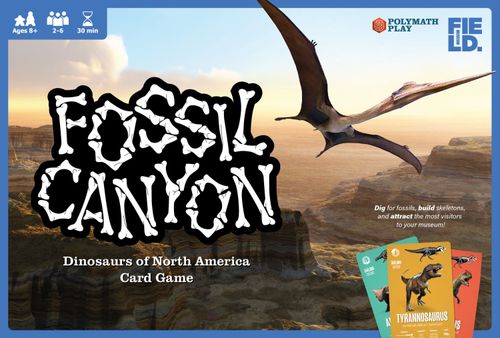
Fossil Canyon
Fossil Canyon Rulebook
Table of Contents
Table of Contents
Game Contents
- 58 skeletal fossil cards, forming 23 complete skeletons of 13 animals
- 6 trace fossil cards (research fossils), used in research
- 18 event cards, for use in Fossil Canyon (top) and Cretaceous Creek (bottom)
- 6 reference cards, with an overview of gameplay
- 3 blank cards, to replace lost cards or create your own fossils
- 1 Storm Phase card, for use in the cooperative game Cretaceous Creek
- 6 player tokens and 6 museum puzzle pieces
- 23 skeleton scoring pieces, 3 endgame bonus scoring pieces, and 4 research award scoring pieces
Your Objective
Your objective is to build the world's most popular natural history museum, as measured in thousands of visitors per month. For example, a complete skeleton worth 18 points attracts 18,000 visitors each month.
There are three ways to score:
- Build a complete skeleton. This is the most common way to score. When you obtain the two, three, or four skeletal fossils needed to complete a skeleton, you earn a skeleton puzzle piece.
Completing skeletons: Three fossil cards are required to complete an Allosaurus skeleton (worth 18 points), as indicated by the bone icons at the top left of each card. The three fossil cards on the left do not complete a skeleton, as the hips/legs are missing.
- Win a research award. Six trace fossils, which provide evidence of the behaviors of ancient life, may be studied in your lab. Each of these fossils has a research value, measured in research value units (shown as magnifying-glass icons on the cards). Collecting research fossils worth 4 or 6 can earn you a research award (see figure). These awards enhance the reputation of your museum, attracting more visitors.
Research awards: If you are the first to collect research fossils worth a total value of 6 or more, you may trade them for a 20-point major research award. (There is only one major research award scoring piece.) If you collect research fossils worth 4 or more, you may trade them for a research award worth 10 points.
- Claim an endgame bonus. At the end of the game, you may claim a bonus for the theme of your museum: a small bonus (8 points) if you have the most carnivore skeletons, a medium bonus (11 points) if you have the most Jurassic skeletons, and a large bonus (14 points) if you have skeletons of each Cretaceous herbivore (Ankylosaurus, Pachycephalosaurus, Parasaurolophus, Triceratops). Or, choose your own criteria for the endgame bonuses! You may qualify for more than one bonus. If players tie for the small or medium bonus, the tiebreaker is the sum of the point values of skeletons in the bonus category.
Endgame bonuses: At the end of the game, you may claim a bonus for the theme of your museum. Here, the large bonus is awarded for completing skeletons of each Cretaceous herbivore.
Keeping Score
Each time you score, you add a puzzle scoring piece to your museum. Pieces worth more points are longer, and the player with the longest string of scoring pieces wins!
Keeping score: The yellow paleontologist just completed a Quetzalcoatlus. They add the piece to their museum and take the lead!
Setup
See the illustration on the next page.
Before you play: If you are playing with young children and you want to keep the scoring simple, you may decide not to use the six research fossils and skip the endgame bonuses. If you do play with the endgame bonuses, decide if you want to customize the criteria or use the standard criteria.
-
Set up Museum Row. Each player chooses a color, takes the corresponding player reference card, and gives the corresponding museum puzzle piece to the player chosen to be scorekeeper. The scorekeeper constructs Museum Row by connecting the museums in player order, top to bottom. The museum of Player 1 (the youngest player) is at the top.
-
Form the dig site. Shuffle the 64 fossil cards (58 if you are not using the research fossils). Randomly discard four fossils (don't look at them!) and spread the remaining fossils face down on the table. This is the dig site. Initially, all fossils in the dig site are buried (face down). During the course of the game, erosion events may cause fossils to be exposed (turned face up in the dig site).
-
Add the event deck. Shuffle the deck of event cards and place them face down near the dig site.
-
Form starting hands. Each player-paleontologist digs (draws) a number of fossils from the dig site according to the number of players (see the table below) without showing their fossils to others.
| Players | Starting hand |
|---|---|
| 2p | 10 |
| 3p | 8 |
| 4p | 6 |
| 5p | 5 |
| 6p | 4 |
A player has completed a skeleton if they have all the fossils of the same genus needed to complete a skeleton. If a player has completed a skeleton, the cards are removed from the game and the scorekeeper adds the skeleton scoring piece to the player's museum.
At the end of the setup phase, each player chooses up to three fossils to keep hidden from other players. All other fossils in their hand must be placed face up so other players can see, and all players reveal their face-up fossils at the same time. If a player has two or more face-up fossils of the same genus, the cards should be placed on top of each other, but staggered, so the type of each fossil is visible.
Example initial setup for four players: The museums in Museum Row show that player 1 is the red player, followed by green, blue, and yellow. Each player has three or fewer cards hidden in their hand (shown as face down), and the rest of their cards are face up. Face-up cards of the same genus are stacked but staggered, so the fossils are easily viewed by other players. The green and yellow players have already completed skeletons, which are now in their museums.
Play
Play proceeds clockwise in turns. If there are no fossils left in the dig site at the beginning of your turn, go to Ending the game. Otherwise, your turn consists of five steps:
-
Draw an event card and follow the instructions. If the event exposes a fossil, turn a fossil card in the dig site face up. Return the event card to the bottom of the event deck, face down.
-
Dig two fossils, one at a time, from the dig site to your hidden hand. (If there is only one fossil left in the dig site, dig one.)
-
Exchange fossils with other players (optional). Give one of your fossils (hidden or face up) to another player by placing it face up in front of them. Immediately take a fossil from their face-up fossils or blindly from their hidden fossils. You may perform a second exchange with any player, but this time give two fossils to get one. Similarly, you may perform a third exchange, at a cost of three fossils to get one.
-
Bonus dig? If you completed one or more skeletons during any of the first three steps, your museum rewards you with extra support to dig one more fossil this turn. If another player completed a skeleton during your turn, they do not get a bonus dig.
-
Adjust your hand so that you have three or fewer hidden fossils. All other fossils must be face up in front of you. You may move hidden fossils to face up, or face-up fossils to hidden.
If you, or any other player, acquires the fossils to build a complete skeleton during any of steps 1-4, the fossils are immediately removed from the game and the skeleton scoring piece is added to the appropriate museum. Also, at any time during your turn, you may trade research fossils for a research award scoring piece. You may only make such a trade during your turn, and you are never obligated to do so; you may keep collecting research fossils without trading them for a score, if you wish. A research award does not entitle you to a bonus dig.
Value of a complete skeleton: visitors per month (15,000 in the example). Number of fossils and skeletons: fossils in a complete skeleton (3), and skeletons in the deck (2). Endgame bonus information: the period when the animal lived (Cretaceous) and its diet (herbivore). Skeletal diagram: fossils discovered (hips/legs). Pronunciation and name meaning. Basic facts: for reference, the African elephant, the largest living land animal, is about 6 m long and weighs about 6,000 kg. Fun fact.
Ending the Game
When there are no cards left in the dig site at the beginning of a player's turn, all players place all their fossils face up in front of them. Each turn is now only step 3 (exchange), and a player may only exchange if they have at least two fossils. Otherwise that player's turn is skipped.
Play continues until no more skeletons or research awards can be completed, or until a stalemate has been reached. Next, award the endgame bonuses. The player with the most monthly visitors to their museum wins! The tiebreaker is the most valuable skeleton.
Scoring puzzle: In this simplified 4-player game (without research fossils or endgame bonuses), the blue paleontologist wins!
Rule Variations
You can try these minor rule variations:
- For 5- and 6-player games, allow a maximum of two fossils in a player's hidden hand.
- The blank customizable cards may be used in place of lost or damaged cards, or you can even create your own skeletal fossils. You can draw on the cards with a permanent marker. (Use an endgame bonus scoring piece to score a new skeleton.)
- When you dig a fossil during step 2, you may decide to put it back in the dig site face up, indicating that you discovered the fossil, but you decided not to excavate it. You may do this only once during step 2, and your dig ends as soon as you keep your second fossil.
- During step 3 (exchange), you may not take fossils from another player's hidden hand.
Fossils and Skeletons
The 58 skeletal fossils form 23 complete skeletons of 13 reptile genera from the Mesozoic Era, including 11 dinosaurs, a pterosaur (Quetzalcoatlus), and a marine lizard (Mosasaurus). ("Genera" is the plural of "genus," and a genus is a group of closely related species, or sometimes just a single species.) The trace fossils represent six different dinosaur genera. Each fossil card indicates when the animal lived (Triassic Period 252–201 million years ago, Jurassic Period 201–145 million years ago, or Cretaceous Period 145–66 million years ago) and its diet (herbivore [plant eater] or carnivore [meat eater]).
Trace Fossils (Research Fossils)
| Genus | Description | Period | Diet | Research value |
|---|---|---|---|---|
| Camptosaurus | Nest | Jurassic | Herbivore | 3 |
| Utahraptor | Feather impression | Cretaceous | Carnivore | 3 |
| Alamosaurus | Gastroliths | Cretaceous | Herbivore | 2 |
| Edmontosaurus | Skin impression | Cretaceous | Herbivore | 2 |
| Ornitholestes | Coprolite | Jurassic | Carnivore |
Skeletal Fossils
Value is in thousands of visitors per month.
| Genus | Fossils | Skeletons in deck | Period | Diet | Value |
|---|---|---|---|---|---|
| Tyrannosaurus | 4 | 1 | Cretaceous | Carnivore | 25 |
| Brachiosaurus | 3 | 1 | Jurassic | Herbivore | 20 |
| Triceratops | 3 | 1 | Cretaceous | Herbivore | 19 |
| Allosaurus | 3 | 2 | Jurassic | Carnivore | 18 |
Other Games
The Fossil Canyon cards can be used for many other games. Here are just a few!
Go Dig
Ages 5+, 2–4 players, 15 min.
Some set-collection card games can be adapted to use the skeletal fossil cards. One of our favorites for young children is based on "Go Fish."
Discard the six research fossil cards and deal seven skeletal fossils face down to each player. Place the rest of the fossils face down in a stack, the "dig pile." If a player has a complete skeleton, the fossils are placed out of the game and the skeleton is added to their museum.
On your turn, ask another player, "Do you have any [name of a genus] fossils?" The genus must be one that you have in your hand, e.g., Triceratops. If the other player has any fossils of that genus, they must hand over all of them. You may then make another request, of the same player or another, for the same genus or another, and continue to make requests until the other player has no fossils of the requested genus. In that case, the other player says "Go dig!" and you take the top fossil from the dig pile. If it matches the genus you requested, show it to the other players and continue making requests. If not, play passes to the next player. If you run out of fossils, take a fossil from the dig pile, and play passes to the next player. If you run out of fossils on another player's turn, take a fossil from the dig pile.
A skeleton is added to your museum as soon as you have a complete set of fossils.
The game ends when all skeletons have been completed. The player with the most monthly visitors to their museum wins.
Memory Game
Ages 4+, 2 players, 10 min.
Choose 24 fossil cards making one four-fossil skeleton (Tyrannosaurus), four different three-fossil skeletons, and four different two-fossil skeletons. Shuffle and put the cards face down in a 6x4 grid. Each turn, a player turns fossils face up until (1) the face-up fossils come from different skeletons or (2) the face-up fossils make a complete skeleton. In case of (1), the player turns the fossils face down again and their turn is over. In case of (2), the player takes the fossils, the scorekeeper puts the skeleton in their museum, and the player's turn is over.
When all fossils have been taken, the winner is the player with the most monthly visitors to their museum.
20 Questions
Ages 6+, 2–4 players, 15 min.
Test your knowledge of the genera! Shuffle the fossil cards and place them face down in a stack. One player (the answerer) draws a card, and the player to their left (the questioner) asks questions and tries to guess the genus. Each question must be a yes/no question about information available on the card. For example, "Did it live during the Cretaceous?," "Was it a carnivore?", "Was its length less than eight meters?", or "Is it Coelophysis?" When the questioner guesses the genus correctly, they get the card, and they become the answerer.
A questioner may choose to pass if they cannot guess the genus. In that case, the answerer discards the card face up (so everyone can see) and draws a new card.
Keep track of the number of questions each player asks with paper and pencil. Each player is allowed to ask a total of 20 questions during the game. (Guessing the genus counts as a question.) The game is over when all players have asked 20 questions. The player with the most cards wins. The tiebreaker is the most valuable research fossil, followed by the most valuable skeletal fossil.