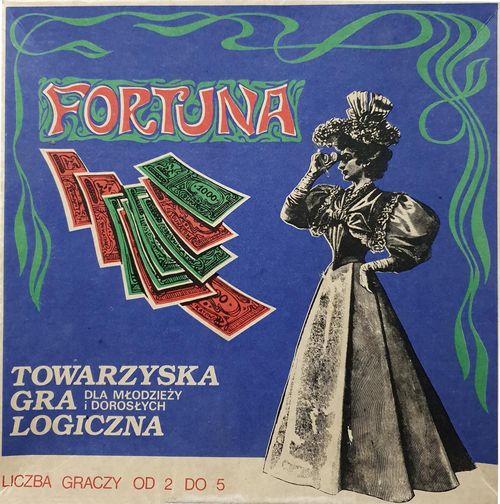
Fortuna (1984)
Fortuna (1984) Rulebook
Table of Contents
Table of Contents
- Rules of the Game
- Components
- Preparing to Play
- Start
- The Race
- Plot for Sale
- Paying Rent
- Houses
- Hotel
- Shortage of Buildings
- Selling Property
- Mortgages (Pledges)
- Chance and Fate
- Taxes
- Restaurants
- Railways
- Waterworks, Power Station
- Hospital
- Holiday
- Banker
- Bank
- Bankruptcy
- Important
- For the Initiated
- Final Remarks
Rules of the Game
The principle of the game is to buy, lease or sell real estate so profitably as to gain an advantage over your opponents and possibly become the winner.
Starting from the "start" space, players move their pawns around the board clockwise. When a player's pawn lands on a free plot, that is, one still owned by the Bank, they have the right to buy it at its face value. If they decline the transaction, the Bank puts the plot up for auction and it becomes the property of the highest bidder.
The owner of a property (plot) has the right and the duty to collect lease payments from opponents whose pawn lands on a space they own.
Leases are much higher if the plot is built on. So it pays to invest. In case of financial trouble the property owner has the right to mortgage it at the Bank.
The board has thirty-one spaces that can be bought from the Bank. There are forty-four spaces in all. The thirteen that cannot be bought are spaces that decide the player's chances or unexpected troubles. A player may get a holiday, end up in hospital, be threatened with house repairs, a luxury tax, etc.
You must try to seize your chances and know how to get out of trouble. Even a stay in hospital can prove advantageous at a certain stage of the game.
Components
- A colourful board imitating the area of central Warsaw eighty years ago. Marked on the board are plots for sale bearing the authentic names of Warsaw hotels of that era, as well as railways, restaurants and public utilities (authentic names).
- Pawns for the players.
- Thirty houses and ten hotels.
- Two sets of sixteen cards each: the "fate" deck and the "chance" deck.
- Thirty-one title cards for the spaces that can be bought from the Bank. Each card shows the value of the space (plots etc.) and the amount of the lease rents for that space.
- A set of money.
Preparing to Play
Spread the board on the table. Shuffle the "chance" and "fate" cards and place them face down on the spaces marked on the board. The players choose the pawns that will represent them as they move around the board. Each player receives 20,000 ducats. The remaining money, title cards, houses and hotels stay in the Bank. One of the players takes on the role of banker (see "Bank" below).
Start
The order of play is decided by drawing lots. Scatter one of the sets of tokens on the table, numbers down. The players draw tokens; whoever has the highest number starts.
After the draw, the players take their places at the table according to the "seniority" of the numbers they drew. Each player receives twelve tokens numbered 1-12. The tokens replace dice. Using them largely eliminates chance and forces thinking and foresight, because the players lay their tokens out in front of them with the numbers (1-12) face up, so that all players can see the movement options of their opponents. When making a move, we give up one of our tokens (put it aside) and move our pawn as many spaces as the number shown on the token.
Every round of the game costs one token, so the choices become more and more limited. Remember that after all the tokens have been played (12 rounds) we get them back. In the thirteenth round we again have a full set from 1-12.
The Race
In pursuit of the "Fortune" the players go around the board with their pawns many times. For every passing of "start" the banker pays 2,500 ducats. If a pawn stops on the "start" space, the player, although beginning a new lap, loses the right to the payment. They do not lose it, however, if they are on the "start" space after drawing that instruction from the "chance" deck.
Plot for Sale
When a player's pawn is on an unsold space, the player has the right to buy the title at its face value. If the player decides to buy, they pay the Bank and receive the title card, which they place face up in front of them. If the player declines to buy, the Bank puts this property up for auction. The opening price is always based on the face value printed on the card. The player who has just declined the transaction may also take part in the auction. The title goes to the highest bidder, who pays the declared sum to the Bank and receives the title card.
Paying Rent
When a player puts their pawn on a space owned by another player, they pay the lease rent shown on the title card. If the plot is built on, the rent rises considerably.
The owner of a complete set of properties of the same colour collects double lease rent. Even if one of the plots is mortgaged, double rent is collected for the others.
The amount of rent is given on each plot's title card, and depends on how far it is built up.
Note: If we forget to claim the rent due to us and the next player makes a move, we lose the right to that rent.
Houses
Houses may be bought only from the Bank, and may be placed on individual plots only if you own the whole property (the complete set of cards of the same colour).
Example: If an owner has managed to acquire the plots Metropol, Wiedeński and Continental (the blue colour set), they may buy a house or houses to put on these plots. If they bought one house, they may put it on one of the three plots. The next house may be built on a not yet built-up plot adjoining the built-up one. The individual properties must be built up evenly. The difference in building may not be more than one house between adjoining plots of the same colour. The price the player must pay the Bank for each house is shown on the title card of that plot.
The rule of even building applies not only to investment. When a player decides to sell houses back to the Bank, removing them from the board, they must follow the same rules.
Hotel
A player has the right to put a hotel on each of their plots. However, a hotel may not be built without first having four houses on the plot. The player buys the hotel from the Bank, paying the price shown on the title card. When putting up the hotel, they return to the Bank the houses from the plot on which the hotel is placed. Only one hotel may be placed on one plot.
Shortage of Buildings
When the Bank has no houses for sale, players who want to build on their plots must wait until one of their opponents returns houses to the Bank (by selling them back or exchanging them for hotels).
Selling Property
Plots, whole properties, railways, restaurants and public utilities may be traded between players. There are no price limits. Negotiations are held openly. The seller may present their offer to the other players in turn. Combined transactions are allowed: an exchange of property supplemented by a suitable cash equivalent.
However, it is not allowed to sell a built-up plot, or even an unbuilt one, if any houses stand on another plot belonging to the same property (colour group). Before a transaction between players, the owner must sell back to the Bank all the houses from the whole property (colour), even if they are selling only one plot. Houses and hotels may be bought only by the Bank, and it always pays half their face value for them. A hotel is worth five houses. A player may sell a whole hotel as five houses and sell back only part of them. However, the rule of even building of the property still applies.
Mortgages (Pledges)
All properties may be mortgaged; the mortgage value is printed on the title card. Mortgages may be taken only at the Bank.
Houses and hotels may not be mortgaged. The Bank pays half their face value for them, and the player loses all rights to them. If a player mortgages a built-up plot, before the mortgage they must sell the buildings from the whole colour group to the Bank, even if they are mortgaging only one plot, so that the rule of even building is kept. No rent is collected for mortgaged plots or objects. Rent is, however, due for other properties of the same group that have not been mortgaged.
To redeem a mortgage, the player pays the Bank the mortgage value (which they received) plus 10%. A player who mortgages a property keeps possession of it, and no other player can acquire the right to it by paying off the mortgage debt. The owner of a mortgaged property may sell it to another player at any price. The new owner must repay the Bank the mortgage debt plus 10%.
Chance and Fate
There are four spaces on the board marked "?" and three marked "1". Standing with our pawn on these spaces we can expect benefits or troubles. What awaits us we find out by drawing the top card of the appropriate deck. The player must follow the instruction on the card drawn. After reading the instructions we slide the card face down to the bottom of the deck. Only the card with the words "release from hospital" may be kept for later use. The lucky holder of such a card may sell it to any other player at an agreed price.
Taxes
In the race for the "Fortune" we may also meet the tax office. On the fourth space from the "start" position you must pay, without hesitation, the enrichment tax: 2,000 ducats or, if you prefer, 10% of your capital. The decision must be made before counting your money. Two spaces before the end of the lap we risk paying the luxury tax: 1,000 ducats. Taxes are paid to the Bank.
Restaurants
There are four of them. Their owner collects rents according to the title card: for owning one, 250 ducats; for owning two, 500; for owning three, 1,000; for owning four, 2,000. They may be mortgaged and sold to other players.
Railways
Three stations; ownership rights as above. Rents: for owning one, 750 ducats; for owning two, 1,500; for owning three, 3,000.
Waterworks, Power Station
Two spaces. Ownership rights on the general principles. The rent is 500 ducats multiplied by the number on the token we used to reach this space. If we reach a public utility from a "chance" card, we pay a rent of 500 ducats multiplied by the number on the token with which we reached the "chance" space. If both public utilities are owned by one player, they collect double rent.
Example: a player stopped on the "waterworks" space after using token "5", so they pay the owner of the "waterworks" 5 x 500 ducats, that is 2,500 ducats.
Hospital
A player is sent to hospital:
- If their pawn lands on the space: "You had an accident, go to hospital".
- If fate decides so, i.e. the "?" or "1" cards.
A player sent to hospital does not collect the bonus for passing the "start" space if they pass that space on the way to hospital (going right).
If a player's pawn lands on the "hospital" space in the course of play, this counts only as a visit to the "hospital" and the player suffers no consequences.
Getting out of hospital happens:
- If the player has the fate card "release from hospital", or if they buy such a card from another player at a price agreed by both sides, and return it to the fate deck.
- After completing the full treatment: missing three rounds of play. On the fourth round the convalescent must set off again in the race for the "Fortune".
While in "hospital", the player has the right to collect rents. They may also carry out all permitted transactions both with the Bank and with partners.
Holiday
You may be sent on holiday by "fate", or when your pawn lands on the "holiday" space. A holiday lasts one round. The player does not have to take the holiday if it does not suit them. During the holiday the player has the right to collect all rents due to them. However, if they decide to carry out any transaction with the Bank or partners, they must give up the holiday and return to normal play.
Banker
One of the players is chosen as the Bank, preferably someone who knows the rules well, counts quickly and has the proper authority, can run auctions efficiently, restrain the partners' emotions, and settle any disputes. The banker may be a "normal" player, that is, in addition to the banker's duties arising from these rules, they may buy and sell plots, build houses, collect rent, etc.
Bank
The Bank owns all properties. All taxes, fines, penalties and interest are paid to the Bank, as well as the costs of tips, gifts, etc. The Bank never declares bankruptcy. If the Bank's cash runs out, it may issue as much money as it needs for its own purposes, writing the appropriate amounts by the banker's hand on ordinary paper.
Bankruptcy
A player goes bankrupt if they have less than they owe one of the partners or the Bank. If they go bankrupt to a partner, the Bank mediates in the settlement. It buys back the houses for half price and gives the money obtained to the creditor. It hands the creditor the bankrupt's mortgaged properties, but charges 10% of the value for transferring the mortgage. If a player goes bankrupt to the Bank (cannot pay a tax or fine), they must return all their assets. The Bank puts all the property taken over in this way up for auction, except houses and hotels. The bankrupt must leave the game immediately.
Important
A player may carry out transactions with the Bank only when it is their turn (they make their proposals before laying down a token). Partners may not defer rent payments for one another. The winner is the one who drives all opponents into bankruptcy and remains alone on the board.
For the Initiated
Once we have learned to move around the board and gained some skill in winning the "Fortune", we can try another version of the game.
Playing in pairs: the first player with the third and the second with the fourth. This forces a different tactic and greatly complicates the situation. In this version of the game, the competing pairs have a common purse. In principle the players should make decisions independently, without loud consultation with their partner, but if temperament does not allow it... At this stage of the game the partners may agree their own rules before each game, supplementing these regulations.
Final Remarks
Beginning players may replace the tokens with two dice thrown at the same time. The playing time can be shortened by giving each player a smaller sum than 20,000 ducats at the start of the game.