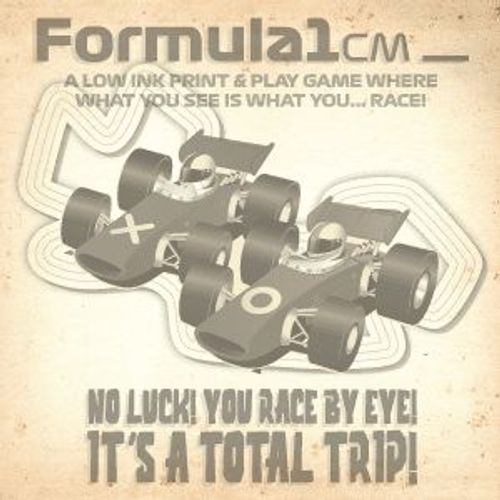
Formula1cm
Formula1cm Rulebook
Table of Contents
Table of Contents
Trial Scope
The cover of the trial sheet lists the full game's modes and tracks. Only the Grand Prix mode is playable in this trial.
Grand Prix mode (this trial): 2 players. "Make it to the finish line first!"
Chrono mode: 2 players. "Score a better lap time than your opponent!" (not in this trial)
Solo mode: 1 player. "Compete against the clock on your own!" (not in this trial)
World Cup mode: 1 to "n" players. "Play the World Cup alone, with a friend, or with several pals!" (not in this trial)
The final version has 4 game modes and 12 iconic tracks. The trial includes one track, Albert Park (best lap 1'14"70). The other tracks listed on the cover (Silverstone, Interlagos, Hungaroring, Zandvoort, Hockenheim, Nürburgring, Montmeló, Spa, Monza, Suzuka and Monaco) are not in this trial.
Components and Materials
In order to play you need: 1 pencil, 1 eraser (not mandatory).
How to Play a Grand Prix
- Two drivers compete in a one-lap Grand Prix.
- Lanes are numbered from 1 to 4, starting from the innermost one.
- The players take turns in the movement of their cars.
- X car goes first.
- Each player can start from any point of the starting line, inside one of the 4 lanes (each player from a different lane and never from a lane line).
During their turn of movement, the players must:
-
mark on their Race Data Sheet the "length" (centimeters) they intend to travel.
-
indicate with a (little) pencil dot the new position of their own car on the track, draw the symbol of their own car (X/O) and write (beside the car symbol) the value of the "length" traveled.
The choice of position is made "by eye" without being able to measure the "length" with the ruler or with the help of the pencil to trace the line of movement or to calculate the distance.
Players must indicate the progressive use of each single "length" as shown in the image on the right. (The 1°, 2°, 3° illustration of the progressive marks is not reproduced in this transcription.)
Movement Rules
- The dot marking the position of the car can never be marked on the line dividing two lanes.
- The player must always change lanes with each movement and may never enter the lane currently occupied by the opponent.
- Each "length" (value) can be used a maximum of 3 times, and by the end of the race (lap), each player must have used each "length" at least once.
Check
Each player has 3 "free" Checks with which to verify, using the ruler, the correctness of the opponent's move, that is to say the compliance with the "tolerance" allowed (± 1cm or ±0.5cm) between the declared "length" and the one actually traveled.
Going over the "tolerance"
Exceeding (downward or upward) the allowed "tolerance" determines a penalty for any further unit of "tolerance" exceeded, even if not entirely "covered" (exploited).
- If the Check reveals that the "tolerance" has been exceeded upward, the player loses (deletes) 1 Engine icon for each "tolerance" exceeded.
- If the Check reveals that the "tolerance" has been exceeded downward, the player loses (deletes) 1 Tire icon for each "tolerance" exceeded.
Example:
Declared length: 7, Tolerance: ± 1cm
- Check: greater than 8 (or less than 6) = 1 Penalty
- Check: greater than 9 (or less than 5) = 2 Penalties
- Check: greater than 10 (or less than 4) = 3 Penalties
Corner Cutting
- If the Check reveals that a curve has been "cut", the players lose 1 Flag icon, and during their next turn they will be forced to move by using the minimum "length" available to them.
(Clear cuts are not allowed... just curve cuts compatible with a plausible error... fair play on the track, please ...)
Risky Check
- Once the 3 "free" Checks have been used up, players can check again but if the opponent's move turns out correct, the player who called the Check, during its next turn, will be forced to move by using its minimum "length" available.
Run out of Engine, Tires or Flags
- Once the 3 icons of a category (Engine/ Tires/ Flags) have been used up, for each further error in an exhausted category, the player is punished with an additional penalty move (which will be noted with a "+1" next to the movement annotation on the track and added to the total of its final moves).
End of the Race
The move that allows a car to cross the finish line is always checked (free of charge) but only when both cars have crossed the finish line; if the last move turns out irregular, the player is sanctioned with an additional penalty move (which will be added to the total of its moves) for each "tolerance" greater or lesser.
The Winner
The winner of the race is whoever crosses the finish line using fewer moves (including any additional penalty moves); in the case of an identical number of moves the winner is the player who has covered the greatest distance between the point where the finish line has been crossed and the final position of the car.
With the same number of total moves, car "O" wins the race, the distance between the point where it crossed the finish line and its final position is greater than that of "X" car.
Advanced Rule (Optional)
Drivers looking for even more difficult challenges can use the following advanced rule:
- At the end of each round (car X and car O move), the player who used the lowest value in the last move moves first.
Practical Tips
- Print the track in actual size (no fitting or resizing).
- Mark the position of the car with a visible but not too large dot.
- Indicate car symbol and "length" number outside the track's carriageway.
- If you can, use a non-transparent ruler at least 15 cm long.
- Keep the ruler upside down during the game so that it is only visible during checks.
- Check precisely; the "1 millimeter doubt" is always in favor of the player being checked.
- Settle any disputes by always using identical standards.