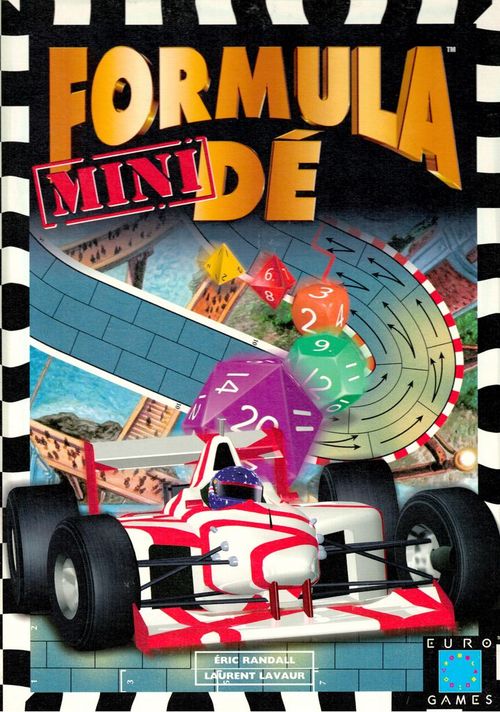
Formula Dé Mini
Formula Dé Mini Rulebook
Table of Contents
Table of Contents
- The Driver's Code
- Formula Dé Mini Contents
- Preparation & Set-Up
- The Three Basic Rules
- Starting Grid
- The Race
- 1. Starting the Race — Black Die
- 2. Overshooting a Corner — 1 LP for each extra space
- 3. Braking — 1 LP for each braking space
- 4. Blocking — 1 LP for each blocked space
- 5. Over-Revving — 1 LP for each gear skipped
- 6. Collisions — Black Die (1-4 = 1 LP)
- 7. Engine Damage — Black Die (1 to 4 = 2 LPs)
- 8. Turbo Boost — 3 LPs
- 9. Slipstreaming — 1 LP
- Pit-Stops
- Finishing the Race
The Driver's Code
Each player is both a driver and a race steward; they must ensure that all players follow the rules of the game, especially those concerning movement. Players should remember that this is a game, and all players are here to have fun.
Each player can drive as many cars as he wishes, but new players are advised to start with one car for their first few races. Later, with the aid of experience, players can drive two cars with the same livery, forming a team.
Formula Dé Mini Contents
- Double-sided Game Board depicting 2 fantastic tracks (one printed on each side) – The first, a canyon circuit, with 2 lanes and the second, an island circuit, with 3 lanes.
- 5 colored dice representing the 5 gears of the cars.
- 1 20-sided black die to determine possible damage sustained by the cars.
- 8 Cars & 8 rear spoilers in 4 colors, representing 4 different teams.
- 8 Gearshifts in the team colors, to show the gear used for each move.
- 200 Life-point Tokens.
- 8 Dashboards in the team colors, with puzzle cut ends to show spoiler colors.
- This rule book.
Preparation & Set-Up
- The players choose which track they will use.
- Now, each player must: a. Choose a car, a dashboard, and a gearshift of the same color. b. Choose the color of their spoiler, place it on their car, and fit the appropriate colored "spoiler puzzle piece" onto their dashboard. c. Place their gearshift on the "X" on their dashboard. d. Take 20 Life-point Tokens and place them beside their dashboard.
- Place the cars on the board on the pits corresponding to the body color of the car.
The Three Basic Rules
1. Gearbox and Movement
Gear
A car has five gears. Each gear uses a different die. The numbers on the faces of each die indicate the number of spaces the car must move. The higher the gear, the faster the corresponding die will move the car (see the movement table below). When accelerating, a driver may only up-shift one gear at a time; for example, you can shift from 1st to 2nd, but not 1st to 3rd. When decelerating however, a driver may skip 1, 2 or 3 gears; for example from 4th to 1st, but not from 5th to 1st. However, the more gears you downshift, the greater the penalty as you will see later on.
Note: When rolling the yellow die for 1st gear, the result is shown at the top of the pyramid.
Movement
As in life, a car starts in 1st gear, changes into 2nd and so on, up to 5th, in order to increase speed.
Gear Progression Table
| Gear | Spaces |
|---|---|
| 1st | 1 to 2 |
| 2nd | 2 to 4 |
| 3rd | 4 to 8 |
| 4th | 7 to 12 |
| 5th | 11 to 20 |
On their turn each driver must proceed as follows:
a. The driver announces the gear that they will use. b. He positions the gearshift in the appropriate space on the dashboard. c. He rolls the die for that gear. d. He then moves his car the number of spaces shown on the die.
At the end of this movement the car is said to have "stopped". This notion of "stopping" will be important in the corners (see below) [of course the car is not stopped, it is actually zipping along at speeds of 200+ miles per hour].
On each new round of play the drivers take their turns according to the order of the cars on the track, starting with the leader.
Example: car A is in first place, but car B passes car A during B's turn. B is now in the lead, and will move before car A in the next round.
Note: When two cars are equally far forward on the track, the car in the highest gear moves first. If the two cars are in the same gear the car that arrived first moves first.
The Black Die is used to determine possible damage from various race events.
2. Course Rules
Cars are moved along the two or three lanes of the track, following one set of rules in the corners and another set of rules in the straights. Cars are never allowed to jump over one another, or to reverse, or to drive in the wrong direction on the track.
Corners
a. In order to negotiate a corner a car must make, inside the boundaries of the corner, at least one stop, as shown on the yellow flag at the entrance of the corner. Once the mandatory stop has been made, the car will leave the corner without damage on its next turn. b. The red and white striped borders mark the corner spaces. c. The red lines across the track mark the beginning and end of each corner for the 2 or 3 lanes. d. The black arrows indicate the only authorized routes through the corners. In corners, a car cannot change lanes unless there is a choice of arrows to follow when leaving the space. The two large black arrows at the entrance of each corner indicate that a car landing on this space must go forward into the corner. The car cannot change lanes from this space. e. To help players better plan their route through corners, the lengths of the longest and shortest routes through the corner are shown in the white box under the yellow entrance flag: L = the longest route, C = the shortest route ("C" because short in French is "court").
Straights
Straights are the section of the track between corners. When moving along a straight a car can change a maximum of one lane on a 2-lane circuit, or two lanes on a 3-lane circuit, in a single turn.
Zigzagging (switching back and forth across lanes) in a straight is strictly forbidden (see example). You cannot move out of a lane and then back into that lane in the same turn, unless you are passing another car (see example).
In all cases, when moving in a straight, drivers must follow the shortest possible route (in number of spaces) to the next corner.
3. Life-Points of a Car (LPs)
During a race a car is pushed to its limits, and LPs are there to "pay" for the possible effects. Although a car with 0 LPs can continue to race, if it is involved in an incident (overshooting, collision, etc.) that it no longer has LPs to pay for, it is eliminated from the game and removed from the board.
Life points may be spent on 8 car-abusing events that may occur during the race: Overshooting a corner, Braking, Blocking, Over-revving, Collisions, Engine Damage, Slipstreaming and Turbo Boost.
Each driver allocates his LPs as he wishes, according to his race strategy. He uses them to pay for the risks he takes, and for the events that affect his car. Each LP lost requires the driver to put a LP token back into the game box. Lost LPs can be recouped when the corresponding car makes a Pit Stop.
Starting Grid
Before the race the positions of the cars on the starting grid must be determined. To do this each driver must roll the black die. The lowest result takes 1st place (pole position). The next lowest roll is 2nd on the grid, etc. In the event of a tie, the tied players roll again against each other.
The Race
1. Starting the Race — Black Die
Before rolling their 1st gear die, each player rolls the black die to find out if they have a bad start or a great one.
- The Number Rolled is 1-4: Bad Start — The driver has missed the start because the engine has stalled. The driver misses their turn and stays in place on the grid. The driver must wait until their next turn and then drive off normally in 1st gear. The driver does not have to roll the black die again to start on the next turn.
- The Number Rolled is 5-16: Normal Start — The driver makes a normal start. He rolls the 1st gear die and moves his car the number of spaces shown on the die. On the driver's next turn he will be able to shift into 2nd gear.
- The Number Rolled is 17-20: Flying Start — The driver pulls away like a rocket! Don't roll the 1st gear die, just move the car four spaces. The driver may shift lanes to avoid other cars in accordance with the rules. On the driver's next turn he will be able to shift into 2nd gear.
2. Overshooting a Corner — 1 LP for each extra space
Any time a car moves through a corner without making the required stop, it has gone through too fast and overshoots the corner. For every space the car overshoots the corner, the car loses one LP.
When overshooting a corner a driver must obey the following three rules:
a. A car must carry on its movement in the same lane in which it left the corner. A car can't change lanes when it's skidding! b. If in the same turn as overshooting one corner a car arrives in a new corner, this does not count as a stop in the new corner. c. If a car is blocked by another car when it is overshooting, it cannot pass. This car is now in a blocking situation (see Blocking below).
Special case: Spinouts — If a car with no more LPs overshoots a corner by ONE space (and one space only), this car "Spins Out"! The car stays in the last space it reached when spinning out, and is turned around to face the opposite direction. On the driver's next turn the car is turned back to the right direction, and must start off again in 1st gear.
Note: If a car ever overshoots by two or more spaces than it has LPs remaining, that car is eliminated.
3. Braking — 1 LP for each braking space
A driver can use LPs to avoid moving the entire number of spaces indicated on the die he has just rolled. For each LP used the number of spaces (required to move) is reduced by 1.
4. Blocking — 1 LP for each blocked space
Blocking occurs when a driver's path is blocked by one or more other cars. If a car is unable to pass the cars in front of it and therefore is unable to use up all of that driver's movement, this driver is considered "blocked". After having moved the car as far as possible, the driver calculates the number of spaces that would remain to be moved if the track had not been blocked. Using the table below the driver determines the car's LP losses.
| Spaces | LPs |
|---|---|
| 1 | 1 |
| 2 | 2 |
| 3 | 3 |
| 4 | 4 |
| 5 | 5 |
| 6 | 6 |
| 7 | Elimination |
Note: If a car does not have enough LPs to pay for a blockage, or it is prevented from moving 7 or more spaces, it is eliminated. When a car is eliminated by blocking, the car in front (the blocking car) is hit by the car that was eliminated, and automatically loses 2 LPs. If there is a choice of cars for the blocked driver to hit, roll the black die to randomly determine which car is hit.
5. Over-Revving — 1 LP for each gear skipped
When a driver downshifts by skipping 1, 2, or 3 gears, the driver is said to be over-revving their car. The number of gears skipped determines the number of points of LPs that are lost by the car (see table below).
| Number of Gears Skipped | LPs |
|---|---|
| 1 (e.g. From 5th to 3rd) | 1 |
| 2 (e.g. From 5th to 2nd) | 2 |
| 3 (e.g. From 5th to 1st) | 3 |
6. Collisions — Black Die (1-4 = 1 LP)
When a car finishes its movement on a space beside or behind (but not in front of) one or more other cars then there is a risk of collision. To find out if a collision occurs and one or more cars is damaged the drivers concerned each roll the black die for their own car. Those who roll a result from 1 to 4 have damaged their car, and lose 1 LP.
In the following example, on the 2-lane circuit, the driver of car A risks collision with cars C and D. The procedure is as follows:
- The drivers of cars C and D each roll the black die once to determine if they have collided with and been damaged by car A.
- The driver of car A rolls the black die two times to check whether the car has been damaged by cars C and D respectively.
Note: The driver who causes the collision (the one that moved next to the other car or cars) rolls the black die last. If that driver causes the elimination of one or more other cars then their own car will automatically lose an LP without rolling the black die.
7. Engine Damage — Black Die (1 to 4 = 2 LPs)
When a driver rolls a 12 when moving in 4th gear, or a 20 in 5th gear, the car's engine is pushed to its limit. After moving the car the driver must roll the black die to test the engine's condition. Additionally, all other drivers who are in 4th or 5th gear at that time must also do the same. Drivers who roll a 1 to 4 must lose 2 LPs.
8. Turbo Boost — 3 LPs
A driver can, once during a race, use 3 LPs to move their car an additional space. For example, a driver uses these 3 Turbo Boost LPs in order to enter a corner, if he has just fallen one space short of it.
9. Slipstreaming — 1 LP
The phenomenon of slipstreaming is produced when a car finds itself in the draft of another. This slipstream works in 3rd gear and up, it never works in 1st or 2nd gear.
In order to benefit from slipstreaming, after moving, car B (in the adjacent diagram) stops on the space just behind car A. In this position car B can add 3 more spaces to its movement. Slipstreaming can accomplish the following three types of movement (see diagram):
a. Pulling out one lane and returning to the original lane, in front of car A. b. Pulling out one lane and carrying on in a straight line. c. Moving out two lanes and carrying on in a straight line (3-lane circuits only).
Conditions to respect:
- A car cannot make a slipstream maneuver unless its speed (gear) is equal to or greater than the car in front of it. The 2 cars involved must be in at least 3rd gear.
- A slipstream always results in an additional movement of 3 spaces. However, the driver can use LPs to move less (by Braking).
- If the slipstream advances car B to a space directly behind another car, car B can make another slipstream, and so on. A car can link together as many possible slipstreams as possible in the same movement at the cost of 1 LP per slipstream.
- If a car benefits from a slipstream, it costs 1 LP.
- In a corner, a car benefiting from one or more slipstreams must follow the arrows during its movement.
- It is forbidden to brake in order to place your car in position to make a slipstream.
Note: Slipstreaming is never obligatory.
Pit-Stops
It is recommended that drivers make a pit stop to regain lost LPs. However, a car may stop in the pits only once during the race, so choose your time carefully. The pit stop can be made after the 1st or 2nd lap, as the driver chooses.
The rules for braking, blocking, collisions, over-revving, and engine damage do not apply in the pit lane. Passing in pit lane is strictly forbidden, you must wait patiently behind the other cars until they move.
Entry Procedure
Cars can enter their pit-stop space in any gear! It does not matter if their movement roll exceeds the number of spaces needed to arrive exactly in their pit stand, any un-used movement is ignored in the pits.
Exit Procedure
The driver immediately rolls the black die to see if he can leave the pits. If the result of the roll is equal to or greater than the driver's current LPs, the driver can (if he wishes) immediately exit (on the same turn as he arrived) the pit stand in 3rd gear (or lower if he wishes). If the driver rolls a number lower than his current LPs, he must stay in the pits until he can roll high enough to exit. The driver will then get to roll the dice once per turn to see if he can exit. When the driver leaves the pits, he is given enough LP tokens so that his total number of LPs is equal to the number he rolled to exit the pits.
Example: A car enters its pit stand with 7 LPs. Its driver rolls the black die and the result is a "10". He IS eligible to exit, but doesn't think that 10 LPs are enough to finish the race. He therefore waits until his next turn to roll the black die again. On his next turn he rolls a "5" (not enough to exit, too bad!). He waits another turn and rolls the die for a third time. This time he gets a "15". Finally he is happy with the result! He immediately exits the pits in 3rd gear with a total of 15 LPs.
Finishing the Race
The winner of the race is the first driver to cross the finish line. Landing on the space that straddles the line (on a 3-lane circuit) does count as crossing. The race ends when all drivers still in the race have crossed the line.