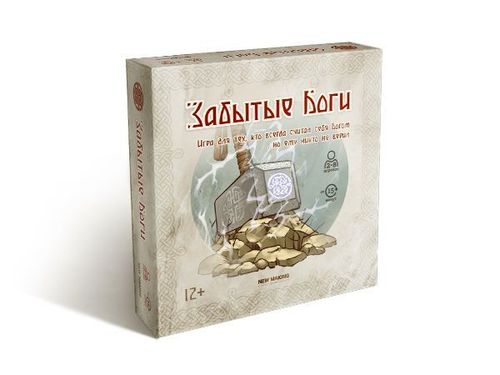
Forgotten Gods
Forgotten Gods Rulebook
Table of Contents
Table of Contents
Components
- Myth Deck (Колода Мифов, ▼ symbol), 60 cards
- Runes of the Gods (Руны Богов), 64 tokens
- Legend Deck (Колода Легенд, ● symbol), 60 cards
- Signs of Great Stories (Знаки Великих историй), 3 tokens
- God Deck (Колода Богов), 8 cards
Setup
- Shuffle the God deck and deal each player one card face down. Put the rest back in the box. You may look at your card. It is not your own card: it belongs to your left neighbour. Now you know who they are. Your name is known to the player on your right.
- Give each player 8 God tokens of one colour. With the tokens you track which variants of your name are still left to check. When one token remains, that is your name.
- Deal each player 3 cards from the Myth and Legend decks. Place the remaining cards in 2 face-down stacks in the centre of the table. The cards in your hand will help you make up stories. If you come across an unknown name, just read the description at the bottom of the card and everything becomes clear.
Playing the Game
The game begins with whoever can drink a cup of intoxicating mead, or who swam in an ice-hole, or who has the biggest beard, or the owner of the game box, or simply by drawing lots. Play then proceeds clockwise. To spark each other's imagination, the previous player sets the theme of the next story in the form of a question, using one of their own cards. That card becomes the first one in the new story.
-
The first player chooses one of the 6 cards in their hand and places it in front of the player on their left (whose divine name is known to the first player). At the same time, they ask the future storyteller a QUESTION. The QUESTION must begin with the words "Tell me a story about how...", be connected to the placed card and to the storyteller themselves.
For example: "Tell me a story about how you once got into Jötunheim, the realm of the frost giants?"
The question should leave room for invention, so that the storyteller can reveal it in more than one way. Do not tell the story for them.
Bad example: "Tell me a story about how Loki stole Odin's horse, and you found it, turned into a fly, led the horse home, and with a potion turned Loki himself into a helpless baby."
Good example: "Tell me a story about how you returned Odin's stolen horse."
-
The storyteller takes a minute to think, then tells the story, answering the question. They must use 5 of their 6 cards, laying them out in a line as the story unfolds, starting with the question card.
Diagram caption: the blue line marks the card of the leader who set the theme of the story; the red line marks the storyteller's cards from which the story was made.
The cards in the example are, from left to right: Jötunheim (the leader's card), Loki's Pranks, Warm Bed, Odin's Throne, Giant's House and Bashful Giantess.
Example story:
"So, you asked me to tell the story of how I ended up in Jötunheim. Very well. Once, because of the cursed Loki's pranks, I mixed up my warm bed with Odin's throne. Imagine it: I undressed and lay down to sleep right on his throne. When Odin saw this, he got so angry that he immediately cast a spell that sent me to the land of the giants. Luckily, I ended up not somewhere in the mountains, but in the house of one of the giants. Er... more precisely, a giantess, who was very embarrassed when she saw that a naked and very sleepy god was standing right in the middle of her room. But that is already another story!"
-
After the story is finished, the storyteller asks the previous player the question:
What to Do During Another Player's Turn
During someone else's story you may hinder your opponent by replacing a card they have just laid out with a card of your own. The card must match in type (character, place, circumstance, item) and have the opposite symbol (a triangle changes to a circle, and vice versa). In addition, you explain why what is written on the new card happened. Changes must weave logically into the story and must not turn it into absurdity.
Not allowed:
- Changing a card if the player has already laid out the next one.
- Replacing more than 2 cards in one story.
How to Replace Cards
Card types (icons on the card):
- Place (tree icon)
- Character (figure icon)
- Item (axe icon)
- Circumstance (lightning icon)
Card symbols: circle and triangle.
Diagram captions:
- Incorrect (card types differ): the replacement card is of a different type from the card it replaces.
- Incorrect (same symbol): the replacement card has the same symbol as the card it replaces, rather than the opposite one.
- Correct: the replacement card is of the same type as the card it replaces and has the opposite symbol. The example shows the place cards Warm Bed (circle) and Giant's House (triangle).
Signs of Great Stories
At the end of each round there is a vote to award a Sign of Great Stories. You cannot vote for yourself. The player who told the most interesting, funny or atmospheric story (in the opinion of the majority) receives a Sign. They must use it immediately.
- With 2 players, Signs are not used.
- With 3 to 5 players, one player receives a Sign.
- With 6 to 7 players, two players receive a Sign.
- With 8 players, three players receive Signs.
From the point of view of the rules, the Signs do not differ from one another. You may reward a story with any Sign. However, to create atmosphere at the table, we recommend the following principle:
- Mjölnir: the legendary hammer of Thor, which only the worthy can lift. It is received by whoever told the most gripping story about a great trial, battle or journey.
- Odin's Raven: the grim herald of the gods' will. The Raven is received by whoever tells a story full of occult secrets, treacherous plots and dark prophecies. Such stories rarely end well, which is why the Raven likes them.
- Mead of Poetry: the divine drink that Odin stole from the Giants. The Mead of Poetry is received by the player who tells the most cheerful, funny or simply crazy story. If you lie talentedly, seduce, sing or dance, then the Mead of Poetry must be flowing in your veins.
How to use a Sign: after receiving a Sign of Great Stories, play it on your next turn. Show your god tokens to the player on your right. They must point to a god token that you are definitely not.
For example, a player holding a Sign may be Odin, Thor or Tyr. They use the Sign of Great Stories, and the previous player says: "You are definitely not Thor." The player discards Thor's token.
Classic Variant of the Game
With 2 to 5 players, the game ends at the end of the 3rd round. With 6 to 8 players, it ends at the end of the 2nd round.
At the end of the last round, the players simultaneously place one of their remaining god tokens face down in the centre of the table, trying to guess their character.
The players reveal their tokens and their god cards.
All players who guessed the true name of their god are immediately declared winners and ascend to Asgard to feast. Those who did not guess are declared losers.
The game can be ended early if any player declares that they know the true name of their god. This happens in two cases:
- The player has one token left.
- The player is already certain who they are. (For example: "I could be Thor or Baldr, but Baldr is the next player, and his card is with me. So I am Thor.")
If a player has made such a declaration, the current round is considered the last one.
Advanced Variant of the Game
In this variant there is no limit on the number of rounds. The game goes on for as long as needed, until only the last player who has not managed to guess their name remains at the table.
A player who has learned their true name does not wait for the round to end. They must stand up to their full height and name themselves aloud. If they are right, the Valkyries immediately seize them and carry them to Valhalla. If they are wrong, Hel drags them down to the Realm of the Dead like an ordinary mortal.
Pantheon
Each god is identified by its combination of three symbols (▼ = triangle, ● = circle).
| God | Symbols |
|---|---|
| Odin | ▼ ▼ ▼ |
| Thor | ▼ ▼ ● |
| Loki | ▼ ● ▼ |
| Baldr | ● ▼ ▼ |
| Freyja | ● ● ▼ |
| Tyr | ▼ ● ● |
| Forseti | ● ▼ ● |
| Heimdall | ● ● ● |