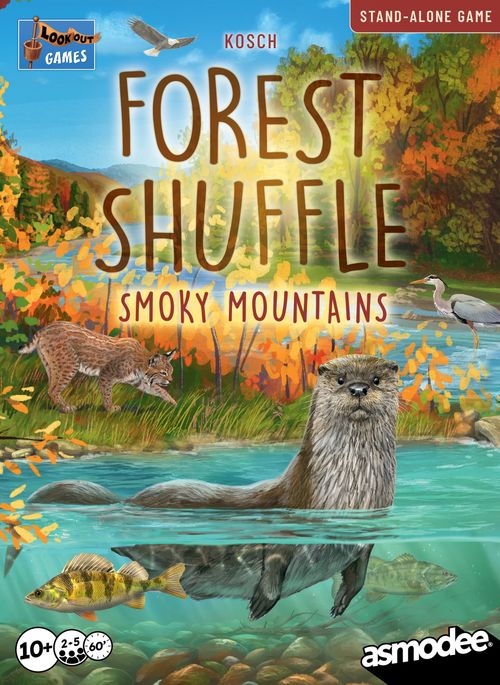
Forest Shuffle: Smoky Mountains
Forest Shuffle: Smoky Mountains Rulebook
Table of Contents
Table of Contents
Object of the Game
In the Great Smoky Mountains of the eastern United States, rivers and streams carve their way through lush forests, offering a diverse home to animals and plants alike. Bald eagles soar majestically overhead, gray squirrels dart from branch to branch, and black bears roam the riverbanks, while brook trout drift peacefully along the flow of the current.
Create a forest according to your own vision—will you focus on densely planted tree lines or varied river landscapes? Skillfully place animals and plants on trees and along rivers to earn the most points. Whether a mighty predator, a humble gatherer, or a water dweller, every creature has its own unique preferences.
Components
180 cards:
- 58 cards split top and bottom
- 49 cards split left and right
- 9 terrains (rivers)
- 3 winter cards
- 56 trees
- 1 scorepad
- 1 game board (the "clearing")
- 5 caves
Setup
If you already know Forest Shuffle, you can skip reading most of this rulebook. Text marked with the NEW symbol indicates that a rule is new with regard to the original Forest Shuffle game.
- Place the clearing (i.e., the game board) in the center of the play area, within reach of all players.
- NEW Set the 3 winter cards and the caves aside. Shuffle the remaining cards and return a certain number of them to the game box, unseen, based on the player count:
- with 2 players: 45 cards
- with 3 players: 30 cards
- with 4 players: 15 cards
- with 5 players: none—you play with all cards
- Divide the remaining cards into three face-down piles of similar size.
- Shuffle two winter cards into one of the piles and put the third winter card on top of that pile.
- Place the other two piles on top of the one containing the winter cards to form a single draw pile, also called the deck, and place it next to the clearing.
- Everyone: draw 6 cards into your hand and place 1 cave in front of you, face up.
- The player who most recently went for a walk in a forest goes first.
Game Flow
Beginning with the start player, everyone takes turns in clockwise order. On your turn, you must carry out exactly one of two possible actions:
A) Draw Two Cards
For each card, you may choose to take it from the deck or the clearing.
OR
B) Play a Card and Check the Clearing
Pay the card's cost, place it in your forest, and perform its effect and bonus, if any. Then check if the clearing needs to be emptied.
A) Draw Two Cards
When taking this action, draw two cards, one at a time, and add them to your hand. For each card you draw with this action, you have the choice of either taking a face-down card from the top of the deck or a face-up card from the clearing (which is empty at the start of the game).
Important: Your maximum hand size is 10 cards. If you have 9 cards in your hand, you may only draw one card. If you are already at hand limit, you cannot choose this action.
Winter Cards
The lower third of the deck contains 3 winter cards. When you draw the first or second winter card, place it face up next to the clearing and immediately draw a replacement card from the deck. When the third winter card is drawn, the game ends immediately.
B) Play a Card and Check the Clearing
There are three types of cards:
-
Each tree card features exactly one type of tree, providing slots for animals and plants on its four sides.
-
NEW Terrains are placed into your forest horizontally and only provide slots for animals and plants on the top and on the bottom. Terrains have a habitat symbol—in this game, it is the river habitat. Furthermore, all card backs show a universal river. They are like terrains and also provide slots for animals and plants on the top and on the bottom.
NEW Important: Universal rivers can only be played when playing a tree card (see below) or when effects and bonuses allow it (see "Effect and Bonus" below).
-
All other cards show animals and plants and are split in two: either horizontally or vertically.
All cards are laid out as follows: cost, illustration, type symbol, name, point value (on some cards), effect (on some cards), water requirement (on some cards), bonus (on some cards), card color with tree symbol, number of cards featuring this species.
Playing a Card
To play a card from your hand, you must first pay its cost by placing that many (other) cards from your hand face up into the clearing. When playing a split card, choose one half to play and pay only its cost.
Normally, it does not matter which cards you discard as payment. Some species, however, provide a bonus if you pay with specific cards (see "Bonuses" below).
Then, place the card face up in front of yourself. The collection of your played cards is called your forest.
Note: Split cards must always be added to tree or terrain.
Trees and Rivers
NEW When you play a tree (i.e., a card with the tree symbol) as an action, you can choose:
- either to play the tree on its own
- or additionally, to play another card from your hand face down below that tree as a universal river; a symbol in the top-left corner of each tree reminds you of this rule.
If you play the tree without a river, you cannot add a river to it later.
Trees, rivers, and trees with a river all feature different ways of adding split cards to them.
- Trees without a river provide card slots on each of their four sides: top, bottom, left, and right.
- NEW Rivers also provide four card slots: two on top and two on the bottom. You cannot place any cards on the left and right.
- NEW Trees with a river provide five card slots: one each on the left and right and on top, and two below.
Whenever you play a tree (with or without a river), you also place the top card from the deck face up in the clearing; a symbol on the game board reminds you of this rule during the game. Note: If you draw a winter card, proceed as described under "Winter Cards" above.
Example: You play a Basswood. To pay for it, you place one card from your hand face up in the clearing. You decide to add a universal river to that tree, so you play an additional card from your hand face down below the tree. Because you played a tree, you now also place the top card of the deck face up in the clearing.
Animals and Plants
The split cards feature various inhabitants of the forest: animals or plants.
When playing a split card, you must place it in an empty slot (i.e., a slot without a card) on the corresponding side of a tree or river in your forest. To play an inhabitant on top of a tree or river, slide the unused bottom half of the card under that tree or river. The same rule applies to inhabitants on the right, left, or bottom halves of cards.
Note: Only the inhabitant that is still visible after the card has been placed counts as being in your forest. The hidden half is not relevant for the remainder of the game or for scoring.
Example: You have just added a Flying Squirrel to your forest by sliding the bottom half of the card under a Yellow Birch.
Important: Split cards can only be played if one of your suitable cards (tree or river) has an empty card slot available on the corresponding side.
NEW Some split cards show a water requirement below their cost:
Stand-alone rivers only accept cards with water requirement. Trees without a river only accept cards without water requirement. Trees with a river accept any cards (with or without water requirement) at the top and to the left and right. Below the river, however, you may place only cards with water requirement.
Example: You are about to play this Brook Trout. To activate the bonus, you pay with a White-Footed Mouse and a Yellow Birch. Both cards have the same color as the Brook Trout (therefore, both show a Birch symbol). If you paid with a Silver Maple instead of a Yellow Birch, you would not activate the bonus.
Effect and Bonus
After you paid for the card (and, if you played a tree, placed a card in the clearing), you first resolve its effect (if available) and then its bonus (if available). Card effects and bonuses are explained with symbols and/or short descriptions. You can find an overview of all used symbols in the "Overview" section below. If you would like a more detailed explanation, consult the digital appendix.
Effects
There are two types of effects:
- Most cards provide an instant effect that you use once. Some of them let you put cards in your cave.
- Other cards provide a permanent effect that you can use for the rest of the game from now on. They have an effect when certain cards are played in your forest. Each time you play such a card in your forest, you use the effect immediately.
Example: You have just played a Wood Thrush. From now on, whenever you play a bird after this one, you draw the top card from the deck.
Bonuses
Some species have a colored arrow featuring the bonus symbol, providing a bonus if you pay for the card with matching cards. To activate the bonus, all cards that you discard as payment must have the same card color (i.e., the same tree symbol) as the card being played. When paying with split cards, it does not matter which half of the card shows the required tree symbol.
Checking the Clearing
At the end of your turn, if there are 10 or more cards in the clearing, the clearing will be emptied. Remove all cards from the clearing and return them to the game box. Then your turn ends, and the next player clockwise takes their turn unless an effect or bonus grants you another turn.
Special case:
NEW In the rare case that you cannot take either action (A or B), reveal your hand. Select up to 2 cards from your hand and put them in your cave, then draw an equal number of cards from the deck. This ends your turn.
End of Game
When the 3rd winter card is revealed, the game ends immediately and you proceed to scoring. You may not finish your turn.
Scoring: Total the points of all visible cards in your forest and add 1 point for each card in your cave. Use the scorepad to determine your total.
If you are unsure how a specific card scores, consult the digital appendix.
The player with the highest score wins. In case of a tie, enjoy a shared victory.
Scoring Example
This display of cards scores a total of 258 points.
Top
- Great Blue Heron: 6
- Bald Eagle: 10
- Water-Starwort: 8
- Thermometer Cricket: 8 (4 each)
Bottom
- Eastern Hellbender: 20 (10 each)
- Brown Water Scorpion: 2
- Greenside Darter: 12
- Yellow Perch: 2
- Smallmouth Bass: 9
Left/Right
- Coyote: 30
- Black Bear: 30
- White-Tailed Deer: 8
- Rock Vole: 5
- River Otter: 18
- Weevil Wasp: 10
- Squirrels (Red Squirrel, Gray Squirrel, Flying Squirrel, Eastern Chipmunk): 40
Trees
- Buckeye: 20 (10 each)
- Hickory: 10
- Black Gum: 5
Rivers
- River Bend: 0
- Creek: 3
Cave
- per card in your cave
Overview
Type Symbols
- Amphibian
- Tree
- Insect
- Mouse
- Hoofed animal
- Plant
- Pawed animal
- Bird
- Fish
- Squirrel
Habitat Symbol
- River
Special Symbols
- Water requirement (see "Animals and Plants" above)
- Optional river (see "Trees and Rivers" above)
Effects and Bonuses
- Draw 1 card from the top of the deck.
- Take 1 card from the clearing into your hand.
- Draw two cards from the top of the deck. Put one of them in your cave and add the other one to your hand.
- Draw as many cards from the top of the deck as there are cards in your forest showing the indicated type symbol (e.g., mouse). (Observe the hand size limit.)
- Take another full turn after this one, choosing between actions A and B again, as normal.
- Play a card with the indicated type symbol (e.g., plant) from your hand into your forest, without paying its cost. You may not use its effect and bonus. Ignore this effect if you do not have a card with that symbol in hand.
- NEW Play a bird card from the clearing into your forest at no cost, without using its effect and bonus. If there is no such card in the clearing, add cards from the deck to the clearing until you either find one or until you have added 3 cards total, whichever happens first. If then there is still no such card in the clearing, you do not play a card from this effect.
- NEW Play any card from your hand as a universal river face down into your forest. You may not place it below a tree.
Note: If you draw a winter card while using any of these effects, proceed as described under "Winter Cards" above.
Tree Symbols
- Basswood
- Hemlock
- Hickory
- Maple
- Black Gum
- Fir
- Birch
- Buckeye