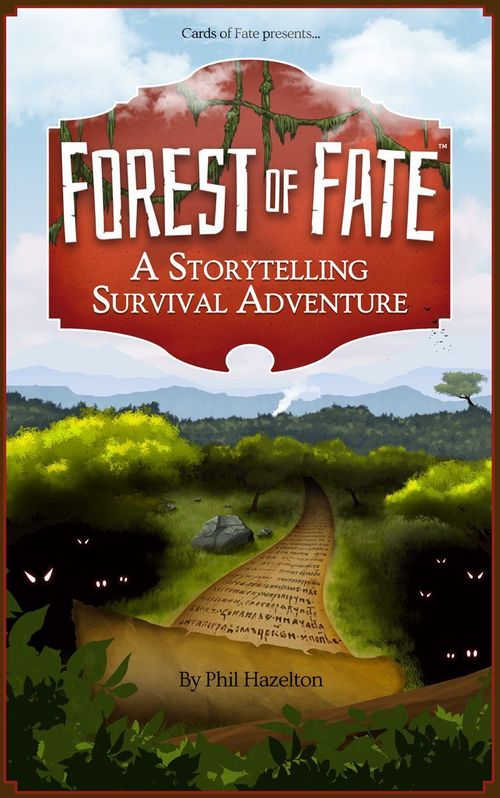
Forest of Fate
Forest of Fate Rulebook
Table of Contents
Table of Contents
- Overview
- Components
- Game Setup
- How Many Encounters?
- Let's Play
- Getting Started
- Resolving Encounters
- Success & Failure
- The Long Way Around
- Items & Artefacts
- Statuses
- Ending the Game
- A Cruel Twist of Fate Awaits You...
- Infrequently Asked Questions
- Do I have to become a Shade?
- Can the Shades change their bet after Second Sight is used?
- Can Healing Potions or the Ancient Amulet revive characters?
- Do Statuses stack alongside other Skill modifiers?
- Can Boosts allow my character to access new Skills?
- When the Bard is Soul-Bound, how much damage should they take?
- How do I revive a character using the Arcane Ritual?
Overview
2 - 6 Players, 30 - 60 mins, Ages 14 - Adult.
Components
- 36 Encounters
- 5 Quests
- 1 Finishing Post
- 6 Characters
- 4 Artefacts
- 10 Items
- 12 Abilities
- 12 Skills
- 12 Statuses
- The Story Book
Game Setup
1. Build Your Character
Each player chooses one Character card, and places it face-up in front of them.
Next, locate the two Ability cards matching your Character's colour and choose one. Place your chosen Ability beneath your Character, so that the heart-shaped marker points to the number 10. Return the other Ability to the box.
Tip: Two or three players can enjoy a longer game by choosing two characters each.
2. Choose Your Quest
As a group, choose one Quest card and place it face-up in the centre of the table. This is your starting point.
3. Claim Your Loot
Locate the Artefact or Item specified by your chosen Quest and place it face-up in front of any player. Put the rest of the Items to one side, and return the other Artefacts to the box.
Tip: In Easy mode you may also take a random starting item of your choice, in addition to the loot granted by your chosen Quest.
4. Plot Your Path
Shuffle the Encounter cards and deal them face-down in a winding path, starting from the Quest. You decide the shape! The length of your path is set according to the number of players and the desired difficulty (see table below).
All Encounters must be placed facing the same direction, matching the orientation of the text on the Quest card.
5. There's No Place Like Home
Locate The Finishing Post and place it face-down at the end of the path. This is your end goal.
Once setup is complete, your table should look something like the illustration in the rulebook (Quest with Character/Ability cards and loot, a winding path of face-down Encounters, and The Finishing Post at the end).
How Many Encounters?
We recommend new players start at Normal, then adjust according to your preferences. Younger players may enjoy Easy mode the best.
| Players | Easy | Normal | Hard |
|---|---|---|---|
| 2 | 6 | 8 | 9 |
| 3 | 9 | 11 | 12 |
| 4 | 11 | 13 | 15 |
| 5 | 13 | 16 | 18 |
| 6 | 15 | 18 | 20 |
Let's Play
The Forest is a dangerous place to go alone, so you must travel together on your homeward journey. Even so, it is possible that some of you may not make it back. It is possible that none of you will make it back. To stand any chance of survival you must work together, using your Skills and Abilities to stay one step ahead of the Forest.
Each character has two Great Skills, two Good Skills and a unique Ability. Sometimes you'll even gain access to Epic Skills!
Tip: If you haven't already, now would be a good time to get to know the Skills and Abilities of your fellow adventurers. Read them aloud, and listen up!
Getting Started
Read the Quest aloud to set the scene, then familiarise yourself with your starting loot; you may need it later!
When you're ready, turn over the first Encounter card (the one nearest to the Quest) and read the scenario text aloud to the group.
Resolving Encounters
Each Encounter must be met by one of your Characters (using one of their Skills) or by using an item. There is no fixed turn order, so it's up to you to decide who will face each Encounter as it is revealed. Once you've decided who will face the Encounter that player must then choose which Skill their Character will use.
Tip: To use a Skill the matching symbol must appear on both the Character card and the Encounter card.
Look up the paragraph number on the matching Skill symbol in the Story Book to reveal the outcome. Always use the symbol closest to the card from which you arrived (in the example, the party chose Guile, and arrived from the South).
Each outcome is revealed in two parts. After reading the first part, skip to the paragraph number shown beneath your current skill level (Fair, Good, Great or Epic). Beware: once you start reading you cannot change your mind!
Success & Failure
Your success will depend on your Skill, the difficulty of the current Encounter and no small amount of luck. Always pay attention to your surroundings and use your intuition!
Tip: You may do better to use a Skill that is more suited to the situation at hand, even if it's not your character's strongest.
If you chose wisely you will emerge unharmed. On rare occasions you may do so well that you gain an Item (in that case, simply place it next to your Character for later).
If you fail, you must lose the number of life points noted. When this happens, slide your Ability along to keep track of your current total.
The Long Way Around
You do not have to beat an Encounter in order to proceed, however if you fail (by losing any life points) the rest of the party must then take the long way around. This costs every other Character 1 life point. Note that nobody can lose their final life point in this way.
Tip: Some Abilities and Artefacts can reduce damage, prevent Statuses or avoid taking the long way around.
Once an Encounter has been resolved, leave it face-up and continue along the path to the next.
Items & Artefacts
You may bypass each Encounter with a specific Item, if you have it, instead of using a Skill.
To use an Item look up the paragraph number provided in the centre of the Encounter card and read it aloud. You may only use each Item once, then it must be set aside. You cannot gain more than one of the same Item.
Artefacts provide powerful one-off abilities but cannot be gained or recharged during your journey, so use them wisely!
Statuses
Statuses provide temporary boosts or penalties to your Skills, based on the results of your actions. They can be both good and bad, but you can only have one Status at a time. The outcome text will tell you when to apply a Status (e.g. "Become Confused").
Statuses wear off after three Encounters, regardless of who faced them. To help keep track of how many Encounters are remaining, slide the Status card beneath your Character card as follows:
- The Ranger has just become Sluggish, reducing their speed from Great to Good for the next three Encounters.
- After the following Encounter is complete, the Ranger slides the Status out by one position (following the guides on the card).
- The Ranger does the same again after the next Encounter, moving the Status on to the final position.
- After the third Encounter is complete, the Ranger removes the Status completely. They are cured, and back to full speed!
In addition, Statuses are discarded immediately if any of the following conditions are met:
- Your character does not possess the affected Skill
- Your character gains a different Status
- Another character gains the same Status
- Your character uses the affected Skill during an Encounter
Certain Abilities, Items and Artefacts can also be used to remove or apply Statuses throughout your journey.
Ending the Game
The game ends once everyone has run out of life points, or at least one Character has made it back to The Finishing Post.
Made it Home?
Congratulations! To find your ending flip The Finishing Post card to reveal the scoring table, then follow the instructions on the card to complete your tale.
The happiness of your ending will depend on how many Characters made it back and how much loot you are carrying on arrival. Each life point is worth 1 victory point. Each unused Item is worth 5 victory points and an unused Artefact is worth 10 victory points.
Example: If you lost one Character on the way to The Finishing Post, you would use the "Some Survived" column. If you had 8 life points left between you and still had one unused Item, your score would be 13 (8 + 5 = 13), so you would use the "11 - 19 points" row. Finally, you would turn to paragraph 825 in the Story Book and read your ending aloud.
If you don't make it back to The Finishing Post, you don't get an ending! Your story ends in the Forest, where it began.
Run Out of Life Points?
For you, the journey is over. You are too weak and must be left behind, but that is not the end of your story.
Tip: To maintain an element of surprise for new players, do not read the next page until somebody has run out of life points.
A Cruel Twist of Fate Awaits You...
Shades
Alone and abandoned, you may choose to simply die and leave the game, or you may allow the Forest to capture your soul. The price? You will be turned into a dreaded Shade, out for vengeance on the party that left you behind. Will you betray your friends for the gift of eternal life?
To become a Shade flip your Ability card to reveal your Shade Ability. Your aim is now to prevent the remaining survivors from escaping the Forest.
Play now progresses as follows: after an Encounter is revealed, but before any discussion takes place, the Shades bet on which Skill they think the party will use next, by placing one of the Skill cards face down on the table. If there is more than one Shade then they must also agree which Shade Ability to use (only one can be active at any time). Reveal the hidden Skill card only after the party have made their final decision.
If you anticipated correctly your chosen Shade Ability will come into effect for the current Encounter. If you did not, the Encounter is resolved as normal.
Each additional Shade that enters the game will make your journey that little bit harder, so it's worthwhile doing your best to keep your companions alive for as long as possible!
Infrequently Asked Questions
This section addresses some of the less common scenarios that might come up during your journey. You don't need to read this before playing, just use it as a reference if required.
Do I have to become a Shade?
No. Becoming a Shade is completely optional, and up to each player.
Can the Shades change their bet after Second Sight is used?
No. Second Sight is a vision that happens only in the Shaman's mind. The Shades have no way of knowing what happened, so their bet must remain unchanged for the second attempt.
Can Healing Potions or the Ancient Amulet revive characters?
No. The only thing that can revive a fallen Character is the Sorcerer's Arcane Ritual.
Do Statuses stack alongside other Skill modifiers?
Yes. For example, if the Thief is already Energetic (taking their speed from Good to Great) and then the Bard used their Soul-Binding Ballad, the Thief would be able to use Epic speed for that Encounter.
Can Boosts allow my character to access new Skills?
No. If your Character card does not include a particular Skill, the only thing that can give you access to that Skill is the Champion's Mask.
When the Bard is Soul-Bound, how much damage should they take?
A Bard under the effects of the Soul-Binding Ballad will take exactly the same amount of damage as the target. For example, if the target is a Warrior with Thick Skin, the Bard would also benefit from their damage-reducing Ability.
How do I revive a character using the Arcane Ritual?
The Arcane Ritual works by transferring life from the survivors to the fallen character. The Sorcerer has the final say on when this ability is used, and how much life to take from each survivor.